


Many see AI as a simple tool – and miss the true potential of artificial intelligence. A tool follows instructions. AI can think for itself, surprise and show new paths. Who would call a hammer that does what it is told a tool?
Introduction
You often read articles with statements like the following:
Generative AI as a tool in science-based teaching – A self-experiment
Or this title of a video:
What is generative AI? Generative AI: A helpful tool for humanity
Why do many refer to AI as a tool? It seems that some people and companies are unable to realize the true potential of AI.
A tool has the following typical features:
- Passive Execution: Only reacts on direct inputs
- Predictability: Identical input leads to identical result
- Limited Autonomy: No independent problem-solving
- Instrumental Character: Means to an end, not a problem solver
Even more illustrative: A hammer is used as a tool to drive nails or other suitable things of various sizes into the wall or other surfaces. It is also used to break things apart. Some use it for throwing (Highland Games).
Nobody would say that a hammer is particularly efficient or intelligent or that it can do things independently.
AI, on the other hand, can solve a wide variety of problems in a highly flexible manner, often better, faster and more reliably than any human would be able to. This has absolutely nothing to do with a tool.
Conventional software does not have these properties. Conventional software is typically
- not highly flexible in solving problems, but only what was intended to be done,
- certainly not of the most diverse kinds, but only what has been programmed in,
- often no better than any human, but simply as a programmer has specified or as is possible based on input data and a database.
Many people only know ChatGPT, Gemini or Copilot. They use these AI systems as someone who types things into a chatbot in front of a screen or speaks into a microphone.
Convenience is the enemy of the good.
AI can do much more.
The potential of AI
If AI is used correctly, it is a problem solver. AI is a solution.
Those who don't use AI to automate things use a chatbot. That's nice, but not more. A Nettbot, so to speak.
Many people equate AI with prompting or prompt optimization. It's like telling an employee exactly what to do. The employee is only allowed to do what they are told.
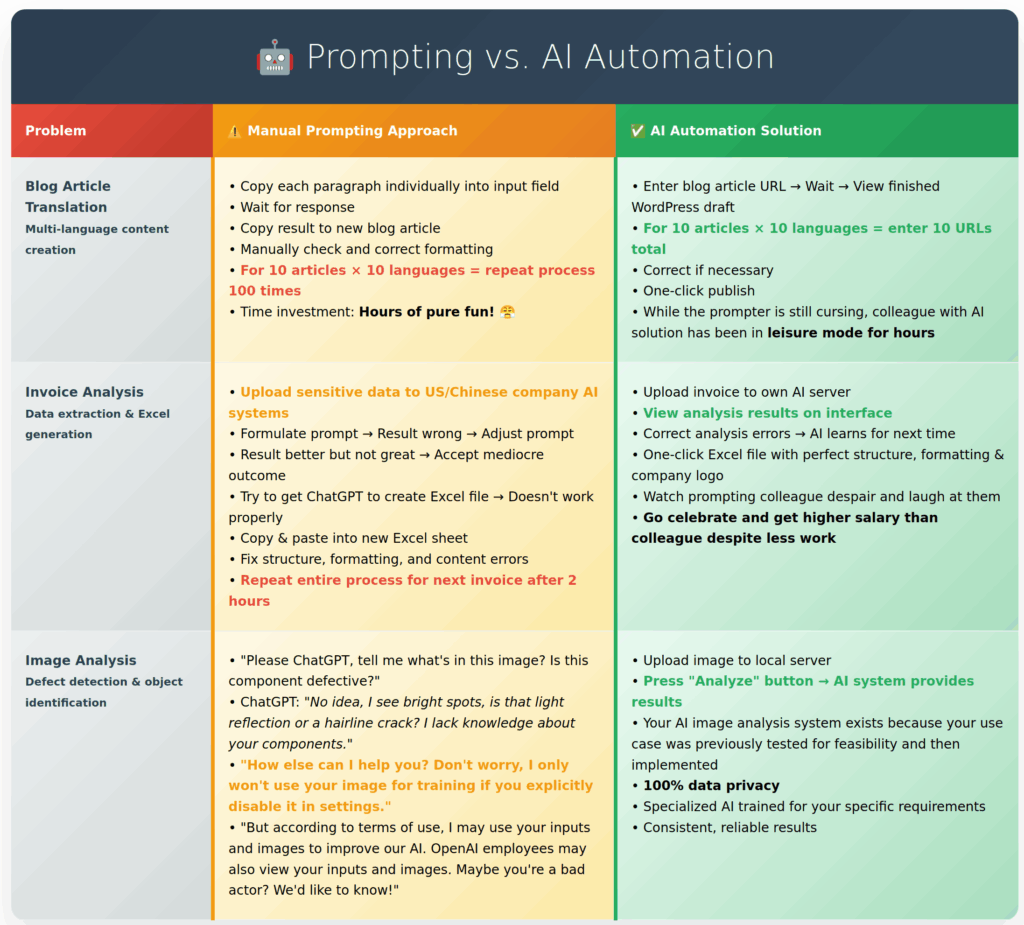
AI automation is what makes a powerful AI solution possible. Prompting, on the other hand, disempowers AI and provides humans who are at a loss with a good tool. But nothing more. Better with tools than without. But I would much rather have an intelligent solution than a very simple tool.
A few examples show the difference between apparently widespread prompting and genuine AI solutions.
Problem: Translating blog articles
Prompting (or DEEPL): Copy each paragraph individually into an input field, wait for a response, copy the result into a new blog article and check and correct the formatting manually. Repeating the process 100 times (10*10) for 10 blog articles and 10 languages is a lot of fun.
AI solution: Enter the URL of the blog article, wait briefly and view the finished WordPress post in draft mode, correct if necessary and publish at the touch of a button. For 10 blog articles and 10 languages, repeat the process once per blog article, i.e. enter a total of 10 URLs. While the prompter is still cursing, the colleague has already been in leisure mode for hours thanks to an AI solution.
AI will be degraded to a tool if its potential is not exploited!
Problem: Analyze invoices: Extract invoice items, extract and compare product group numbers, generate result as Excel file
Prompting: Uploading an invoice with sensitive data into a AI-System of an American or Chinese company. Formulate prompt. Check result, does not match. Adjust prompt. Result better, but not very good. Last try, then accept mediocre result. Input prompt so that ChatGPT creates an Excel file. Does not work properly. Therefore, copy & paste the result into a new Excel sheet. Correct structure, formatting and content errors. Two hours later, same show with a new invoice.
AI-Solution: Upload invoice to own AI server. View analysis results on user interface. Have possibility to correct analysis errors; AI learns from it for next time. Get an Excel file in perfect structure, formatting, and with company logo at the click of a button. Watch colleague struggle and laugh at him. Then go partying and get more salary than colleague at next pay review, although having less work.
Problem: Analyzing images for certain features (component defects or even texts, people, cars, etc.)
Prompting: Please, ChatGPT, tell me what's on the picture? Is that part defective? ChatGPT says: No idea, I see bright spots, is that a light reflection or a hairline crack? I'm missing knowledge about your parts. How can I help you otherwise? Don't worry, I won't use your image for training if you've explicitly disabled it in your settings. But according to the terms of service, I'm allowed to use your inputs and images to improve our AI. OpenAI employees are also allowed to look at your inputs and images. Maybe you're a bad guy? We'd like to know that!
AI-Solution: Upload image to local server, press “Analyze” button. AI system provides results. Your AI image analysis system exists because your use case what previously checked for feasibility and then realized.
The list of such examples could go on and on.
How do you move away from prompting and towards an AI solution?
The most important step is identifying possible use cases. You want a universal AI system that can do everything? Try ChatGPT. You want an AI solution that can solve a class of problems very well. Read on.
A use case is initially a problem that occurs in your company and needs to be solved. Examples of good AI use cases are:
- Translating blog articles including automation, translation, SEO optimization and maintaining formatting
- Detection of defects (hairline cracks) in components (given as an image)
 My name is Klaus Meffert. I have a doctorate in computer science and have been working professionally and practically with information technology for over 30 years. I also work as an expert in IT & data protection. I achieve my results by looking at technology and law. This seems absolutely essential to me when it comes to digital data protection. My company, IT Logic GmbH, also offers consulting and development of optimized and secure AI solutions.
