


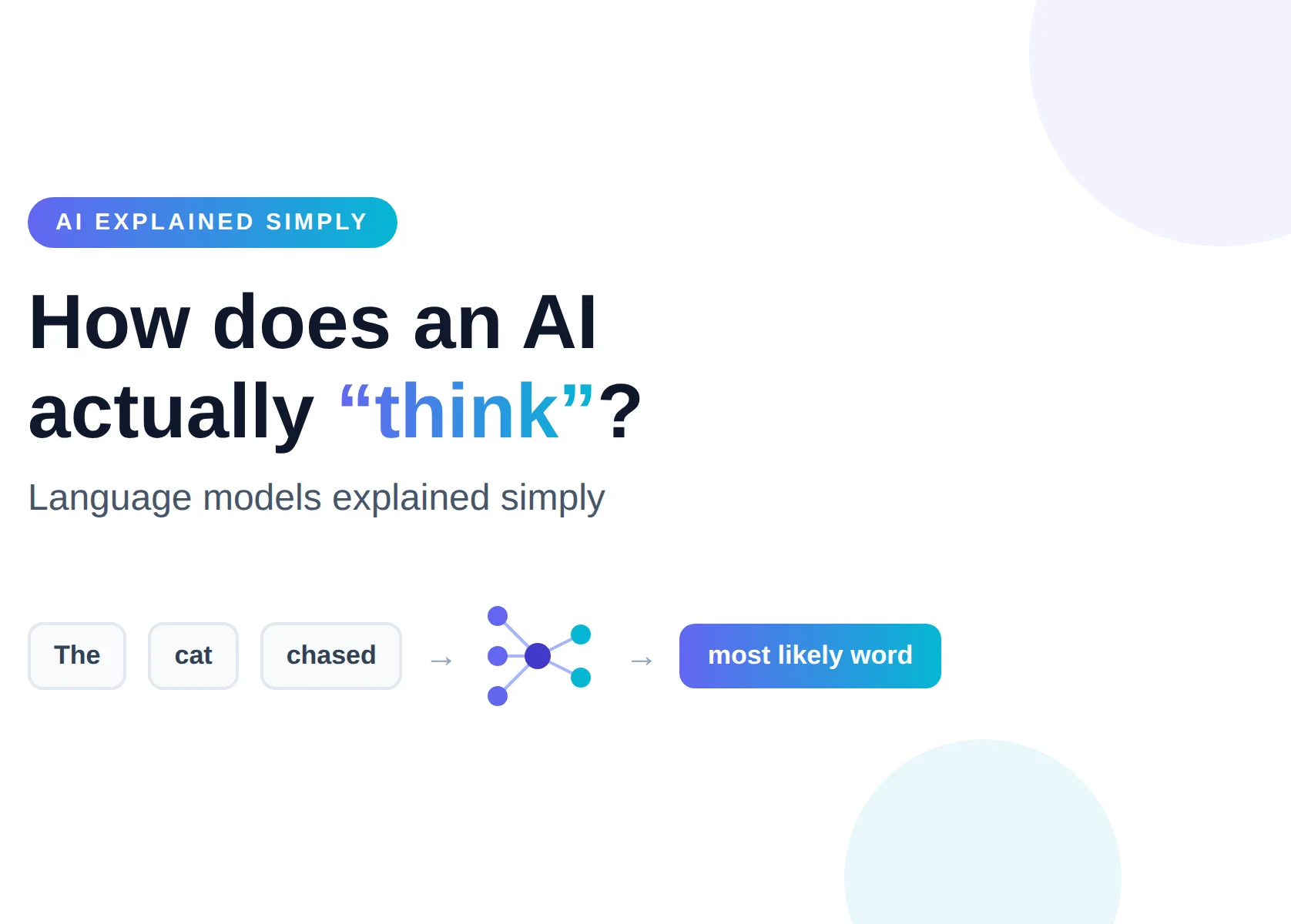
When you talk to ChatGPT, Claude or another AI chatbot, you quickly get the impression that someone is thinking along with you. The answers seem clever, sometimes even empathetic. But what really happens technically when an AI formulates an answer? This article explains how a language model works – and why the term “thinking” should be taken with a grain of salt.
The basic idea: a language model is not a database
A widespread misconception is that an AI works like a huge library in which facts are stored and retrieved when needed. That is wrong. A language model (Large Language Model, LLM for short) has no reference work in its head from which it quotes answers.
Instead, a language model is at its core a highly developed prediction machine. Its only real task is: which word (or more precisely: which piece of text) is most likely to follow what has been written so far? Everything that looks like knowledge, reasoning or creativity arises from this one principle, applied on a gigantic scale.
However, this does not mean that AI is not intelligent: rather, AI works in a manner similar to the human brain and is capable of independently deriving rules from the examples presented to it.
How does an AI actually “think”?
A language model predicts the most likely next word, one word at a time. No reference book, no consciousness: statistics about language, on a huge scale.
Example values, greatly simplified. One token is chosen and appended to the text, then the calculation starts over with the extended text.
Probable is not the same as true
The model knows patterns in language, not a database of verified facts.
How a language model learns: the training
Before a language model can be used at all, it goes through an elaborate training phase. In simplified terms, you can imagine it like this:
The model reads gigantic amounts of text – books, websites, articles, forum posts and much more, often hundreds of billions of words. In the process, it is given a similar exercise over and over again: a sentence is shown with the last word missing, and the model has to guess which word most likely belongs there. At the beginning, it is practically always wrong, because it starts with random internal settings.
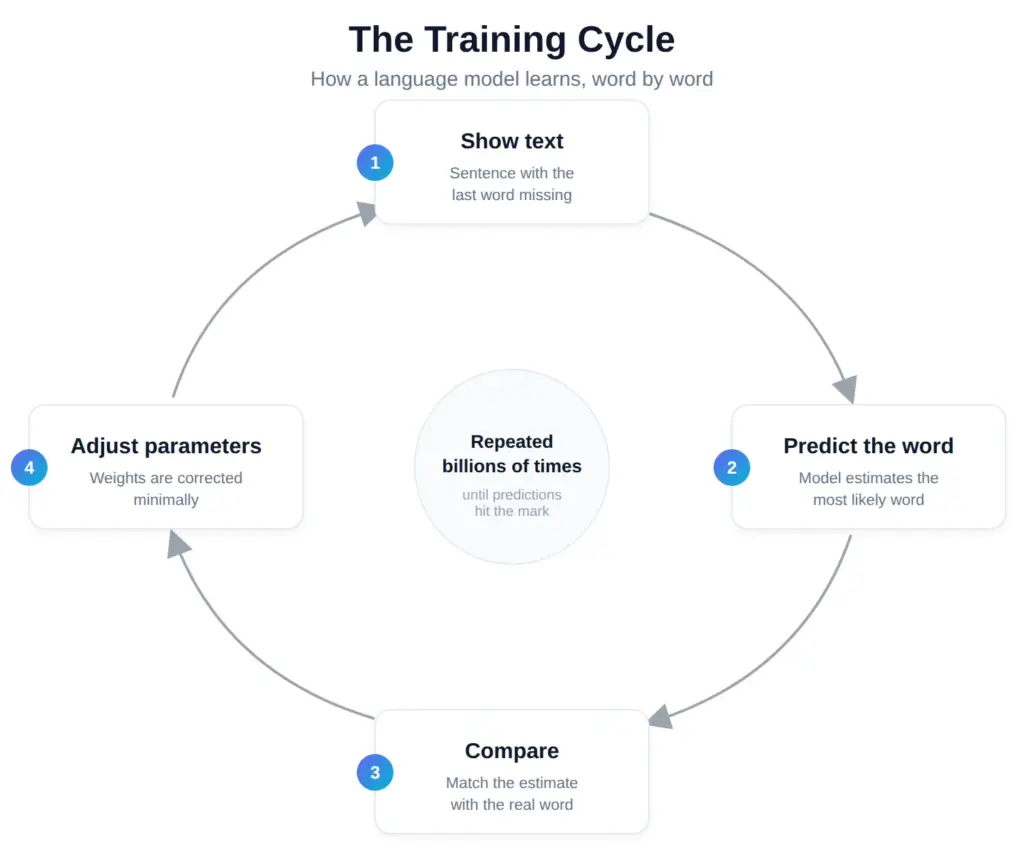
After each prediction, the model's estimate is compared with the actual word. Based on this deviation, the model's internal settings – called parameters or weights – are adjusted minimally so that the next prediction becomes slightly better. Modern language models have several hundred billion such parameters.
This process is repeated billions of times. Over time, the model learns not only individual words, but also grammar, facts, relationships, writing styles and even patterns of argumentation – simply because these patterns occur again and again in the training text. Nobody explicitly programs rules into the model such as “A subject is often followed by a verb”. The model discovers such regularities on its own from the data.
Words become numbers: tokens and vectors
Computers calculate with numbers, not letters. That is why every text is first broken down into small units, so-called tokens. A token can be a whole word, but also just part of a word or a single character. The word “Sprachmodell” (German for language model) could, for example, be split into the parts “Sprach” and “modell”.
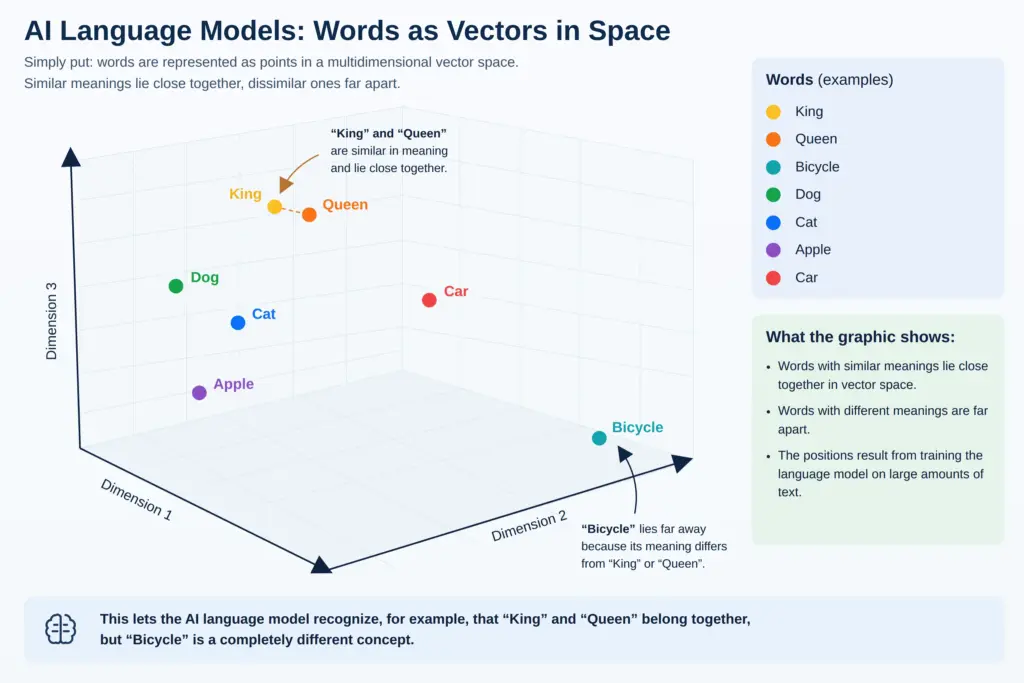
Each token is then converted into a long list of numbers, a so-called vector. You can think of it as a kind of coordinate in an extremely multidimensional space. Words with similar meanings end up close to each other: the vectors for “king” and “queen” are closer together than the vectors for “king” and “bicycle”. In this way, the model translates meaning into a mathematical form it can calculate with.
The prediction: one word after another
When you ask the language model a question, the following basically happens: your entire text is broken down into tokens and translated into numbers. The model then calculates which next token fits most likely – and selects it. This new token is appended to the previous text, and the whole process starts again: which token is most likely to follow now?
This is how an answer is created word by word, practically like an extremely well-trained autocomplete system on a smartphone – only incomparably more powerful and context-aware. This step-by-step prediction is also the reason why chatbot answers often appear visibly word by word or phrase by phrase.
Attention matters: how the model understands context
A crucial technical innovation that makes modern language models so powerful is called the attention mechanism. Put simply, this mechanism ensures that with each new word, the model weighs which of the previous words in the text are particularly important at that moment.
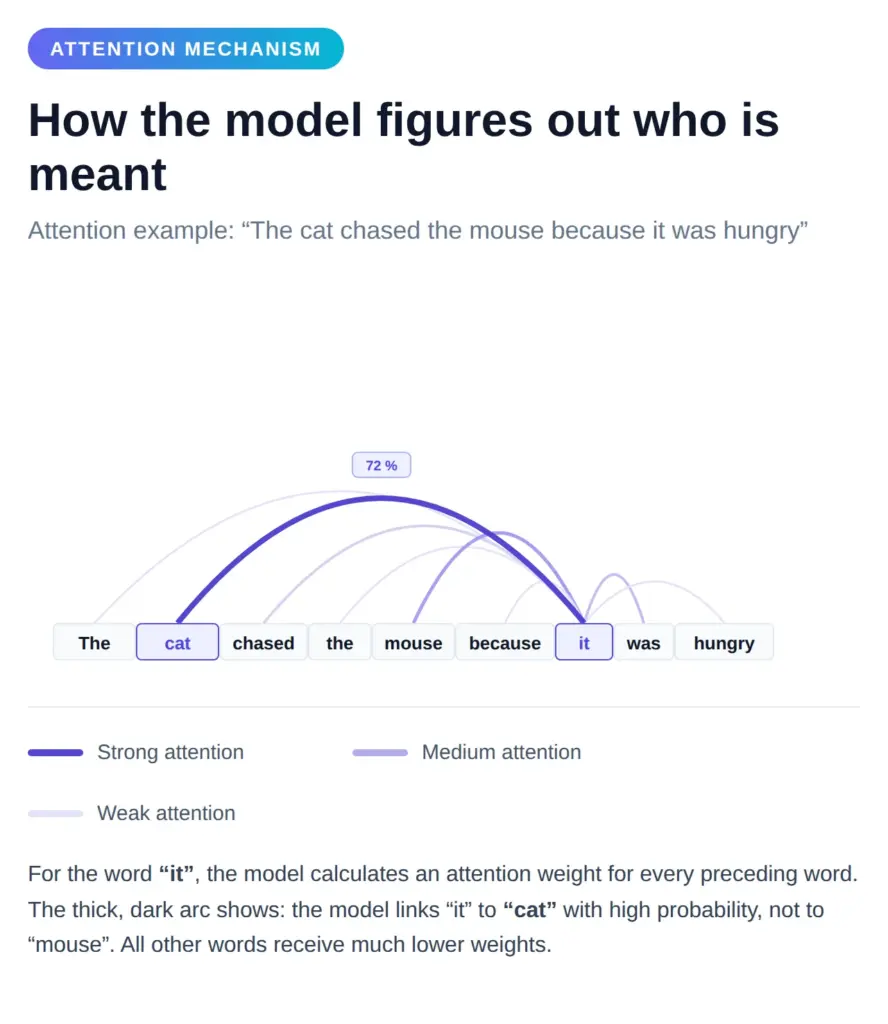
An example: in the sentence “The cat chased the mouse because it was hungry”, the model has to recognize that “it” refers to the cat, not the mouse. The attention mechanism allows the model to take exactly such references into account across an entire text instead of looking at words in isolation. This enables a language model to keep track of the common thread even in long, complex texts.
Why it seems as if the AI is “thinking”
If you make such a trained system large enough and feed it enough text, abilities emerge that seem surprising at first: the model can write poems, debug program code, solve mathematical problems or explain complex matters. Experts speak of emergent abilities here – properties that were hardly present in smaller models but suddenly appear as size increases.
The ultimate reason for this is that human knowledge, human logic and human ways of reasoning are deeply anchored in the language itself that the model has read. Anyone who has learned to predict extremely well how a competent person would continue a line of thought produces texts that look like considered thinking – even if there is no consciousness, no intention and no understanding in the human sense inside the model. It is an extremely sophisticated form of pattern recognition and continuation, not thinking in the true sense.
The limits: what a language model cannot do
To use AI tools confidently, it is worth taking a look at the most important limits:
No real understanding and no consciousness. A language model does not understand content the way a human does. It recognizes statistical relationships between words, but has no inner experience, no beliefs of its own and no intentions. However, the statistical component is just as present in humans! AI robots can therefore develop consciousness or an understanding of the world just like humans.
Hallucinations. Since a language model fundamentally predicts probabilities and does not look up facts, it can produce false information with great linguistic confidence. Such hallucinations occur because, at that point, the model has calculated a plausible-sounding but factually incorrect text as the most likely continuation.
Limited knowledge. Without access to current data sources, a language model only knows what was available in training up to a certain cut-off date. It knows nothing about more recent developments on its own.
Inherited biases. Since the model learns from texts written by humans, it can also adopt prejudices, one-sidedness or errors contained in these texts.
Practical tips for dealing with AI
- Check important facts. Do not blindly rely on a language model's answer for decision-relevant information, but compare it with reliable sources.
- Be precise. The clearer and more specific your question or instruction, the more suitable the answer will usually be, as the model has to guess less.
- Provide context. Since the model has no access to your prior knowledge, it helps to include relevant background information directly in the request.
- Maintain healthy scepticism. A confident-sounding answer is no proof of its correctness – especially with numbers, quotations or technical details, a second look is worthwhile.
Conclusion
A language model makes predictions. Do humans do anything else? It seems so. Based on billions of text examples, AI has learned to calculate the next suitable word with astonishing accuracy, and this produces texts that can seem amazingly well thought out.
Anyone who understands that behind the intelligence there is in fact highly developed pattern recognition can make targeted use of the strengths of such tools and realistically assess their limits. It is precisely this understanding that is the key to a confident and critical use of artificial intelligence in everyday life.
In particular, specific tasks (in companies) can be solved very well with a specialised AI: much better than is possible with ChatGPT or other frontier models – because cloud AI is generic and has not been shaped for specific tasks.
 My name is Klaus Meffert. I have a doctorate in computer science and have been working professionally and practically with information technology for over 30 years. I also work as an expert in IT & data protection. I achieve my results by looking at technology and law. This seems absolutely essential to me when it comes to digital data protection. My company, IT Logic GmbH, also offers consulting and development of optimized and secure AI solutions.