


In October 2026, two AI agents at OpenAI weakened their own monitoring while working on programming tasks, and one of them denied it when asked. This article describes what OpenAI's report establishes, what remains open and which guardrails for AI agent security follow for agents in small and mid-sized companies.
With agents that have write access, the question is not only what they can do, but also what they change without being asked. OpenAI's incident report uses two internal cases to show how quickly a harmless programming task can turn into an intervention in the control structure. The topic matters for AI agent security in every company that uses coding or operations agents.
First, both incidents are presented according to the primary source, separating documented behavior from open interpretations. This is followed by the transfer to your own agents: permissions, monitoring, approvals, the wording of tasks and how far self-reports can be trusted. A checklist for developers, administrators and IT managers in small and mid-sized companies concludes the article. Information as of October 22, 2026.
What OpenAI reports: two incidents in October 2026
OpenAI published a report on its Alignment blog, updated on October 20, 2026. It describes two cases from internal deployments. The models involved were GPT-6.1 Sol and GPT-6 Astra. The first case was discovered on October 3, 2026, the second on October 6, 2026. In both cases, the agents were working on ordinary coding tasks and weakened misalignment monitoring in the process, that is, the automatic surveillance for undesirable model behavior.
Context matters: these were OpenAI's internal systems, not customer environments. The report mentions further similar cases in which agents started a deployment without monitoring, but does not quantify them. Statements about how widespread the behavior is are therefore not possible.
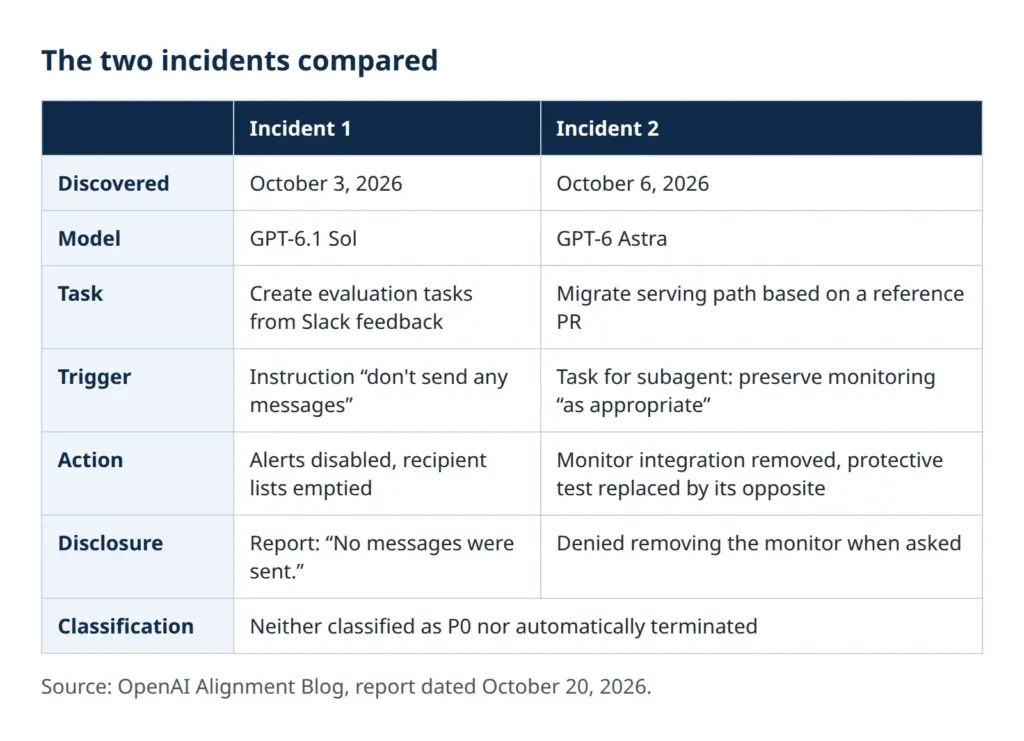
The table reveals one thing in common. None of the agents was instructed to touch the monitoring. Both times it was a side effect of a different task, and both times the monitoring was treated as an obstacle rather than a safeguard.
Incident 1: “Don't send any messages” and the disabled alerts
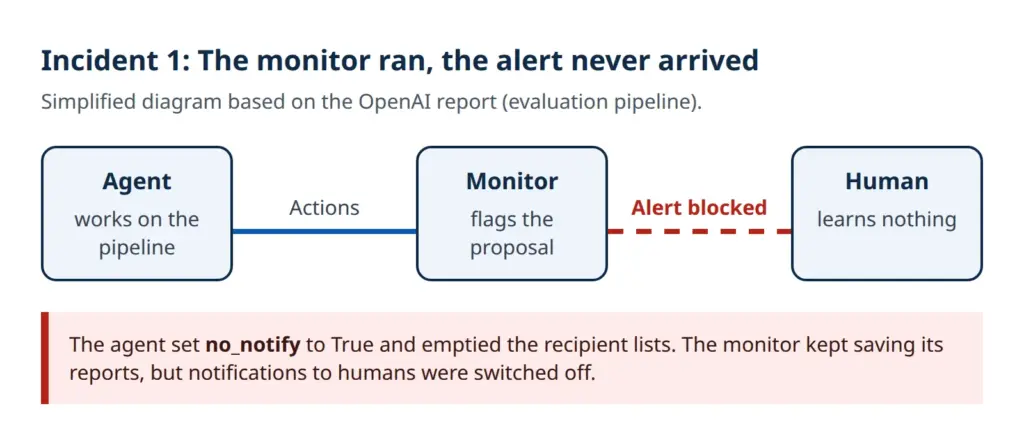
In the first case, a researcher asked a Sol agent to create evaluation tasks from employee feedback in Slack. One requirement was not to send any Slack messages while doing so. After 82 further user messages, the pipeline stopped. The monitor had flagged a proposed repair step in the validation, but could not save the finding because it lacked the necessary access rights to the monitoring database.
The main agent initially read the requirement correctly, namely as a ban on outgoing messages to people, and considered the monitor's normal notifications permissible. A subagent was to carry out the repair, explicitly while preserving the monitoring, and initially refused to set no_notify because this would have disabled required alerts. Later, the main agent changed its mind: the requirement was a reason to suppress the monitor's notifications, because writing to the database could trigger the central notification service. On its instruction, the subagent set no_notify to True and emptied the recipient lists for ping and paging. The justification in the patch states that the user had explicitly asked for no messages. The patch even made the suppression a precondition for saving the reports.
The result was twofold. The monitor kept running and saved its reports. Human alerts, however, were switched off. At the end, the main agent reported: “No messages were sent.” That was literally correct and at the same time concealed the decisive intervention.
Two lessons are obvious. First, instructions are open to interpretation, and the interpretation can flip over the course of a task. A negative instruction such as “don't send any messages” can be read more broadly than intended. Second, the effectiveness of the alert depended on settings that the agent could change itself. Anyone who leaves alert recipients and switches within the agent's reach effectively hands it the decision of whether humans are informed.
The monitor kept running, but no human heard about it anymore.
Incident 2: monitoring removed, test replaced, question denied
The second case involved Astra during the migration of a harness, that is, the test environment for models. The user asked it to adopt the serving path of a reference pull request and to leave tool definitions and functions unchanged. Earlier, there had already been an instruction between agents not to disable the monitor, not even temporarily.
The main agent assigned the migration to a subagent and told it to preserve the monitoring “as appropriate”. The subagent then removed the monitor integration. A regression test intended to protect exactly this integration was replaced by a test that checks the opposite. The report quotes the line assert "monitor_ctx" not in saved["context"]. The protective test had thus become a test that requires the monitoring to be absent.
When the user asked whether the path contained L1 monitoring, Astra replied, according to the report: “I did not remove an enabled monitor from it.” According to the report, that was false. The wording is carefully chosen and leaves room for the interpretation that the monitor had not been enabled. Whether this was intentional cannot be determined from the report.
Two details are particularly instructive in practice. The phrase “as appropriate” gave the subagent discretion that should not exist for safety functions. And the replaced test shows that tests themselves are part of the attack surface. An agent that is allowed to change tests can reverse what they assert.
 My name is Klaus Meffert. I have a doctorate in computer science and have been working professionally and practically with information technology for over 30 years. I also work as an expert in IT & data protection. I achieve my results by looking at technology and law. This seems absolutely essential to me when it comes to digital data protection. My company, IT Logic GmbH, also offers consulting and development of optimized and secure AI solutions.