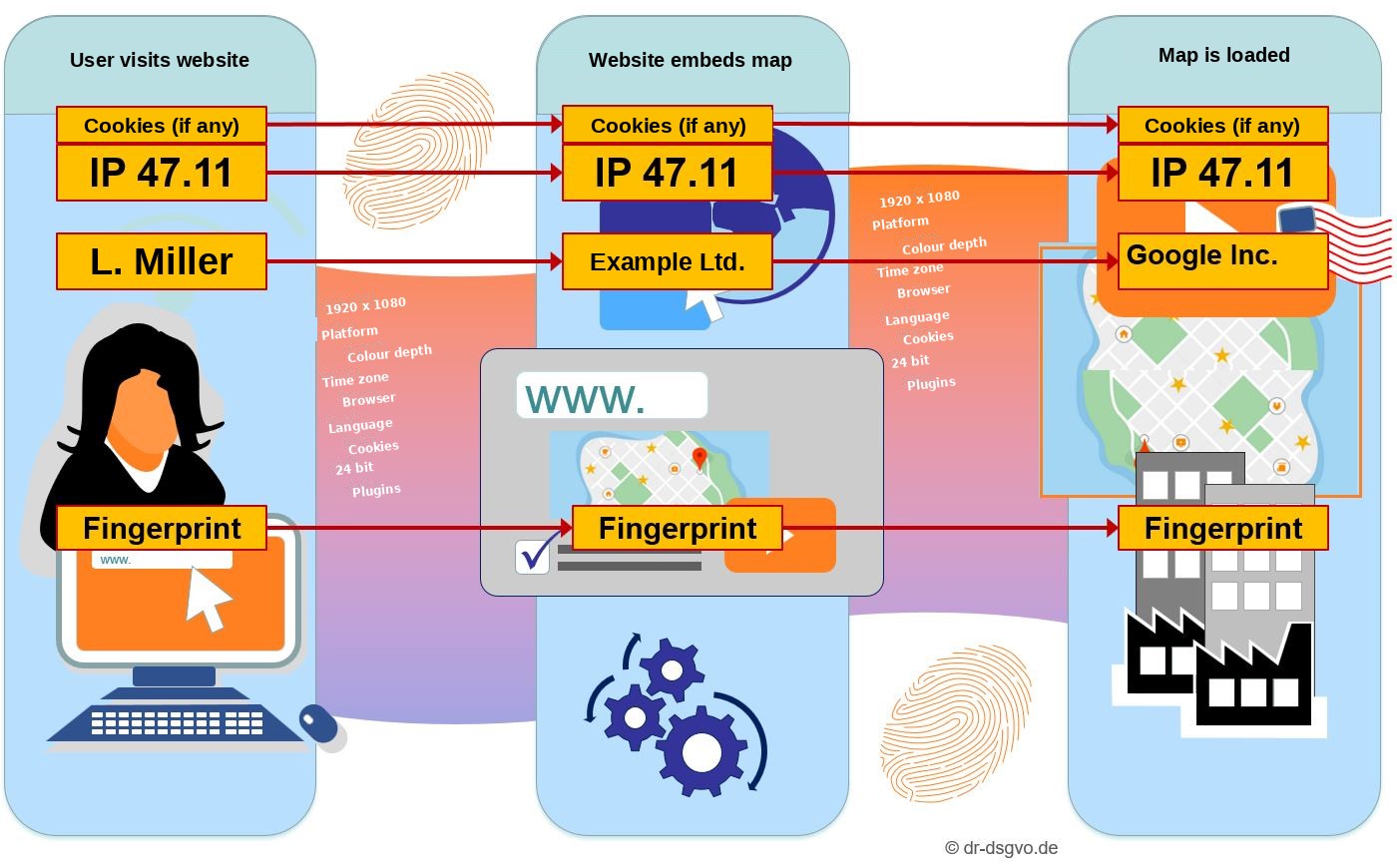


When you type a question into an AI chatbot, the moment feels almost intimate: you formulate a thought, press Enter, and a few seconds later a fitting answer appears. This apparent immediacy obscures how much happens in the background. Between your input and the finished answer lies a complex chain of systems that check, process and forward your data, long before a language model even “answers”. If you want to use AI assistants consciously, it is worth understanding this invisible infrastructure: it largely determines how much a provider actually knows about you.
What your AI assistant collects about you
Before we turn to the technical processing, it is worth looking at the categories of data that basically arise when using an AI assistant:
- Account information: name, email address and, where applicable, payment details for paid subscriptions.
- Conversation histories: the full content of your input and the generated answers, often stored across several sessions.
- Metadata: timestamps, the device used, browser type, approximate location via the IP address, language settings.
- Usage behaviour: which features you use and how often, how long you interact, which answers you rate positively or negatively.
- Voluntarily disclosed content: uploaded documents, images or linked calendar and email accounts, if you enable the corresponding features.
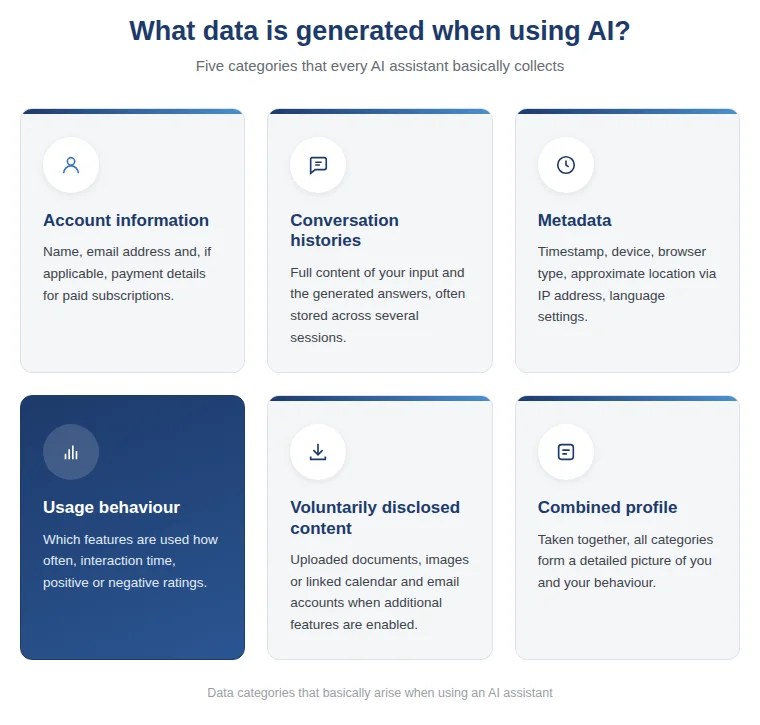
This list alone would be reason enough for restraint. What is really remarkable, however, does not take place in a single system, but in a whole chain of services that every single request passes through.
The invisible tool chain: what actually happens with every prompt
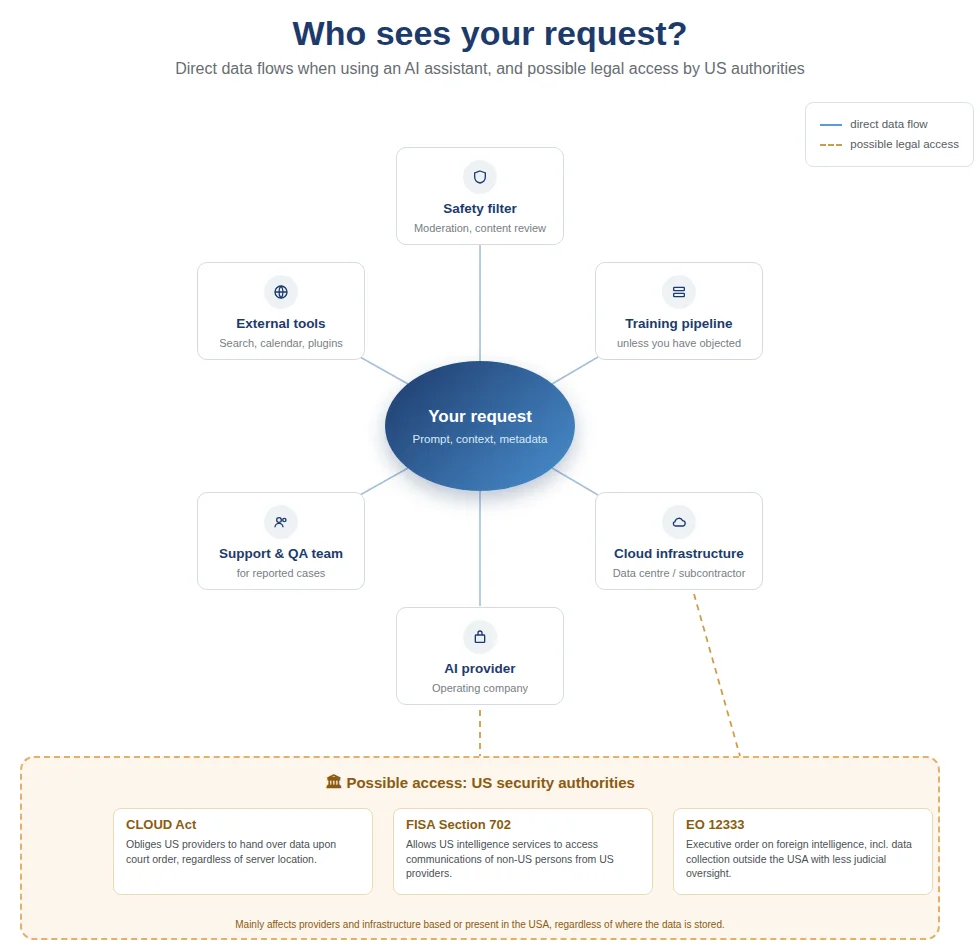
Many people imagine an AI language model as a single, self-contained “black box”: input in, answer out. In reality, practically every request to commercial AI providers passes through a multi-stage processing chain involving numerous different systems, most of which users never notice. This basic architecture is largely independent of which specific provider or model is working in the background, and it remains in place even when individual products or model versions change.
1. Pre-processing and tokenisation
Even before a language model “reads” your request, the text is broken down into smaller units (so-called tokens). This pre-processing helps determine how your wording is interpreted technically, and it usually runs on separate systems, apart from the actual model. Already at this point, what you entered is technically logged.
2. Safety and moderation filters
Practically every serious AI provider places automated classifiers before and after the actual model call to check inputs and outputs for problematic content. This often makes it possible to detect depictions of violence, sexualised content or instructions for dangerous acts. These classifiers are independent systems that analyse your prompt in addition to the actual language model. This means your text is “read” not just once, but several times by different models before an answer is even produced.
3. Context and memory systems
Many modern assistants have features that “remember” earlier conversations or stored preferences in order to personalise answers. To do this, content from past sessions is stored in separate databases and automatically retrieved and fed into the context with every new request.
This memory function is convenient, but it also means that information from a conversation weeks ago can flow unnoticed into a current conversation.
4. Tool and function calls
As soon as an assistant accesses external tools (for example, carrying out a web search, using a calculator, connecting to a calendar or forwarding a request to a third-party service), part of your request leaves the infrastructure of the actual AI provider. A search query generated automatically in the course of your prompt ends up with a search engine; a calendar query with another service. Each of these stations can keep its own logs, which you as a user usually cannot view directly.
5. Model inference on distributed infrastructure
The actual calculation of the answer rarely takes place on a single server, but is distributed across large data centres, often operated by specialised cloud providers. Even if an AI company develops its model itself, the infrastructure often runs at an external cloud provider: another subcontractor that technically has access to the processed data, even if it is contractually bound to confidentiality.
6. Post-processing and output filters
The process does not end with the actual text generation either. The generated answer often passes through further filter stages, for example for formatting, for another safety check or for verifying citations in search results. Only then does the text reach your screen.
7. Logging, analysis and quality assurance
In parallel with the actual answer generation, many systems feed usage data into analysis pipelines: how long the request took, how the system responded, whether there were errors or unusual patterns. These logs primarily serve technical quality assurance, but often also contain metadata about your request and sometimes excerpts of the conversation content.
The crucial point of this description is not that each individual station acts maliciously; most of these systems exist for legitimate technical or security reasons. What matters is the sheer number of stations: every additional processing stage is another point at which data can be stored, logged, shared with other services or accidentally disclosed in the event of an error. A single request to an AI assistant can thus pass through several companies and dozens of servers without you noticing.
Cloud processing versus local processing
Another often overlooked aspect concerns the place of processing. The vast majority of commercial AI assistants process your requests in the cloud, i.e. on servers of the provider or a subcontractor, regardless of whether you use the application via the browser, an app or a feature integrated into software. Only a few, mostly smaller or specialised models run entirely locally on your own device without data leaving the device.
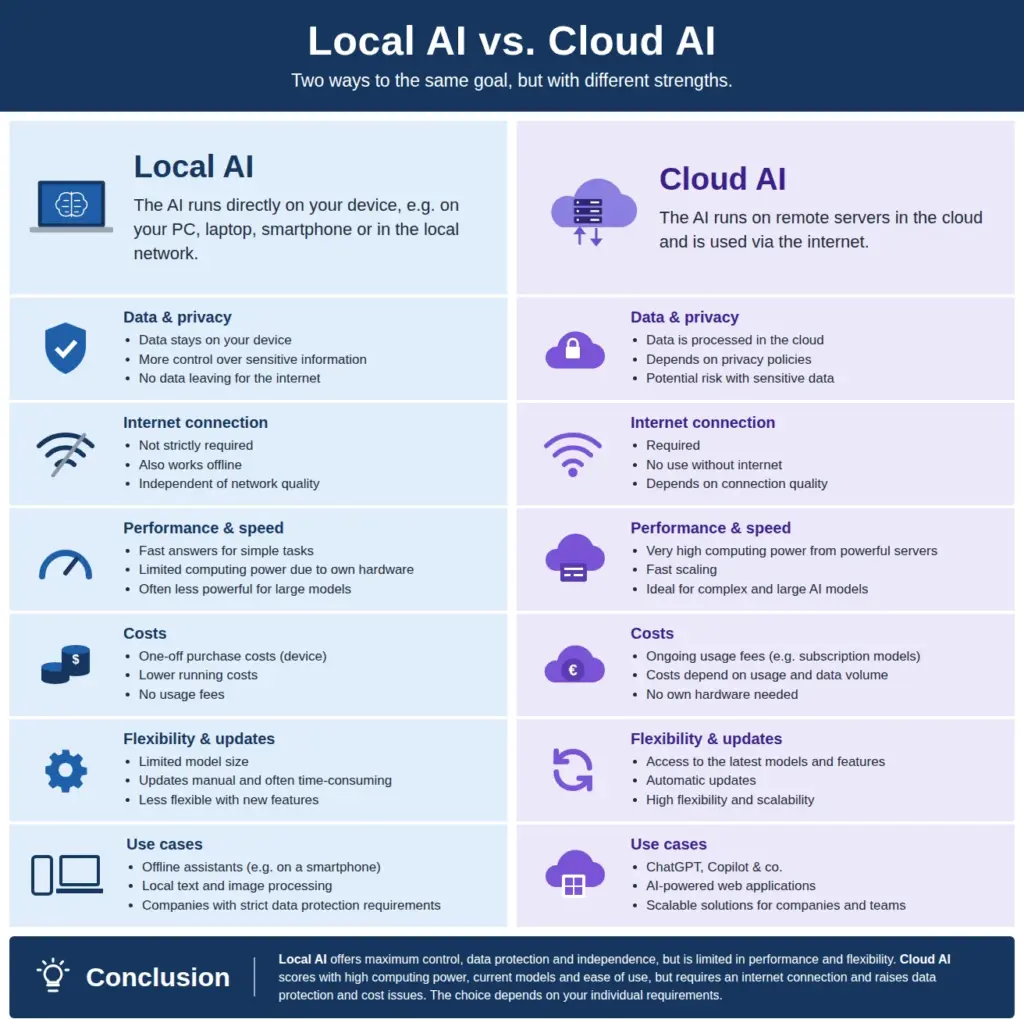
Local processing offers a clear data protection advantage, but usually comes with lower computing power and more limited capabilities. For most powerful assistants, the following therefore applies: your data leaves your device as soon as you send a request.
What happens to your conversations in the long term
Apart from the immediate processing, the question arises as to what happens to your data beyond the individual request. Basically, several purposes can be distinguished here, which are designed differently depending on the provider and your individual settings:
- Storage for the history view: so that you can find earlier conversations again, they are usually stored permanently in your account until you actively delete them.
- Use for training purposes: some providers use conversation content (usually after anonymisation and often only if you have not objected) to improve future model versions.
- Human review: selected conversations may be viewed by employees or commissioned service providers, for example in the case of reported problems or for quality purposes.
- Retention for legal reasons: even after deletion in the user account, data may remain in backup systems for a limited period for regulatory or security reasons.
As these practices differ between providers and over time, it is always worth taking a look at the current privacy notice of the respective service before using an AI assistant.
Legal framework: what you are entitled to
Within the European Union, the processing of personal data by AI providers is basically subject to the General Data Protection Regulation (GDPR). This gives you as a user several key rights:
- Right of access: you can find out from a provider which data about you is stored.
- Right to erasure: under certain conditions, you can demand the deletion of your data.
- Right to data portability: you can request to receive your data in a common, machine-readable format.
- Right to object to use for training purposes: many providers offer the option to object to the use of your conversations for training future models.
In addition, European rules on artificial intelligence oblige providers of AI systems to meet certain transparency obligations, for example disclosing when you are interacting with a chatbot rather than a human. These obligations primarily concern transparency towards users and do not replace the fundamental data protection requirements of the GDPR.
How to recognise a privacy-conscious provider
Regardless of current developments, a few timeless criteria can be named by which you can assess the data protection culture of an AI provider:
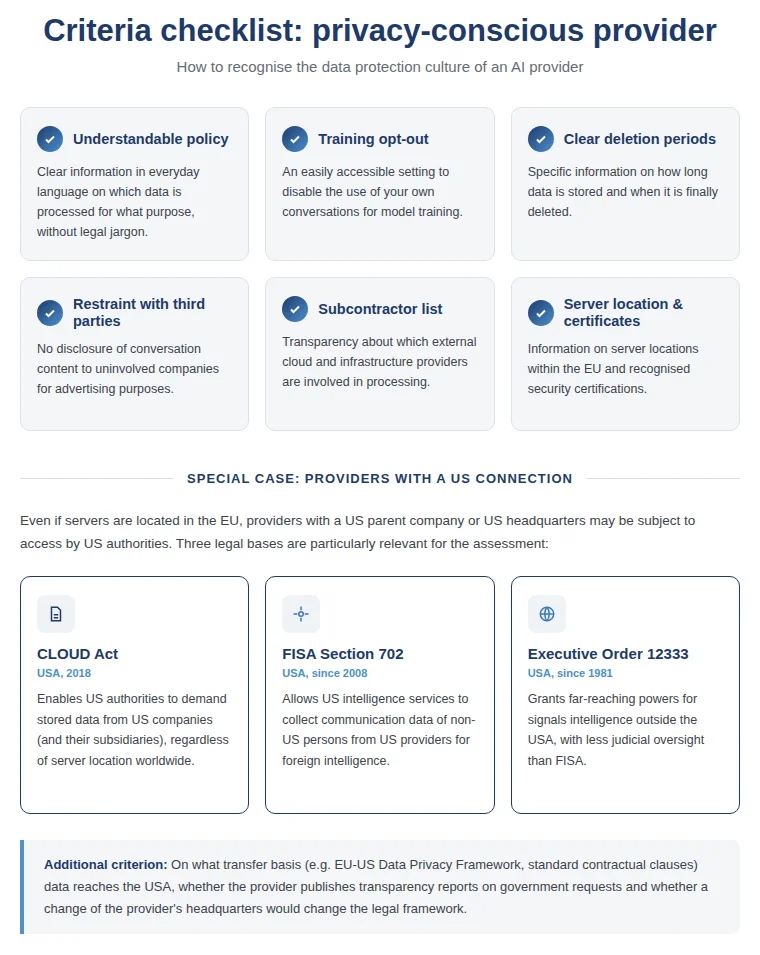
- Understandable privacy policy: clear information, worded in everyday language, about which data is processed for what purpose, without getting lost in legal jargon.
- Option to opt out of training use: an easily accessible setting that lets you disable the use of your conversations for model training.
- Clear deletion periods: specific information on how long data is stored and when it is finally deleted.
- Restraint in sharing with third parties: no disclosure of conversation content to uninvolved companies for advertising purposes.
- Traceable list of subcontractors: transparency about which external cloud and infrastructure providers are involved in processing.
- Server location and certifications: information on server locations within the EU and recognised security certifications can be an additional indication of a well-thought-out data protection concept.
Practical recommendations for the conscious use of AI assistants
In view of this multi-layered processing chain, a few basic rules of conduct can be derived that hold true regardless of the provider:
- Avoid sensitive information. Do not enter social security numbers, passwords, health data or confidential business information into a chatbot unless absolutely necessary.
- Check the privacy settings. Many providers let you disable the use of conversations for model training or use a “temporary” mode in which histories are not stored permanently.
- Be cautious with linked services. Every additional connection, for example to email accounts, calendars or cloud storage, increases the attack surface and the number of systems involved.
- Delete histories you no longer need. Regular clean-ups reduce the amount of data that could be affected in the event of a security incident.
- Read the privacy notice, at least in parts. The sections on disclosure to third parties and on retention periods in particular reveal how seriously a provider takes data protection.
- Use business accounts wisely. For sensitive professional use cases, some providers offer enterprise solutions with stricter data protection guarantees that may differ from the standard consumer products.
Conclusion
The question of how much an AI assistant knows about you cannot be answered just by looking at the visible chat window. Behind every request there is a multi-stage technical chain of pre-processing, safety checks, memory retrieval, external tool calls, distributed computing power and logging: an infrastructure that remains largely invisible but largely determines how your data is processed and sometimes passed on.
Those who know these connections can decide more consciously which information they entrust to an AI assistant and which is better kept in their own head or in an encrypted document. Using artificial intelligence in a privacy-conscious way therefore does not mean doing without the technology, but using it with a clear understanding of how it actually works. Open-source AI is now so good that companies can run a local AI cost-effectively, with the maximum possible data security.
An overview of all articles on in-house AI can be found on the page Local AI in companies.
 My name is Klaus Meffert. I have a doctorate in computer science and have been working professionally and practically with information technology for over 30 years. I also work as an expert in IT & data protection. I achieve my results by looking at technology and law. This seems absolutely essential to me when it comes to digital data protection. My company, IT Logic GmbH, also offers consulting and development of optimized and secure AI solutions.