


An open question for discussion: share your opinion and discuss it with others.
Background: How is AI changing our working lives?
Artificial intelligence (AI) is no longer a topic for the future – it has arrived in the middle of our everyday work. Whether in clerical work, marketing, software development or healthcare, AI-based systems are increasingly taking over tasks that were previously done exclusively by people. This development raises fundamental questions for employees, companies and society as a whole.
What do current studies say?
According to the World Economic Forum's Future of Jobs Report 2025, AI will displace around 83 million jobs worldwide by 2027 – but at the same time create about 69 million new ones. The change is therefore not only a threat but also an opportunity, provided employees and companies adapt in time.
An analysis by the McKinsey Global Institute shows that by 2030, up to 30 percent of all working hours could be automated by technology – including generative AI. For Germany, this means that up to 3 million employees will have to fundamentally change their occupation or areas of responsibility.
In Germany, according to Bitkom (2025), 36 percent of companies already use AI actively, and a further 47 percent plan or are discussing its use. Even so, 67 percent of companies do not expect an immediate reduction in their workforce – which shows that AI is initially seen above all as a complement to human work, not as a replacement.
Which professions and activities are affected?
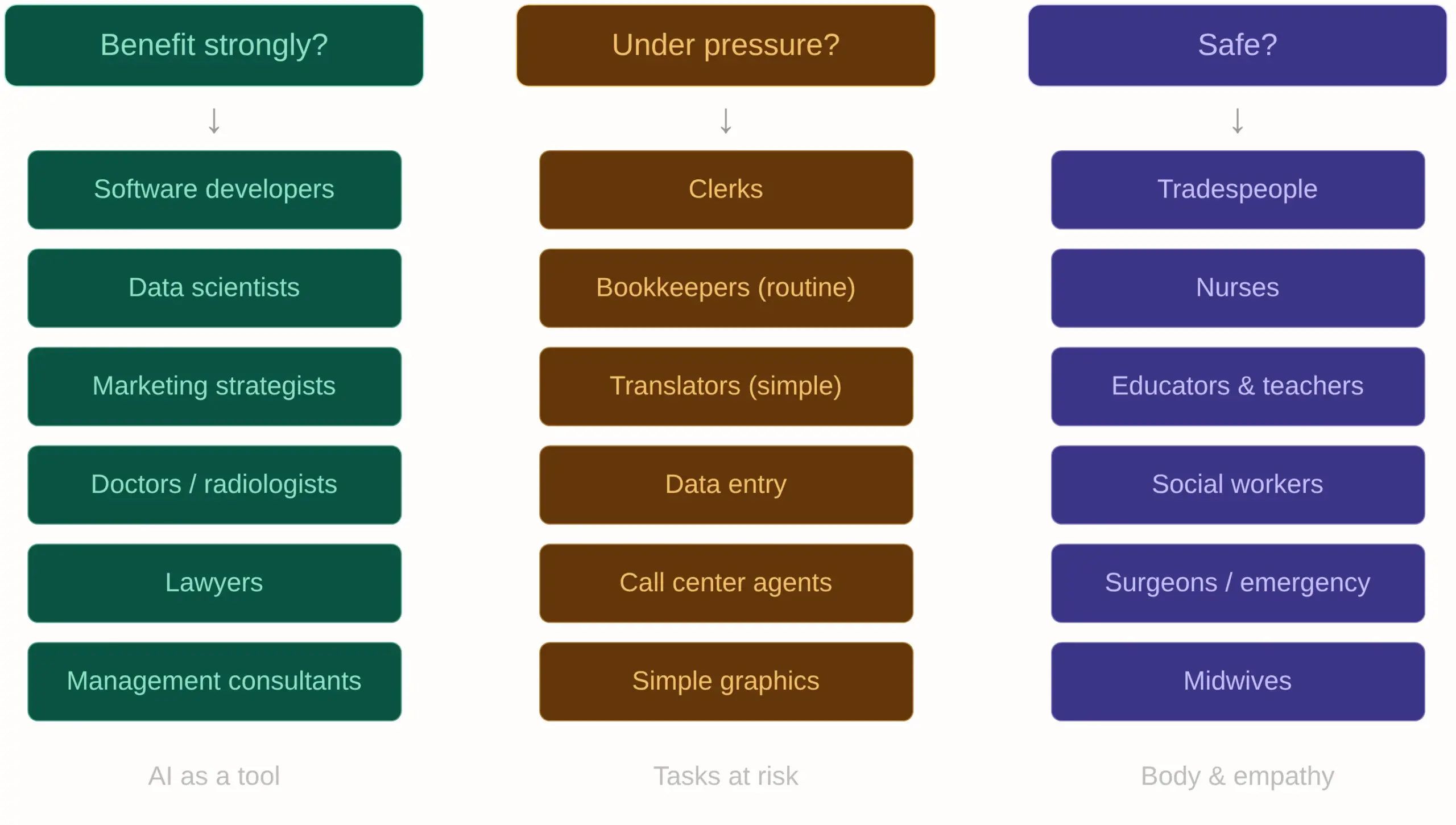
Activities with a high share of routine tasks are particularly affected by AI-driven change: simple clerical work, standard bookkeeping, data entry, translations or initial research. Less affected, by contrast, are skilled trades, creative strategy work and complex advisory services – that is, activities that require social skills, judgment or physical presence.
In most cases, AI does not replace entire occupations but individual tasks within an occupation. That does change the requirements, though: anyone who stays in their job today may have to work with AI tools tomorrow that take over parts of their previous work.
New qualifications are in demand
Working with AI tools is becoming a key skill. Lifelong learning is no longer a buzzword but a concrete career factor. Demand for technological and social-emotional skills is growing – especially in STEM (science, technology, engineering, mathematics) and in healthcare. Universities and companies are already responding with new training concepts built around so-called transformation skills.
Opportunities and risks in balance
Introducing AI brings real opportunities: higher productivity, relief from monotonous tasks, new occupational fields and better decision-making through data analysis. At the same time, risks arise – above all for employees who lack the opportunity or support to develop further in time. Career starters in highly AI-exposed jobs in particular already feel today that their career prospects are changing.
The decisive question is therefore not whether AI changes the world of work – that is already reality – but how this change is shaped: fairly, sustainably and with real added value for everyone involved.
We want your opinion
With this survey, we want to understand how you personally experience and assess the changes brought by AI in your field. Your answers help paint a realistic picture of real-world perceptions and expectations from practice.
 My name is Klaus Meffert. I have a doctorate in computer science and have been working professionally and practically with information technology for over 30 years. I also work as an expert in IT & data protection. I achieve my results by looking at technology and law. This seems absolutely essential to me when it comes to digital data protection. My company, IT Logic GmbH, also offers consulting and development of optimized and secure AI solutions.
0 opinions