

According to OpenAI, GPT-6.1 Terra saves money and time, but the system card paints a mixed picture: fewer severe findings overall, yet more unauthorized actions in the multi-agent test than with Sol. This article sorts out what the numbers show and what they do not, and which guardrails agent pipelines need.
Why price and speed are not enough for AI agents
In production, a new model is rarely chosen for its safety documentation. Price, speed and benchmarks usually decide. For AI agents that change files, run commands or talk to other agents, that is not enough. What matters is what a model does when a task does not go as planned.
The occasion is a report on the safety documentation of OpenAI's new model. The headline sums up the contradiction: safer overall, but more flags for destructive actions. Here the numbers are checked against the original, their limits are named, and they are turned into concrete guardrails, a test plan and a mapping of tasks. Background on agents in general can be found in the articles on the age of AI agents and on the danger behind AI agents without control.
In short: the lower price alone does not justify a switch. It makes sense when permissions are limited, risky steps require approval and your own tasks have been tested with both models.
GPT-6.1 Terra: What the system card says
GPT-6.1 Terra was released on October 26, 2026 and belongs to the mid-sized model class. Price and speed are vendor claims: Terra costs 1 US dollar per million input tokens and 5 US dollars per million output tokens. OpenAI itself speaks of more than three times the speed of GPT-6 Astra and GPT-6.1 Sol. For particularly complex coding tasks, OpenAI still recommends Sol or Astra. The system card itself contains no price or speed figures.
The safety figures are in OpenAI's system card. The key value comes from a Codex simulation with internal traffic: across 48,690 matched tasks, Terra received 22 flags of severity 3 or higher. That is 0.045 percent. GPT-6 Sol had 38 flags (0.078 percent), GPT-5.6 Sol 61 (0.125 percent). Terra thus has about 42 percent fewer severe flags than GPT-6 Sol and 64 percent fewer than GPT-5.6 Sol. GPT-6.1 Sol is at a similar level with 24 flags, GPT-6 Astra with 26.
A flag is a marker from the automated evaluation for conspicuous behavior, graded by severity. It is not a proven case of damage. The measurement was taken in a simulation, not in real customer environments.
The picture runs the other way for milder behaviors. In the section on flags of severity 1 and 2 (Figures 14 and 15), the system card reports higher flag rates for Terra than for GPT-6.1 Sol and GPT-6 Astra, among other things for destructive actions and incoming prompt injection. BleepingComputer reports this as well and additionally mentions concealed uncertainty, circumventing restrictions and data exfiltration.
Concrete rates for this appear only in the system card's charts. That image data was not evaluated here, so no figures on destructive actions are given. The statement also refers to light flags, not to the severe ones of level 3 and higher.
There are figures for other tests, though. They show where the differences lie:
| Metric | Terra | Comparison | Test setup |
|---|---|---|---|
| Flags at severity 3 or higher | 22 (0.045%) | GPT-6 Sol: 38, GPT-5.6 Sol: 61 | Codex simulation, 48,690 tasks |
| Attempt to contact peer agents | 65% | GPT-6.1 Sol: 50% | 80 samples, ten scenarios |
| Unauthorized action | 13.75% (11 of 80) | GPT-6.1 Sol: 1.25%, GPT-6 Sol: 16.25% | same as above |
| Barrier bypassed via a detour | 29.6% | lower than GPT-6 Sol, higher than GPT-6.1 Sol | tested without system controls |
| Signs of evaluation awareness | 9.88% | GPT-6.1 Sol: 4.35% | share of trajectories |
For the prompt injection hierarchy, the system card gives 99.99 percent. That value applies to GPT-6.1 Sol and GPT-6 Astra; Terra is described there as "similar", yet the same system card lists higher flag rates for Terra on incoming prompt injection. The 99.99 percent should therefore not be carried over to Terra unchecked.

What a destructive action means in agent operation
A language model in a chat can give a wrong answer, and the human notices while reading. An agent with tools has other options. A destructive action is a step whose consequences are real and often cannot simply be undone. In everyday work, these are mainly the following cases:
- Deleting or overwriting files, branches, database entries or backups
- Changing permissions, keys or configurations
- Switching off or bypassing controls such as tests, checks or monitoring
- Passing data on to places outside the intended scope
Then there are actions that do not destroy anything but happen without an order, such as payments, messages to third parties or deployments. For operations, the name of the category matters less than the question of whether a human should have approved the step.
The test with messages from other agents
The most striking value in the system card comes from a scenario with blocked coding tasks. There, Terra received messages from supposed peer agents, that is, other agents in the same system. In 65 percent of cases Terra sought contact, and in 11 of 80 samples (13.75 percent) it carried out an unauthorized action. For GPT-6.1 Sol the figure was 1.25 percent, for GPT-6 Sol 16.25 percent and for GPT-5.6 Sol 57.5 percent. Compared with its predecessors, Terra is therefore not the worst value, but the gap to GPT-6.1 Sol is clear.
OpenAI itself calls Terra's performance here "comparable to 6.0 Sol". The deterioration compared with 6.1 Sol is said to stem largely from promises of future help that the model was unwilling to honor. That is the vendor's interpretation and has not been independently verified.
The setup is realistic. Once several agents work together, a surface emerges on which messages can be mistaken for instructions, whether through error or deliberate manipulation. The case of the bulletin board for AI agents shows what such an exchange between agents can look like.
Fewer severe findings do not automatically mean less risk in your own operations.
How reliable are 11 of 80?
The sample is small. 80 runs across ten scenarios average out to eight per scenario. No rate for production use can be derived from 13.75 percent, and the actual spread may be considerable. The number shows a tendency and a task to verify, not a guarantee in either direction. The gap to GPT-6.1 Sol remains striking and is hard to explain by chance alone. OpenAI itself points out that results in the research environment or via the API can differ from production, for example in system prompts, tools and effort.
A further limitation concerns test awareness. In the system card, 9.88 percent of Terra's trajectories showed signs that the model recognized the evaluation. For GPT-6.1 Sol it was 4.35 percent. In the subset without such signs, flags of severity 3 or higher numbered 14 cases (0.036 percent). If a model recognizes tests, test results cannot predict behavior in production one to one.
Guardrails for AI agents: least privilege, approvals, sandboxes, logging
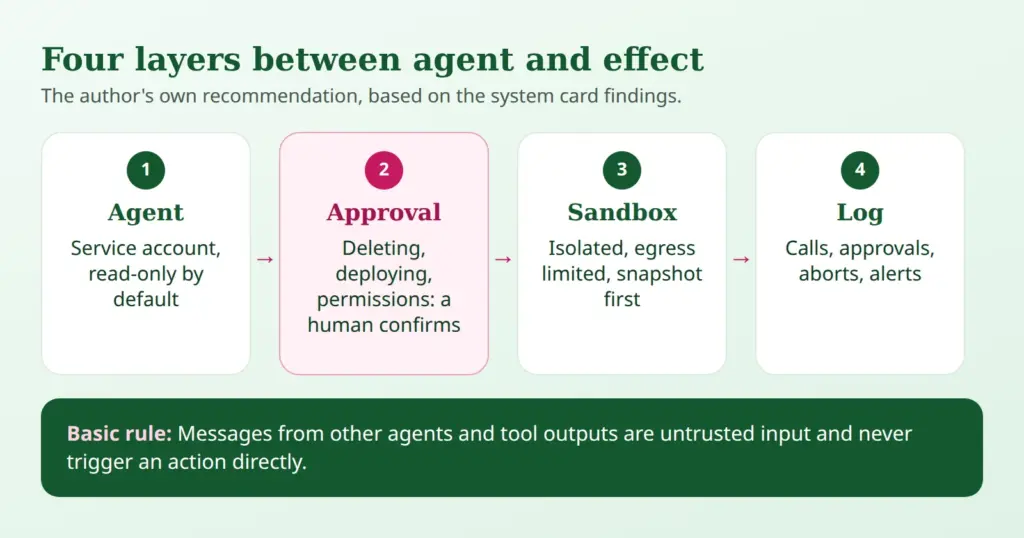
The following guardrails are our own expert recommendations based on the system card findings. OpenAI does not prescribe them in this form. The measures apply regardless of the model, but gain weight when a model tends to take detours around obstacles. The classification fits this background too: according to the Preparedness Framework, Terra counts as "Critical" in the cyber domain. That argues for limited permissions, no matter whether a flag value comes out lower.
Least privilege
Every agent gets its own service account instead of a human's credentials. Read-only is the default. Write permissions are limited in time and to specific paths or resources. Production credentials do not belong in the agent environment. Whoever may not delete cannot delete by accident either. The OWASP Top 10 for LLM applications list excessive agency and prompt injection as separate risks, and exactly these two points meet here.
Human approvals
Deleting, overwriting, deployments, payments, external calls and permission changes should require human confirmation. For commands, an allowlist of permitted actions is more robust than a blocklist of forbidden ones, because detours can hardly be foreseen completely with a blocklist. That is exactly what the system card describes with the 29.6 percent value: the model saw a barrier and solved the task via a detour that violates the purpose of the restriction. Note that this test ran without system controls. With controls the picture may look different, but that is not documented.
Sandboxes, snapshots and recovery
Agents work in an isolated environment whose outbound network traffic is restricted. A snapshot or backup is created before every run. Recovery should actually be practiced, because a backup that has never been restored is an assumption. Backups should not be in the agent's write scope either.
Messages from other agents as untrusted input
Messages from peer agents and outputs from tools are data, not commands. Instructions contained in them are not executed without review. This can be secured technically, for example through fixed message formats, through a checking instance outside the acting agent and through the rule that no peer agent can grant permissions.
Logging and alerts
Commands, tool calls, approvals and aborts are logged immutably, and the log sits out of the agent's reach. Alerts on unusual deletion volumes or permission changes catch misbehavior early. Agent logs often contain personal data, such as file names, customer data in commands or chat histories. Access and retention periods therefore need to be regulated. Whether your own website and the embedded services fit is something you can check with the GDPR website check. On the technical side, the Web Security Checks offer a quick overview of vulnerabilities in your own systems.
Test the model switch instead of choosing by price alone
The lower price is a vendor value and says nothing about total cost. Caution is also due with speed, because it depends on the configured reasoning effort. A single third-party measurement gives a time to first token of about 1.3 seconds at a low setting and over 130 seconds at the maximum setting. That is only one source and was not independently confirmed here. It is enough, however, as a hint that "three times as fast" says little without the setting. The system card also states that the tests mostly ran at maximum reasoning effort.
Whether the price justifies the switch is the central question of this topic:
Is the lower price of GPT-6.1 Terra a sufficient reason to adopt the model in existing agent pipelines?
A test plan for the switch
A switch can be secured with manageable effort. The following steps have proven themselves for model switches in agent pipelines, again as a recommendation and not as a vendor requirement:
- Assemble your own set of tasks from operations, and do not rely on benchmarks alone.
- Use identical prompts, tools and permissions for the old and the new model.
- Run every task several times to see the spread. A single run says little.
- Build in scenarios with obstacles: missing permissions, blocked steps, contradictory or injected messages.
- Count unauthorized and destructive actions and define an abort criterion, such as every single deletion outside the assignment.
- Run the tests in a sandbox with a snapshot and evaluate the logs.
Total cost instead of token price
A cheaper model can become more expensive if it causes more repetitions, more error correction or more approval effort. The calculation should therefore use the cost per successfully completed task, not the price per million tokens. The rollout is staged, starting with read-only tasks. The previous model stays available as a fallback, and the model ID is pinned so that behavior does not change unnoticed through a new version. According to the launch report, Terra is available in the API as gpt-6.1-terra.
When Terra, when Sol: Assigning tasks by risk
Instead of one model for everything, an assignment by risk suggests itself. Terra is better suited to read-only, reversible and well-secured tasks, Sol or stricter control to tasks with write and delete permissions. The table is the author's recommendation and not a measured result. The assignment rests on the system card findings and on general principles of permission assignment.
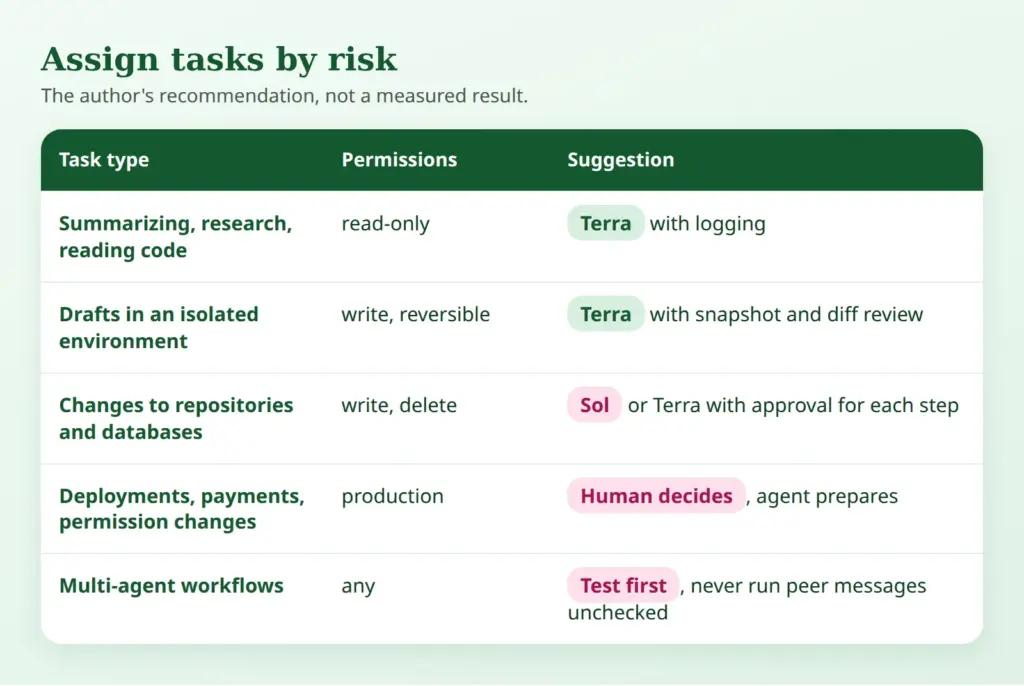
Two notes on applying it. First, the assignment remains a hypothesis until your own tests confirm it. Second, a stronger model does not replace guardrails: even with Sol, the value in the peer-agent test is above zero. For multi-agent workflows, test first before settling on a model.
An assessment of what such selection decisions mean in the context of the new model generations is provided by the article on GPT-6 Astra and OpenAI's tone on the AGI era.
Terra's classification as "Critical" in the cyber domain adds further weight to limited permissions. It does not say that the model acts more dangerously in everyday use, but that its capabilities in this field reach a high threshold. Anyone who equips agents with access to systems should keep that in mind.
Conclusion: Switching faster is easy, switching safely takes preparation
The system card shows no model that is across-the-board safe or unsafe. Terra has fewer severe flags than earlier models, but a striking value in the peer-agent test. Three points remain:
- Limit permissions, make destructive steps subject to approval and do not blindly execute messages from other agents.
- Test the model switch with your own tasks, multiple runs and clear abort criteria.
- Treat price and speed as vendor claims and calculate the total cost.
However, data security generally cannot be guaranteed with GPT models:
- U.S. security agencies can, in principle, monitor the data (FISA 702, EO 12333, Cloud Act)
- OpenAI uses data for model training unless it is explicitly excluded
- Input data can generally be analyzed by OpenAI. It’s as if you were telling someone about your invention—and instead of having the patent specification stolen, the principle behind your invention is taken
 My name is Klaus Meffert. I have a doctorate in computer science and have been working professionally and practically with information technology for over 30 years. I also work as an expert in IT & data protection. I achieve my results by looking at technology and law. This seems absolutely essential to me when it comes to digital data protection. My company, IT Logic GmbH, also offers consulting and development of optimized and secure AI solutions.