

AI assistants save time, but anyone who enters contracts, customer data or design drawings into ChatGPT, Copilot or similar cloud services gives up control over that data. The alternative is an AI that runs in your own house or with a provider in Germany. This overview shows when local AI pays off, how it works with company knowledge, which language model fits and what data protection officers should check.
The key points in brief
- With cloud AI, your inputs leave the company. With US providers, access rights of US authorities come on top, regardless of where the server is located.
- Local AI runs on your own hardware or with a provider of your choice. Data stays under your control, and many questions about data processing agreements and third-country transfers fall away.
- Open language models are good enough for many business tasks, and for narrowly defined tasks often even better than large general-purpose models.
- The greatest benefit comes when the AI knows your own documents. This works with a semantic search over company knowledge, not with long prompts.
- Start with one clearly defined task and measure the result before you expand.
Why cloud AI is a data protection risk
Whatever is entered into an AI chatbot is processed by the provider on its servers. AI and data protection: How much does your assistant know about you? describes the traces this leaves. In addition, language models can themselves contain personal data. How do AI language models store data? and Personal data in AI models explain how to understand this technically. Whether and when training with such data is permitted is covered in AI training and the GDPR: What is allowed?.
Even products advertised as secure do not always live up to their promises. Practical tests show this:
- Microsoft Copilot test: a complete failure
- Copilot under the microscope: The uncomfortable truths behind Microsoft's AI promise
- DeepSeek vs. ChatGPT: Fact check on the Chinese AI language model
What local AI is and what it can do
Local or offline AI runs without a connection to a third-party service. The data stays in your own network, and the costs do not depend on the number of requests. Offline AI as an opportunity for companies of every size and the frequently asked questions about offline AI offer an introduction. The advantages of company-owned systems over cloud services are shown in The advantages of company-owned AI systems, with a practical example.
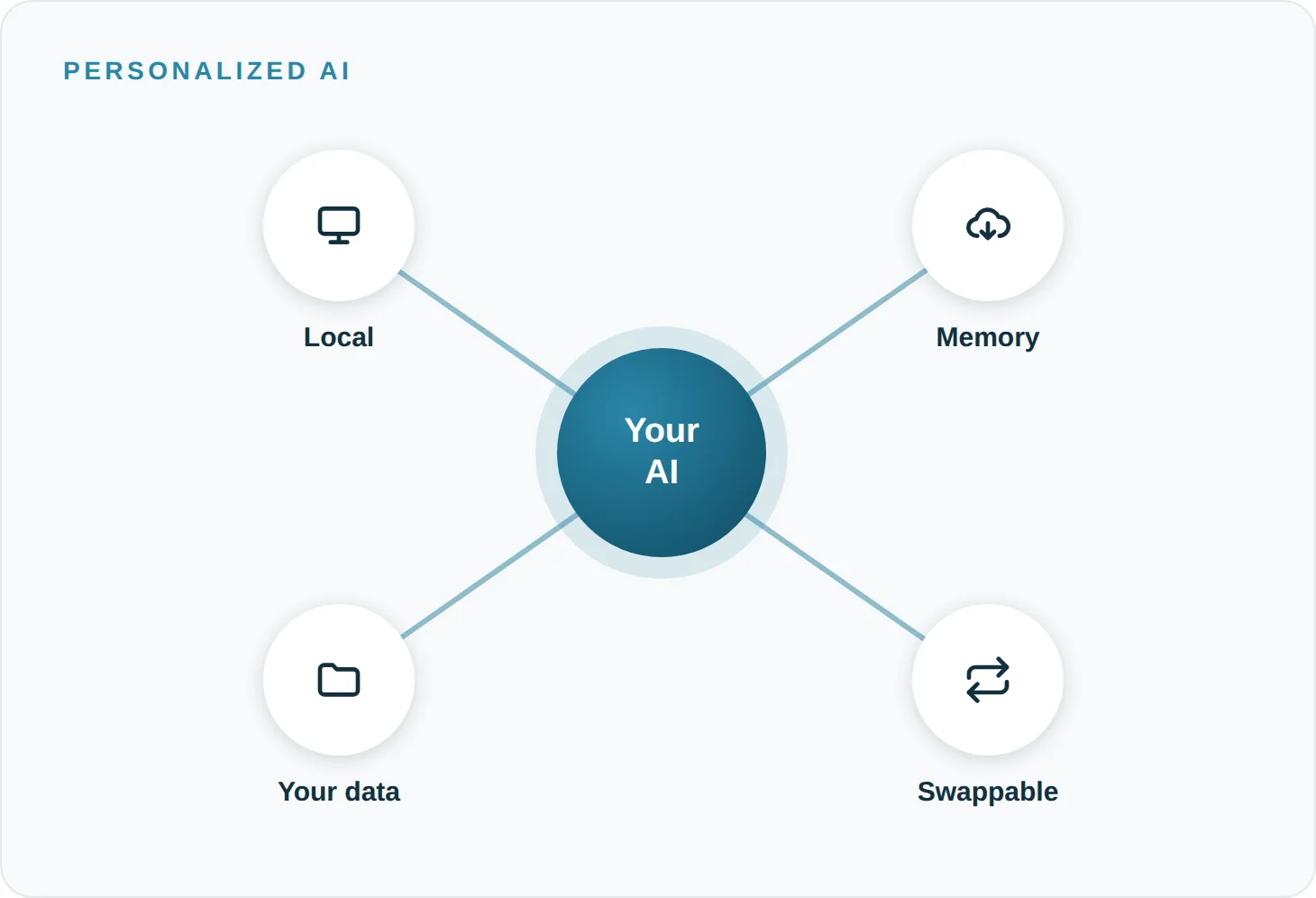
Personalized AI explains why an AI that learns from your data achieves more in the long run than a general cloud service. For chatbots on your own website or in customer service, AI chatbots: Opportunities and risks for companies sums up the trade-offs. More basics:
- AI: Endless possibilities with full independence from third parties
- Problem solver in a state of emergency: How offline AI cracks your challenges
- Frequently asked questions and answers about affordable, secure AI
- AI glossary: the most important terms
AI with your own documents and company knowledge
Cloud assistants do not really know your company documents, even if you upload them. The reasons are limited context length, cost and the lack of analysis across many documents: Why Claude or ChatGPT does not really know your company documents. A better approach is an AI that opens up your documents through a semantic search and backs its answers with sources.
The step-by-step guide Extending local AI with your own data shows how to build such an AI yourself. Ready-made applications and examples:
- Finding knowledge in company documents: Semantic AI search
- AI database: How your knowledge becomes usable
- How local AI reveals hidden patterns and transferable knowledge
- Question-and-answer system for the data protection blog Dr. DSGVO
Choosing the right language model
For running your own system, open models are an option: you download them and use them without a connection to the vendor. AI: Which language model is the best? explains which size and which model fit which task. What matters for German texts is shown in German texts in AI language models.
Models from China can also be used safely if they run locally instead of through the vendor's app: DeepSeek: The AI revolution from China, also as a secure variant. More model comparisons:
 My name is Klaus Meffert. I have a doctorate in computer science and have been working professionally and practically with information technology for over 30 years. I also work as an expert in IT & data protection. I achieve my results by looking at technology and law. This seems absolutely essential to me when it comes to digital data protection. My company, IT Logic GmbH, also offers consulting and development of optimized and secure AI solutions.