

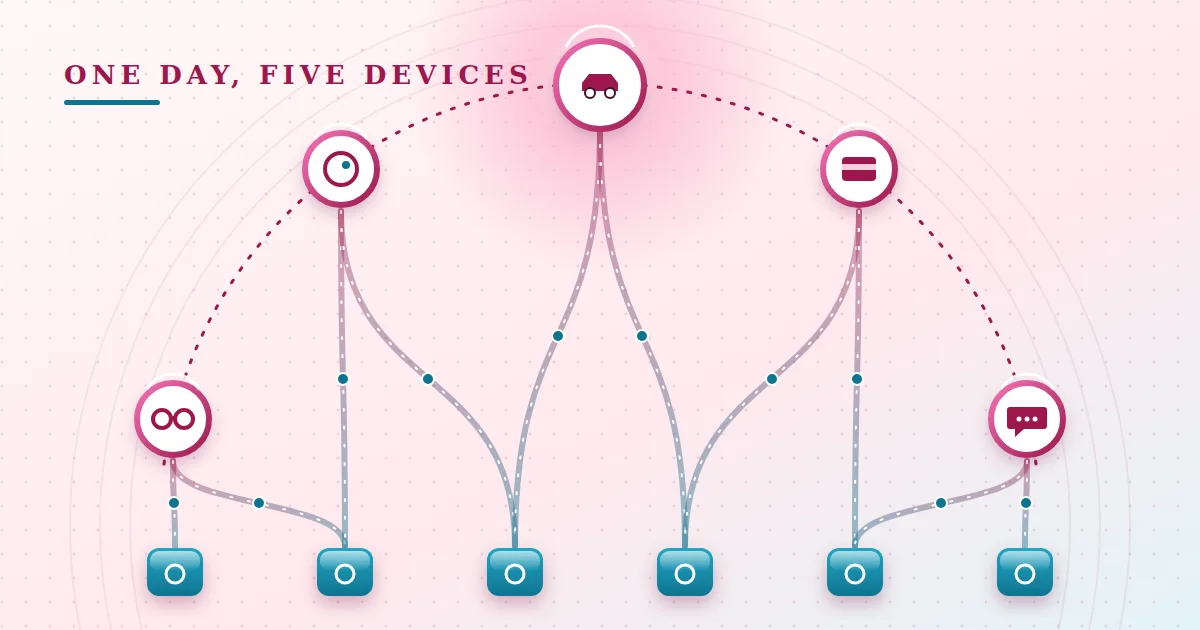
Your digital footprint in everyday life starts growing before breakfast, without anyone consciously handing over data. We follow a fictitious example person for one day, from smart glasses in the morning to an AI chatbot in the evening. Along the way it becomes clear who receives which traces, what rights exist and which steps can make a difference in ten minutes.
One day, many traces: what the digital self is
An ordinary day consists of many small actions. A device is switched on, an app opened, a question typed. Each of these actions leaves traces, and hardly any of them stay on the device. The data travels to manufacturers, to service providers and sometimes to parties whose names appear in no user manual.
Here, the "digital self" refers to the sum of the data that is collected, linked and analysed about a person. It does not arise in one place but from many sources. Individually, the traces seem harmless. Together, they form a picture that reveals habits, whereabouts and interests.
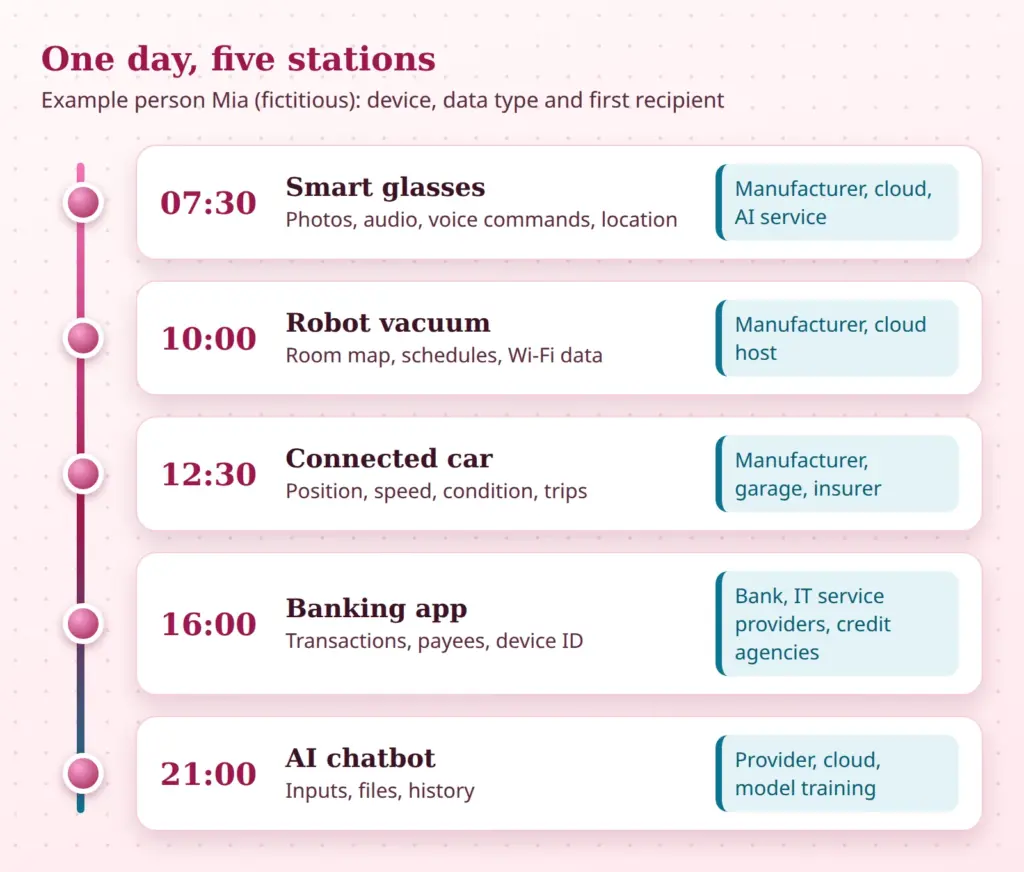
The common thread is one day in the life of an example person called Mia. Mia is entirely made up, as are all the details of her day. Mia wears smart glasses in the morning, lets the robot vacuum run in the late morning, drives her connected car at midday, checks her banking app in the afternoon and asks an AI chatbot for advice in the evening. At each station, we describe which data is generated, who receives it and what the people concerned can do.
Digital footprint in everyday life: what a day leaves behind in data
Traces arise in two ways. The first is conscious: anyone who uploads a photo or fills in a form knows that data is being passed on. The second goes unnoticed. Sensors measure, apps log, servers store, and most of this happens in the background. The second way is the larger one.
The following overview shows Mia's day in five stations. It is deliberately kept simple and only shows which device generates which type of data and who typically learns about it first.
A few terms are enough for what follows. Personal data is any information relating to an identified or identifiable person. This includes name and address, but also location histories, device identifiers and voice recordings. A detailed explanation can be found in the article on the definitions of the GDPR. Device data is all data that a connected product generates, such as operating states, measurements or usage logs. Device data is not always personal, but it can become so as soon as it is attributed to a person.
The controller decides on the purposes and means of processing. This is usually the manufacturer or provider. A processor works on its behalf, for example a cloud host. Third parties are all other recipients. Further technical terms are explained in the glossary.
Three sets of rules, one everyday life: GDPR, Data Act and AI Act
Three European sets of rules matter for Mia's day. Each answers a different question.
The GDPR protects personal data. Every processing operation requires a legal basis, such as consent or a contract. Data subjects have the right of access, of erasure and to object. The GDPR applies regardless of the device and takes effect as soon as a person is identifiable.
The EU Data Act governs access to data from connected products. According to guidance from the Federal Network Agency, the rights have applied since September 2025 and only cover data generated after that date. Users' rights can be summarised in three points:
- Before purchase or conclusion of a contract, users must be informed about which data the product generates and how access works (Article 3).
- Users can request their product and service data from the data holder, free of charge, securely and in machine-readable form (Article 4).
- Users can request that the data be passed on to third parties, for example an independent garage (Article 5). Third parties may only use it for the agreed purpose.
One important restriction concerns personal data. The GDPR remains applicable. If the user is not also the data subject, the Data Act alone does not provide a legal basis for access or disclosure. Moreover, direct access within the product itself ("access by design") is only mandatory for products placed on the market from mid-September 2026. For older devices, access runs indirectly via the manufacturer.
The AI Act mainly concerns the chatbot in the evening. The transparency obligations under Article 50 are intended to ensure that people recognise when they are talking to an AI. The deadlines for high-risk systems were recently postponed by the so-called "Digital Omnibus on AI". As things stand, they now apply from December 2027 and August 2028 respectively. For labelling certain AI content, the regulation grants providers of systems already on the market a transition period of four months. Everyday life does not need more than this framework.
The sets of rules complement one another but do not replace each other. The GDPR asks whether data about a person may be processed. The Data Act asks who can get at a device's data. The AI Act asks whether it is disclosed that a machine is answering.
Morning: smart glasses and the people who never agreed
At half past seven, Mia puts on her smart glasses. The device looks like an ordinary frame but contains a camera, speakers, microphones and an AI assistant. On the way to the train, one voice command takes a photo and another asks the assistant about the weather.
What data is generated: photos and videos, audio, voice commands, location information and usage data from the companion app. With AI features, image and audio data are transmitted to the manufacturer's service for processing. It is not only Mia who is affected, but also passers-by, colleagues and fellow passengers who were neither asked nor notice it.
Who receives the data: the manufacturer via the companion app, its cloud service provider and possibly systems for training AI models.
How the supervisory authority assesses this is shown in the report by the Hamburg Commissioner for Data Protection on the Ray-Ban Meta AI Glasses. The authority examined the Gen 1 model technically, analysed the companion app and took the glasses apart. The key findings:
- Private individuals are, in principle, also subject to the GDPR when using the glasses. The household exemption applies, for example, when close friends or family are filmed.
- Depending on distance, viewing angle and light, the outward-facing LED is only partially perceptible. Its lighting up alone is not enough to inform the people concerned adequately. Additional measures such as pictograms or speaking to people are required.
- If personal data of third parties is transmitted to the manufacturer for AI training, an additional legal basis is needed. Users can then not rely on the household exemption but become joint controllers with the manufacturer with regard to the training data.
- In the authority's assessment, recognisably recording people outside the close circle of friends and family will, apart from rare constellations, not be permissible under data protection law, because informed consent cannot be obtained in practice.
- An objection to AI training only has effect for the future. It does not undo training that has already taken place.
Two points from the report deserve attention.
First, the authority found database tables in the app whose names point to facial recognition. The tables were empty; in the authority's assessment, no facial recognition is taking place so far, but the structure for it has been set up.
Second, this is a legal assessment by the authority and not a ban, let alone a court judgment.
The Federal Network Agency also comments on such devices. Products that can record unnoticed and transmit wirelessly are considered prohibited spy devices. Recording must be recognisable, for example through a light or a non-removable sticker.
Countermeasure: Use the recording function deliberately and speak to third parties beforehand. Take the glasses off in sensitive places such as medical practices, changing rooms or schools. Check the AI features and permissions in the companion app and object to AI training. Request information from the manufacturer about the stored data. Anyone who allows such devices at work should set clear rules, because responsibility then does not lie with the individual alone.
Late morning: robot vacuum, a map of the flat and the cloud
At ten o'clock, the robot vacuum starts automatically. Mia has long since left for the office. The device drives through the flat, creates a map and sends a message to her phone: cleaning complete.
What data is generated: floor plan and room map, schedules and thus patterns of presence, Wi-Fi access credentials and the assignment of rooms. Models with a camera add images, models with a microphone add audio. The map and schedule reveal how large a flat is, how it is laid out and when nobody is at home.
Who receives the data: the manufacturer, its cloud host, support service providers and possibly partners for voice assistants. Whether and which data leaves the cloud of the respective device is stated in the app's privacy notice. Individual incidents involving specific manufacturers are not mentioned here because there is no reliable source for them. The finding holds anyway: the cloud is an additional storage location that the household does not control.
The Federal Network Agency points out that devices keep coming onto the market whose camera is not only directed at the floor or ceiling. Viewing angle and image quality are decisive, it says. The authority's advice is simple: read the product description and the app's privacy notice before buying and look out for unusual cameras or microphones. Anyone who owns a prohibited device should not put it in household waste, but destroy it and send proof to the authority.
Legally, the situation has two sides. As soon as the map of a flat and the schedules are attributed to a person or household, they are personal data. The GDPR therefore requires a legal basis and, for servers outside the EU, additional safeguards. In addition, the Data Act gives users a right to the device data, and they must be informed about the types of data generated before purchase.
What helps in practice: Switch off the camera and microphone where they are not needed. Deactivate the cloud map if the device also works locally. Set up a separate guest Wi-Fi for smart home devices so that they are not on the same network as computers and phones. Install firmware updates. When selling or giving away the device, reset it and delete the account. The article on smart home devices and data protection explains the legal basis for connected household appliances.
Midday: the connected car, driving data and insurers
At half past twelve, Mia gets into her car. Navigation, phone pairing and assistance systems start by themselves. The vehicle is a small computer with a mobile connection, and what is generated there has developed into a data market of its own. Keepers, drivers and passengers are all affected.
What data is generated: The ADAC lists, among other things, speed, acceleration, location, mileage, tyre pressure, brake pad wear, battery level, temperatures, energy consumption and trip summaries. Raw data from sensors, cameras, radar and the vehicle bus may also be affected.
Who receives the data: the manufacturer and its backend, telematics and mobile service providers, garages, breakdown services and, if the keeper wishes, insurers. Passing data to insurers is common as part of voluntary telematics tariffs. Under the Data Act, it is also possible at the express request of users, as the ADAC describes. No claim is made here that data is sold against the will of users, because there is no primary source for that. It remains open to what extent manufacturers use aggregated data for their own purposes. This can only be clarified through the privacy notices and an access request.
The Data Act creates a practical route here. Users can request vehicle data from the manufacturer and have it forwarded to third parties. The process works like this: register on the manufacturer's Data Act portal or send a request by email, state the desired period, then wait, which can take up to 30 days. The data usually arrives as JSON files that are hard for laypeople to read. Passing it on to third parties is said to be still cumbersome in many portals. With AI, however, probably every second person can now solve this problem!
| Who requests vehicle data? | Purpose | Requirement |
|---|---|---|
| The keeper herself | Overview, checking, switching provider | Request to the manufacturer, data from 12 Sep 2025 |
| Independent garage | Diagnosis and maintenance | Disclosure at the user's request |
| Insurer | Telematics tariff, claims assessment | Voluntary and with consent |
Under the GDPR, vehicle data relating to a person must be treated as personal data, i.e. data that can be attributed to the keeper or driver. Location data is considered particularly sensitive because it reveals home, workplace and habits. Rental cars, company cars and passengers are a case of their own, because their data is generated too.
Countermeasure: Go through the privacy settings in the vehicle and in the manufacturer's app. Weigh telematics tariffs soberly: the price advantage comes at the cost of permanently disclosing driving behaviour. Retrieve your own data via a Data Act request to see what is actually stored. Before selling, reset the vehicle and disconnect it from phone and account.
Afternoon: the banking app between payments and credit agency
At four o'clock, Mia opens her banking app. She sees her balance and transactions and transfers the rent. A particular honesty applies here: there are hardly any reliable primary sources on data flows within banking apps. We can therefore only describe what the structure of the business suggests and what consumer organisations document.
What data is generated: account balance, transactions, payees, payment references, device identifier and information about app usage. Card payments add time and place. This is a very revealing picture: transactions show income, habits, health expenses and memberships.
Who receives the data: the bank as controller, its IT service providers and data centres, payment networks and card schemes, as well as the recipients of transfers. In lending, banks usually report data to credit agencies under the contract terms. Whether analytics services also run in the app can only be determined from the respective bank's privacy notice and the information in the app store. Blanket statements on this would be speculation.
There is a documented conflict with add-on apps. The Hamburg Consumer Advice Centre advises against granting the Bonify app access to your bank account. With this access, the service learns about income, expenses and the punctuality of payments. The consumer advice centre fears that people feel pressured to grant account access in order to have better chances of loans or contracts. The Schufa base score is available without account access, and a copy of your data from Schufa is available free of charge once a year.
What helps in practice: Check the app's permissions and limit them to what is necessary. Reset the phone's advertising ID. View and withdraw consents given in the app. Only use account access services if the benefit clearly outweighs the price of sharing data. If in doubt, request a free copy of your data, from the bank as well as from the credit agency.
Evening: AI chatbot, history, training and the model's memory
In the evening, Mia asks an AI chatbot how to word a letter to her landlord. Then she uploads a doctor's letter to have its content explained. Both inputs are common in everyday life, and both are sensitive.
What data is generated: inputs, uploaded files, metadata such as time and device, the history and, with some services, a long-term memory. People often confide things to chatbots that they would not tell anyone else: health, relationships, money worries. This makes the chatbot one of the densest data sources of the day.
Who receives the data: the provider, its cloud infrastructure and possibly service providers for security and moderation. If inputs are used for training, they flow into the model itself. There, they cannot simply be retrieved. The Hamburg report on the glasses describes the same principle: an objection only applies to future training.
Legally, three things are in the foreground. First, under the GDPR the provider needs a legal basis, including for training. Second, rights of access, erasure and objection exist. Third, Article 50 of the AI Act requires that it be recognisable whether a machine is answering. The supervisory authorities have published guidance, but it is aimed mainly at businesses. For businesses and websites, the articles on AI chatbots on websites and on the reliability and data security of AI chatbots explain the requirements. On training itself, the overview AI training and the GDPR provides an assessment.
What you can do: Do not enter health, login or customer data. Turn off training use in the provider's settings and use temporary chats where they are offered. Delete the history regularly. Providers change their menus frequently, so the respective help page is a more reliable guide than any second-hand instructions. Anyone who wants to process sensitive content can consider a locally operated model.
The central question: who owns my digital self?
After a day with five stations, the question arises that gives this topic its name. The word "owns" suggests that data can be possessed like things. Legally, that is not the case. There is no ownership of data in the sense of property law. Instead of a property right, there is a bundle of rights: self-determination over one's own data, access, erasure, objection, access to device data and portability.
Who actually owns my digital self?
In everyday life, the word "owns" still works. It describes the feeling that something personal should not be passed on without knowledge and consent. The law partly reflects exactly this feeling. The difference lies in practice: the rights have to be asserted. Without an access request, it remains unknown what is stored. Without a Data Act request, device data stays with the manufacturer.
Who gets what? The recipients at a glance
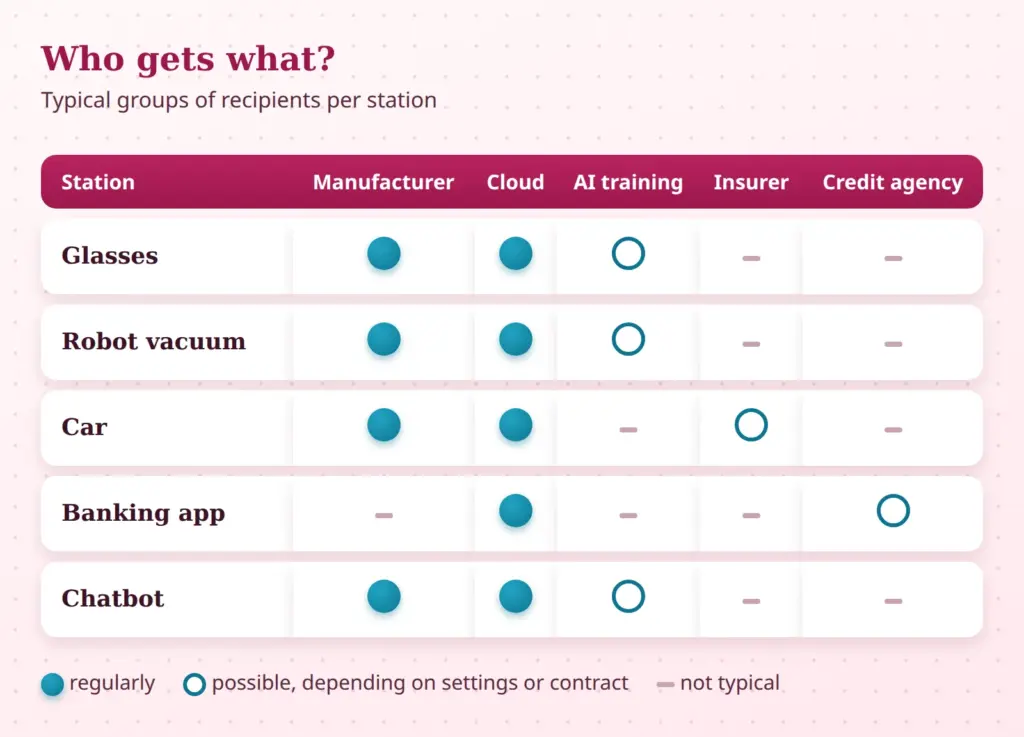
The table summarises what is generated on Mia's day, who typically receives it and what course of action is available in each case.
| Station | Data | Typical recipients | Rules | Course of action |
|---|---|---|---|---|
| Smart glasses | Photo, video, audio, location | Manufacturer, cloud, AI service | GDPR | Access request, objection to training, inform third parties |
| Robot vacuum | Room map, schedules, Wi-Fi | Manufacturer, cloud host, support | GDPR, Data Act | Switch off cloud, guest Wi-Fi, data request |
| Car | Position, driving behaviour, condition | Manufacturer, garage, insurer | Data Act, GDPR | Data request, control disclosure |
| Banking app | Transactions, payees, device ID | Bank, IT service providers, credit agencies | GDPR | Permissions, avoid account access services, access request |
| AI chatbot | Inputs, files, history | Provider, cloud, model training | GDPR, AI Act | Turn off training, delete history |
The graphic shows the same overview as a matrix. The matrix is a guide. Which recipients are actually involved in an individual case depends on the device, provider and settings.
Websites have recipient lists too. Where traces arise on the computer and in the browser, and to whom they go, should be stated in the privacy policy.
The problem is not the individual device, but the sum of traces that come together to form a profile.
Conclusion of the data day
Websites also pass data on to third parties
The GDPR website check shows which services a page loads and which data goes to recipients in the process.
Reducing your digital footprint: ten minutes that make a difference
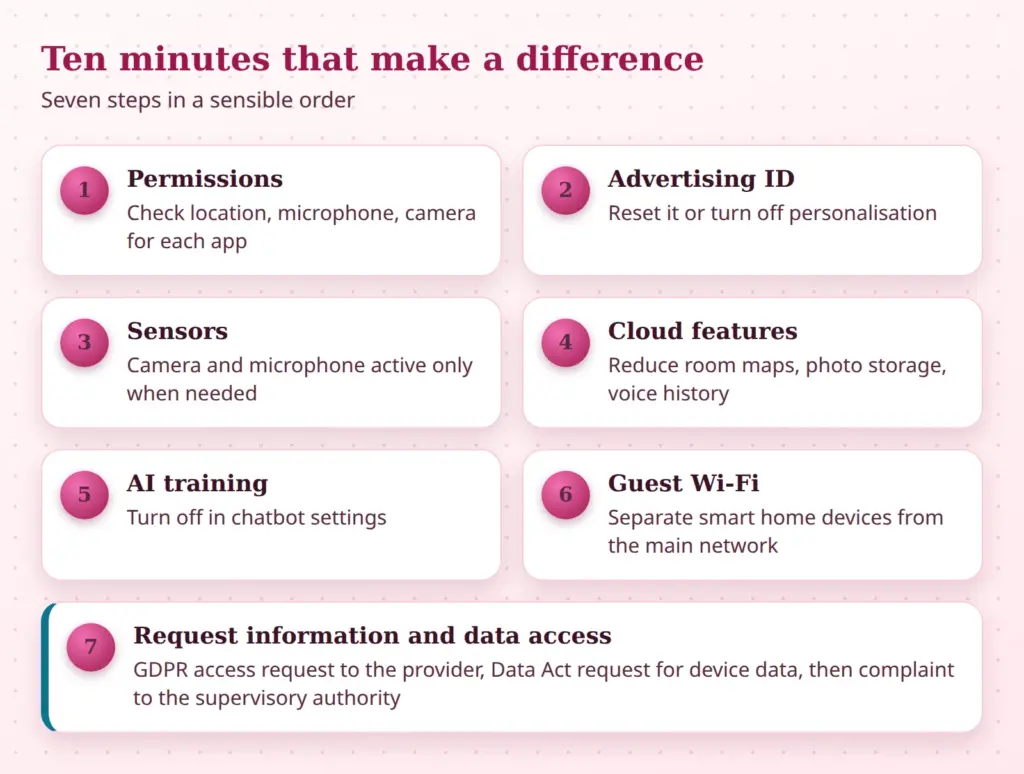
Your digital footprint in everyday life cannot be avoided completely, but it can be reduced. Small measures have a bigger effect than it seems, because they start where most data is generated. A sensible order could be:
- Check app permissions. Allow location, microphone, camera and contacts only where they are needed. Location "only while using the app" is usually enough.
- Reset the advertising ID. The phone manages an identifier through which apps link behaviour. Resetting it or turning off personalisation breaks this link.
- Switch off camera and microphone when they are not needed, on glasses, robot vacuums and voice assistants.
- Reduce cloud features. Only activate room maps, photo storage and voice history if the benefit justifies the price.
- Set up a guest Wi-Fi. Smart home devices get their own network, separate from computers and phones.
- Turn off training. Switch off use for model training in the chatbot, delete the history, avoid sensitive inputs.
- Request information and data access. A GDPR access request provides clarity about stored data, a Data Act request about device data. If no answer comes, the next step is a complaint to the competent supervisory authority or the Federal Network Agency.
When selling or passing on devices, resetting them and deleting the account are part of the process. Otherwise the digital self stays behind in the old device and the old account. A template for a request can be kept short: name, device or account, period, a request for a copy of the data and for information about recipients and purpose, with a deadline. This is not legal advice but a practical aid. If the request is ignored, a complaint to the supervisory authority or going to court can help (the person concerned can decide which).
Limits of the rights and what is still open
The rights are real, but they have limits. The Data Act only applies to data generated from mid-September 2025 and only to products on the EU market. Manufacturers can invoke trade secrets but must name them in advance. Direct access within the product only applies to new devices from 12 September 2026. For older devices, the indirect route via the manufacturer remains.
Supervision is also fragmented. Data protection authorities are responsible for personal data, the Federal Network Agency for radio equipment and spy devices, and also for complaints about the Data Act. The assessment of smart glasses is ongoing. The AI Act deadlines were recently postponed, and further changes are possible.
A related area of tension is shown by the debate on chat control: there, too, the question is how much insight third parties may have into private communication. The outcome of these discussions will help decide how large the digital self may be in future.
The conclusion is sober:
A digital footprint in everyday life is (unfortunately) the norm. No single device makes Mia transparent, and complete isolation is unrealistic. But anyone who knows the traces can steer them: with settings, with requests and with the decision about which device should receive which data in the first place.
Anyone who wants to reveal less data about themselves uses alternatives: DuckDuckGo instead of Google, Signal instead of WhatsApp, Linux instead of Windows, more time for yourself instead of Facebook, and so on.
 My name is Klaus Meffert. I have a doctorate in computer science and have been working professionally and practically with information technology for over 30 years. I also work as an expert in IT & data protection. I achieve my results by looking at technology and law. This seems absolutely essential to me when it comes to digital data protection. My company, IT Logic GmbH, also offers consulting and development of optimized and secure AI solutions.