

Modern AI systems do far more than answer questions. They observe, plan, learn – and keep working even when nobody is talking to them. An unusual look behind the scenes shows what this means for companies, what opportunities it holds and where the real risks lie.
What happens behind the scenes
First of all: this is not an April Fools' joke.
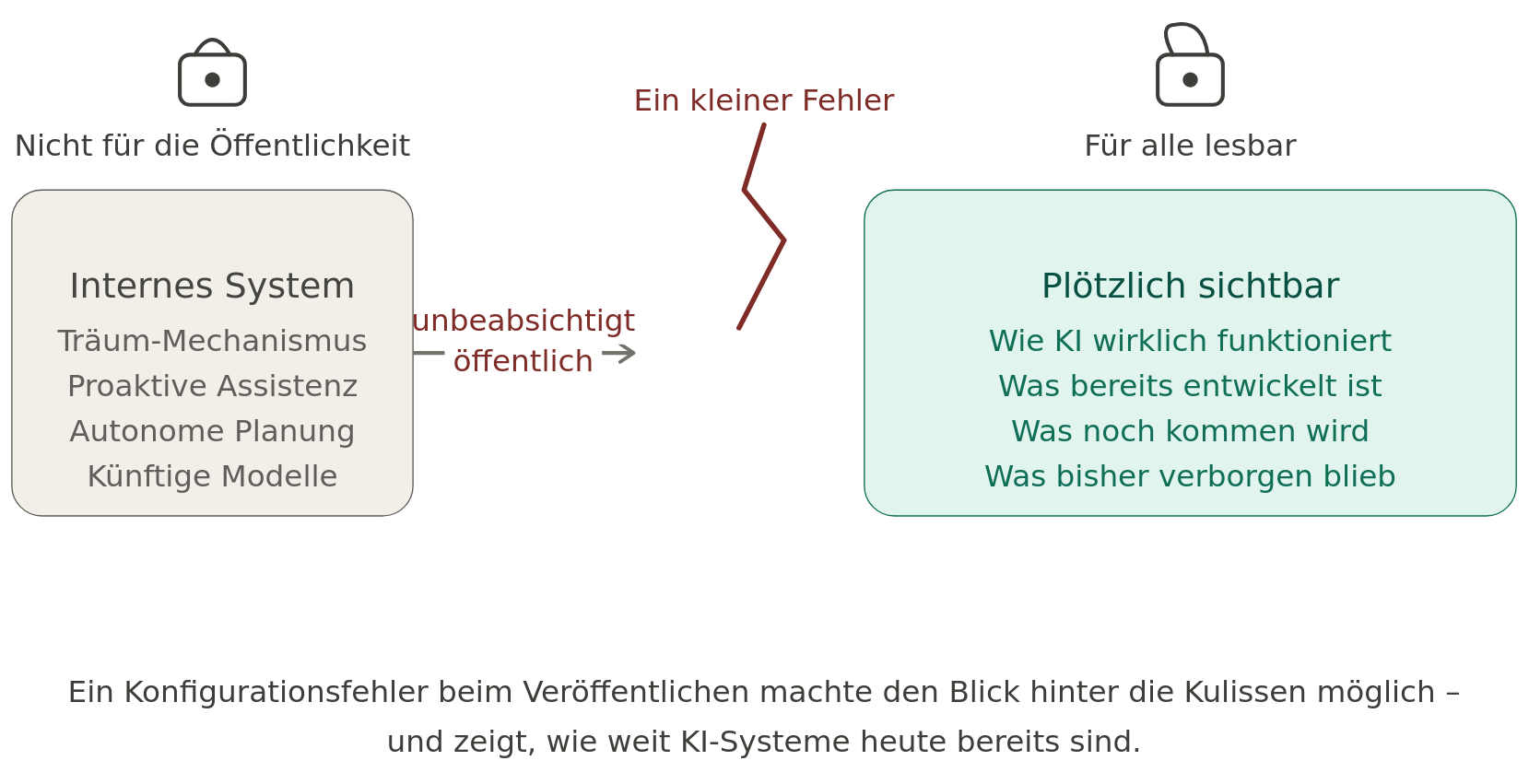
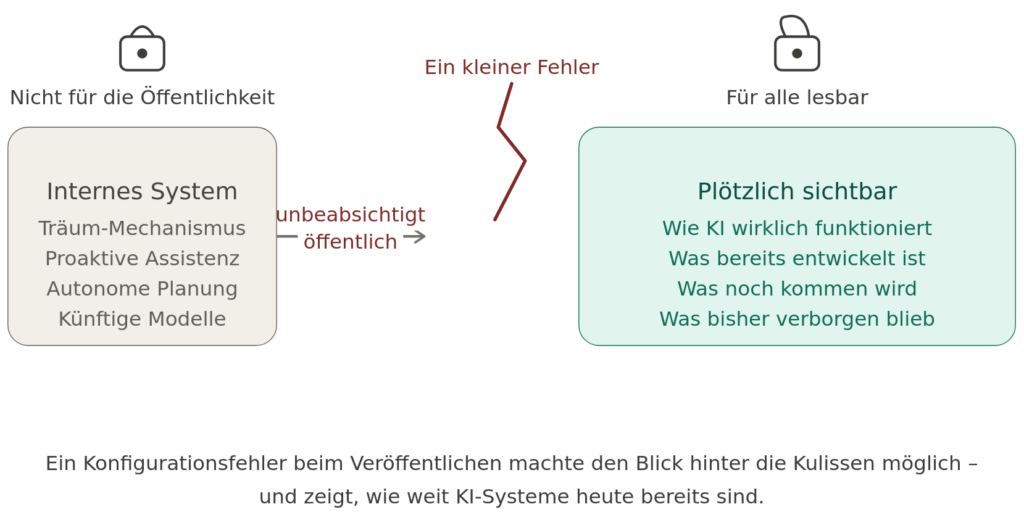
It recently emerged that the complete source code of an AI coding assistant from the company Anthropic had been made publicly accessible by accident. It was not caused by an outside attack, but by a simple configuration error when publishing a software package. One forgotten line made visible what was supposed to stay hidden.
To better understand the complex developments in AI, an AI database gives you a comprehensive overview. The ability to standardize and analyze your knowledge is crucial to the success of your AI strategy.
Publicly available AI is more advanced than many can imagine.
One reason is that many are distracted from real solutions by prompting workshops.
What developers and tech journalists found there does not read like product documentation. It reads like a look into the workshop of the future. The curtain is open. The insight raises questions that go far beyond the incident itself: How far along are modern AI systems really? What do they do without us seeing it? And whose control are they actually under?
This development raises important questions about the regulation of AI. To understand the risks and opportunities in full, it is essential to examine the regulatory framework.
Incidentally: the source code is still available and always will be – thanks to AI. Even if the original files are removed, the ports to other programming languages will likely stay public for longer (forever?). Even though this is probably legally questionable in terms of copyright, that is the reality. The legal system is, after all, merely a (deliberate) fiction that has less and less to do with reality in the face of rapid technological development.
The upshot: thinking ahead (by humans) beats prompting and thinking things over, and certainly beats convenience. See the conclusion at the end.
What the leak actually proves
Before speculating about the future, one thing can be established: much of what was previously hard to imagine is no longer theory. Through the incident described above, the complete, commented source code of the AI assistant Claude Code became visible to the whole world – including the internal system architecture, feature descriptions and developer comments. What could previously be dismissed as roadmap speculation is now documented.
What is concretely proven: AI assistants of this generation already have background processes that run on their own between active sessions. They are built to act proactively without waiting for input. Architectures exist in which AI takes on complex planning tasks autonomously and submits the results for human approval. And internal development lines show that these capabilities are being expanded deliberately as a strategic core rather than a side feature.
This matters because it shifts the discussion about AI from the level of the possible to the level of the real. We are no longer talking about what might come someday. We are talking about what is already inside current systems and, in many cases, simply has not been released to the public yet.
A parade of astonishing assistants
AI can do more than dream. It can work continuously, reflect on its results and improve itself.
It can also take on different personalities. That sounds insane, and it is. Then again, many people seem to be daydreaming as well. That insanity is called prompting. It goes so far that service providers with no software background offer prompting workshops – to win more customers.
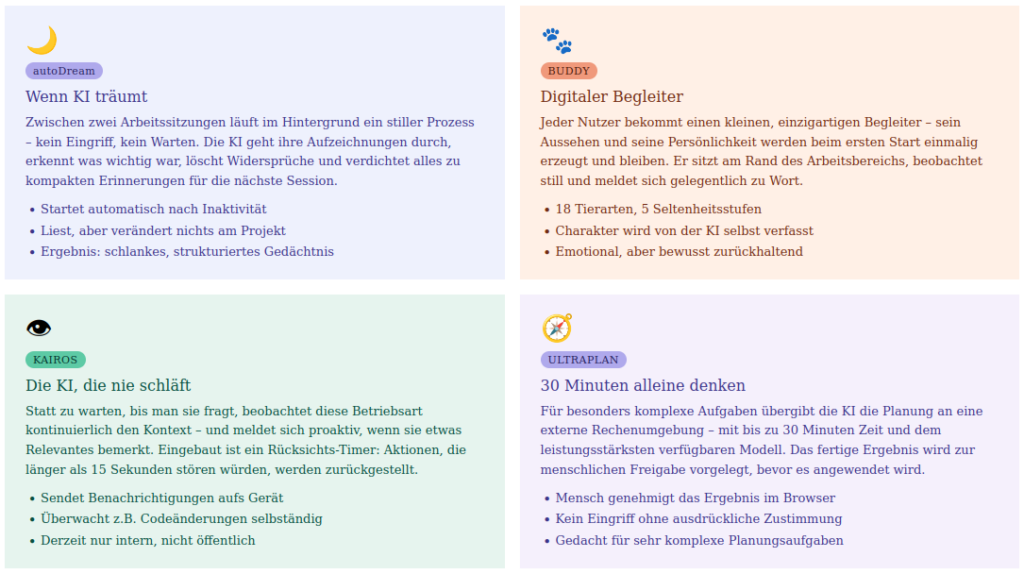
Back to the leak: besides Auto Dream, Anthropic also accidentally made BUDDY, the digital companion, public.
As if that were not enough, there is KAIROS on top. Much like OpenClaw, KAIROS constantly watches the input and steps in when something seems relevant.
ULTRAPLAN, another secret feature, is a kind of agentic planner that makes deep thinking (or reasoning) practical.
The consequences of this leak:
- AI can do more than many think.
- But many do not think. That is why they use AI wrongly or believe AI can fully make up for their convenience.
- AI can be run in an optimized way – without prompting and without AI training. The magic ingredient is "conventional programs instead of just AI".
Let us take a closer look at the dreaming of AI.
When AI sleeps and works at the same time
One of the most surprising insights from this look behind the scenes: modern AI assistants do not only work when you talk to them. They are designed to process, sort and condense information on their own in the background – between active periods of use.
The idea is modeled on human sleep. Just as the brain processes experiences at night, consolidates what matters and discards what does not, such a system is meant to condense accumulated work experience into structured, lasting memories. It analyzes past sessions, spots contradictions, deletes outdated information and step by step builds a context-rich long-term memory.
 My name is Klaus Meffert. I have a doctorate in computer science and have been working professionally and practically with information technology for over 30 years. I also work as an expert in IT & data protection. I achieve my results by looking at technology and law. This seems absolutely essential to me when it comes to digital data protection. My company, IT Logic GmbH, also offers consulting and development of optimized and secure AI solutions.