

On 21 October 2026, the Council of the EU adopted its negotiating position on the Data Omnibus, the Digital Omnibus GDPR reform. It provides for more exemptions for cookies, AI training based on legitimate interest and restrictions on the right of access. None of this is applicable law: cookie banners and access request processes remain unchanged for now.
Since the member states reached their agreement, reports have been circulating that make it sound as if the end of the cookie banner had been decided. That is not the case. A Council decision is a negotiating position, not a law. Several steps still lie between the Commission's proposal, the Council's position and a later legal text. This applies to the Digital Omnibus GDPR changes as a whole.
According to press reports, the Council has kept the definition of personal data and added rules on pseudonymisation. It wants to extend the exemptions from the consent requirement for cookies, allow AI training to rely on legitimate interest and restrict the right of access for abusive or excessive requests. On these points it differs from the Commission draft and from current law: the definition of personal data, cookies and audience measurement, AI training and the right of access. The table below sets the three levels side by side.
The sources are the reports by netzpolitik.org and IAPP, the Council press release and Council document 14756/26 of 22 October 2026. The information reflects the state of reporting and is not legal advice. The change markings in the Council document are not always clearly legible in the text version, so statements about them are subject to reservation.
Digital Omnibus GDPR: where the procedure stands
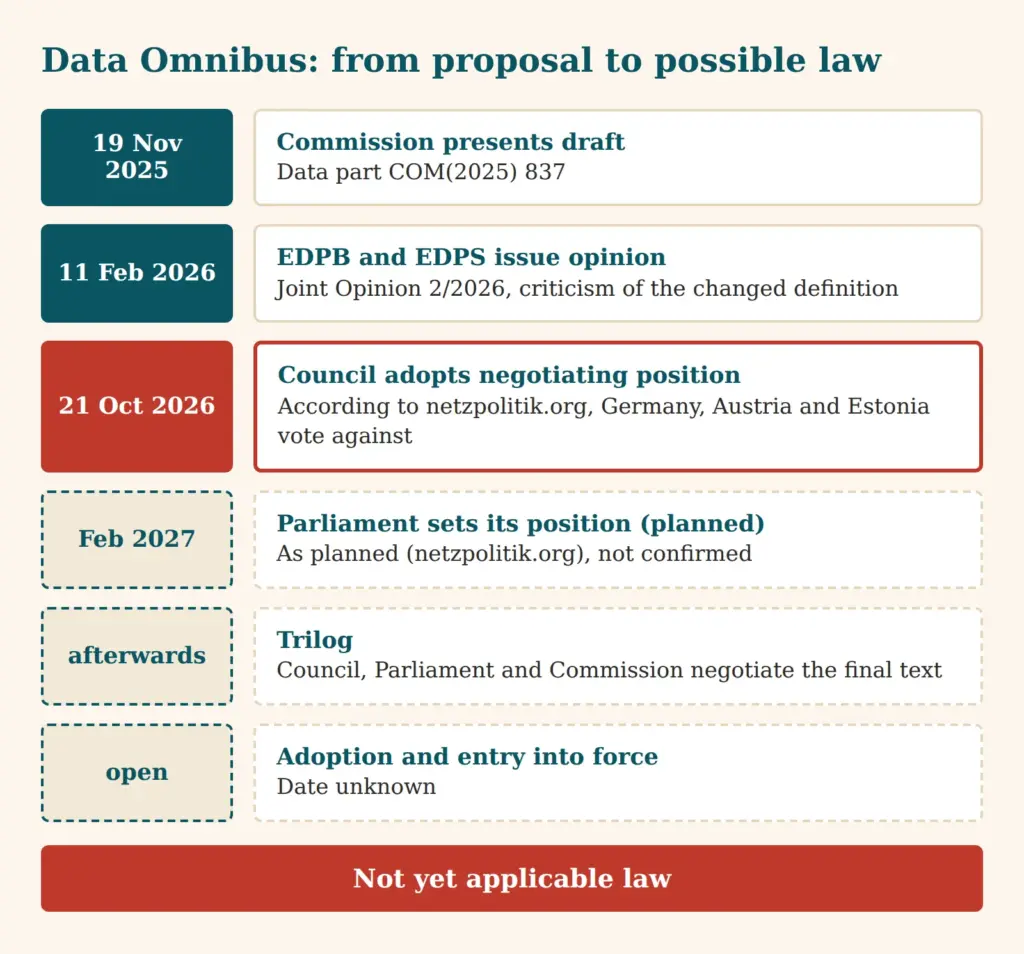
"Data Omnibus" here means the part of the Digital Omnibus package that is meant to amend the GDPR, the ePrivacy rules for cookies and terminal equipment, and parts of data law. In the press, the package and its parts are called Digital Omnibus or Digital Rulebook, depending on the outlet. They refer to the same project. The Commission presented the data part on 19 November 2025 as COM(2025) 837. The part on the AI Act is proceeding separately as COM(2025) 836.
Quite a lot has happened since then. On 11 February 2026, the European Data Protection Board and the European Data Protection Supervisor issued their Joint Opinion 2/2026 and, according to IAPP, spoke out against the originally proposed change to the definition of personal data. On 21 October 2026, the Irish Council Presidency announced the agreement of the member states. According to netzpolitik.org, citing government circles, Germany, Austria and Estonia voted against.
Next, the European Parliament needs its own position. According to netzpolitik.org, this is to happen in February, apparently meaning February 2027. That is a plan, not a firm commitment. Only after that does the trilogue begin, in which the Council, Parliament and Commission negotiate a joint text. When a law will be adopted and from when it will apply remains open.
It helps to distinguish three stages. The Commission's proposal is the starting point. The Council's negotiating position is the member states' stance for the trilogue. Only a law that has been adopted and published binds companies. At present the procedure is at the second stage, and the third is not in sight.
A Council position is not yet law.
For running a website, this means: the GDPR, the ePrivacy Directive and, in Germany, the TDDDG continue to apply unchanged. Anyone who now switches off banners or adapts processes to a draft is acting on a basis that does not exist.
Does the EU states' agreement on the Data Omnibus already require changes to cookie banners or access request processes?
The five most important changes in the Council position
The reporting names five points that matter in practice for companies. The table compares them with current law and the Commission draft.
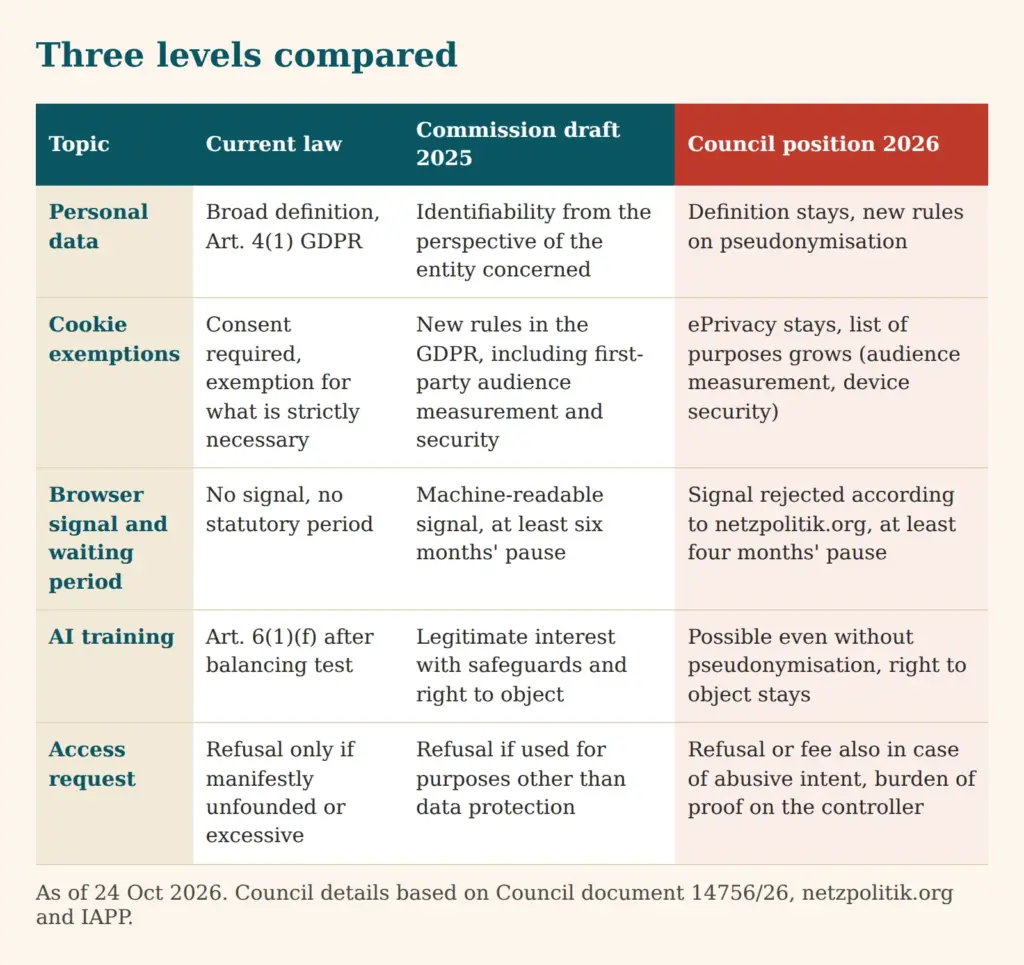
First, the definition of personal data stays, and rules on pseudonymisation are added. Second, the list of purposes for which terminal equipment may be accessed without consent grows. Third, according to netzpolitik.org, the Council rejects a central signal in the browser. After a refused consent request, it should not be permitted to ask again for at least four months. Fourth, AI training is to be allowed to rely on legitimate interest. Fifth, access requests are to be easier to refuse as excessive. Netzpolitik.org summarises this as the right of access lapsing for unfounded or excessive requests.
In addition, according to netzpolitik.org, the position provides for targeted exemptions for scientific research. Under the Data Act, trade secrets are to be better protected, and for the reporting of cybersecurity incidents the Council, according to IAPP, rejects a single EU reporting portal. These points do not directly affect most website operators and are not discussed in depth here.
 My name is Klaus Meffert. I have a doctorate in computer science and have been working professionally and practically with information technology for over 30 years. I also work as an expert in IT & data protection. I achieve my results by looking at technology and law. This seems absolutely essential to me when it comes to digital data protection. My company, IT Logic GmbH, also offers consulting and development of optimized and secure AI solutions.