

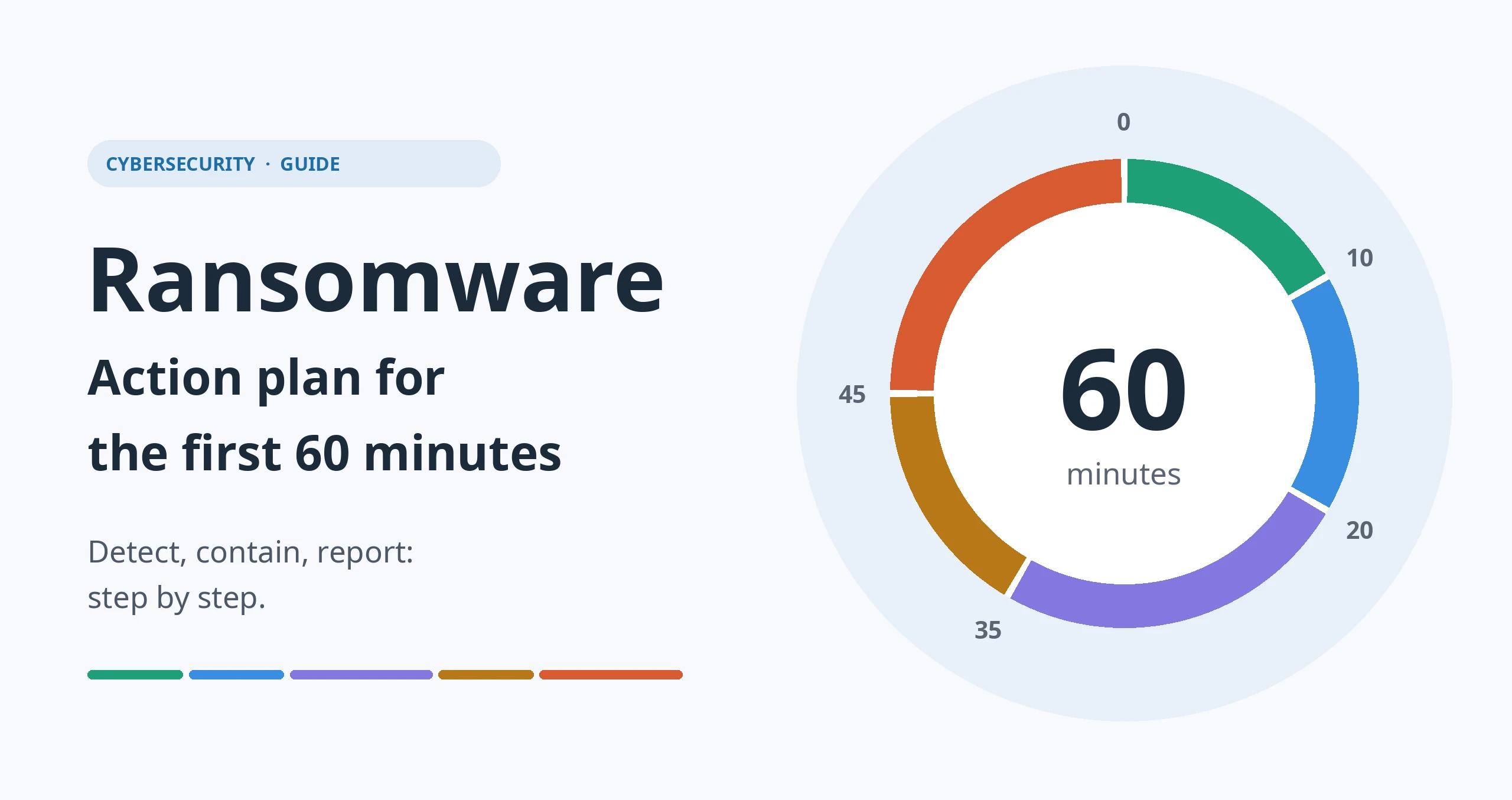
A hacker attack with extortion demands structured, well-thought-out and, above all, fast action. A guide to emergency measures that helps avoid mistakes and sets the course for a successful recovery in the first hour.
Key points at a glance
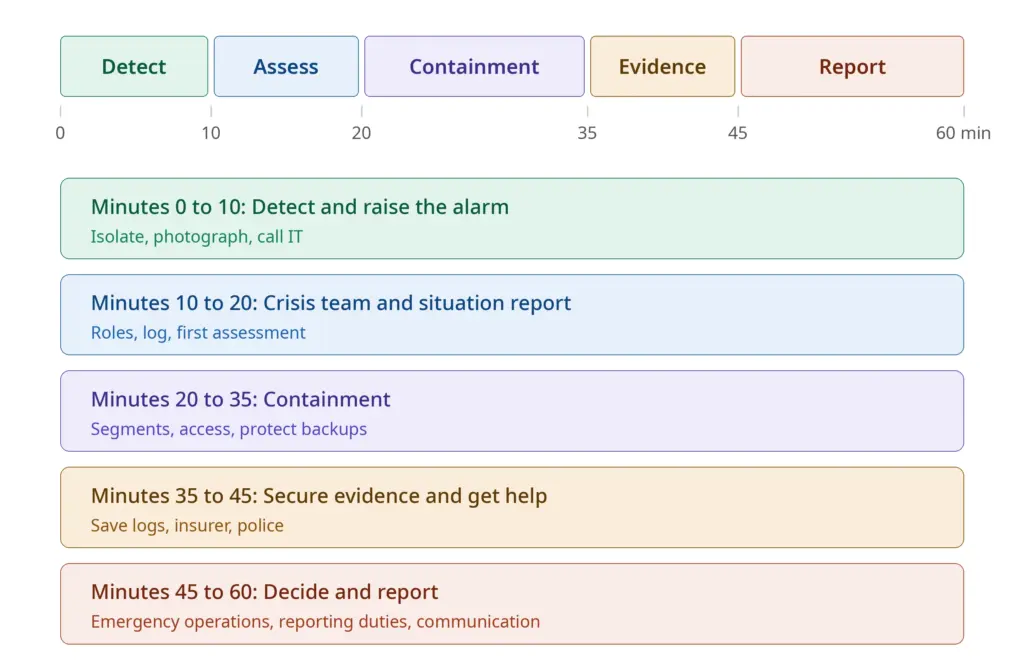
In a ransomware attack every minute counts, but speed alone is not enough. What matters is that the right steps happen in the right order: detect, contain, secure evidence, involve those responsible and only then recover. Those who act calmly and in a structured way during the first hour limit the damage considerably, protect important traces for the root cause analysis and can more easily meet later reporting and documentation obligations.
This article describes the first 60 minutes step by step. It can serve as a guide for an emergency. A checklist supports a structured approach.
What is ransomware?
Ransomware is malware that encrypts data and systems or blocks access to them. Websites can also be affected. The attackers then demand a ransom, usually in cryptocurrency, and promise a decryption key in return.
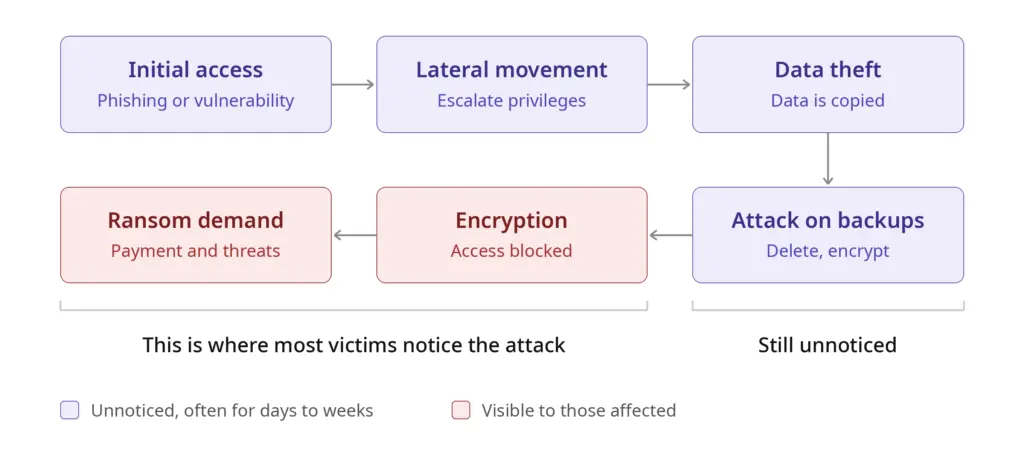
Modern attacks often go far beyond pure encryption:
- Double extortion: Data is copied before encryption. The perpetrators additionally threaten to publish or sell this data.
- Attacks on backups: Perpetrators specifically search for backups and delete or encrypt them so that recovery without payment becomes impossible.
- Long lead time: The attackers are often active in the network for days or weeks before the encryption becomes visible. They explore systems, extend their privileges and prepare for the moment of greatest damage.
This leads to an important insight: once the ransom demand becomes visible, the attack is usually already well advanced. Cleaning up a single computer is therefore not enough. It must be assumed that the entire network may be compromised.
The ground rules for an emergency
Before the actual schedule, four principles apply that hold across all phases:
- Stay calm, but act quickly. Hectic individual actions often cause more damage than the attack itself.
- Contain before cleaning up. First the spread must be stopped, then the clean-up follows.
- Preserve traces. Without evidence it is impossible to determine how the perpetrators got in. Then there is a risk that they will strike again immediately after the recovery.
- Document everything. Every measure goes into the log with the time and the person responsible. This supports the team, authorities, insurers and the later review.
Preparation: what should be ready before an attack
The best action plan loses its value if it is unclear in an emergency whom to contact. The following points should be clarified in advance, ideally printed out and available offline:
- Emergency contacts: Phone numbers of IT management, executive management, the data protection officer, the IT service provider, the incident response provider, the cyber insurer, legal counsel and the police.
- Emergency credentials: A secured location independent of the production network where important accounts and instructions are stored.
- Network diagram: An up-to-date overview of sites, segments, servers, firewalls and remote access points.
- System list with priorities: A definition of which systems are business-critical and in which order they should be brought back online.
- Alternative communication channels: If email and the phone system are affected, a fallback is needed, for example private mobile phones with a messenger group agreed in advance.
- Backup concept: At least one backup should be stored offline or immutable. It is crucial that recovery is tested regularly.
Roles in a crisis
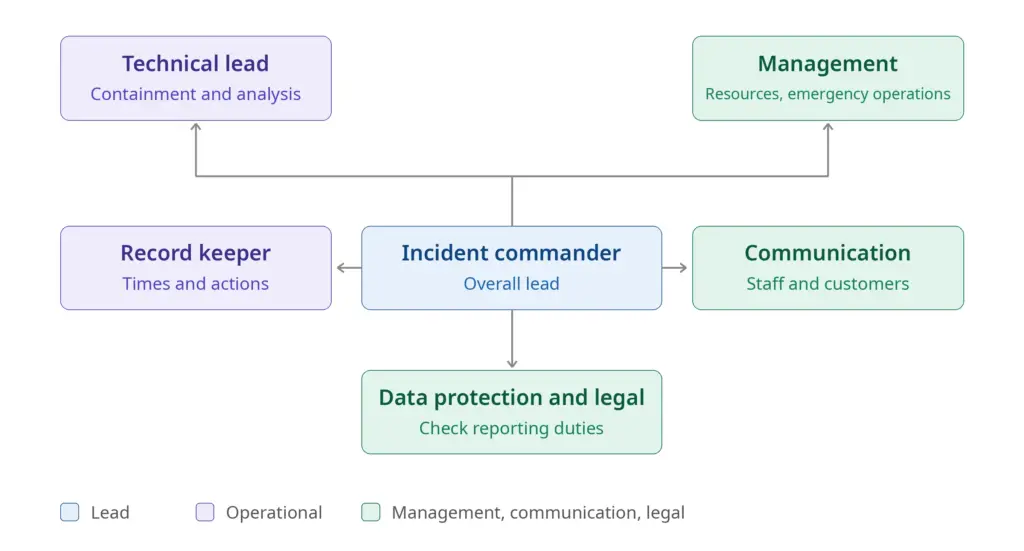
Even in small organisations it must be clear who makes which decisions. One person can take on several roles, but the roles themselves must be filled.
| Role | Task |
|---|---|
| Incident commander | Keeps the overview, makes decisions, assigns tasks |
| Technical lead | Coordinates containment, analysis and recovery |
| Record keeper | Documents times, observations and measures |
| Communication | Informs staff, customers, the press and partners |
| Data protection and legal | Checks reporting obligations and legal consequences |
| Executive management | Decides on resources, emergency operations and external help |
 My name is Klaus Meffert. I have a doctorate in computer science and have been working professionally and practically with information technology for over 30 years. I also work as an expert in IT & data protection. I achieve my results by looking at technology and law. This seems absolutely essential to me when it comes to digital data protection. My company, IT Logic GmbH, also offers consulting and development of optimized and secure AI solutions.