

Google CEO Sundar Pichai says the industry is still far from the end state of recursive self-improvement. At the same time, he describes loops in which AI agents already help build new models. As of today, it is possible to sort out what is documented and what it means for AI use in small and medium-sized businesses. Is humanity at risk?
The occasion is an interview on the Big Technology podcast, reported by Big Technology on 23 October 2026. It contains a highly quotable sentence on self-improving AI: the industry is still far from the end state of RSI. RSI stands for recursive self-improvement, a cycle in which AI systems improve their successors, which in turn build better successors.
The basics of how such loops work are covered in the article on recursive self-improvement of AI. Statements from the interview, vendors' self-reports, a research paper and an insider forecast are kept separate below.
What Pichai said and what he did not say
The core is short. According to Alex Kantrowitz's report, Pichai said: “To be very clear. We are pretty far from the end state of RSI.” Kantrowitz sets this sentence against the expectation of some in the AI industry that an intelligence explosion is imminent and that AI will soon improve itself in a complete loop without human involvement.
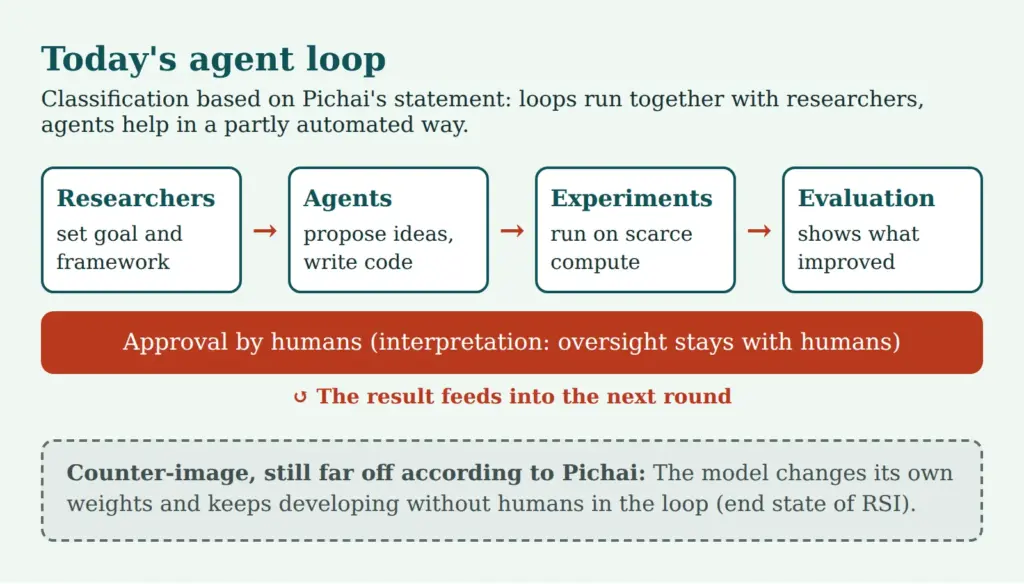
Directly afterwards come two further sentences that matter more for the assessment than the first. According to the report, Pichai said: “You have RSI loops along with AI researchers in various aspects of model development.” And: “You almost have agents helping AI researchers in some automated way work together to build these models.” In essence: in various areas of model development there are feedback loops together with the researchers, and agents help them build the models in a partly automated way.
What is documented verbatim is therefore this: partial loops are already running, and they run together with the researchers. These sentences do not mention a model that rebuilds itself without supervision. The sentence about the end state can be read as referring to exactly that picture. That is one reading, not a quotation.
As a side topic, Big Technology reports on compute. Pichai says everyone is short of it, not only Google: “The compute we have today is a function of decisions I made in 2024.” According to the report, he also says the cloud business repeatedly forgoes short-term revenue because compute is reserved for developing frontier models. This is relevant to self-improvement, because every loop of idea, experiment and evaluation costs compute time. Where compute is scarce, it also slows automated research.
A timeframe is not documented. The Big Technology report contains no statement that Google expects major successes in a few years. Secondary reports such as DigitalToday give “next year” as the point for further progress.
What follows is an interpretation that does not come from Pichai. Anyone who speaks of an end state assumes that a path leads there and that this path has begun. The sentence can therefore also be read as a statement in favor of RSI: the development is happening, Google is pushing it with great effort, and major successes are conceivable in a few years. This expectation is our own assessment. No such statement by Pichai appears in the sources read.
One possible reading: anyone who speaks of the end state assumes that the path there has begun. The sentence would then be less an all-clear than a statement of position.
Self-improving AI: agent loop versus weight change
The term covers two very different things that are often mixed up in everyday use. The first is the agent loop. Here, AI agents take part in development: they propose experiments, write and change code, start training runs, evaluate results and report back. Humans set goals, check results and decide on changes. The cycle improves processes, tools and workflows.
The second is the weight change. Here, a model would change its own weights so that its successor is better, without a human approving results in between. This is the picture that carries the term intelligence explosion. And this, on one reading of Pichai, is exactly what the industry is still far from.
Between the two poles there is no switch but a spectrum. The number of steps agents complete without asking can grow. With it grows the share of development that humans check only by sampling. A second report attributes a “continuous spectrum” to Pichai, but the wording cannot be verified there and is therefore mentioned only with reservations. How agents act in operation and why that calls for control is described in the article on the age of AI agents.
The central question deserves a sober answer. It can be derived from the documented sentences.
Is Google already practicing recursive self-improvement when AI helps build successor models?
For SMEs, the difference is not academic. An agent loop speeds up model cycles without loss of control being the issue. An unsupervised weight change would raise the question of whether humans can still follow changes. The two questions need different answers, and only the first arises in practice today.
What Google and others report about their own progress
Vendors' statements about their own progress are self-reports. They may be accurate, but they have not been independently verified. That applies to everything in this section.
A current example is Flint. In its announcement, the company Recursive presents the model as a fast coding model for local hardware, with 40 billion parameters in total and 2.5 billion active per token. By its own account, a small team of humans and agents built it in under four months. The automated research system, the “Eureka Machine”, is said to have co-developed nearly every part of the model-building chain, from data and training recipes to inference. The benchmarks come from the vendor and have not been independently verified. Recursive itself warns that Flint may need more guidance than large closed models.
This is interesting for SMEs for two reasons. First, the case shows that automated research is already producing products, even in small teams. Second, the model runs locally. Anyone who does not want to send sensitive data to cloud providers gains one more option, without the vendor's claims thereby being proven. How local models fit into a company is shown in the overview of local AI in the enterprise.
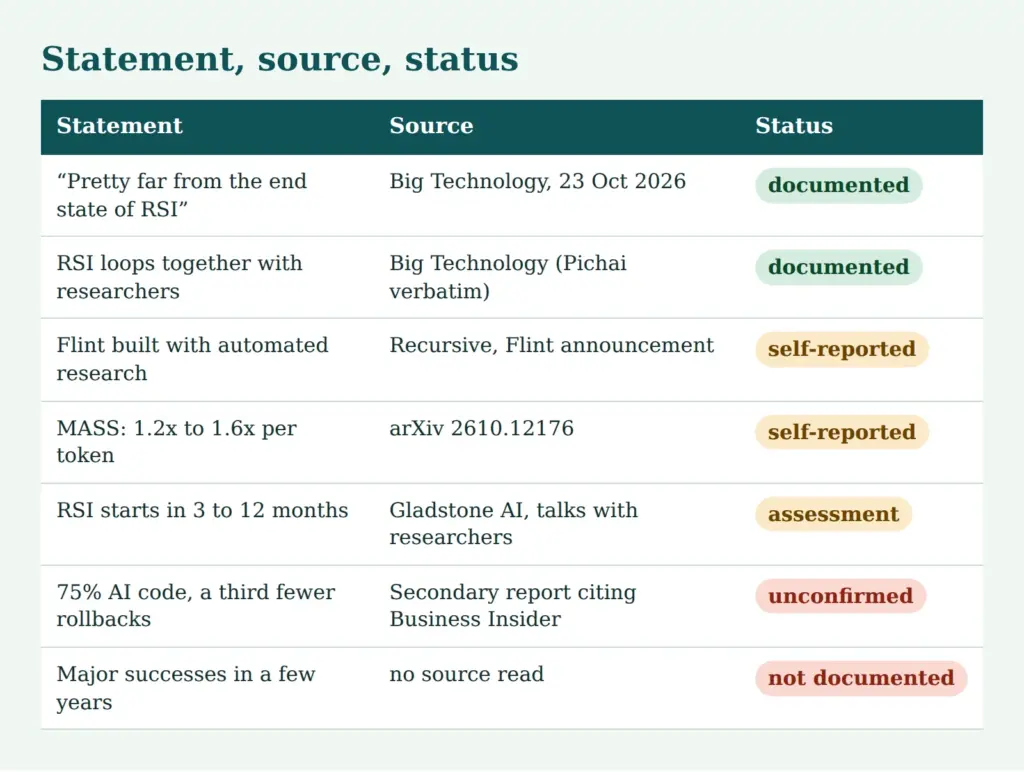
The overview shows how the statements in this article should be rated. Pichai's two sentences are documented in the wording of the report. Vendor and research figures are self-reported. Gladstone is an assessment from conversations with researchers, not a measurement. The code figure remains unconfirmed, and the alleged timeframe “in a few years” is not documented as a statement by Pichai.
What research shows and where it ends
A research paper makes tangible what such a loop can look like. Under the title “Recursive Self-Improvement through Multi-Agent Self-Supervision” (arXiv 2610.12176, submitted on 8 October 2026, authors including Matei Zaharia), the method MASS is described. A single base model, Qwen3.6-27B in the paper, proposes multi-agent workflows, executes them and evaluates them itself. It is then retrained on its own runs, and the procedure repeats.
After two cycles, the abstract reports 1.2 to 1.6 times the performance per output token on four open benchmarks. It also says a model trained on the runs of multiple agents performs better than one trained on the runs of a single agent with 40 percent more training data. These are the authors' claims; the work is a preprint and has not been peer-reviewed.
The limits can be seen in the material itself. This is one model and two cycles. The improvement signal comes from self-evaluation. On the two coding benchmarks Terminal-Bench 2.0 and SWE-bench Verified, a figure in the paper shows values of 0.96 and 0.94, slightly below the baseline per token. On these two tests, then, the figure shows no gain per token.
The authors' starting point fits the topic of oversight. They write that a single model struggles to critique and improve its own complex reasoning when it works in a homogeneous loop. They therefore rely on multiple instances with different roles. If the same model generates and evaluates, shared errors can go undetected. That is an inference from the approach; the paper's wording is aimed at the method, not at companies.
What follows from this: research shows that the idea can work and that checking is the bottleneck. It does not show that models reliably improve themselves without humans in everyday use. This fits Pichai's sentence and does not contradict it.
How fast it could go: Gladstone and the limits of forecasting
A different kind of source is the Gladstone AI report titled What recursive self-improvement looks like inside an AI lab, published on 14 October 2026. The authors write that they spoke with researchers at Anthropic, OpenAI and Google DeepMind. Most of them expected recursive self-improvement to begin in the next three to twelve months, possibly sooner, assuming the US government does not intervene or slow things down.
This is a forecast by insiders, not a measurement. The sample is small; accounts in secondary reports speak of about six people, a number not stated in the report itself. Those interviewed have a personal stake in the field's momentum, and the authors are an organization focused on security policy. The report also contains drastic scenarios that derive from assessments rather than data.
One idea from the report is more useful in practice than the month figure. Automated research may be technically possible without being economical. Good ideas are not the bottleneck; compute time to test them is. This matches Pichai's reference to scarce compute.
The statements do not rule each other out. “Beginning” and “end state” are different points on the same path. Pichai says the path is long and at the same time describes loops running with researchers. Gladstone expects part of this to become more autonomous soon. Reading both gives a picture in which recursive self-improvement increases step by step. Basing plans on month figures alone is risky, because they come from a small circle of conversations.
Consequences for SMEs: testing model cycles and model changes
For companies, the effect shows up not as an intelligence explosion but in calendars and technology. If agents take load off researchers, new model versions can appear more often. That is an assumption derived from the statements, not an established finding. For operations, however, one thing counts regardless of the cause: models change faster than departments adapt their processes.
This has practical consequences. A model may answer the same prompt differently from its predecessor. Tone, format, error types and cost per task shift. Providers retire older versions, sometimes at short notice. And anyone relying on the alias “latest” gets changes in production without asking.
This results in a simple procedure for changing models. First, a test corpus of real tasks, for example 50 to 200 anonymized cases with a known good answer. Second, a comparison run of the new model against the current version with unchanged prompts. Third, approval by a named person who has seen quality, cost and error patterns. Fourth, a rollback path, meaning a pinned model version and retained configuration, so that switching back takes minutes.
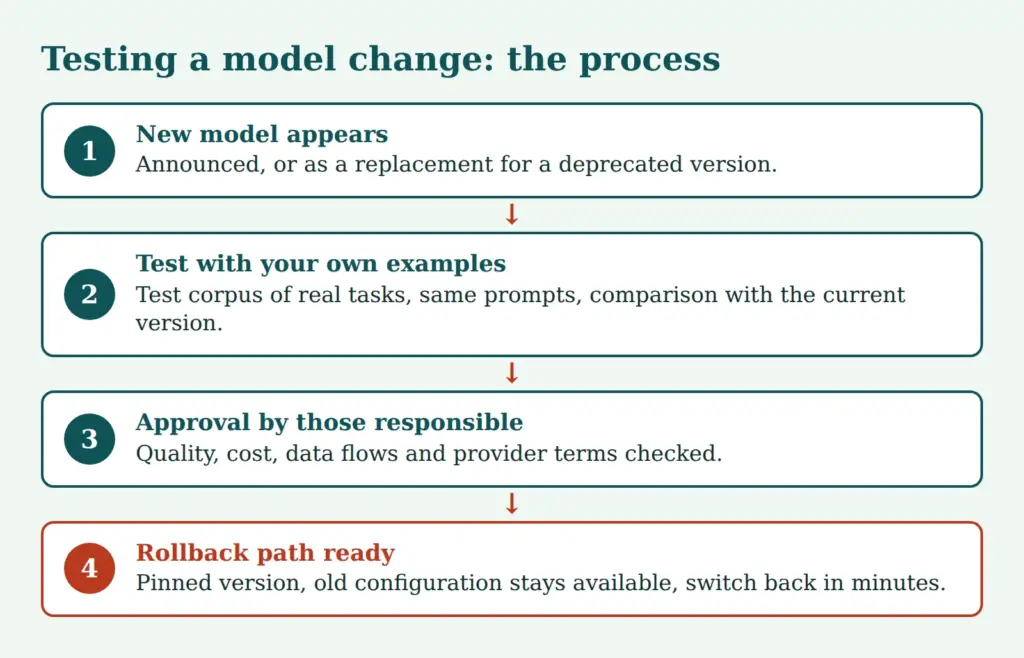
With a change of provider, or a new model from an existing provider, data protection and contracts come into play. Data flows, server location, data processing agreements and the question of whether inputs are used for training need clarifying. Automatic upgrades to the newest model should not be allowed in production. Local models shift the question: they remove dependence on the provider and bring their own maintenance, see the overview of local AI.
Small companies do not need to build their own testing department for this. A table of examples, a script that sends them through both models and a short approval note are enough to start.
Keeping oversight and approvals: what remains the human's job
When in-house developers use agents with write access, the same loop emerges on a small scale as in the labs: the agent changes code, tests run, the agent corrects. Oversight can follow the same pattern. The agent may propose and test, but a named person approves changes to production systems, configurations and data.
This includes logs that make it possible to trace what the agent has done, and permissions as narrow as necessary. Deleting, sending and paying are actions that deserve an additional confirmation. The risks of an agent without control are described in the article The danger behind AI agents.
The question of who checks also matters. If the same model generates and evaluates, the same blind spots remain. That explains why the research paper emphasizes multiple roles and external signals. In operations this means: one AI may check another, but only in addition. The reliable cross-check comes from tests, a different provider or a human.
AI checks AI reliably only if the cross-check is independent: through tests, a different provider or a human.
Responsibility remains with the company deploying the agent. That holds regardless of how much of the development is automated in the background. A claim that AI improves itself does not relieve the operator.
Checklist: what to do now and what not to do
A sober list can be derived from the documented statements and the unconfirmed figures. It is deliberately short so that it can be implemented in companies without their own AI department.
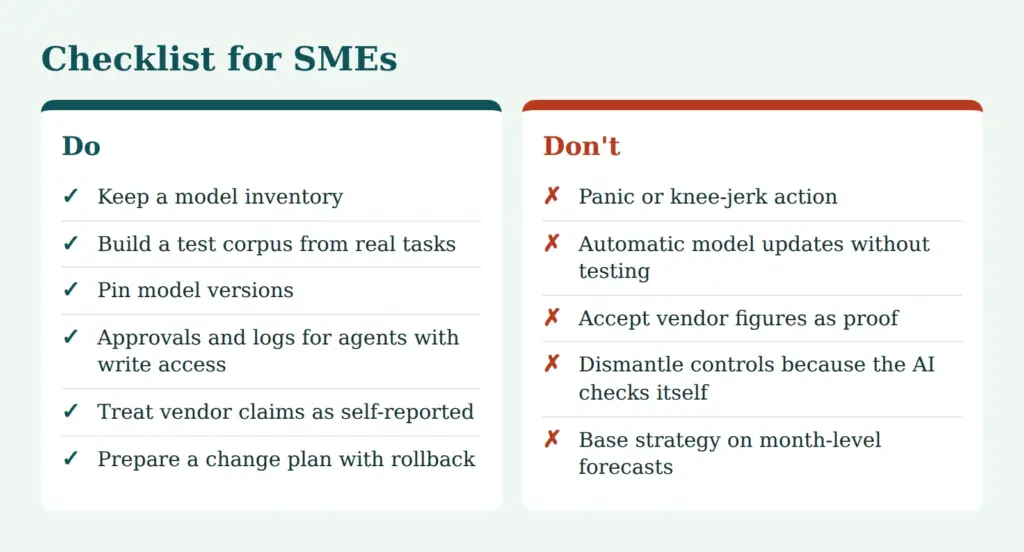
The points in detail. The model inventory records which models run where and in which version, who is responsible and what data flows. The test corpus grows with every error noticed in operation. Versions are pinned and changed only after testing. Approvals and logs apply to agents with write access. Vendor claims, whether on benchmarks or AI shares of code, are treated as self-reports and not as proof.
Panic and knee-jerk action are not advisable, because the documented situation is a partial loop with humans. Nor should controls be dismantled because an AI checks itself. And strategies based on month figures from forecasts stand on thin ground. Anyone who also wants to check the technical side, such as permissions and the attack surface of systems, will find a starting point in the security checks at wwwschutz.de.
Conclusion
In summary, the statements and the current state of affairs, which can change daily, can be sorted as follows.
Pichai documents that feedback loops with researchers exist and that the end state without humans is still far off. This is not an all-clear. One possible reading is that the path is already under way and major progress is possible in a few years.
For SMEs, what counts is shorter model cycles, tests before every change, pinned versions and approvals for agents. Whether the loop becomes significantly more autonomous in three months or in three years, no one can reliably say today. Those who have mastered tests, approvals and rollback are prepared for both cases.
 My name is Klaus Meffert. I have a doctorate in computer science and have been working professionally and practically with information technology for over 30 years. I also work as an expert in IT & data protection. I achieve my results by looking at technology and law. This seems absolutely essential to me when it comes to digital data protection. My company, IT Logic GmbH, also offers consulting and development of optimized and secure AI solutions.