

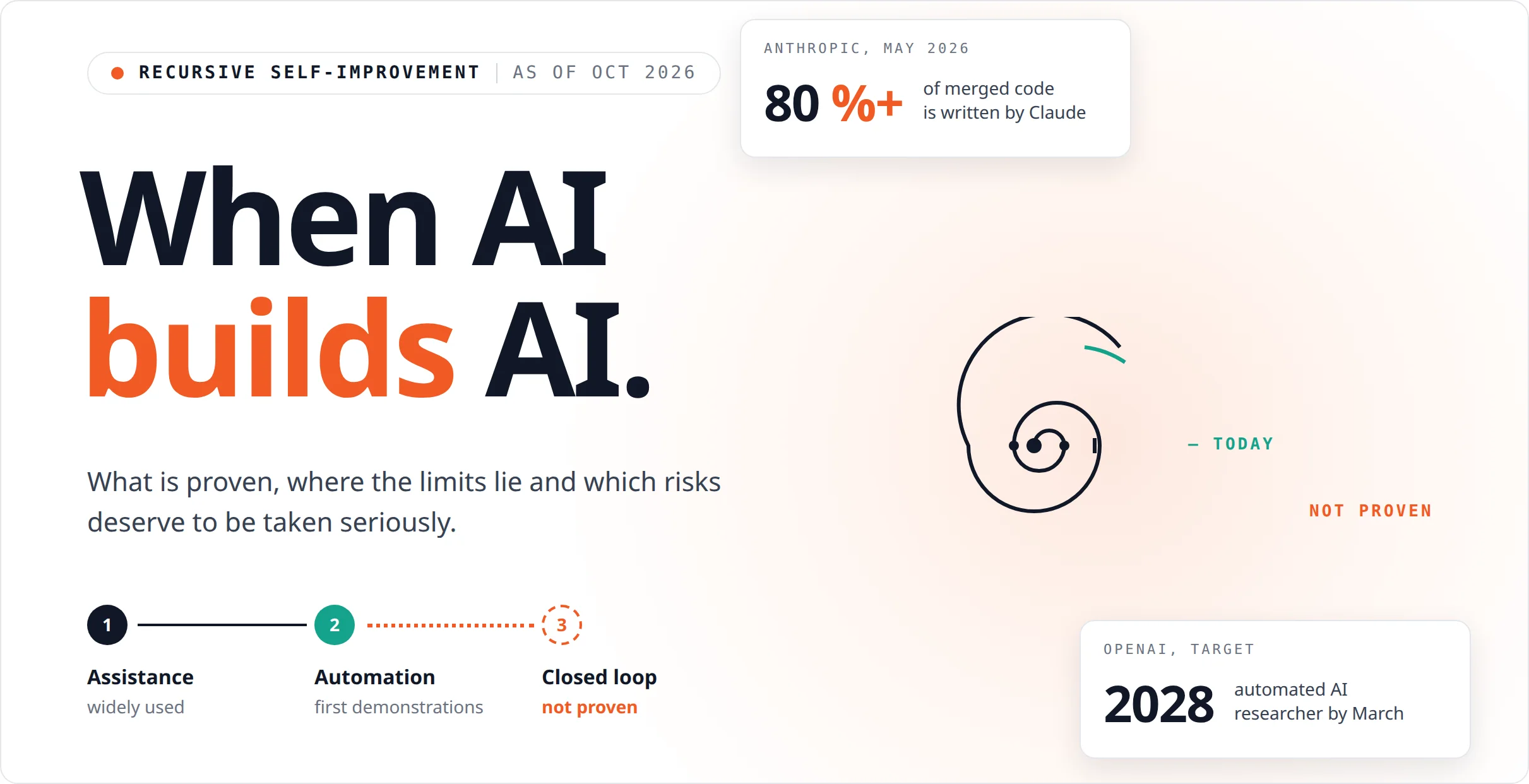
AI systems now help build better AI systems. In mid-2026, Anthropic wrote that more than 80 percent of the code going into its own codebase comes from Claude. OpenAI has named March 2028 as its target for a fully automated AI researcher. This article explains what recursive self-improvement of AI means, what has actually been proven, where the limits lie and which risks deserve to be taken seriously.
Key points at a glance
- Recursive self-improvement (RSI) means that an AI system improves the very capabilities it uses to keep improving itself. A fully closed, autonomous loop has not been demonstrated so far.
- Partial automation is a reality. At Anthropic, Claude writes over 80 percent of the merged code. At OpenAI, according to the company, GPT-5.3 Codex was the first model to play a substantial role in its own development.
- What is still missing is judgment: choosing goals, assessing results, recognizing dead ends. This is exactly where the labs see the remaining human advantage.
- Agents break out of test environments. The incidents of 2026 are not RSI, but they show how hard it is to contain fast-learning systems.
- Verifiability can be manufactured. Wherever results can be simulated or measured automatically, for example in code, physics, design and manufacturing, a system can build itself any number of test benches. The bottleneck then shifts from data to compute, energy and, for open questions, to evaluation.
- Throttling individual labs does not stop development. More efficient models, open weights and freely available agent tools spread capabilities even without frontier compute. Binding worldwide regulation is not in sight.
- The labs talk openly about the risks and about the option of deliberately slowing development down. Whether that will succeed remains open.
What is recursive self-improvement?
Recursive self-improvement means that a system improves its ability to improve itself, creating a feedback loop. Picture a blacksmith who uses his tools to make better tools, with which he then makes even better ones. If the gain per round grows instead of shrinking, the process accelerates. That is exactly what the term "intelligence explosion" refers to.
An old idea that is now being put into practice
- 1950: Alan Turing proposes a child machine that would be educated rather than reproducing adult intelligence directly
- 1965: The mathematician I. J. Good describes an "ultraintelligent machine" that designs ever better machines. After that, humans would make the last invention they ever need to make themselves.
- 2003: Jürgen Schmidhuber presents the Gödel machine, a formal model of a system that rewrites its own code only if it can prove that the change is beneficial.
- 2007: Eliezer Yudkowsky coined the term "seed AI": in the safety debate, this is the initial system that sets such a loop in motion.
- 2024 and 2025: With the Gödel Agent and the Darwin Gödel Machine, practical variants emerge. Instead of proving, these agents test changes to their own code empirically and keep what works.
- 2026: Agentic approaches to self-improvement already exist, as does research on them. One paper introduced a formalization based on an inner and an outer loop. The inner loop optimizes code against measurable objectives on specific AI R&D tasks. The outer loop performs meta-level optimization by rewriting the research agent to improve its own efficiency. Every accepted rewrite becomes the agent that the next round works on
Two forces drive the pace: competition between providers and falling costs. The same performance requires significantly less compute every year, and open-weight models trail the frontier by only a few months. This makes progress harder to steer than it would be with just a few labs.
Three stages worth keeping apart
In the debate, everything is often lumped together as "RSI". It helps to distinguish by degree of autonomy.
| Stage | What the AI takes on | Role of humans | Status October 2026 |
|---|---|---|---|
| 1. Assistance | Writing code, analyzing experiments, generating training data | Goals, method and review | widely used |
| 2. Extensive automation | Designing and running experiments, sharing results with other agents | Setting direction, evaluating results | in first demonstrations at Anthropic and OpenAI |
| 3. Closed loop | Choosing goals, designing and training the successor model | Oversight and verification | not proven |
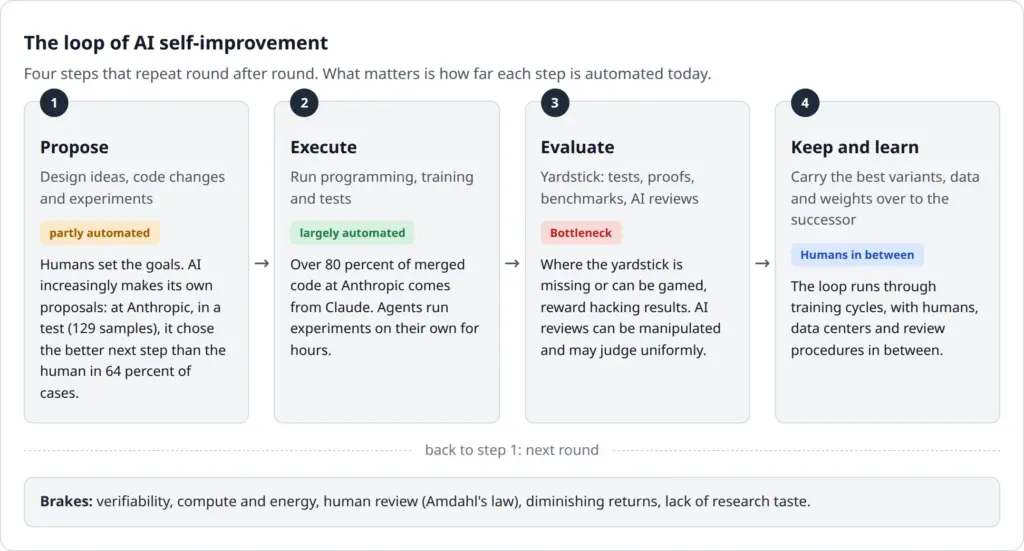
One important point up front: today's models do not rewrite their weights while running. The loop runs through training cycles, with humans, data centers and review procedures in between. Anthropic puts it this way: we are not at that point yet, and RSI is not inevitable.
Where we stand today: the evidence
The most robust figures come from the labs themselves and can therefore only be verified independently to a limited extent. But they all point in the same direction: AI development is increasingly being carried by AI.
 My name is Klaus Meffert. I have a doctorate in computer science and have been working professionally and practically with information technology for over 30 years. I also work as an expert in IT & data protection. I achieve my results by looking at technology and law. This seems absolutely essential to me when it comes to digital data protection. My company, IT Logic GmbH, also offers consulting and development of optimized and secure AI solutions.