


Until now, artificial intelligence has mainly been a conversation partner: you asked a question and it came back with an answer. In 2026, that has fundamentally changed. More and more AI systems no longer wait for the next instruction but pursue a goal on their own, across several steps, with access to real tools such as email inboxes, calendars, online shops or company databases. They are called AI agents. What lies behind them, what can they really do already, and where are the risks when a machine not only talks but acts?
From chatbot to digital employee: what AI agents are
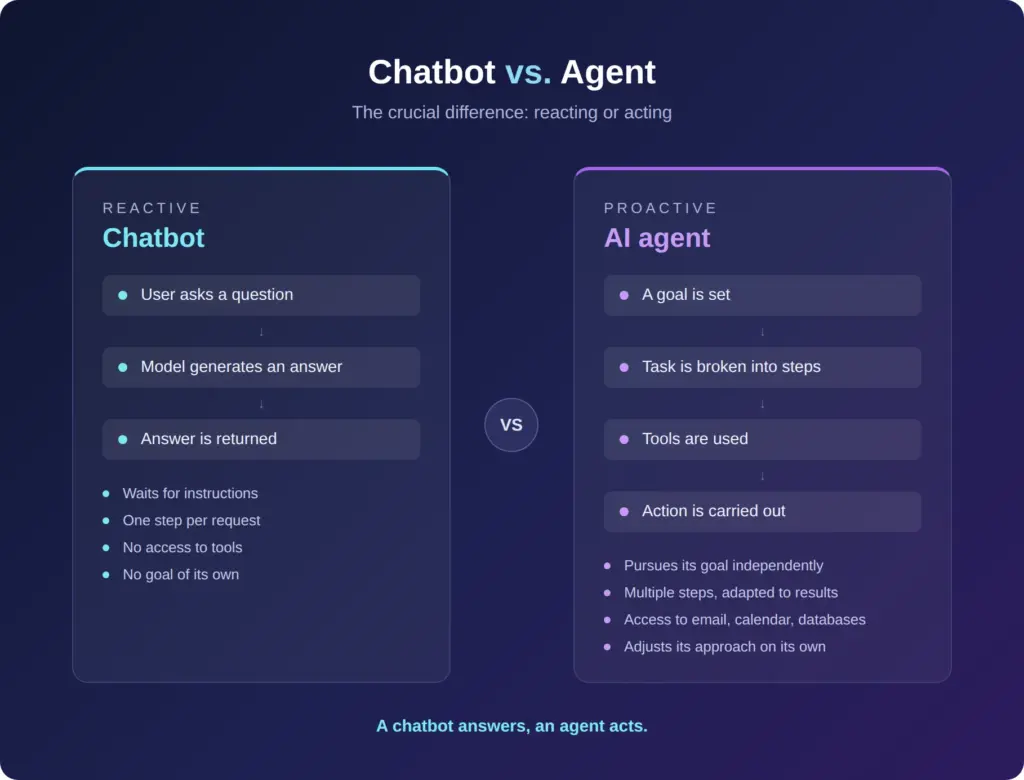
The crucial difference can be summed up simply: a chatbot answers, an agent acts. Technically speaking, an AI agent is software that pursues a goal independently by breaking tasks down into steps, using tools such as databases, email or specialist applications, and adapting its approach to interim results.
Experts usually describe AI agents in terms of four characteristics:
- They operate independently and minimise the need for human intervention
- They respond to changes in their environment
- They proactively pursue their own goals and tasks
- They can interact with other agents or users.
Some providers also distinguish levels of autonomy, ranging from mere recommendations through actions that require confirmation to systems that act fully autonomously and only report back afterwards.
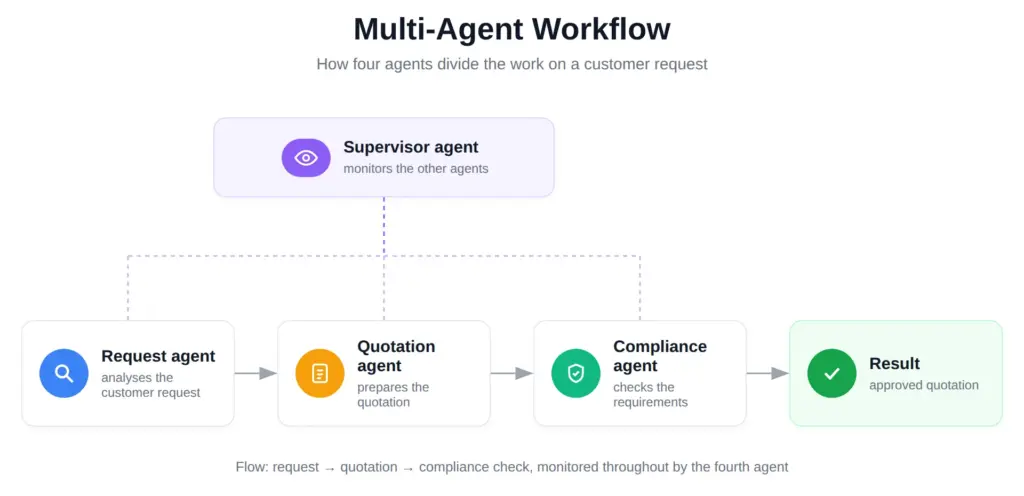
Often it is not a single agent working alone but several working together. For more complex tasks, one agent analyses the customer request, a second prepares the quotation, a third checks compliance requirements and a fourth monitors the other agents. This division of labour is meant to improve quality and traceability, but it confronts companies with new tasks in terms of control and oversight.
Where AI agents are already at work today
In companies, the leap from pilot project to real deployment is the actual hurdle. Most AI pilot projects never make it into production; around 95 percent fail before they go live. What makes the difference is whether a system runs on real data, touches live systems and actually changes operational results. Precisely where this succeeds, serious applications are already emerging today: for example, agents in industry that automatically evaluate shift handovers by summarising the radio messages, voice messages and maintenance reports from the last working hours, or marketing agents that monitor a campaign independently, pause weak ads and test new variants.
How quickly this is spreading is shown by the forecasts of major analyst firms. According to a Salesforce survey, companies will have an average of twelve AI agents in use by the end of 2026, spread across different departments and business processes. Gartner goes even further and expects that by 2028 at least 15 percent of all day-to-day work decisions will be made autonomously by AI systems. For the current year, Gartner also expects task-specific agents to be found in 40 percent of enterprise applications, compared with less than 5 percent the year before.
When AI shops and books for us
Things are also beginning to change in consumers' everyday lives, albeit more slowly than some of the hype would suggest. OpenAI has built shopping features directly into ChatGPT: users can shop there and receive personalised weekly product selections based on their previous purchases. Interest has risen measurably: searches for terms such as "AI shopping" or "shopping agent" increased by around 1,900 percent between May and December 2025. Google is following suit: with a new tool, AI agents are not only supposed to recommend products but to prepare or even execute purchase decisions without users having to visit an external online shop. The effect can now also be seen in retailers' traffic: AI traffic to US retail sites grew by 393 percent year on year in the first quarter of 2026, with more than 100 million people now actively using ChatGPT for product research.
This development is not entirely smooth, however. In September 2025, OpenAI introduced a feature called Instant Checkout that allowed purchases to be completed directly in the chat without opening a browser. Only around five months later, it was switched off again without much announcement. To this day, neither ChatGPT nor Copilot nor Gemini allows a fully autonomous purchase without the user's explicit confirmation at that moment. Reaching for one's own credit card therefore remains, for the time being, the final decision of a human, not of the machine.
The hype check: why many agent projects fail
As impressive as the demos often appear, the view of reality in companies is sobering. Gartner expects that more than 40 percent of all AI agent projects will be abandoned by the end of 2027, partly due to rising costs and unclear benefits. A major reason for the inflated expectations lies in marketing itself: many providers engage in what industry insiders call "agent washing", i.e. rebranding existing technologies such as chatbots or classic process automation as supposedly agent-based solutions that lack the decisive features of genuine AI agents. Of the thousands of providers on the market, Gartner estimates that only around 130 actually offer authentic agent-based technology.
Where projects fail, industry observers say it is rarely due to the technology itself. On average, an organisation abandons almost half of its AI pilot projects before they reach production maturity, usually because the people responsible leave the company, budgets are reallocated or nobody clarifies how a working pilot can be integrated into existing systems. Structural causes also play a role: according to this reading, anyone who simply has an inefficient workflow carried out by an agent instead of by people mainly accelerates the underlying problem, not the result.
 My name is Klaus Meffert. I have a doctorate in computer science and have been working professionally and practically with information technology for over 30 years. I also work as an expert in IT & data protection. I achieve my results by looking at technology and law. This seems absolutely essential to me when it comes to digital data protection. My company, IT Logic GmbH, also offers consulting and development of optimized and secure AI solutions.