

From 20 November 2026, the new Section 37a of the German Federal Data Protection Act (BDSG) applies. It specifies which data may no longer be used in credit scores, including the address, which settles the question of the Schufa score and address, and it gives data subjects a right to information about the most influential criteria. Shortly before, the Federal Court of Justice delivered four judgments on information about scores.
Three developments, one topic: score, address, information
On the question of the Schufa score and address, the short answer according to the available presentation of the law (as of 31 October 2026) is: the address may no longer be used, while the length of residence remains open. Three developments come together in autumn 2026. A new law reorganises scoring, Schufa introduced a new score in March, and the Federal Court of Justice has ruled on rights to information about score values. Each of these is complex in itself; together they create a picture that unsettles many consumers and businesses.
The central question is how address, score and the new law relate to one another. What follows is an assessment in several steps: what the law prohibits, what the new score contains, which rights to information exist, what the Federal Court of Justice actually decided, what a supervisory authority in Hamburg pursued with a fine, and what businesses should check.
What enters into force on 20 November 2026: Section 37a BDSG
The new Section 37a of the Federal Data Protection Act (BDSG) regulates scoring. This refers to a probability value for credit checks (scoring) that is calculated from data about a person and is meant to predict whether they will pay bills or loans. Such values lie behind many decisions: mobile phone contracts, instalment purchases, rented flats, credit cards. The best-known provider is Schufa, but there are other credit agencies, and banks and retailers also calculate with their own models.
The provision is found in Article 3 of an act that transposes the EU Consumer Credit Directive. According to the sources evaluated, the new section replaces the previous Section 31 BDSG. The trigger was judgment C-634/21 of the CJEU of 7 December 2023. The CJEU had ruled that the calculation of a score can itself be an automated decision within the meaning of Art. 22 GDPR if a third party, such as a bank, bases its decision decisively on it. This raised the question of whether the national rule could stand alongside the European requirement. Section 37a is the legislator's answer.
Schufa score and address: what may no longer be included in the calculation
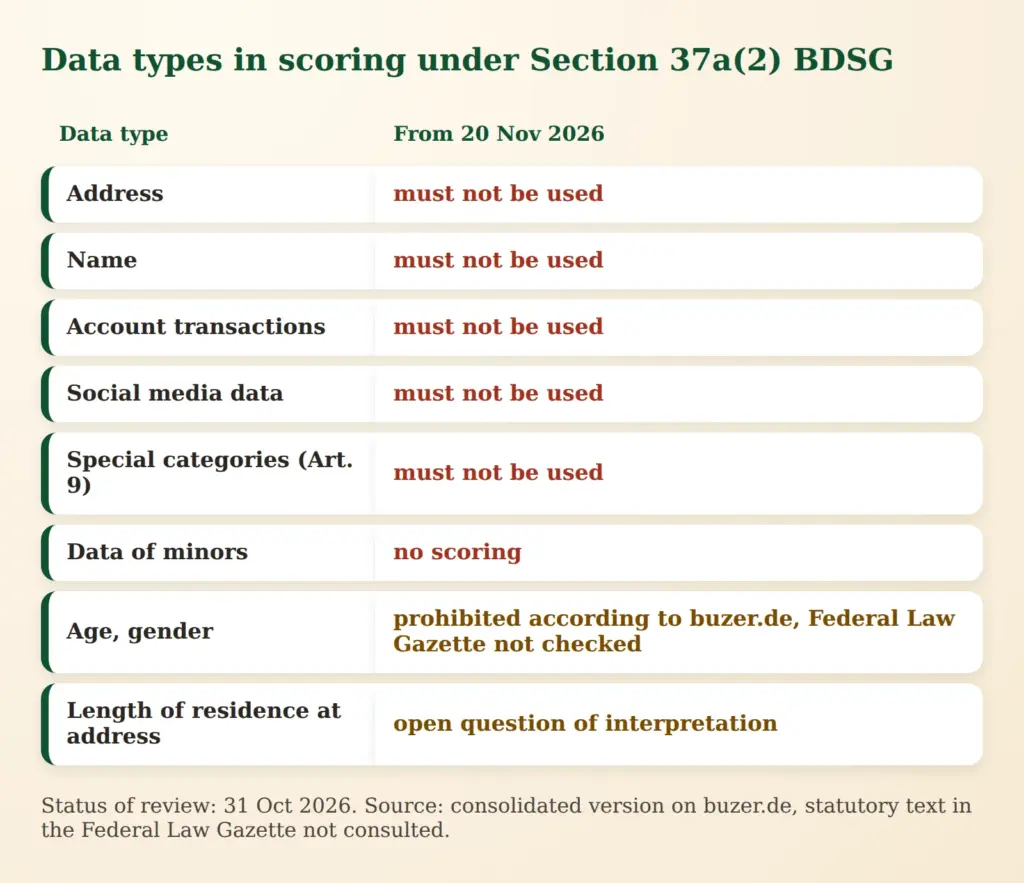
The core is paragraph 2. According to the presentation on buzer.de, a score may only be created or used if certain types of data are not included. These are special categories of personal data under Art. 9 GDPR (such as health or religion), the name, the address, account transactions and data from social networks (account transactions and social media data are only documented via buzer.de and the CMS presentation). In addition, no score may be created for minors. Two conditions are added: the data used must demonstrably be relevant to the prediction, and the values may not be processed further for other purposes.
For the address, the statement is clear: it is regarded as a sensitive data item.
For age and gender, the situation is inconsistent. However, there is much to suggest that these are also sensitive data.
The reasoning behind the address ban is easy to follow. Anyone who lives in a particular neighbourhood is treated like many others in that neighbourhood, even if their own payment history is impeccable. Scoring, however, is supposed to reflect individual behaviour, not the neighbourhood.
The scope is also important. The rule applies not only to credit agencies but also to internal scoring models used by banks and retailers. So it does not affect Schufa alone.
The new Schufa score: 12 criteria
Independently of the law, Schufa introduced the new Schufa Score 2026 on 17 March 2026. According to consistent guidance sources, it replaces the previous base score and the industry scores, rates on a scale from 100 to 999 points and is based on twelve named criteria instead of around 250 characteristics. Payment defaults carry the most weight. At launch, about a quarter of contractual partners used the new score; by the end of 2026, around 50 percent are expected to do so. The old score is to be fully replaced by the end of 2028.
One criterion is controversial: the length of time at the current residential address. It is one of the 12 criteria. Schufa stresses that the place of residence itself plays no role. Consumer advocates criticise the length of residence because moves are not always voluntary, for example due to a change of job, separation or termination by the landlord.
Whether the length of residence falls under the ban on "address data" is currently still open. In favour of this is the fact that the duration can only be derived from the address history. Against it, one can argue that it is not the address as a place that is assessed, but a temporal characteristic of the person.
May the place of residence still be included in the Schufa score from 20 November?
Right to information: key criteria
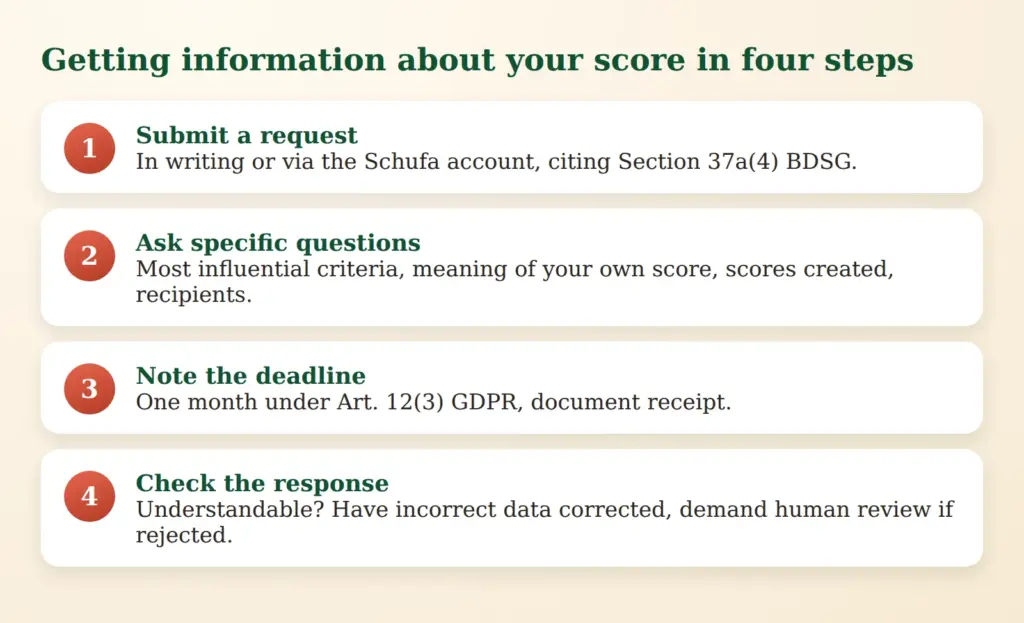
The second major topic is transparency. According to the summary of Section 37a(4), controllers must, on request, disclose which data and criteria were used, which of them had the greatest influence, what the specific value means and which values were created and to whom they were transmitted. The underlying data must be stored for one year so that later review is possible.
The statutory text does not use the term "main criteria". What is meant is information about the most influential criteria or groups of criteria. The algorithm itself does not have to be disclosed. Nor can the controller probably rely across the board on trade secrets when it comes to explaining the criteria.
This information exists alongside the general right of access under Art. 15 GDPR. Under Art. 12 GDPR, a response must in principle be given within one month at the latest, and it must be understandable. The CJEU has also stressed that the logic behind automated decisions must be explained (C-203/22, Dun & Bradstreet Austria).
In practice, the process can be described as follows: the request goes to the credit agency or the company that uses the score. Schufa also offers the Schufa account, where you can view your own score. Anyone who notes a deadline, documents receipt and asks specifically about the criteria with the greatest influence is more likely to get a useful answer than with a general request for information. If the answer is insufficient, you can follow up or involve a data protection supervisory authority.
The address is blocked as a data type. Whether a characteristic such as the length of residence is also blocked must be clarified by legal interpretation.
In other words: nobody knows what will happen.
Rights in automated decisions
Paragraph 5 gives data subjects three options: contest the decision, express their own point of view and request a decision by a natural person. This ties in with Art. 22 GDPR, which is intended to protect people from being left at the mercy of a machine alone.
The basic idea is simple. If a bank rejects a credit card solely because the score is too low and nobody examines the reasons, the algorithm is effectively making the decision. In that case, the data subject should be allowed to explain why the value does not fit in their individual case, for example because of a data error or a one-off event. In 2023, the CJEU confirmed that the score itself can be such a decision if the third party relies on it decisively.
What the Federal Court of Justice decided
Four judgments of the Federal Court of Justice (I ZR 227/25 to 230/25) were published at the end of October 2026. Schufa's appeals on points of law were successful. The Federal Court of Justice set aside the four appeal judgments of the Dresden Higher Regional Court and referred the cases back. The judgments do not concern the reporting of claims to Schufa, but information about score values.

In substance, the cases concern the right of access under Art. 15(1)(h) GDPR. According to the press release, the creation of a score can be an automated decision. Schufa must then provide information about the logic involved if a third party bases its decision on entering into, performing or terminating a contract decisively on the score. The right only exists if all the elements of Art. 22(1) GDPR are met.
For data subjects, the question of proof is decisive. The claimants generally bear the burden of proof, but the Federal Court of Justice sets low requirements. Anyone who shows that a score was transmitted to a company and that an adverse decision followed shortly afterwards can thereby establish a presumption that the score was decisive.
The judgments do not replace Section 37a BDSG. The law applies in addition and regulates data prohibitions and a separate right to information.
Supervision in practice: a fine of 492,000 euros from Hamburg
A case from Hamburg shows how seriously supervisory authorities take automated decisions. According to the interim review by the Hamburg Commissioner for Data Protection, the authority imposed a fine of 492,000 euros on a company in the financial sector. Several customers with good creditworthiness had been rejected automatically when applying for credit cards. When asked, the company did not adequately fulfil its information obligations. The company later improved its practice considerably and cooperated extensively with the authority. This reduced the fine.
This is not a case against Schufa and not a current decision, but an example from 2025. The lesson: anyone who decides automatically must be able to explain how in an understandable way when asked. Without this explanation, the rights of data subjects come to nothing.
What businesses and the self-employed should check now
Credit agencies are not the only ones affected. Retailers offering purchase on account, landlords, telecommunications providers and other companies that use credit scores should clarify which data feed into their decisions. A checklist:
- Record the data used: which characteristics feed into your own models or into purchased scores? Address, name or account data are critical.
- Document the purpose: are scores only used for the purpose for which they were created?
- Ensure you can provide information: an understandable answer must be possible within one month at the latest.
- Regulate retention: the basis of the calculation must be stored for one year.
- Organise human review: who is responsible for objections to automated rejections?
- Ask service providers: for purchased scores, clarify what the provider can deliver.
Where data collection and information obligations on your own website are concerned, for example with credit checks in the ordering process, the GDPR website check provides an initial overview.
What remains open
Several questions have not yet been answered:
- Does the length of residence fall under the prohibited address data?
- Are age and gender expressly prohibited in the statutory text, as buzer.de presents it?
- How will the easing of the burden of proof work in the remitted proceedings?
- How will supervisory authorities respond to industry associations that see a conflict with fraud prevention?
The law does not replace scrutiny in the individual case. Anyone who knows their score and uses the right to information can identify errors and have them corrected. Whether this improves the value is unclear. The decision on whether to enter into a contract still lies with the company.
 My name is Klaus Meffert. I have a doctorate in computer science and have been working professionally and practically with information technology for over 30 years. I also work as an expert in IT & data protection. I achieve my results by looking at technology and law. This seems absolutely essential to me when it comes to digital data protection. My company, IT Logic GmbH, also offers consulting and development of optimized and secure AI solutions.