

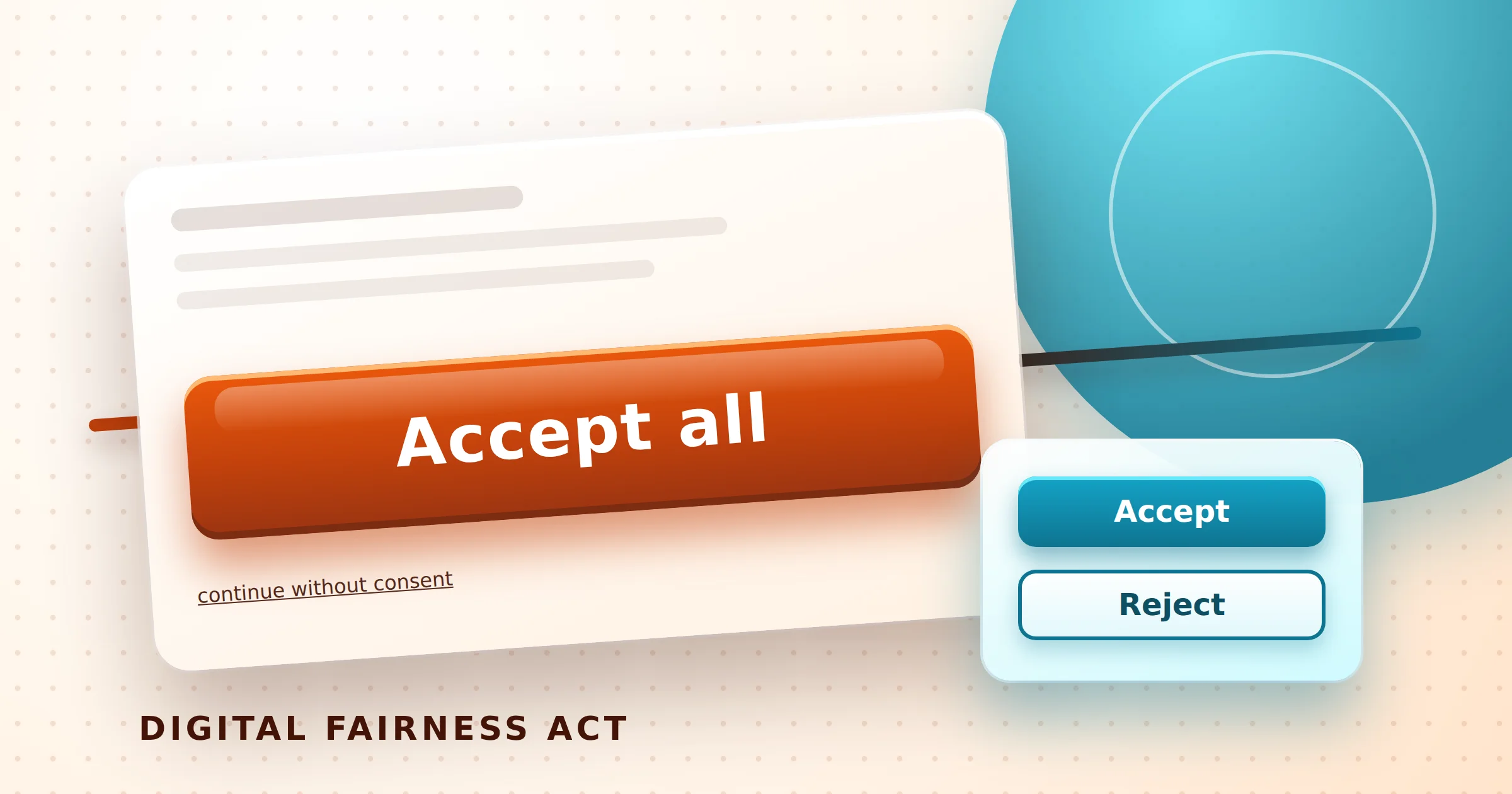
The EU Commission has proposed the Digital Fairness Act. It aims to ban manipulative design online: unfair cookie banners, hidden costs and subscriptions that are almost impossible to end. It is still a draft, but the direction is clear.
A banner pops up, one button lights up, and the way to reject hides behind grey text. In an online shop a countdown ticks away, although the offer is not actually expiring. And anyone who wants to cancel a subscription wanders through menus that seem to have been built for the sole purpose of making sure nobody gets there.
The proposal is meant to regulate exactly this kind of design uniformly across Europe. For operators of websites, shops and subscription services, the question is what would be new, what already applies anyway and what can already be done better today.
What the Digital Fairness Act is
The Digital Fairness Act, DFA for short, is a legislative proposal by the EU Commission for fair conduct in digital consumer protection. The Commission adopted it on 11 November 2026 together with a simplification directive. Both are part of a consumer package that also includes a revision of the rules on cooperation between consumer protection authorities. The Commission calls it the biggest update of EU consumer protection law in more than 20 years.
The DFA is intended as a regulation. That matters, because a regulation applies directly in all member states and does not first have to be transposed into national law. The patchwork that operators know from other areas is meant to shrink as a result. In return, the simplification directive is supposed to clean up existing consumer rules so that even more paperwork does not pile up.
The proposal is not yet law. Parliament and Council have to agree, and experience shows that drafts change in this process, sometimes considerably. According to the draft, the regulation is to apply around twelve months after its entry into force. So it will probably be a few years before a shop has to meet specific obligations under the DFA.
The reason for it is well documented. The Commission reviewed consumer law in the digital environment and presented the results of this fitness check at the end of 2024. It showed that the existing directives on unfair commercial practices, consumer rights and unfair contract terms cover a lot, but are not tailored to interfaces that deliberately steer behaviour. The DFA closes this gap.
The topics of the proposal are wide-ranging. They include dark patterns and addictive design, subscriptions and the conversion of free trials, access to human customer service, unfair personalisation, influencer marketing, dynamic pricing and misleading price information. For operators of websites and shops, the first points are the most relevant.
What is to count as a dark pattern
The term dark patterns refers to interfaces that push people into decisions they would not have made with a clear view. Experts also speak of deceptive design. So far, there is no uniform legal definition of it in the EU. This is exactly what the DFA is meant to change: a common definition and a list of practices that are considered unlawful.
These include typical patterns that everyone has come across in everyday life:
- Confirmshaming: the rejection is worded as a reproach, such as “No, I don’t like saving money”.
- Double negatives: anyone trying to make sense of “do not not unsubscribe” needs patience.
- Pre-selected options: boxes for newsletters, insurance or extra services are already ticked.
- Hidden opt-outs: the rejection exists, but can only be reached through several layers.
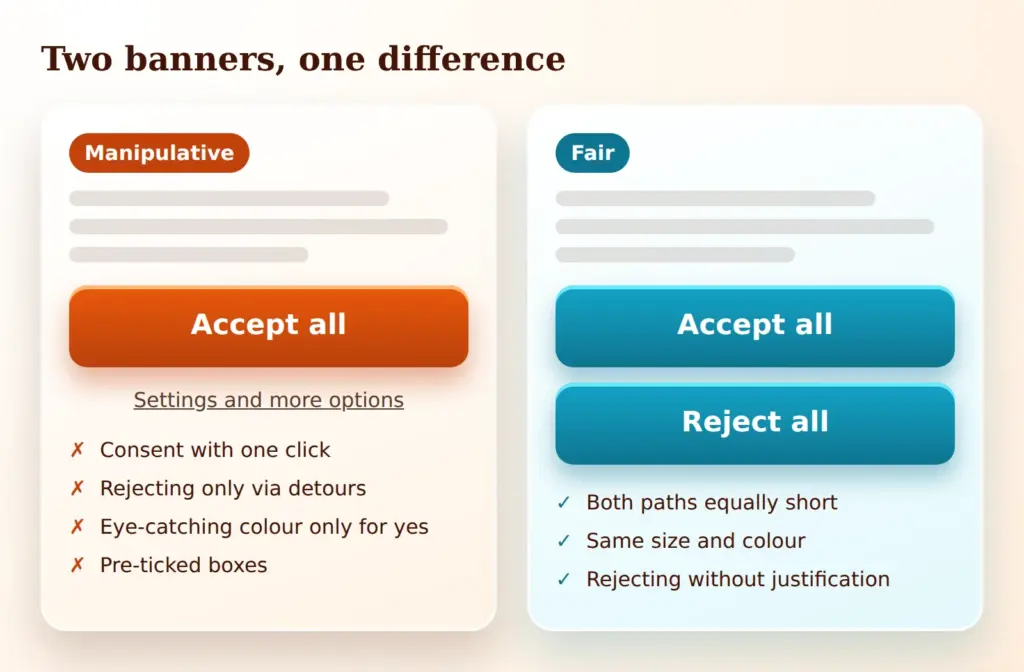
- Asymmetric design: the desired answer is large and colourful, the alternative small and pale.
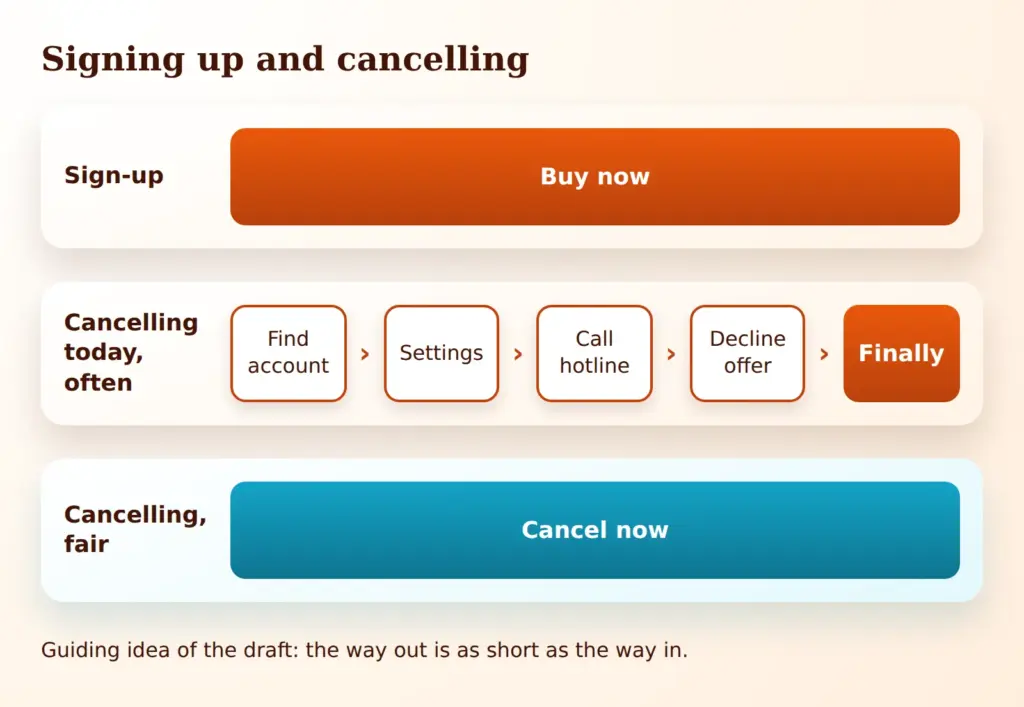
Behind this is a simple principle that can be described as equivalence of paths: rejecting and cancelling must not be more effort than consenting and signing up. This is measured by the number of steps, the visual weight and the colours. If consenting takes one click, rejecting must not take three.
Rejecting and cancelling should not be harder than consenting and signing up.
At its core, this is not a new idea. Data protection authorities already described deceptive design patterns in earlier guidelines, and platform law has prohibited manipulative interfaces for several years. What would be new is that the idea ends up in general consumer law for all traders and is backed by clear examples. For operators, this means more legal certainty, but also less room for grey areas.
Cookie banners remain in focus
Hardly any element on the web stands for dark patterns as much as the cookie banner. The stage typically belongs to “Accept all”: large, colourful, in the middle or at the bottom edge, while the rejection appears as a text link in the corner or only in a second dialogue. Some banners give the rejection such an inconspicuous colour that it looks like part of the background.
Legally, this can already be challenged today. Consent must be freely given, informed, specific and unambiguous. Anyone who obtains consent only because the rejection is hard to find does not have valid consent. For access to end devices, the German Telecommunications Digital Services Data Protection Act also generally requires consent in Section 25 TDDDG. On top of this comes the principle that withdrawing consent must be as easy as giving it, as laid down in Art. 7 GDPR.
So why is yet another law needed? Because practice shows that these rules alone have not been enough. Data protection authorities apply different standards, courts decide case by case, and many banners operate precisely on the line between still permissible and already manipulative. The DFA is meant to create a clear consumer protection basis here that consumer authorities and associations can use as well, not just data protection supervisors.
The overview of cookies and consent covers the most important basics for anyone who wants to go deeper. In practice, a banner can already be checked now: are “Accept” and “Reject” on the same level, the same size and designed the same way? Is there no wording that belittles the rejection? Does the selection work without pre-ticked categories?
Online shops and checkout
The shop is the second big playground for manipulative design. Here it is less about data and more about money. Many of the common tricks are already unfair today and can lead to cease-and-desist letters under unfair competition law, which is based on the EU Unfair Commercial Practices Directive. The DFA builds on this and aims to tighten the framework for digital interfaces.
One area the draft explicitly addresses is misleading pricing. A well-known example is drip pricing: a low price is shown first, and fees are only added during the ordering process, such as a service charge, booking fee or packaging. In the end, the amount is well above the bait price. Anyone who has already completed many steps is reluctant to stop, and that is exactly what the pattern relies on.
The following practices are already considered problematic under current fair trading law if they are untrue:
- False scarcity: “Only 2 left” appears although stock levels are high.
- Artificial time pressure: a countdown runs out and then starts again from the beginning.
- Pre-selected extras: insurance, express shipping or a donation are already in the basket.
- Fake activity: messages such as “12 people are looking at this right now” come from a random generator.
- Fake discounts: the struck-through previous price was never actually charged.
For shop operators, the difference between permissible sales promotion and manipulation is not always easy to spot. A note about genuine scarcity is legitimate, and so is a time limit for an offer that really does end. It becomes problematic when the information is untrue or only serves to create pressure. A simple rule of thumb helps: every statement in the checkout should be verifiable on request.
Price presentation is part of this too. The total price should be recognisable from the start, and surcharges must not appear only on the last page. This is standard for many shops anyway. For traders who work with fees late in the ordering process, on the other hand, things may change.
Subscriptions, free trials and cancellation
The asymmetry is most obvious with subscriptions. Signing up takes one click, while cancelling requires a phone call, a letter, an account login and one confirmation after another. This imbalance is at the heart of many complaints in online consumer law. The DFA draft explicitly addresses it: cancellations should not be made more difficult, automatic renewals should be transparent, and a free trial should not turn into a paid subscription unintentionally.
According to the draft, a trial subscription is only to turn into a paid one if the consumer has expressly agreed. So anyone who books a free trial should no longer agree in the small print to a later price they have forgotten about. For traders, this means the conversion needs its own clearly visible step.
Germany has set an example here. Since 2022, Section 312k of the German Civil Code (BGB) has required traders to provide a cancellation button for consumer contracts concluded online. It must be easy to read and permanently available, and cancelling should be possible in a few steps. Traders who fail to implement it risk consumers being able to cancel at any time without notice. An EU-wide counterpart would align the rules in other member states.
The draft supplements this with access to humans in customer service. Anyone who only talks to a chatbot and never reaches someone who can make decisions may have no real way of solving a problem. The DFA is meant to prevent consumers from being stalled in this way.
What already applies today
The DFA is not a starting signal in a legal vacuum. Anyone who uses manipulative design today can already receive a cease-and-desist letter, be warned by supervisory authorities or be sued by associations. The instruments are just scattered: data protection law for consent, unfair competition law for misleading claims, consumer law for contracts and cancellation, platform law for large online services.
Platform law in particular is a forerunner. The Digital Services Act prohibits providers of online platforms from deceiving or manipulating users through the design of their interface. However, it excludes practices that are already covered by data protection or fair trading law. The DFA is meant to extend the concept beyond platforms to all traders who sell to consumers.
Much of this is not entirely new, but is to be defined more clearly.
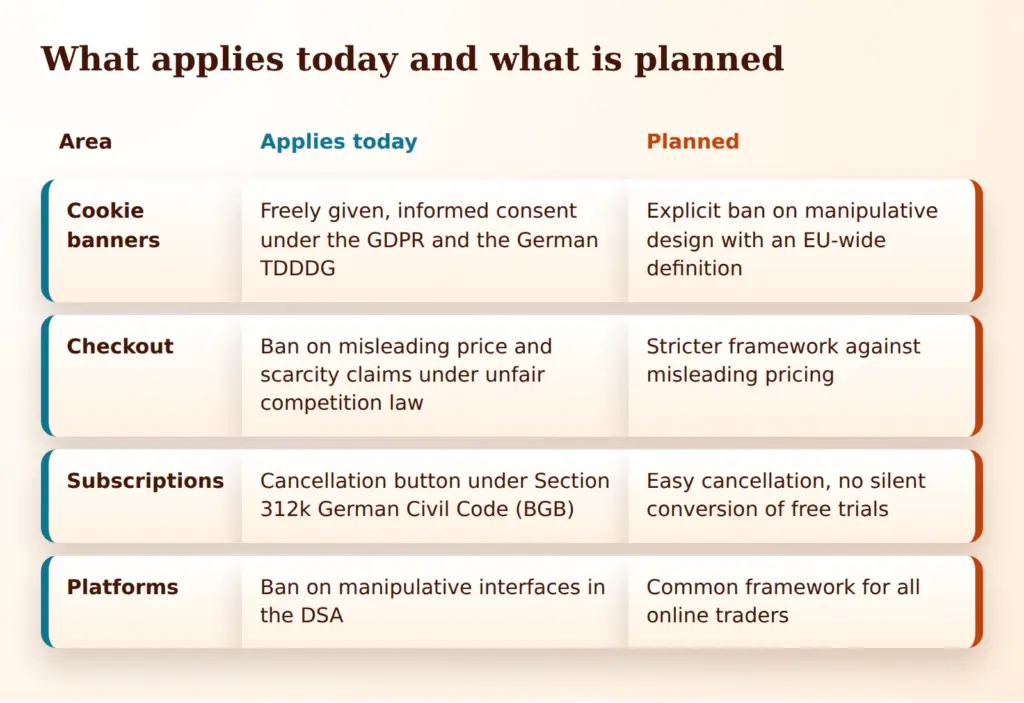
From the operators’ point of view, the key insight is this: anyone whose design is fair today has little to fear from the DFA. Anyone who has relied on grey areas should use the time until it enters into force.
Does the Digital Fairness Act already apply to shops and cookie banners?
Fines and enforcement
A law is only as strong as its enforcement. The proposal therefore relies on several channels. The consumer authorities of the member states are to cooperate more closely, and the revision of the corresponding regulation is running in parallel. The Commission is to be able to investigate certain large cross-border cases itself. Until now, this has been almost entirely in the hands of national authorities.
For large cross-border infringements, substantial fines based on worldwide turnover are envisaged. This is reminiscent of data protection law and is mainly aimed at international corporations, for which small fines have little effect. For medium-sized businesses, this framework is less the yardstick than the risk of cease-and-desist letters, representative actions and the unwinding of contracts.
Representative actions in particular are an effective instrument. Qualified consumer associations in the EU can also sue jointly on behalf of many affected people. For traders who use a manipulative design on a large scale, this can become more expensive than a single action by an authority. Associations have been paying close attention to cookie banners and subscription traps for years, and a clearly defined catalogue of prohibited practices makes their work easier.
Criticism and open questions
The project does not only meet with approval. Criticism comes from business and politics, including from the German federal government, which commented on the plans in a paper of its own in October. The concern: additional obligations mainly hit small and medium-sized enterprises, which have fewer resources for legal advice and redesign than large platforms.
A second point of criticism is the overlap with existing rules. Data protection law, platform law, unfair competition law and, in future, the DFA partly deal with the same design. Anyone who is not careful has to observe several requirements at the same time that differ in the details. With the parallel simplification directive, the Commission promises the opposite.
Then there is the timing. At the same time, the EU is working on a package to simplify its digital laws, the so-called Digital Omnibus. For companies, this creates the impression of a moving target: sometimes rules are relaxed, sometimes tightened. The result is uncertainty, especially for investments in technology that will have to be changed again later.
On the other side is a strong argument. Manipulative design gives an advantage to those who use it and disadvantages those who work fairly. Uniform rules can therefore also create a level playing field. Anyone who designs their banner honestly and gets fewer consents as a result is overtaken today by competitors who give it less thought. A reliable framework can reduce this imbalance.
Digital Fairness Act checklist for operators
Even without an adopted law, a lot can be checked right away. The following points help to get your own site in shape and largely match what the law already requires today.
Cookie banner
- Are “Accept all” and “Reject all” on the same level, the same size and equally prominent?
- Are all optional categories switched off by default?
- Does the rejection come without any wording that judges the decision or creates feelings of guilt?
- Can consent be withdrawn at any time with one click?
- Are trackers really only loaded after consent?
The checklist for consent requests is a useful help here. The website check also shows whether a website already sends data on the first visit.
Checkout
- Is the total price including all fees visible from the start?
- Do scarcity and activity indicators match reality?
- Are there no pre-ticked extra services?
- Are struck-through prices genuine previous prices?
- Does every countdown really end with the offer?
Subscription flow
- Is cancelling as short as signing up, and is the cancellation button easy to find everywhere?
- Is it made clear before the contract starts when the subscription renews and what it will then cost?
- Does a free trial only turn into a paid subscription after express consent?
- Are there no detours such as retention offers that hold up the process before the cancellation is confirmed?
Customer service
- Can a human be reached if necessary, even if a chatbot comes first?
- Are cancellations and withdrawals possible without a phone call or letter?
- Are enquiries answered within a reasonable time?
Anyone who can answer yes to these questions is on the way to fair design. The effort pays off twice: it lowers the legal risk and strengthens customer trust, because people notice very clearly when an interface pushes them in one direction.
Conclusion
The Digital Fairness Act is still only a proposal, but it shows where consumer law online is heading. Cookie banners, checkout and subscription flows are to be designed so that rejecting and cancelling are not an obstacle course. Much of this is already required by current law, just less clearly and less uniformly.
Whether the text will be adopted unchanged is open. The criticism about the burden on medium-sized businesses and the double regulation should be taken seriously, and the legislative process will bring changes. For operators, it is still worth adapting the design now: anyone who relies on fairness will hardly need to make corrections later and is already better protected against cease-and-desist letters and complaints today.
 My name is Klaus Meffert. I have a doctorate in computer science and have been working professionally and practically with information technology for over 30 years. I also work as an expert in IT & data protection. I achieve my results by looking at technology and law. This seems absolutely essential to me when it comes to digital data protection. My company, IT Logic GmbH, also offers consulting and development of optimized and secure AI solutions.