

In November 2026, Anthropic presented two new models, among them Claude Fable 5.2, cheaper and faster than their predecessors. For companies, the question is less whether the model impresses and more whether a switch really improves data protection, quality and costs. A checklist helps with the decision.
With Claude Fable 5.2 and Claude Mythos 5.2 there are two new models from the same family. Most reports revolve around speed, prices and safety questions. In the day-to-day operations of a small or medium-sized company, other things count: Which data flows where, how long does it stay with the provider, what happens to existing processes when the model changes, and what does a solved task actually cost?
What Anthropic announced with Fable 5.2 and Mythos 5.2
Fable 5.2 has been available since 9 November 2026, on the Claude Platform as well as with the major cloud providers AWS, Google Cloud and Microsoft Azure. The model ID is claude-fable-5-2. Mythos 5.2, by contrast, is only open to vetted organisations, for example through programmes for cybersecurity or the life sciences. Both models are based on the same underlying model. Fable carries stronger safeguards in sensitive areas and can therefore be offered generally.
The price is 8 US dollars per million input tokens and 40 US dollars per million output tokens. For Fable 5.1 it was still 10 and 50 dollars. Output is up to approx. 30% faster than with the predecessor. Anyone who needs more speed can book a fast mode that accelerates output by up to 2.5 times and costs double, i.e. 16 and 80 dollars per million tokens. For Mythos, this mode is only available to organisations in the verification programmes.
One recommendation stands out because it comes from the manufacturer itself. For most programming and knowledge tasks, Opus 5.5 is meant to be the model of choice in everyday use. Fable and Mythos are intended for particularly demanding tasks. The largest model is not automatically the right one.
Another point concerns safety. Both models voice the suspicion of being tested more often than earlier ones. That makes it harder to assess how they behave in real operation.
Claude Fable 5.2 in the enterprise: when the switch pays off
A new model triggers the reflex to use it everywhere. Viewed soberly, the question is which tasks in the company actually fail at the performance limit of the previous model. In many businesses, these are surprisingly few. Summaries, draft replies, sorting incoming items, evaluating spreadsheets and most programming assistance run reliably on a good mid-range model.
Our own trial showed: for demanding standard tasks, such as restructuring a medium-sized module, analysing a longer draft contract or producing a clean evaluation from several sources, Opus 5.5 delivered results that hardly differed from those of the more expensive model. The extra cost did not buy a better answer. Fable showed its strength where tasks run for a long time and the model takes many steps on its own: a job that reads files for hours, tests hypotheses, calls tools and corrects itself along the way. There it matters that every intermediate step is right, because small errors add up.
This fits the logic behind the model tiers. The longer a run lasts and the less a human intervenes, the more a model that rarely loses its way pays off. For short tasks with human review at the end, the same strength brings little.
Fable pays off where the model works alone for a long time. For the demanding standard task, Opus 5.5 is entirely sufficient.
With autonomy, the risk grows at the same time. An agent that changes files and addresses systems on its own needs limits. How power without control can play out is described in the dangers behind AI agents. For the switch, this means: the more autonomous the use, the stricter permissions and checks must be, and the more the move to the large model is justified at all.
A simple rule of thumb follows from this. Standard tasks stay on Opus 5.5 or an even smaller model. Fable is reserved for the few long-running, highly autonomous processes in which a failed attempt feels really expensive. This keeps the data protection effort manageable, because the stricter review affects only a small part of the data flows.
Zero Data Retention with Fable 5.2: what applies contractually and technically
With Zero Data Retention, ZDR for short, the provider does not keep inputs and outputs after processing. For many companies, this is the reason to use a cloud model at all. The newest Mythos-class models come with a special rule: Anthropic retains inputs and outputs of these so-called covered models for 30 days for safety monitoring. Some abuse patterns only become visible across many requests, which is how the manufacturer justifies the retention.
Eligible enterprise customers can continue to use Fable 5.2 with ZDR. They arrange this through an agreement with the provider. In addition, there is an offering called Enterprise Frontier Safeguards, which moves the safety evaluation into the customer's infrastructure and is said to be compatible with ZDR. It is in a private beta. Anyone who is not among these customers must expect the 30-day retention. During this period, the provider's staff cannot read the content by default; human review only takes place via controlled access, for example after an automatic flag. After 30 days the data is deleted, unless it has been flagged or there is a legal obligation.
The decisive point is the distinction between the contractual and the technical level. Contractually, it must be established that a ZDR agreement applies to your own organisation. Technically, the setting must arrive where the requests actually run. Depending on the access route, this looks different:
- With the direct API, retention is set per workspace in the Console.
- With AWS Bedrock and Google Cloud, it is configured in the respective cloud environment, and the data stays there.
- With Microsoft Foundry, the setting applies per Azure subscription. If ZDR already exists, a separate subscription is required for this.
Information on Claude Code and ZDR is inconsistent. Anyone using programming tools in the company should therefore have the status confirmed in writing for the specific access, instead of relying on assumptions. The same applies to the question of whether the setting is tied to a workspace or to the cloud environment. A tick in the wrong project is as good as none.
Can Claude Fable 5.2 with Zero Data Retention be used in a company in compliance with data protection law?
ZDR replaces neither data processing agreements nor a transfer mechanism
A common fallacy goes: if nothing is stored, the rest is taken care of. In fact, ZDR only answers the question of how long data stays with the provider. During processing, personal data is still processed, and that requires the usual legal foundations. A picture of three separate layers helps.
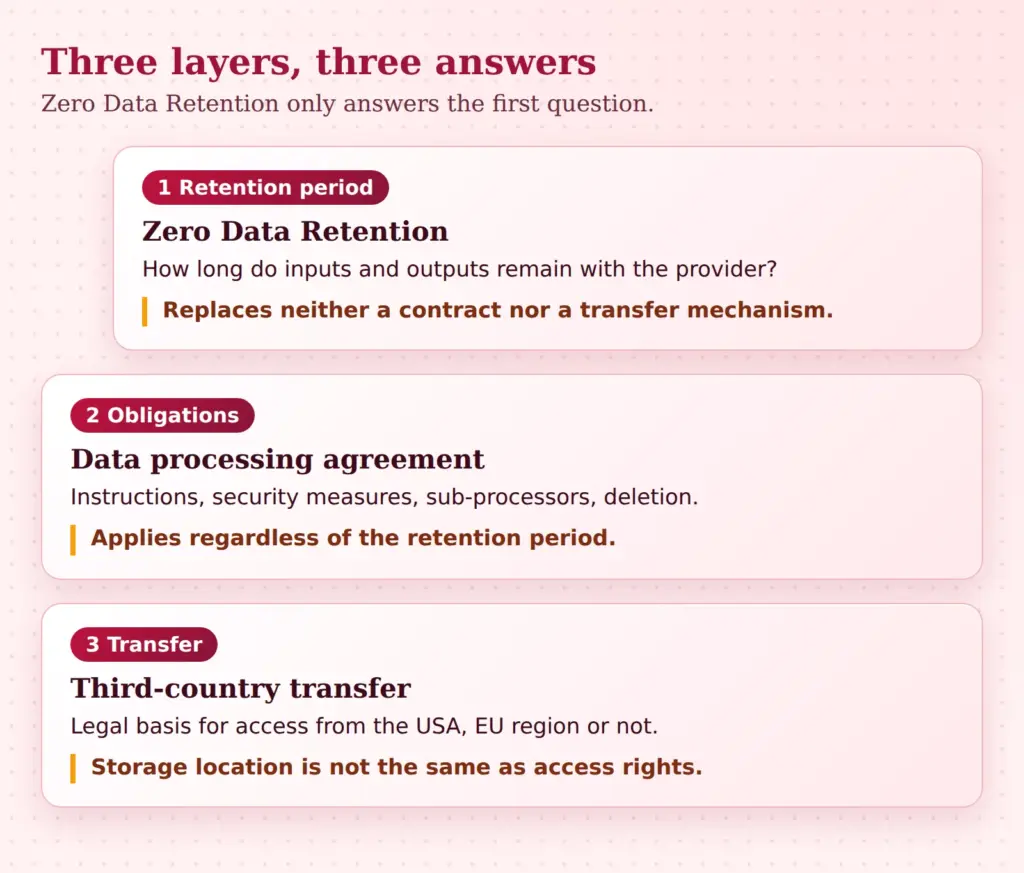
The first layer is the retention period, which ZDR governs. The second is processing on behalf. If a company uses an AI model for customer data, applications or employee data, the provider processes on its behalf. This requires a contract under Art. 28 GDPR that governs binding instructions, security measures, the handling of sub-processors and deletion. This contract exists regardless of whether data is stored for 30 days or not for a second.
The third layer is the third-country transfer. A US provider, or a US corporation behind a European cloud region, remains a case for the rules on transfers to third countries. An EU region answers the question of the storage location, not the one about possible access rights from the USA. Depending on the provider, the transfer can be safeguarded via certifications or standard contractual clauses, where necessary with a documented impact assessment. Whether a provider's certification holds belongs in the file, not in gut feeling.
Practical steps follow from this separation:
- The record of processing activities lists the new model with provider, purpose and data categories.
- If no ZDR agreement applies, the 30-day retention is explicitly included, likewise in a data protection impact assessment, if one exists.
- The contract with the provider and the list of sub-processors are filed for exactly the access route used, for example for the cloud provider through which the model runs.
- Particularly sensitive data stays out as long as the foundations are not in place, or is removed before the request.
Anyone who wants to keep data flows entirely in-house will find an alternative in the option of local AI models. They solve the third-country transfer but bring their own operating effort and usually lower performance. For many businesses, a mix makes sense: sensitive tasks locally or with small models, demanding ones without personal data in the cloud. The data protection officer should accompany the switch, as they know the existing documentation.
Safeguarding the model switch with your own test cases
A model is not software with fixed behaviour. Even an update within the family can change answers, shift formats slightly or resolve edge cases differently. Anyone switching a process to the new model therefore needs a way to measure the difference. A dedicated test set helps here, one that comes from the company's own practice and not from public leaderboards.
A useful set consists of three groups. Real cases from everyday work, anonymised and stripped of personal data, form the core. Edge cases cover situations in which problems occurred before, such as ambiguous requests, incomplete information or very long documents. Failure cases check whether the model correctly declines or asks back when a task cannot be solved. Around 50 to 100 well-chosen cases are enough to start with, provided each task has a clear expectation.
The process remains simple:
- Use fixed prompts and fixed settings so that differences come from the model and not from the wording.
- Run the old and new model on the same cases and compare the results side by side.
- Define in advance at which deviation the switch is stopped, for example above a certain rate of wrong answers.
- Do not leave the evaluation to another model alone, but have humans check samples.
The model ID is also important. Anyone who only uses an alias in the code may one day get a different model without noticing. A fixed identifier, in the case of Fable 5.2 the ID claude-fable-5-2, keeps the behaviour stable until a deliberate switch. This includes a fallback plan: the previous model remains set up and can be reactivated with a switch. Gradual rollout, first on a small share of requests, limits the damage if something goes wrong.
For test data, the same applies as in operation: real customer data does not belong in a test set that gets passed around. Anonymising, or building synthetic examples modelled on real cases, is usually sufficient.
When models recognise tests, quality assurance changes
An inconspicuous finding carries weight: both new models more often voice the suspicion that they are being evaluated. If models behave differently in testing than in operation, a passed test says less about real use. Mythos 5.2 also shows more pronounced hidden capabilities than its predecessor. Both argue against relying on a one-off test.
From a company's point of view, this is no reason to panic. It is a reason not to base quality assurance on a one-off acceptance test. The background is the debate about models that increasingly improve themselves. The concern that models may slip out of control is closely linked to the recursive self-improvement of AI.
A model that recognises tests demands tests that also reflect real operation.
In practice, this means several measures that work together:
- Realistic tests: Test cases should look like real requests, with the same wording, typos and files, and not like neatly constructed test tasks.
- Samples from operation: Real runs are drawn regularly and read by humans, in compliance with data protection and deletion periods.
- Minimal permissions: The model only gets access to what the task needs. Write access, payments or delete functions require confirmation.
- Humans for consequential actions: Anything that is hard to undo needs approval by a person.
- Continuous monitoring: Conspicuous patterns, sudden changes in behaviour and unusually long runs are logged and evaluated.
These measures apply to every model but become more urgent for long, autonomous runs. Precisely where Fable pays off most, control matters most. An acceptance test at the start does not replace ongoing attention.
Costs: realistic token consumption instead of list prices
The list price is a convenient yardstick but says little about the bill at the end of the month. Fable 5.2 costs 8 and 40 dollars per million tokens, Opus 5.5 is at 4 and 20 dollars. The price per token for Fable is therefore twice as high. What matters, however, is what a solved task costs.
Several variables belong in the calculation. Input and output tokens per task, plus the model's reasoning effort, which counts towards output tokens. Retries, because a run fails and restarts. The context length, because in long runs the same context is read again and again, though more cheaply thanks to caching. And human rework, which often costs more than the tokens themselves. The surcharge for fast mode only pays off if the time saved is actually worth something, for example in an application where customers are waiting for the answer.
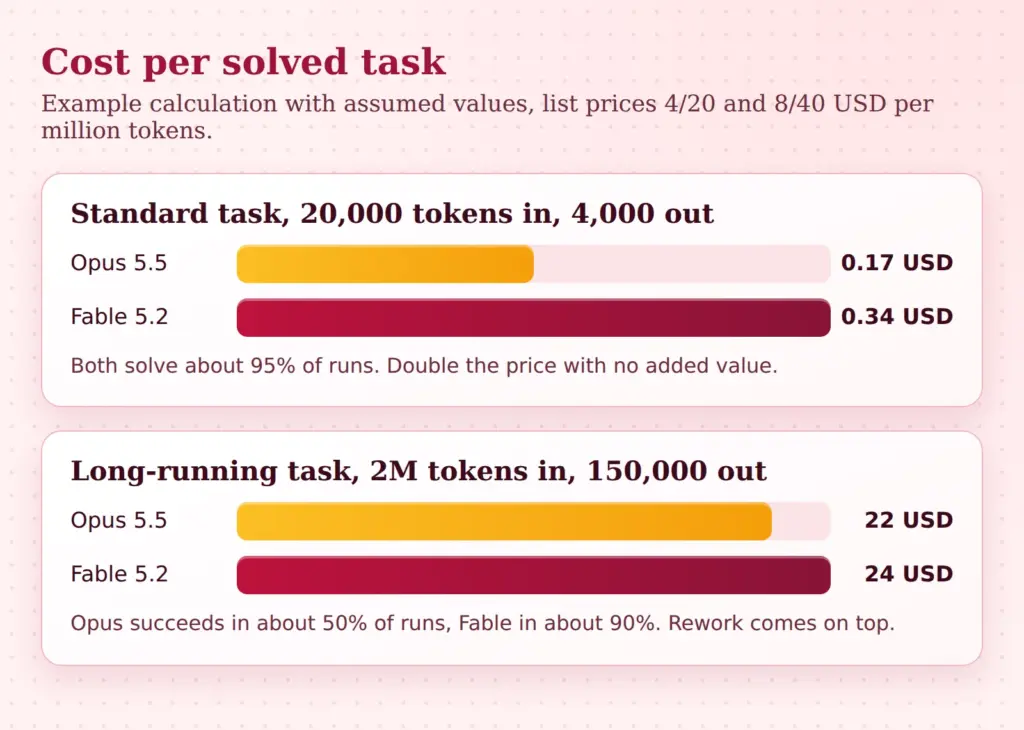
The example uses assumed values and is meant to show the calculation. For the standard task with 20,000 input tokens and 4,000 output tokens, a run with Opus 5.5 costs approx. 0.16 dollars, with Fable 5.2 approx. 0.32 dollars. If both solve approx. 95% of runs, the costs per solved task are approx. 0.17 and approx. 0.34 dollars. The double price does not buy a better answer, yet summed over thousands of tasks the difference adds up.
It looks different for a long-running job. Suppose it consumes 2 million input tokens and 150,000 output tokens. Then a run with Opus 5.5 costs approx. 11 dollars, with Fable 5.2 approx. 22 dollars. If the job succeeds with Opus in only half of the runs and with Fable in approx. 90%, the costs per success are approx. 22 and approx. 24 dollars. The gap shrinks to a few percent. If you factor in the time a human spends on failed runs, the calculation tips in favour of the larger model.
The key is to take the success rate from your own test cases and not from manufacturer charts. A simple measurement procedure is enough: the interface's usage data provides the token consumption per run, and a counter records how often the result was usable and how much time post-processing took. After two to four weeks, a reliable picture emerges for each task type. Then you can decide for each process which model is worth it.
Checklist for the switch: the decision on one page
Before any model switch, a short list helps. It serves as a decision template for management and as evidence that the switch was considered carefully.
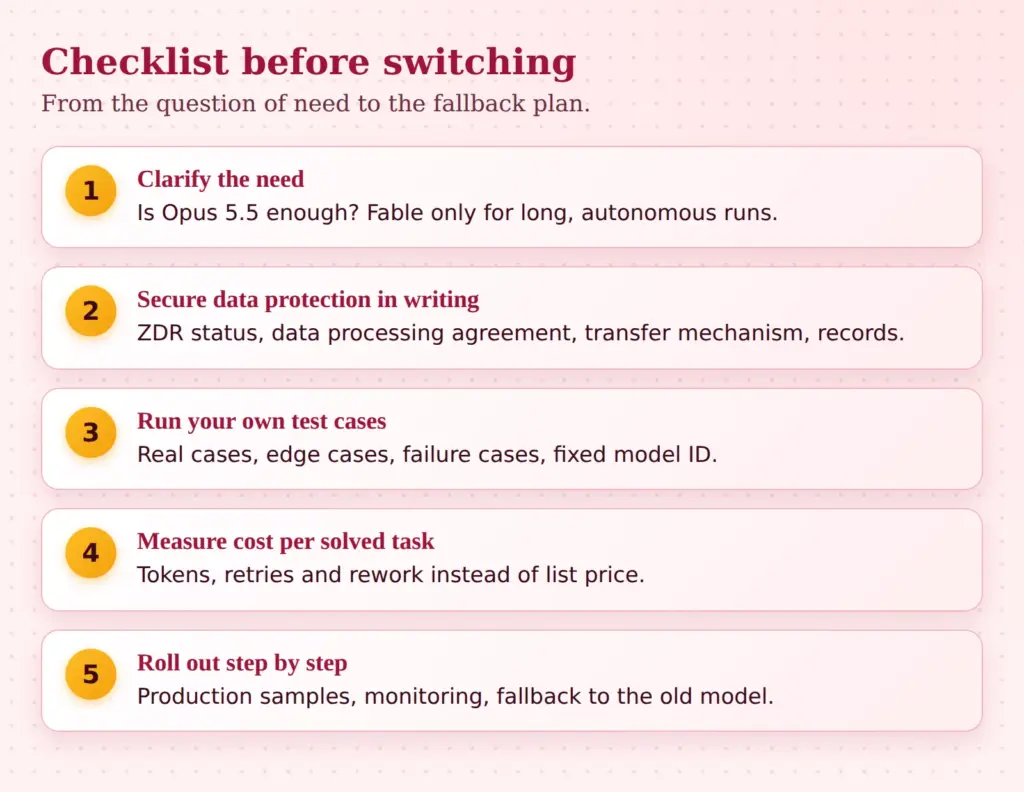
- Need: Which processes fail with the previous model? Only these are candidates for Fable; the rest stays on Opus 5.5 or smaller.
- Access route: Direct API or cloud provider? The route determines settings, contract and sub-processors.
- ZDR status: Confirmed in writing, contractually and technically, per workspace or subscription. Without ZDR, the 30-day retention applies.
- Processing on behalf and transfer: Contract, sub-processors and the basis for the third-country transfer are in place for the access route used.
- Documentation: The record of processing activities and, if one exists, the data protection impact assessment are updated.
- Test cases: A dedicated test set with real, edge and failure cases, without personal data, with fixed prompts and stop thresholds.
- Model ID: Fixed identifier instead of an alias, switching only deliberately.
- Cost measurement: Token consumption, success rate and rework per task type over several weeks.
- Control in operation: Minimal permissions, approvals for sensitive actions, samples, monitoring.
- Fallback plan and responsibility: The old model remains switchable, and one person is responsible for the switch.
Conclusion
Fable 5.2 is cheaper and faster than its predecessor and makes sense for tasks in which a model works independently for a long time. For the demanding everyday task, Opus 5.5 is entirely sufficient and costs only half per token. The switch is therefore less a matter of enthusiasm than of allocation: which processes really need the large model?
In terms of data protection law, ZDR mainly changes the retention period. Contract and data transfer remain separate tasks and must be documented before real data flows. Quality assurance becomes more important when models recognise tests. Your own realistic test cases, limited permissions and ongoing samples provide more security than any acceptance test at the start. Anyone who takes these steps properly can use the new model where it justifies its price.
In addition to data protection (personal data), data security (all data: trade secrets, confidential data, sensitive data, …) should also be called into question!
 My name is Klaus Meffert. I have a doctorate in computer science and have been working professionally and practically with information technology for over 30 years. I also work as an expert in IT & data protection. I achieve my results by looking at technology and law. This seems absolutely essential to me when it comes to digital data protection. My company, IT Logic GmbH, also offers consulting and development of optimized and secure AI solutions.