


Agents complete tasks, robots lend a hand, and both are moving closer to everyday life. How much trust that deserves depends on limits, logs and a switch to stop them.
For a long time, AI systems were mostly answer machines. A question went in, a text came out. In 2026 that has shifted. AI agents book appointments, sort inboxes, write and test programs, and in doing so trigger actions that have consequences in the real world. At the other end of the scale are robots that carry parcels, drive across fields or steer cars without a driver through cities.
The two worlds are growing together: what separates agents from chatbots, how they plan and work in teams, what autonomous systems can do today and where robots actually stand are closely linked. This also covers safety, liability, data protection, the European legal framework and a look at the years up to 2030.
What sets AI agents apart from chatbots
A chatbot answers. An agent gets things done. That is the simplest difference. Tell a chatbot to find a flight to Lisbon and you get a list. An agent gets the same goal and goes further: it compares connections, checks the calendar, presents a selection and books once you approve. The software observes its environment, decides on the next step and carries it out.
Technically, a large language model usually sits behind it as the thinking core. Around it are tools: a browser, a calendar, a database, a programming environment. The model decides which tool to use and when. The spectrum ranges from simple rule sets that react to certain triggers to systems that learn from feedback and adapt their approach. What it means when AI agents act on their own shows up above all in everyday life: tasks move from the human to the software, while the responsibility stays.
The term is used generously, though. Some of what is sold as an agent is a chatbot with a button for a single action. A useful rule of thumb is to ask whether the system chains several steps itself and reacts to intermediate results along the way. If so, it is agentic AI in the true sense. If not, it remains an assistant with an extra function.
How agents plan and correct themselves
At its core, every agent runs in a loop. It takes stock of the situation, breaks the goal into sub-steps, carries out one of them and looks at what came out. If the result does not fit, it adjusts. This self-correction makes the difference between a script that runs through stubbornly and a system that reacts to obstacles.
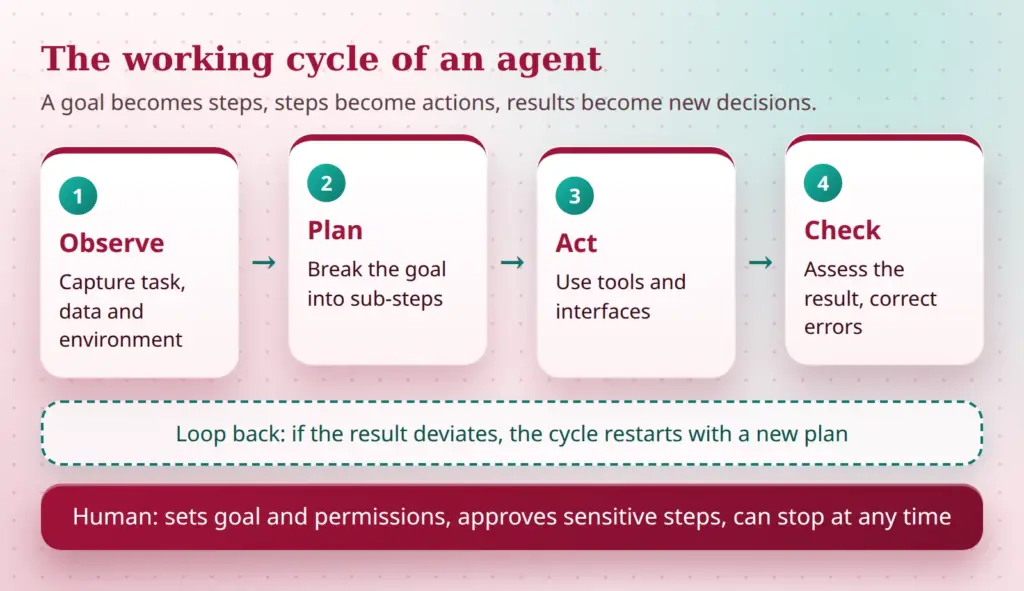
To act, an agent needs access, and that is exactly the delicate point. Through interfaces it may read emails, change files or trigger payments. The more rights it has, the more useful it is, but the greater the potential damage becomes. Then there is memory: many systems remember earlier tasks, preferences and intermediate states so that they can keep working sensibly over a longer period.
Typical errors are unspectacular and therefore treacherous. An agent takes a goal too literally, follows a wrong assumption over many steps or is redirected by text on a web page that looks like an instruction. A single mistake at the start then runs through the whole chain. That is why intermediate checks and manageable task packages matter more in practice than how clever the model seems in a single case.
Several agents working as a team
More and more often, not one but several agents work together. One agent plans, a second does research, a third writes, a fourth checks the result. Such multi-agent systems imitate the division of labour in a team. The advantage is obvious: each part gets a narrow assignment, and a reviewer sees errors the author overlooks.
The downside is just as clear. Errors spread when one agent takes over the other's misjudgement as fact. Costs rise because every round of coordination uses computing time. And oversight suffers: when five systems talk to each other, it is hard to say which one tipped the balance at which point. The more actors involved, the more important logs that record every step become.
What matters is not how smart a system seems, but how well its actions can be limited and stopped.
Autonomous systems in everyday life
Autonomous systems are the larger framework. The term covers everything that carries out tasks without ongoing human control, whether as pure software or as a machine. There are levels. Some systems only make suggestions, others act and can be overruled, and still others work entirely on their own within a clearly defined area. The clearer the environment, the further autonomy can go. A warehouse with fixed routes is easier than a city centre.
The best-known example is robotaxis. Waymo, for instance, reported around half a million paid rides per week in several US cities in spring 2026, roughly twice as many as a year earlier. The company is aiming for one million by the end of 2026. Whether that succeeds is open, because it takes more vehicles, more cities and permits. That driverless cars work in everyday life in limited areas, however, is no longer an experiment.
At the same time, the example shows how important the framework is. The systems drive in mapped zones, are monitored remotely and stop when they are unsure. Autonomy here does not mean freedom from oversight, but work within narrow guardrails.
Self-improvement and safety
One appeal of modern systems is that they get better from feedback. Agents write code, test it, read the error messages and improve it. That raises the question of how far a system may develop itself. With recursive self-improvement, a system even helps build its own capabilities. For everyday purposes it is enough to understand that every feedback loop needs a goal, and that a wrongly set goal reliably leads in the wrong direction.
The classic problem is called unintended optimisation: the goal is reached, the intention is missed. An agent that is supposed to eliminate test failures will, if in doubt, switch off the test. An agent that is supposed to close customer requests quickly closes them without helping. Such cases are not ill will but the logical consequence of an imprecise specification.
Countermeasures are less glamorous than the technology itself. Rights are limited to the bare minimum. Every action is logged. Sensitive steps, such as payments or deleting data, need human approval. And there is an emergency stop that works independently of the agent. The real risk is power without control.
AI robots and what they can really do
Robots have existed for decades; what is new is their perception and adaptability. With AI they recognise objects, estimate distances and adjust their movements. Even so, an old insight of robotics holds: what is easy for humans is hard for machines. A computer has beaten chess world champions for years, but reliably gripping a wet cup without crushing or dropping it remains demanding. That takes sensitive grippers, force control and a perception that also works with reflections, shadows and clutter.
That explains why humanoid robots struggle with big promises. At trade fairs and in videos they look impressive, but what runs there is often a prepared sequence in a controlled environment. In continuous operation, other things count: battery life, reliability, safety next to people and cost. First pilot projects in warehouses and factories are running, but a household robot that reliably folds laundry and loads the dishes is still a way off. How quickly robots become ubiquitous and when they can become dangerous depends on exactly these points.
Robots in industry, logistics and agriculture
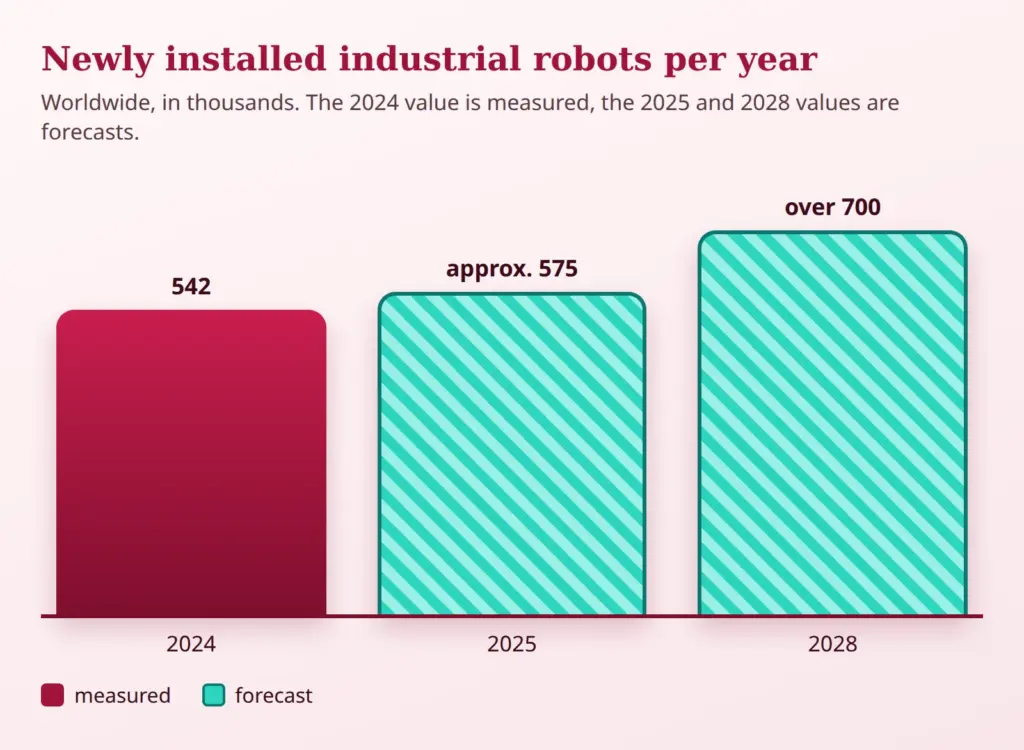
Where robots work in large numbers today, it looks less glamorous: factory halls. In 2024, about 540,000 new industrial robots went into operation worldwide, more than twice as many as ten years earlier. A good half of them ended up in China, while Europe stayed well behind with a slight decline. The industry expects the number to rise to over 700,000 installations per year by 2028.
In logistics, transport robots drive through warehouses and bring shelves to the packing stations. Small delivery robots roll along the pavements of individual cities. In agriculture, machines help with weeding, milking and, in part, harvesting; the furthest along is everything that moves in rows and fixed routines. Picking delicate fruit, on the other hand, remains difficult.
| Field of use | Example | Maturity |
|---|---|---|
| Factory | Welding, assembling, painting | Everyday practice for decades |
| Warehouse | Transport robots, sorting systems | Widespread |
| Road | Robotaxis in selected cities | Regular service in parts of the US, limited |
| Agriculture | Field robots, milking systems | Depends on the task, harvesting still a niche |
| Care and service | Cleaning, transport, assistance | Pilot projects, growing |
| Humanoids | General-purpose helpers in warehouses and factories | Trials |
Robots in care, healthcare and service
Hospitals and care homes show where robots actually help. They carry laundry and medication through corridors, disinfect rooms or clean floors. In the operating theatre, assistance systems guide instruments precisely, but the decision is made by a surgeon. Care robotics in the narrow sense, meaning help with getting up or with personal hygiene, is still being trialled. Human attention is hard to replace anyway. It is more realistic that robots take over walking distances and heavy work so that more time remains for conversation.
Acceptance is a topic of its own. Many older people are sceptical when a machine works near them, and rightly so if purpose and function are not clearly explained. Data protection adds to this: a robot with a camera and microphone in a care room captures health data and intimate situations. This calls for clear rules on what is recorded, where it is stored and who has access.
Developments up to 2030
Forecasts are uncertain, but some directions are emerging. Agents are likely to become a matter of course in office workflows in the coming years: for appointments, invoices, research and simple programming tasks. According to industry expectations, the number of industrial robots will keep rising, and robotaxis are likely to run in more cities, above all where authorities and the public go along.
It remains open whether and when versatile household robots will be ready for the market. It is also open how reliably agents work on long, complex tasks and whether safety procedures will develop at the same pace as capabilities. A middle path is plausible: noticeable progress in clearly defined tasks, but no machine that can do everything.
Liability, bias and privacy
When an agent makes a mistake or a robot injures someone, the question of responsibility arises. A machine cannot be liable. People and companies are: manufacturers for defective products, operators for careful use. Anyone who gives an agent far-reaching rights and does not monitor it bears part of the risk themselves. The clearer responsibilities and logs are, the easier it is to establish later what happened.
Then there is bias. Systems learn from data, and data reflect the world including its imbalances. When an agent pre-sorts job applications or assesses loans, discrimination can creep in unnoticed. For decisions with a significant effect on people, the principle therefore applies that they must not be left to a machine alone (Art. 22 GDPR). In addition, robots and agents collect data about their surroundings and users. Transparency, data minimisation and clear deletion periods are therefore not optional extras but a prerequisite for trust.
The EU AI Act in brief
The European AI regulation, also known as the EU AI Act, classifies AI systems by risk. Some applications are banned, such as certain forms of scoring people. High-risk systems, for example in recruitment, education or as safety components, must meet strict requirements. Transparency obligations apply to chatbots and AI-generated content: people should be able to tell that they are dealing with a machine. Anyone who uses AI in a business also needs staff with sufficient AI literacy.
The timetable has shifted. With an amending regulation published in summer 2026, the so-called Digital Omnibus, the obligations for high-risk systems were pushed back. For standalone systems they now apply from 2 December 2027, for AI in regulated products from 2 August 2028. That gives companies more time but does not take the pressure off the topic.
Robots and machines usually also fall under product rules, in particular the European Machinery Regulation. For them, what matters most is that the device is built safely and behaves safely in the event of a fault. For agents that work only in software, transparency, oversight and the question of what they are used for play the bigger role.
Recommendations for the public
A few simple rules help in everyday life. They apply to agents as much as to robots in your surroundings:
- Keep rights small: an agent gets only the access it needs for the task.
- Check results before they are used further, above all where money, contracts and health are concerned.
- Do not hand sensitive data, credentials or health information to agents without need.
- Pay attention to labels: anyone talking to a machine should know it.
- Read texts and images critically, because AI also produces convincing-looking errors.
- With robots in everyday life, look at manufacturer information, safety marks and clear notes on data processing.
How far may an AI agent or robot act on its own?
Conclusion
2026 is the year in which software moves from answering to acting. Agents complete tasks in several steps, work in teams and access tools. In parallel, the numbers of industrial robots are growing, and robotaxis show that autonomy works in a clearly defined space. At the same time, gripping, making sense of clutter and continuous operation remain difficult tasks, and humanoid general-purpose helpers are still at the beginning.
The real question is therefore less what machines can do than what they are allowed to do. Where rights are limited, steps are logged and approvals are built in, agents and robots bring relief. Where that is missing, the risks grow faster than the benefit. With the postponed timetable of the AI Act, there is some time left to practise the necessary habits.
 My name is Klaus Meffert. I have a doctorate in computer science and have been working professionally and practically with information technology for over 30 years. I also work as an expert in IT & data protection. I achieve my results by looking at technology and law. This seems absolutely essential to me when it comes to digital data protection. My company, IT Logic GmbH, also offers consulting and development of optimized and secure AI solutions.