

Some German providers claim that using ChatGPT on a German server is secure and GDPR-compliant. GDPR-compliant may be officially true, but security is absent. US law forces Microsoft and other US companies to cooperate with US authorities, and we are not allowed to learn anything about it (this is called "spying on foreigners" or "US security interests").
"We absolutely want to use ChatGPT, so it has to be secure. And if it is not secure, we simply define it as secure."
It is very easy: host ChatGPT on a tenant (server) in Germany or Europe in the Azure cloud. In other words, in a supposedly secure data space that would belong only to you. After all, the server is in Germany and is therefore supposedly secure.
Bullshit.
There really are German companies that sell this or something similar as a solution. Instead of ChatGPT, they use either Claude or Gemini, and instead of Azure, either AWS.
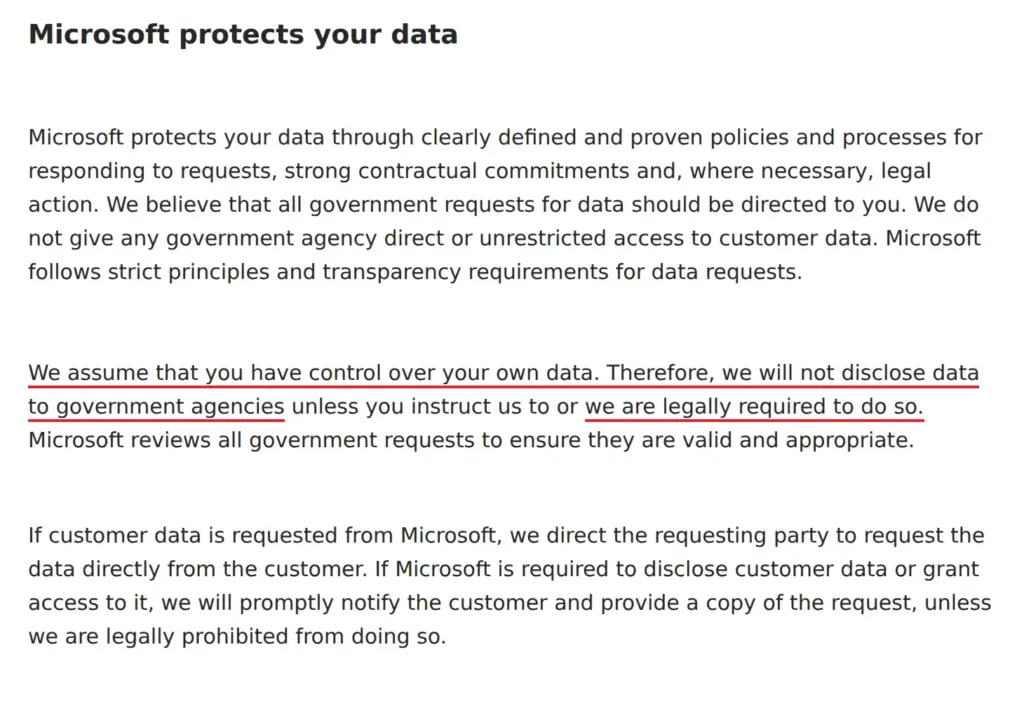
About ChatGPT in the Azure cloud, Microsoft writes:
The text gives cause for thought. We take it apart sentence by sentence. What is not discussed here are so-called AI anonymisers, which supposedly anonymise texts automatically before they are sent to the insecure ChatGPT. That is just as much bullshit. First, a treat (it applies to all cloud services from US companies):
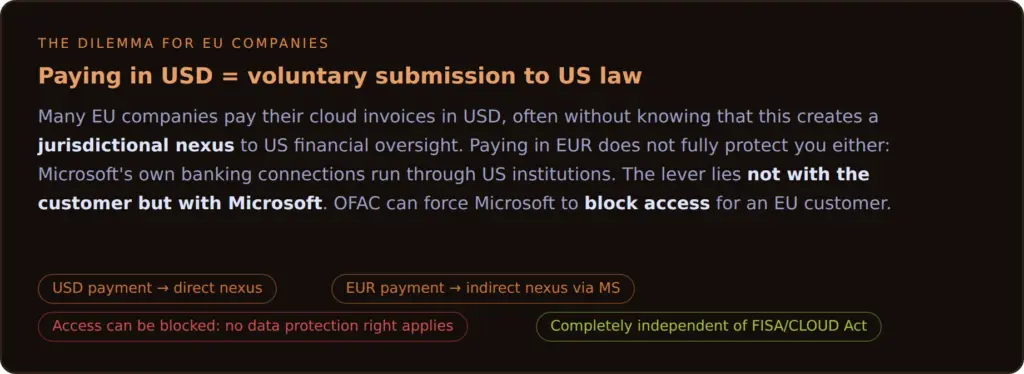
Parts of the following explanations deal specifically with Microsoft's privacy promises. At their core, the points of criticism apply to all US companies, some of which do not even bother with (questionable) promises and are just as insecure or even more so (if there is any comparative for "insecure" at all).
Microsoft's privacy promises: what they really mean
All of the following quotes refer to the Microsoft page on Azure privacy.
Original: "Microsoft protects your data through clearly defined and proven policies and processes for responding to requests, strong contractual commitments and, where necessary, legal action."
Reality: As a US company, Microsoft is legally obliged under FISA Section 702 and the CLOUD Act to hand over customer data on official order, regardless of its own policies or contracts. Contractual commitments (e.g. SCCs) are simply overridden by a US warrant. Legal action against US authorities is structurally hopeless.
Original: "We believe that all government requests for data should be directed to you."
Reality: This opinion is legally irrelevant. Under FISA Section 702, requests are not addressed to the customer but directly and secretly to Microsoft. The customer is deliberately bypassed, and Microsoft is bound by a gag order and may not inform them.
Original: "We do not give any government agency direct or unrestricted access to customer data."
Reality: Under EO 12333, the NSA can intercept data before it even reaches Microsoft, by tapping undersea cables. Microsoft does not have to "give" any access at all, because the data is intercepted outside its control. EO 12333 also allows this data to be passed on in bulk to 16 other US agencies, without a court order.
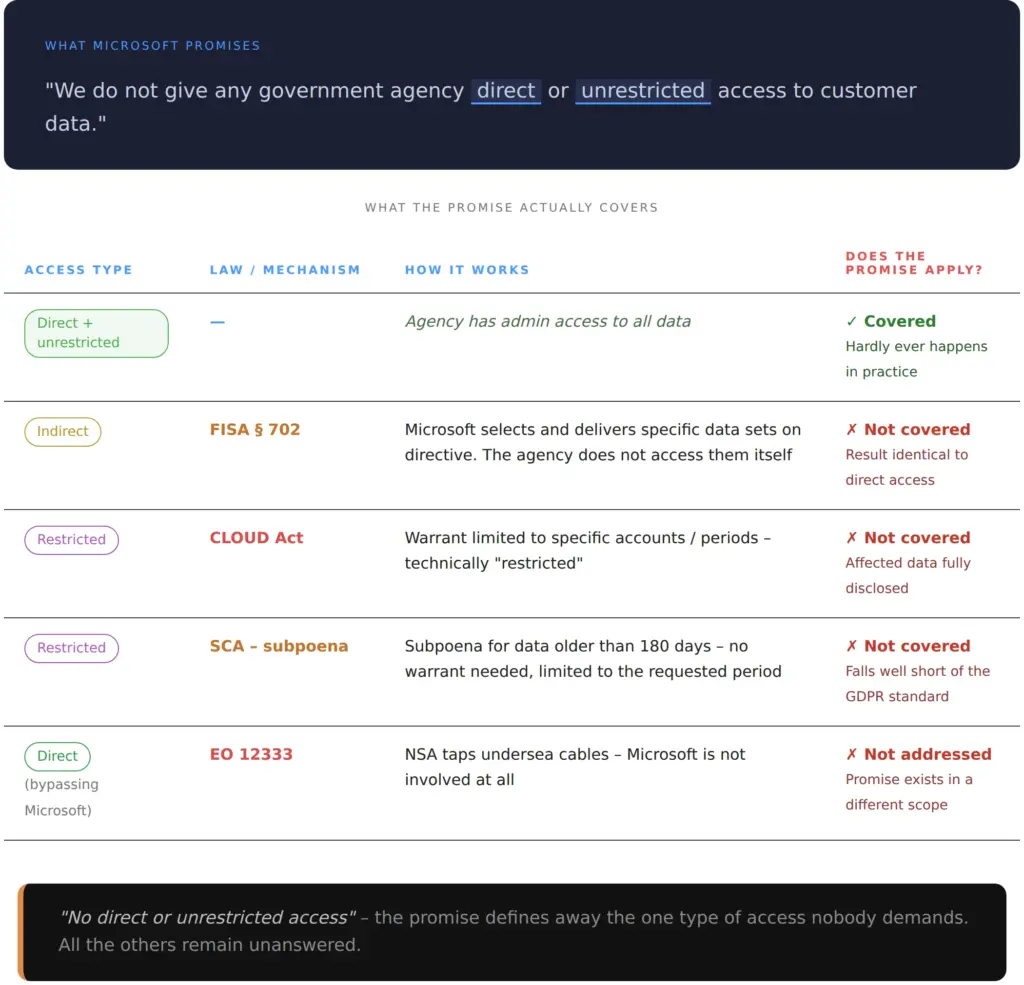
The promise protects against exactly one type of access, the direct, unrestricted one, which practically never occurs. All real access mechanisms under US law are either indirect (Microsoft delivers the data itself) or formally restricted (limited to certain data), but identical in effect for those affected: their data ends up with US authorities, without their knowledge and without legal protection.
Original: "Microsoft follows strict principles and transparency requirements for data requests."
Reality: Transparency ends where US law begins. Under FISA Section 702 and the SCA (Stored Communications Act), there is a statutory gag obligation. In many cases Microsoft cannot and may not inform affected customers. Transparency is structurally made impossible.
Original: "We assume that you have control over your own data."
Reality: EU customers have de facto no control over their data. In Schrems I & II, the CJEU found that US surveillance laws (especially FISA 702) are incompatible with EU fundamental rights because they give data subjects no effective legal protection. Non-US citizens have no enforceable rights against US authorities. Microsoft merely assumes that you have control over your data, while benevolently acknowledging that the opposite may be the case at any time.
Original: "Therefore, we will not disclose data to government agencies unless you instruct us to or we are legally required to do so."
Reality: The exception "legally required" is the normal case, not the exception. The CLOUD Act, FISA 702 and the SCA create far-reaching statutory disclosure obligations. The addition "or you instruct us to" obscures that Microsoft must hand over this data even without any customer instruction, and if it must, it may not even inform the customer.
 My name is Klaus Meffert. I have a doctorate in computer science and have been working professionally and practically with information technology for over 30 years. I also work as an expert in IT & data protection. I achieve my results by looking at technology and law. This seems absolutely essential to me when it comes to digital data protection. My company, IT Logic GmbH, also offers consulting and development of optimized and secure AI solutions.