

Employees use AI services that nobody in the company has reviewed: with private accounts, as browser extensions or as newly enabled features in familiar software. This shadow AI affects IT security, data protection and trade secrets all at once. An outright ban rarely solves the problem. A managed approach with approved tools, clear data classes and short rules is feasible for SMEs.
Introduction
Hardly any technology has spread through everyday work as quickly as generative AI. Summarising texts, drafting emails, analysing spreadsheets, generating program code: all of this takes just a few clicks, often free of charge and without installation. That is exactly the problem. What is convenient for the individual employee remains invisible to the organisation. There is no contract, no review and no entry in any register.
This article is aimed at managing directors, IT managers and data protection officers in small and medium-sized enterprises. It describes what shadow AI is, how it arises and the forms it takes. It then looks at the risks from three angles: IT security, data protection and the AI Act. A separate section deals with the protection of trade secrets. Finally, it sets out a practical approach that does not require a major project, together with a short checklist.
What shadow AI is and why it arises
Shadow AI refers to the use of AI services in a work context without the knowledge and approval of the organisation. The term is modelled on "shadow IT", meaning software and cloud services that departments use without involving IT. A typical case is an employee using a private account with a chatbot provider and entering work content there. Malicious intent is rarely involved. Most people simply want to work faster and better.
Several causes come together:
- Low barrier to entry. A browser and an email address are enough. No purchasing, no rollout, no training.
- No approved offering. If the company does not provide a vetted solution, employees find one themselves. According to the Bitkom press release of 21 October 2025, only 26 percent of companies provide their employees with access to generative AI.
- Unclear rules. According to the same survey, 23 percent of companies have rules for the use of AI. Where nothing is regulated, many people assume that whatever is not forbidden is allowed.
- Pressure to be productive. Anyone facing deadlines who knows a tool that takes work off their hands will reach for it.
- Underestimated risks. A chat window feels like a private conversation. Many people are unaware that inputs can be stored, analysed or passed on to third parties.
Typical forms of shadow AI
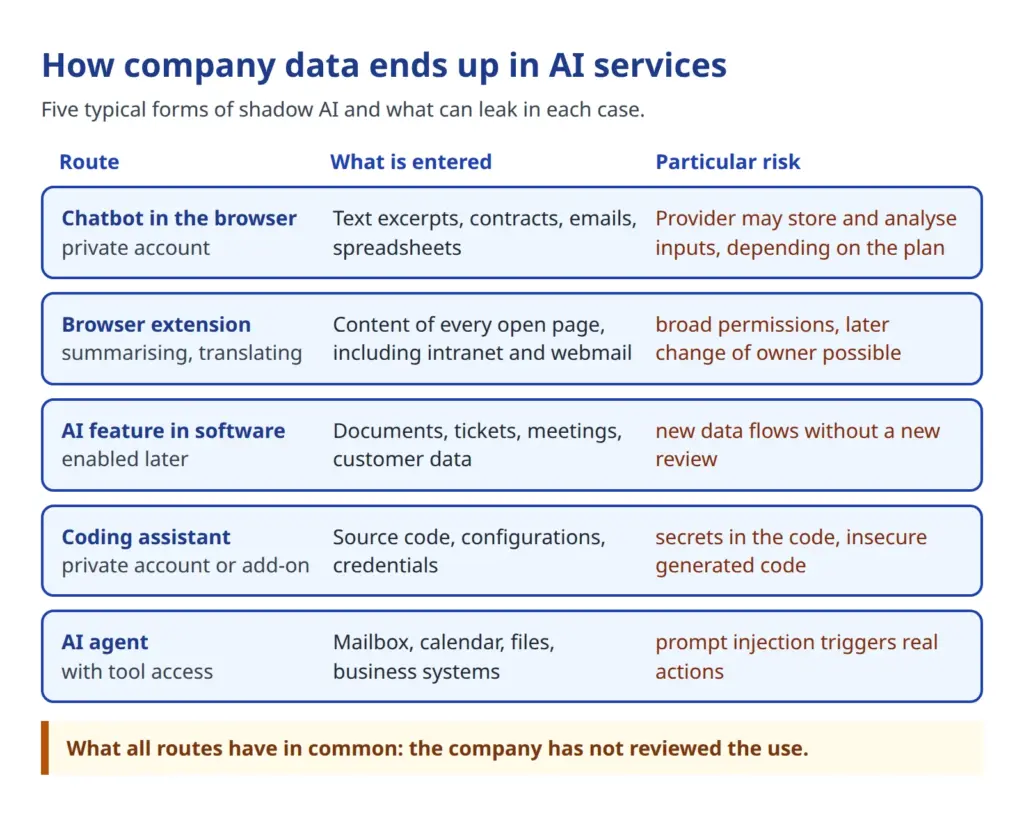
Shadow AI is more than the chat window in the browser. Five forms can be distinguished.
Chatbots with a private account
The best-known form. Employees copy text passages, contract clauses, customer emails or spreadsheet extracts into a chatbot. The plan and the settings are decisive. Depending on the provider and plan, inputs may be stored and, under certain conditions, used to improve the services. Business accounts with a contract are often subject to different terms than free private accounts. This varies from provider to provider and must be checked case by case.
Browser extensions
Extensions for summarising web pages, translating or rephrasing often request permission to read "all data on all websites". This means they can also see webmail, the intranet, ticketing systems and customer portals. Anyone who grants such permissions effectively gives the provider access to everything open in the browser.
AI features in existing software
Many vendors are adding AI assistants to their products: in office suites, video conferencing, ticketing systems, CRM and design tools. They can often be enabled with a switch, sometimes by employees themselves. The software has been approved, but the new feature has not. It may route data to additional sub-processors or to other regions, and the record of processing activities is suddenly out of date.
Coding assistants
Developers use assistants in their development environment or in a chat. Source code, configuration files and sometimes credentials end up with external services. Conversely, generated code lands in the product without anyone having reviewed it thoroughly.
AI agents
Agents go one step further: they read mailboxes, search files, call interfaces and trigger actions. A privately set-up agent with access to the work mailbox is a special case of shadow AI with a particularly high risk, because it does not just receive data, it acts.
How widespread is shadow AI?
Reliable figures for Germany come from the Bitkom Research survey mentioned above. 604 companies with 20 or more employees were surveyed by telephone in summer 2025; the survey is representative. The results:
- In 8 percent of companies, private use of AI tools for work is widespread (2024: 4 percent).
- In a further 17 percent there are isolated cases (2024: 13 percent).
- Another 17 percent do not know for sure but suspect such use.
- Another 24 percent also do not know for sure but do not suspect such use.
- Only 29 percent are certain that it does not occur in their company (2024: 37 percent).
Taken together, around 42 percent of the companies surveyed assume or know that AI is used privately for work. The figures are based on the companies' own statements, not on measurements. Actual use may be higher or lower. As of 10 October 2026, the 2025 survey is the most recent known study on this topic.
The Cost of a Data Breach Report 2025, produced by IBM together with the Ponemon Institute, gives an indication of the consequences. According to IBM, 20 percent of the organisations studied had a security incident related to shadow AI. According to these figures, such incidents caused around USD 670,000 in additional costs on average compared with others. They also more frequently involved personal data and intellectual property. The study is international in scope and comes from a provider of technology and security solutions. It is useful as an indication of the order of magnitude, not as a forecast for an individual SME.
Risks from an IT security perspective
Data leakage
The obvious damage is that confidential content leaves the company. Anyone who copies a cost calculation for a quote, a customer list or an expert report into a chatbot has given up control over this data. Whether the provider stores it, for how long, who has access and whether it flows into training data is determined by the provider's terms. The company has no influence over this and, in case of doubt, does not even know that the transfer took place. Later deletion is also hard to prove.
There is a second risk: private user accounts are often less well protected than business accounts. Without a second factor, a stolen password is enough to view the history containing company content.
Prompt injection
Language models do not reliably distinguish between instructions and data. If a document, web page or email contains hidden instructions, the model may follow them. This pattern is called prompt injection and ranks first in the OWASP list of risks for LLM applications. With a pure chatbot, the damage is limited. But if the application has access to the mailbox, files or interfaces, a manipulated document can extract data or trigger actions. This applies in particular to agents and to extensions that process third-party web pages.
Extensions with broad permissions
Browser extensions run with the permissions the user grants them. An extension that sends page content to an AI service also sends content from business applications. A further risk: extensions change owners or receive updates that alter their behaviour. A one-off review is then not enough. Companies that do not manage extensions centrally have no overview of this.
Agents with tool access
The more an agent is allowed to do, the greater the potential damage. An agent with read and write access to the mailbox and file storage can pass on data, send messages or modify files, and it does so with the employee's identity. The principle of least privilege applies here in particular. Self-configured agents usually lack approval steps, logs and an emergency stop entirely.
AI-generated code
Coding assistants speed up development, but they also produce faulty or insecure code. Typical problems are missing input validation, outdated libraries, invented package names and embedded credentials. That is no reason to do without assistants. But generated code must go through the same checks as any other code: code review, automated tests and dependency scanning. If it is created outside the organisation, there is often not even any knowledge that it was AI-generated.
Risks from a data protection perspective
If an employee enters personal data into an AI service, this is processing within the meaning of the GDPR. If employees act in the course of their work, the processing is generally attributed to the company, because under Art. 29 GDPR they only process data on the instructions of the controller. This may be different where they use it for their own purposes; Guidelines 07/2020 of the European Data Protection Board on the concepts of controller and processor deal with such cases, in which employees go beyond their instructions (known in German law as "Mitarbeiterexzess"). The distinction depends on the individual case and should be clarified with legal advice. A work-related use that management is unaware of does not automatically relieve the company of responsibility. The following points are regularly affected.
Legal basis and purpose limitation
Every processing operation requires a legal basis under Art. 6 GDPR. For entering customer data into an external chatbot, such a basis can hardly be properly justified if neither the purpose nor the recipient has been reviewed. Legitimate interest requires a documented balancing of interests. This is not possible if nobody knows about the processing. Information obligations towards data subjects also come to nothing if a recipient is missing from the privacy policy.
Data processing agreements
If a company uses a service provider that processes personal data on its behalf, a contract under Art. 28 GDPR is required. With private accounts, there is no such contract. Consumer terms of use are not designed for this. With approved business solutions, however, the data processing agreement is part of the review. This is also where to clarify whether the provider uses inputs for its own purposes, which sub-processors are involved and how data is deleted. The European supervisory authorities have commented in detail on AI models and data protection in Opinion 28/2024 of the European Data Protection Board. The German supervisory authorities have summarised their requirements in the guidance of the German Data Protection Conference (DSK).
Transfers to third countries
Many AI providers are based in the USA or use data centres outside the EU. Transfers to third countries are subject to the rules of Art. 44 GDPR and the following articles. For providers covered by the EU-US Data Privacy Framework, the European Commission facilitated transfers with its adequacy decision of 10 July 2023. The General Court of the EU dismissed an action against it in its judgment of 3 September 2025. To our knowledge, an appeal against this is pending before the Court of Justice of the European Union. As of 10 October 2026, to our knowledge no decision has yet been handed down. The current status should be checked before any assessment in an individual case. Important for shadow AI: with private accounts, nobody checks whether a provider is certified. With approved solutions, this is part of the selection process.
Record of processing activities
The record under Art. 30 GDPR is supposed to show which processing operations take place in the company. Shadow AI, by definition, is not in it. The record is therefore incomplete, and a supervisory authority may object to this. The effort of cleaning it up later is considerably greater than the effort of adding new tools right away.
Data subject rights
Data subjects can request access (Art. 15 GDPR) and erasure (Art. 17 GDPR). The company can neither find nor delete what sits in a private chat history with a provider. Moreover, it is hardly possible to say whether data has been fed into a model. The less is known about where data has gone, the harder it is to answer such requests.
Data protection impact assessment
For processing operations likely to result in a high risk, an impact assessment under Art. 35 GDPR is required in advance. This may be the case for AI applications involving employee data, extensive analysis or agents with far-reaching permissions. With shadow AI, it does not take place because nobody recognises the processing as such.
Data breaches and the duty to notify
If personal data is accidentally disclosed to unauthorised parties, there may be a personal data breach. Under certain conditions, controllers must notify the supervisory authority within 72 hours (Art. 33 GDPR). The deadline starts as soon as the company becomes aware of the breach. The problem with shadow AI lies in detection: anyone who does not know that data has been entered cannot assess whether a notifiable breach has occurred either. A clear internal reporting channel shortens this time considerably.
Risks from the perspective of the AI Act
The AI Act is addressed to providers and deployers of AI systems. Under Art. 3(4) AI Act, a deployer is anyone who uses an AI system under their own authority. If a system is used for work, this is generally attributed to the company. This may be different for purely private use. Attribution in the case of unapproved use is a legal question that depends on the individual case.
AI literacy under Art. 4
Art. 4 AI Act originally required providers and deployers to take measures to ensure, to their best extent, a sufficient level of AI literacy among their staff. The requirement was amended by the so-called Digital Omnibus on AI. According to the wording of the new version, providers and deployers take measures to promote the development of AI literacy among their staff. They do not owe a specific level of competence of individual persons. Measures must therefore still be taken. The regulation was published in the Official Journal on 24 July 2026 and entered into force on 27 July 2026. How the supervisory authorities will handle the new version remains to be seen.
Deployer obligations and deadlines
The detailed deployer obligations apply mainly to high-risk systems, for example in human resources, creditworthiness assessment or education. For these systems under Annex III, the Digital Omnibus postpones the start date from 2 August 2026 to 2 December 2027, and for AI in regulated products to 2 August 2028. These obligations do not apply to most everyday uses such as drafting texts and summaries. They become relevant as soon as an employee uses an AI system for tasks such as selecting applicants or assessing performance. This can easily happen without the HR department knowing. Certain transparency obligations and prohibitions apply regardless. Which dates apply to which obligation in detail can be found in the text of the regulation. The legal situation is still young here, and some of the Commission's interpretative guidance is still pending.
Trade secrets
Besides personal data, business information is at stake: formulas, price calculations, design documents, source code, strategy papers. The German Trade Secrets Act (GeschGehG) only protects information that is subject to reasonable confidentiality measures. Anyone who allows trade secrets to be entered into external services without a contract and without rules risks weakening this protection. Confidentiality commitments to customers and partners may also be breached, for example if a framework agreement prohibits disclosure to third parties. Professionals bound by secrecy, such as tax advisers, doctors or lawyers, are subject to additional obligations.
Why outright bans achieve little
The obvious reaction is a ban. It is quickly drafted and looks decisive. But experience with shadow IT suggests that a ban alone does not help:
- The need remains. People who work faster with AI will not give that up just because it is forbidden. Use shifts to private devices and mobile networks, where it is even less visible.
- Bans are hard to enforce. Blocking individual addresses on the company network only catches part of it. New services keep appearing, and AI features are increasingly built into familiar software.
- Visibility is lost. People who fear punishment do not report mistakes. Yet prompt reports are a prerequisite for containing a data breach and meeting deadlines.
- Opportunities are missed. Used well, AI saves time. A ban gives up this benefit without eliminating the risk.
This does not mean that bans never make sense. For clearly defined cases, such as entering health data or credentials into unvetted services, a clear ban belongs in the policy. But it only works if a permitted alternative exists. The Bitkom study also recommends that companies set rules and provide their employees with suitable tools.
A practical approach to shadow AI for SMEs
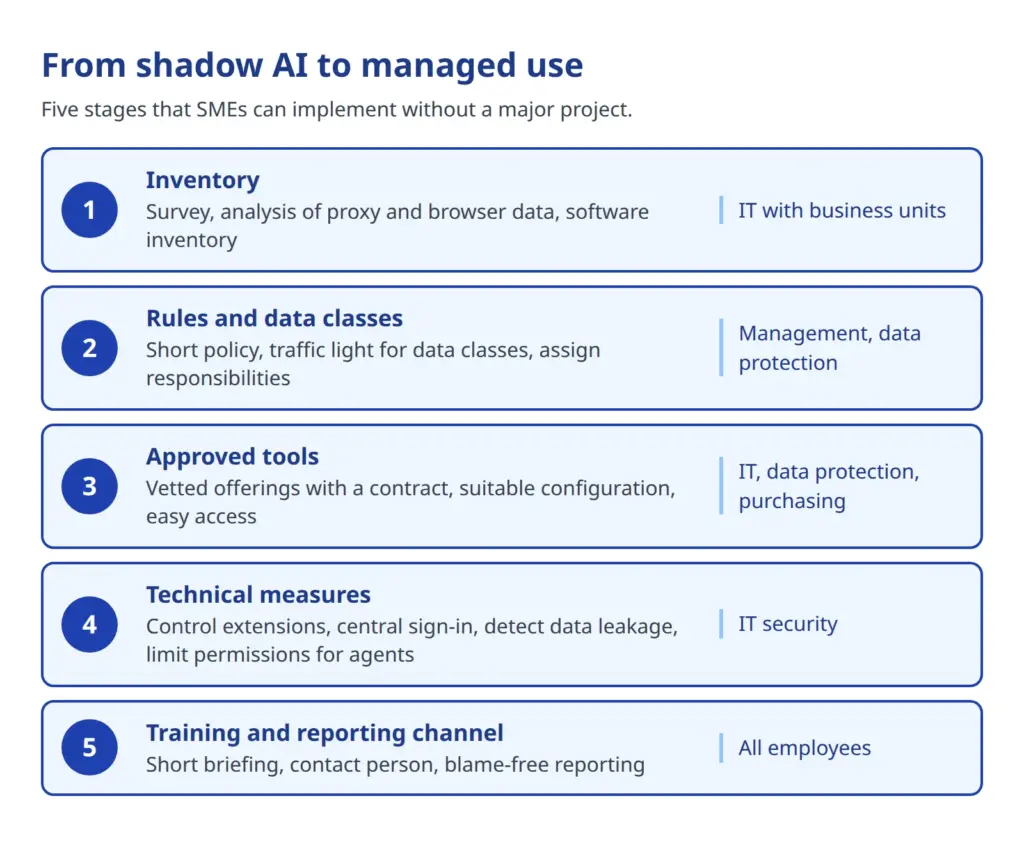
The approach can be divided into five stages. The order matters, and the effort remains manageable. Starting small, you can have a solid foundation in place within a few weeks.
1. Inventory
The first question is what is actually being used. A short, anonymous survey of employees is a good starting point, provided it is made explicitly clear that this is not about assigning blame. Technical sources also help: proxy and DNS logs, overviews of installed browser extensions, software and licence inventories, as well as invoices and credit card statements. It is also worth checking which AI features are already enabled in existing software. When analysing usage data, data protection and, where applicable, the works council must be involved.
2. Rules and data classes
A policy that nobody reads has no effect. Two pages are often enough. It sets out which tools are allowed, which data may and may not be entered, that results must be checked before use and who can help with questions. It is also important to point out that AI output can be wrong and that responsibility remains with people. A works agreement may be necessary if the tools can record employee behaviour or performance.
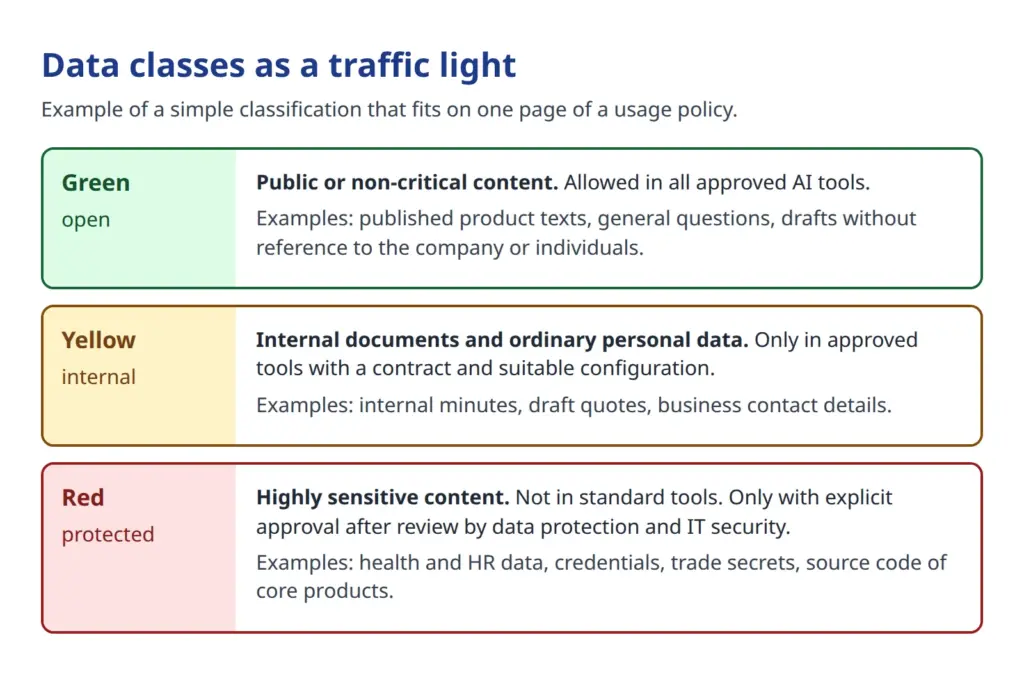
This includes making the data classes easy to understand. Employees can only make the right decisions if the rules are simple. A three-level traffic light has proven effective. Each company decides for itself which examples belong in which level. The figure shows one possible classification.
3. Provide approved tools
At least one vetted offering should be available that covers the most common tasks. Selection criteria include: a data processing agreement, the location of processing, no use of inputs for training, deletion periods, central sign-in with a second factor, logging and manageability. The approval is documented and added to the record of processing activities. Where personal data is processed on a larger scale or with a high risk, the need for an impact assessment must be checked.
4. Technical measures
Technology complements the rules; it does not replace them. Useful measures are:
- Manage browser extensions centrally, for example with an allowlist and a review of the permissions requested.
- Make approved AI services usable only via business accounts with central sign-in and a second factor.
- Detect data leakage, for example through controls at network gateways, on endpoints or in the cloud application. Proportionality and co-determination rights must be observed.
- Enable AI features in existing software only after review, and check the default settings.
- Run agents only with minimal permissions, separate accounts, an approval step for actions with external effect, and logging.
- Put code from assistants through review, tests and dependency scanning, and keep credentials out of repositories.
5. Training and reporting channel
Training does not have to be long. Half an hour with concrete examples from your own company works better than a general lecture. Content: how services handle inputs, what the traffic light means, how outputs are checked, how to recognise prompt injection. A reporting channel is also needed: an address or contact person to whom mistakes and uncertainties can be reported without fear of punishment. The training also supports the promotion of AI literacy under Art. 4 of the AI Act.
The steps can be started in parallel. What matters is that responsibilities are clear: management takes the decision, data protection and IT security prepare it, and the business units report their needs.
Check your own website too
Websites may also embed AI chatbots and third-party scripts that send visitor data to external services. Looking at these complements the internal inventory: GDPR website check and web security checks.
Checklist
- Survey and technical inventory carried out, including AI features in existing software.
- At least one approved AI tool with a data processing agreement and central sign-in provided.
- Record of processing activities updated, need for an impact assessment checked.
- Two-page usage policy with data classes and the rule "red only with explicit approval".
- Browser extensions and AI features managed centrally.
- Agents only with minimal permissions and an approval step.
- Code from assistants is reviewed like any other code.
- Short training held, reporting channel named, procedure for data breaches with the 72-hour deadline known.
- Transfers to third countries and their legal basis documented, status of the Data Privacy Framework monitored.
- Regular review, for example every six months, because services and the legal situation change quickly.
Conclusion
Shadow AI is a symptom: the need for AI support is there, but the organisation's offering is missing or unknown. Those who recognise this can bring it under control with manageable effort. An approved tool, a short policy with understandable data classes, a few technical guardrails and an open reporting channel create more security than a ban alone. The legal situation remains in flux. This applies to the deadlines of the AI Act as well as to data transfers to the USA. Regular review is therefore part of the process.
 My name is Klaus Meffert. I have a doctorate in computer science and have been working professionally and practically with information technology for over 30 years. I also work as an expert in IT & data protection. I achieve my results by looking at technology and law. This seems absolutely essential to me when it comes to digital data protection. My company, IT Logic GmbH, also offers consulting and development of optimized and secure AI solutions.