

No sooner is a new AI model out than the next one is announced. Almost every week, OpenAI, Google, Anthropic and a growing number of challengers report new records: faster answers, larger context windows, better programming skills. To outsiders, this often looks like a race with no visible goal. And indeed, this race has neither a finish line nor a pause button.
This article looks behind the scenes of that race. In the first part, we put into context who is currently playing and why the pace is so high. In the second, deliberately timeless part, we explain something that repeats with every new model but that hardly anyone sees: the complex tool chain that runs in the background as soon as you click “Send”.
A Race Without a Finish Line
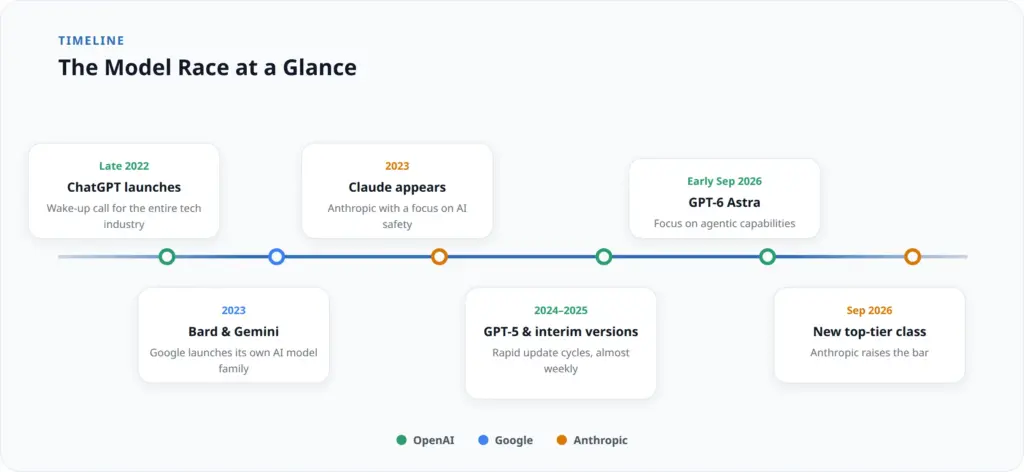
When OpenAI released ChatGPT in late 2022, it was a wake-up call for the entire technology industry. Google, which had been working on its own AI research for years, soon launched Bard and later the Gemini model series. Anthropic, founded by former OpenAI employees with a focus on AI safety, released its Claude models. Within a few years, what had been a niche topic for research labs turned into an arms race worth billions.
What makes this race so special is its pace. Where classic software products used to have annual or biennial update cycles, some AI model generations are now only a few weeks apart. A model that was still considered the front-runner in spring can belong to the second tier by autumn. That is exactly why it is worth understanding not only the current names but also the mechanisms behind them, because those are far more stable than the model designations.
The Current Heavyweights at a Glance
A snapshot of the situation in September 2026 shows how broad the field has become.
OpenAI: From Chatbot to Agent Operating System
OpenAI has developed its GPT model series in rapid succession over recent months, from GPT-5 through several interim versions to the current flagship model GPT-6 Astra, which was rolled out in early September 2026. The focus is increasingly on agentic capabilities: the model is no longer meant merely to answer questions but to complete multi-step tasks on its own, such as carrying out long research projects and writing code across several work steps while retaining context over long sessions. Because of its growing cybersecurity capabilities, OpenAI has for the first time imposed stricter access restrictions on security-critical functions for this model.
Google: Gemini Grows into Every App
Google is pursuing a different strategy: instead of a few large model versions, the company releases many specialized variants of its Gemini series, from lean “Flash” models for quick everyday tasks to more powerful “Pro” and “Deep Think” variants for complex reasoning. It is striking how deeply Gemini is now embedded in existing Google products, from searching your Gmail inbox through photo management to voice control on Android devices. In the background, Google is already working on the next major model generation.
Anthropic: Safety as a Selling Point
Anthropic explicitly positions its Claude models around safety and reliability, especially for use in business. The current model family ranges from compact, fast variants to a new, particularly powerful model class above the previous flagship models. One technical detail is remarkable: to meet the new labeling requirements of the EU AI Act, Anthropic has built an invisible watermark into the word choice of its models, which allows AI-generated texts to be identified statistically after the fact, without any visible characters or additional tokens.
The Challengers: xAI, Meta, Mistral, DeepSeek and Alibaba
Alongside these three providers, a broad field of challengers has established itself. xAI (Grok) relies on a connection to real-time information from social networks and trains its models on one of the largest known compute clusters. Meta continues to take an open approach with its Llama model family: the model weights can be downloaded and run locally, which is particularly interesting for companies with their own data protection requirements. Mistral from France is considered the most important European alternative, with a focus on efficiency and European data infrastructure. From China, DeepSeek and Alibaba’s Qwen series are driving development, often with surprisingly good performance at significantly lower computing cost, which makes them an inexpensive alternative, albeit with their own questions about data security and state influence.
What Drives the Race
Behind the weekly headlines are four factors that hardly change, no matter which model is currently in the lead.
Computing power. Larger and more capable models need more training and computing capacity. The major providers are therefore building their own data centers in the gigawatt range, some with hundreds of thousands of specialized chips.
Capital. Training a top-tier model now costs hundreds of millions to billions of euros. Anyone who wants to keep up needs either very deep pockets or strong investors behind them.
Data and talent. Good training data and the best AI researchers are as fiercely contested as computing power, one reason for the repeatedly sensational salaries and poaching in the industry.
Energy. The power consumption of AI data centers is growing so strongly that it has become a site-selection and climate issue in its own right, with consequences for electricity prices and grid expansion far beyond the tech industry.
The Invisible Engine Room: What Really Happens with Every Prompt
KI-Beratung, KI-Lösungen
Leistungsangebot:
- Erstberatung inkl. Machbarkeitsaussagen
- Schulungen und Workshops für Führungskräfte, Berufsgeheimnisträger, Angestellte, Entwickler
- KI-Lösungen mit und ohne ChatGPT/Azure. Cloud oder eigener KI-Server
 My name is Klaus Meffert. I have a doctorate in computer science and have been working professionally and practically with information technology for over 30 years. I also work as an expert in IT & data protection. I achieve my results by looking at technology and law. This seems absolutely essential to me when it comes to digital data protection. My company, IT Logic GmbH, also offers consulting and development of optimized and secure AI solutions.