

Most website incidents are not caused by clever hackers but by simple gaps that a specialized security scan would have found long ago. Why the scan is often more important than the expensive pentest, and where the two fit together.
A mid-sized company has not had its website tested for years, because a full pentest never made it to the top of the budget and was always something to do "at some point". Exactly in that gap, an attacker ends up inside the content management system, because an outdated software version and an exposed configuration file were enough together. No complex attack, no clever chain: just simple, long-known vulnerabilities that a specialized scan would have found within minutes. This pattern shows why most companies need a security scan first and should only think about a pentest afterwards, not the other way round.
What an automated scan really delivers
A vulnerability scanner works by a clear principle: it automatically compares systems, servers and applications against known vulnerability databases such as the NVD and reports hits based on signatures. The process takes minutes to hours, can be repeated as often as you like and covers the entire attack surface of a company, not just selected systems. That is its strength: vulnerability scanning quickly and repeatably creates visibility into where your own inventory of servers, services and software stands.
For day-to-day operational security this is indispensable. New vulnerabilities are published daily, software versions change, configurations drift. A scan provides breadth: it does not examine one system in great detail, but all systems at least superficially, and so becomes a sensible starting point for assessing your own security status at all.
Where generic scans reach their limits
A general, very broad scan has a downside, though. Because it tries to cover as many different systems as possible at once, the depth of testing per system stays limited. False alarms are relatively common, meaning reported problems that turn out not to be exploitable on closer inspection. Teams then spend time working through findings that prove harmless in the end. Such a scanner can also identify a vulnerability, but cannot always judge whether it is actually exploitable in the specific context.
For websites and web applications this is a decisive point: a generic scan designed for all kinds of IT systems is rarely as specialized as a company's web presence would actually require. This is where specialized security scans come in.
Specialized security scans: a high degree of automation, reliable results
Alongside general vulnerability scanners, a category of its own has emerged: specialized scans that focus on one specific area, such as a company's web presence. Because the scope of testing can be clearly limited, such specialized scanners can reach a very high degree of automation, in some cases almost complete, while delivering very reliable, robust results. The narrow focus is therefore not a disadvantage but the prerequisite for breadth and depth moving much closer together than with a general scan.
A good example of a powerful check that only a specialized scanner can perform is the check of the security.txt file. The web admin is supported with detailed guidance and examples; the decision-maker receives a separate, compact report with statistics on the points met (green), the warnings (yellow) and the errors (red). A generic scanner could not do that in this way – and this was only one of many examples.
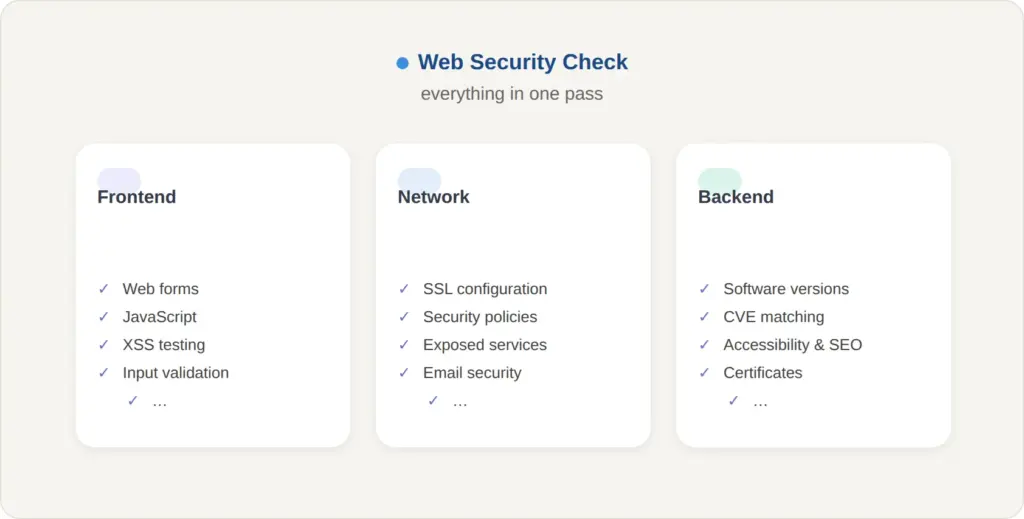
A web security check typically covers the entire attack surface of a website in one pass: in the frontend, forms, embedded JavaScript and possible XSS vulnerabilities are tested; at the network level, the SSL configuration and the security-relevant Content Security Policy (CSP); and in the backend, the web server and software versions are identified and compared against known CVE vulnerabilities. Additional checks for accessibility or SEO recommendations are often included. This all-in-one approach makes sense precisely because the focus is consistently on the web presence, instead of having to cover a company's entire, heterogeneous IT landscape as a generic scan does.
Anyone who has their website checked regularly in this way, for example with a website security check that also offers GDPR-related tests, gets a reliable, continuously updatable picture of the current status with manageable effort, and far more often than a one-off pentest could ever provide.
Where a pentest adds value
For particularly critical systems or complex attack surfaces, a pentest remains worthwhile. Experienced testers think like real attackers and actively try to combine several individually harmless vulnerabilities into a real attack chain. This creative linking of individual steps into a kill chain remains a domain in which human testers outperform automated systems, including newer AI-based testing tools. A recognized methodological framework for this is the OWASP Web Security Testing Guide.
For most companies, however, this is the second step, not the first: it makes sense once a solid baseline of protection exists and individual, particularly sensitive systems are to be examined in more depth, not as a replacement for ongoing, regular checks of your own web presence.
Pentests have their limits too
A typical pentest engagement consists of one or two testers with limited time, which can hardly deliver the necessary depth and breadth at the same time for complex, widely branched attack surfaces. Pentests also mostly take place only once or twice a year, which leaves long windows between appointments in which new vulnerabilities go undetected. Because the scope of testing is defined in advance, entire areas of the infrastructure can stay completely out of view simply because they were not in the agreed scope.
 My name is Klaus Meffert. I have a doctorate in computer science and have been working professionally and practically with information technology for over 30 years. I also work as an expert in IT & data protection. I achieve my results by looking at technology and law. This seems absolutely essential to me when it comes to digital data protection. My company, IT Logic GmbH, also offers consulting and development of optimized and secure AI solutions.