

Whether data is personal does not depend on a name, but on whether someone can be singled out from the crowd. Identifiable personal data is any information that can be linked to a person through additional knowledge. This article explains how the courts understand “identifiable”, what the CJEU’s SRB judgment changes and what this means for IP addresses, cookies and fingerprints.
Why the name is not decisive
In practice, the concept of personal data is often understood too narrowly. Anyone who does not store a name quickly considers the data harmless. Legally, that argument does not go far. The decisive question is who can recognise, re-recognise or distinguish a person from others, and by what means.
This article examines that question step by step. It starts with the wording of the regulation and the concept of distinguishability. This is followed by the leading decisions of the CJEU and the German Federal Court of Justice (BGH) as well as the most recent judgment in the SRB case. The second part deals with identifiable personal data online, i.e. online identifiers, fingerprints, the TC string and the consequences for damages claims. A short checklist summarises the result. Where the author’s own assessments appear, they are marked as such.
What “identifiable” means: Art. 4(1) and Recital 26
The definition can be found in Art. 4(1) GDPR. According to it, personal data means
“any information relating to an identified or identifiable natural person (‘data subject’); an identifiable natural person is one who can be identified, directly or indirectly, in particular by reference to an identifier such as a name, an identification number, location data, an online identifier or to one or more factors specific to the physical, physiological, genetic, mental, economic, cultural or social identity of that natural person”.
Basics and examples are covered in the article What is personal data? (in German). Here, the focus is solely on the second half of the sentence: when is someone identifiable? It can be the name, but it does not have to be. An online identifier or a combination of specific factors is enough.
How far this possibility extends is set out in Recital 26. It requires account to be taken of “all the means reasonably likely to be used, such as singling out, either by the controller or by another person to identify the natural person directly or indirectly”. What counts are “all objective factors, such as the costs of and the amount of time required for identification, taking into consideration the available technology at the time of the processing and technological developments”.
Three points stand out. First, identification by the controller “or by another person” counts. Second, what matters is likelihood, not mere theoretical possibility. Third, the text explicitly names “singling out” as a means. This builds the bridge to the next section. Identifiability under the GDPR can only be understood once it is clear what “identifying” actually means.
Identifiable personal data: distinguishability instead of a name
The former Article 29 Working Party (WP29) broke down the concept in its Opinion 4/2007 (WP 136) of 20 June 2007. The opinion referred to Directive 95/46/EC, but its approach continues under the GDPR. Accordingly, a person is considered identified if, within a group of persons, he or she can be “distinguished” from all other members. A person is identifiable if this distinction is possible, even if it has not yet taken place. The suffix “-able” means exactly that.
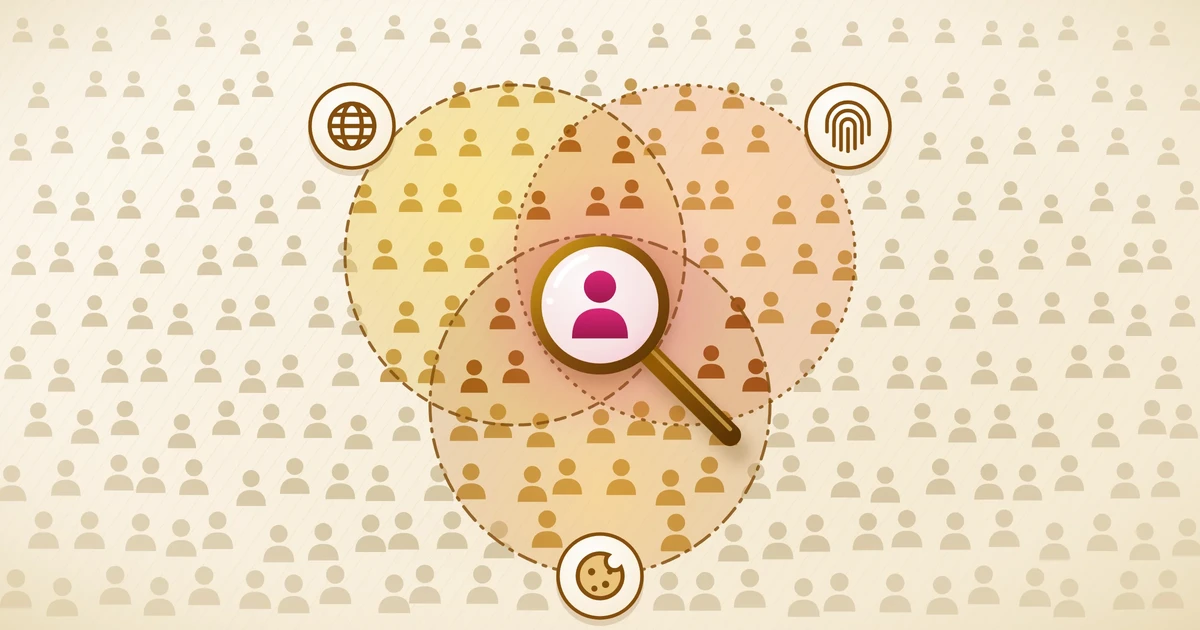
Identifying does not mean knowing the name, but being able to single someone out from the crowd.
The WP29 also examines when information “relates” to a person. This is the case if its content is about the person, if it is used for the purpose of evaluating or treating the person, or if it affects the person’s rights or interests. A record with only an identifier can therefore be personal data if it is used to make decisions about precisely that person.
The Irish supervisory authority took up this reading in the WhatsApp proceedings. The Data Protection Commission (DPC) under Helen Dixon described Opinion 4/2007 as a helpful analysis in its decision of 20 August 2021 (IN-18-12-2), even though it is not binding. In para. 79, it states that Recital 26 provides for a risk-based approach. The possible risk of identification must be assessed on the basis of all means that could reasonably be used by the controller or a third party. The case concerned telephone numbers of non-users. The DPC considered singling out to be present there even if nobody knows the name.
The idea is simple: identifiable personal data exists as soon as a piece of data can be attributed to a person, even without a real name. An identifier that picks out one device or profile from millions of others does exactly that. Recital 30 describes this constellation: natural persons may be associated with “online identifiers provided by their devices, applications, tools and protocols, such as internet protocol addresses, cookie identifiers”. This “may leave traces which, in particular when combined with unique identifiers and other information received by the servers, may be used to create profiles of the natural persons and identify them”.
Relative or absolute: who can identify is what counts
For a long time, it was disputed from whose perspective identifiability should be assessed. The absolute theory says: personal data exists as soon as anyone in the world can identify the person. The relative theory asks about the means available to the party concerned. The relative approach to personal data is not an invention of recent years but is rooted in the wording of Recital 26.
The turning point came with the Breyer case. On 19 October 2016 (C-582/14), the CJEU ruled that a dynamic IP address constitutes personal data for a website operator if the operator has legal means to have the data subject identified with the help of the additional information held by the internet access provider. This refers, for example, to going through the competent authority. The Court emphasised that not all information has to be in the hands of one party. In addition, the very term “indirectly” shows that information does not have to enable identification on its own.
The BGH implemented the proceedings (VI ZR 135/13) with its judgment of 16 May 2017
 My name is Klaus Meffert. I have a doctorate in computer science and have been working professionally and practically with information technology for over 30 years. I also work as an expert in IT & data protection. I achieve my results by looking at technology and law. This seems absolutely essential to me when it comes to digital data protection. My company, IT Logic GmbH, also offers consulting and development of optimized and secure AI solutions.