

Imagine giving a new employee access to the entire knowledge of your company on their first day – not through hours of reading, but through a system that answers questions in natural language and shows exactly which document each answer comes from. That is exactly what an AI database does.
This article explains what is behind the term, how the technology works, and why the difference from an ordinary database is bigger than it first appears.
Why information is so hard to access in companies
Every company has knowledge – but rarely where you need it. It sits in PDF reports on a network drive, in email attachments, in old Excel spreadsheets, in SharePoint folders, in the ERP system manual, or in the heads of experienced employees who at some point wrote it down in a Word document.
The problem is not missing knowledge but missing accessibility. Classic search tools only help to a limited extent: they search file names and full texts for keywords – and at best deliver a list of documents that you then have to work through yourself. Anyone searching for “warranty period supplier” may get twenty hits. The actual answer to the question still has to be found by hand.
This is exactly where artificial intelligence comes in. The following animation illustrates the architecture of an AI database to which an AI model (answer engine) is connected.
What AI actually means in this context
Artificial intelligence is not a single concept but an umbrella term for various technologies that enable machines to take over tasks that used to require human intelligence: understanding text, recognizing patterns, answering questions, and making connections.
The subfield relevant for AI databases is Natural Language Processing (NLP) – the machine processing of natural language. Modern language models (Large Language Models, LLMs) such as GPT, DeepSeek, Llama or Mistral can understand the content of text instead of merely searching it superficially. They recognize that “delivery deadline”, “delivery date” and “delivery time” mean the same thing, even if the word in the document is different.
This ability is the foundation for a system that can answer questions in everyday language – without the user having to know exactly how a document is worded or where it is stored.
Conventional database vs. AI database
A direct comparison helps to understand the difference.
A conventional database stores structured information in tables: customer numbers, order quantities, dates. Queries work with exact criteria – a record is found if it matches the searched value exactly. This is fast, precise and ideal for structured data. But free text, scans, presentations and manuals cannot be searched in any meaningful way.
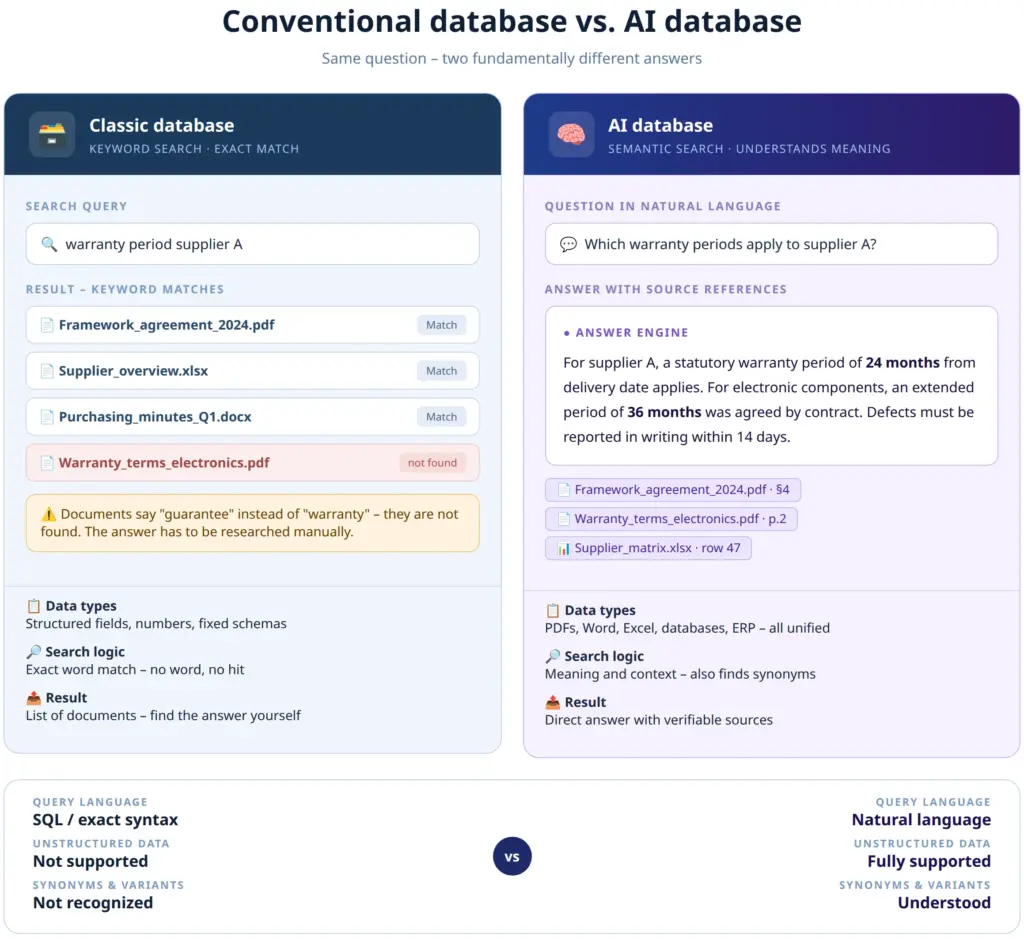
An AI database – technically often called a vector database – works fundamentally differently. It does not store exact values but the meaning-bearing properties of content. Texts, documents and even table values are converted into mathematical vectors that represent their semantic content. Two passages with a similar meaning lie close together in vector space – even if they are worded completely differently.
| Conventional database | AI database | |
|---|---|---|
| Data types | Structured (numbers, fields) | Structured + unstructured (text, documents, images) |
| Search | Exact value matching | Meaning-based similarity search |
| Query language | SQL / proprietary syntax | Natural language |
| Result | Records | Contextual answers with source references |
| Prerequisite | Defined data schema | Any content, no schema required |
What vectorization means – and why it is the key
Vectorization sounds technically abstract but is intuitive to understand. Every word, every sentence, every section of text is converted by a so-called embedding model into a numerical vector – a sequence of numbers that encodes the meaning of the content.
A simple example: the term “dog” and the term “puppy” become vectors that lie close together. “Dog” and “automobile” are far apart. The system has not memorized a list of synonyms – it has learned from huge amounts of text in which contexts terms appear, and derived their semantic relationships from that.
For a company this means: internal technical vocabulary, abbreviations or industry-specific terms can also be classified correctly by the system – either because they are already known to the language model or because the model learns their context from enough internal company material.
When an employee asks “Which conditions apply to returns according to the framework agreement?”, the system does not look for the word “returns” in documents. It looks for passages whose vector representation matches the question in content – and thus also finds passages that talk about “return shipments”, “product returns” or “right of withdrawal”.
How an AI database is built in practice
The underlying principle is called Retrieval-Augmented Generation, or RAG for short. It combines two components:
1. The vector database (retrieval) All company documents are read in, split into sections and vectorized. These vectors are stored in a database. When a user asks a question, the question is vectorized as well and compared with the stored vectors. The system finds the passages that match best in content – without a single keyword having to match.
2. The language model (generation) The passages found are handed to a language model as context. The model uses them to formulate a coherent, understandable answer in natural language – and cites the sources the information comes from.
The result: no hallucinated answers out of thin air, but answers that can be traced back to real company documents.
Which data sources can be connected
A major advantage over isolated search tools is the breadth of possible data sources. An AI database can take in content from very different formats and systems and consolidate it in a single semantic space:
Document formats: PDF, Word, Excel, PowerPoint, CSV, Markdown, HTML, plain text files – anything that is machine-readable can be read in and processed.
Structured databases: SQL databases, NoSQL systems and internal databases can be connected as well. Tabular content is prepared so that its meaning is captured, not just the bare values.
Third-party systems: ERP systems such as SAP, CRM platforms such as Salesforce or industry-specific applications such as iTWO can be connected via interfaces (APIs). Content is synchronized regularly or on demand.
Missing interfaces? No obstacle
In practice, the interface landscape of many companies is anything but uniform. Old systems offer no APIs, proprietary formats resist common export tools, and grown IT infrastructures sometimes resemble a patchwork built over decades.
Here the AI database offers a pragmatic way out: if a direct connection is technically complex or impossible, the relevant content can be provided as file exports or reports – and loaded into the AI database. A report generated from the ERP as a PDF, a CSV exported from the ticket system, manually maintained overviews as Excel – all of it becomes part of the same semantic pool.
This means: the AI database can work as a single access point for company knowledge, even if the source systems do not communicate with each other. Instead of opening ten different tools, the user asks one question – and gets an answer assembled from several sources, with exact references to where it came from.
Why local operation means more than GDPR compliance
When data security in connection with AI is discussed, the term GDPR almost always comes up immediately. That is justified – but it falls short.
Of course, personal data needs protection, and the General Data Protection Regulation prescribes that it must not be transferred to third countries without control. Anyone who sends documents containing customer data to an external AI service risks a data protection violation.
But companies have far more to protect than personal data:
Trade secrets – pricing strategy, calculations, purchasing conditions, margins: this information is highly interesting to competitors and legally protected by the German Trade Secrets Act (GeschGehG).
Technical know-how – design drawings, production recipes, development documentation: anyone who uploads this data to an external service may be giving away the core of their competitive advantage.
Contract details and conditions – framework agreements with suppliers, special arrangements, discount structures: if this information reaches third parties, direct economic damage results.
Strategic plans – M&A considerations, product development roadmaps, market entry plans: here a leak of information can have existential consequences.
With cloud-based AI services, the transmitted data is usually not stored permanently – but it passes through foreign infrastructure, is processed on foreign servers, and full control over it is simply not given. Even if a provider promises confidentiality: what is technically possible remains a risk.
A fully locally operated system eliminates this risk structurally. The documents do not leave the company network. The language model runs on your own hardware. No request, no document content, no answer is transmitted to external servers. Data security here does not arise from trust in a provider but from technical reality.
Transparency and the EU AI Act
Since the EU AI Act came into force, AI governance has also become legally binding. Companies that use AI systems must – depending on the risk class – be able to demonstrate how decisions are reached, which data is used and how the system is monitored.
A locally operated AI database makes it considerably easier to meet these requirements:
The model in use is known and can be documented. The data flow is fully traceable. Every answer contains a direct source reference – auditors can check at any time what a statement of the system is based on. There is no dependence on an external provider whose model changes without notice.
Especially in regulated sectors – finance, healthcare, public administration – this transparency is not optional but a prerequisite for legally compliant operation.
How the system handles internal technical vocabulary
Every company has its own language. Abbreviations, product names, internal process names, industry-specific terms – what is incomprehensible to outsiders is self-evident internally. A general search tool does not know these terms and delivers correspondingly poor results.
An AI database learns this vocabulary from the documents it processes. The more internal material is fed in, the better the system recognizes how certain terms are used in the company context and what they mean. In addition, systems can be adapted specifically: through glossaries, through fine-tuning the language model on company-specific texts, or by enriching the vector database with structured definitions of meaning.
The result is a system that does not just find documents but understands and answers technical questions in the language of the company.
What an AI database is not
To foster realistic expectations, it is important to name the limits as well.
An AI database is not an all-knowing system. It can only return knowledge that has been made available to it. If an important document is missing from the data basis, the system cannot give any information on it.
It is not a substitute for human judgment. The system’s answers are starting points, not final decisions. Especially for complex legal, medical or strategic questions, human review remains indispensable.
It is not a self-learning system in continuous operation. The knowledge of the database does not grow automatically – new documents have to be fed in actively. Regular updates are part of operation.
And it is not a universal tool for all data tasks. For high-frequency transaction processing, real-time accounting or complex relational database queries, the classic database remains the right tool. The two systems do not exclude each other – they complement each other.
Conclusion: Making knowledge accessible without giving up control
The real strength of an AI database lies not in spectacular technology but in pragmatic benefit: it makes existing knowledge actually findable – fast, precise, source-based and in natural language.
In doing so it combines something that was long considered a contradiction: the comfort of modern AI assistants with complete control over your own data. No knowledge leaves the company. No external infrastructure processes sensitive content. No provider has insight into trade secrets.
For companies that want to consolidate their distributed knowledge, relieve their employees and keep sovereignty over their data, this is a convincing approach – regardless of industry or company size.
You can find more guides, model comparisons and practical examples in the overview of local AI.
 My name is Klaus Meffert. I have a doctorate in computer science and have been working professionally and practically with information technology for over 30 years. I also work as an expert in IT & data protection. I achieve my results by looking at technology and law. This seems absolutely essential to me when it comes to digital data protection. My company, IT Logic GmbH, also offers consulting and development of optimized and secure AI solutions.