


Who doesn’t know it: a pile of receipts somewhere on the desk that has to be typed into a spreadsheet by hand – for bookkeeping, expense reports or inventory management. What used to take hours can now be done in seconds. The combination of classic text recognition (OCR) and modern AI makes it possible. So what is behind AI OCR – technically, strategically and in practice?
What is OCR – and what can AI do better?
OCR stands for Optical Character Recognition. The principle has been known for decades: an algorithm analyzes an image and converts the character patterns it recognizes into machine-readable text. Classic OCR systems are rule-based and optimized for clean, uniform print. With receipts, however, they quickly reach their limits.
Receipt paper is thermally printed, fades over time, creases easily, and the typeface varies considerably from one cash register model to the next. Add handwritten notes, torn edges or poorly scanned PDFs.
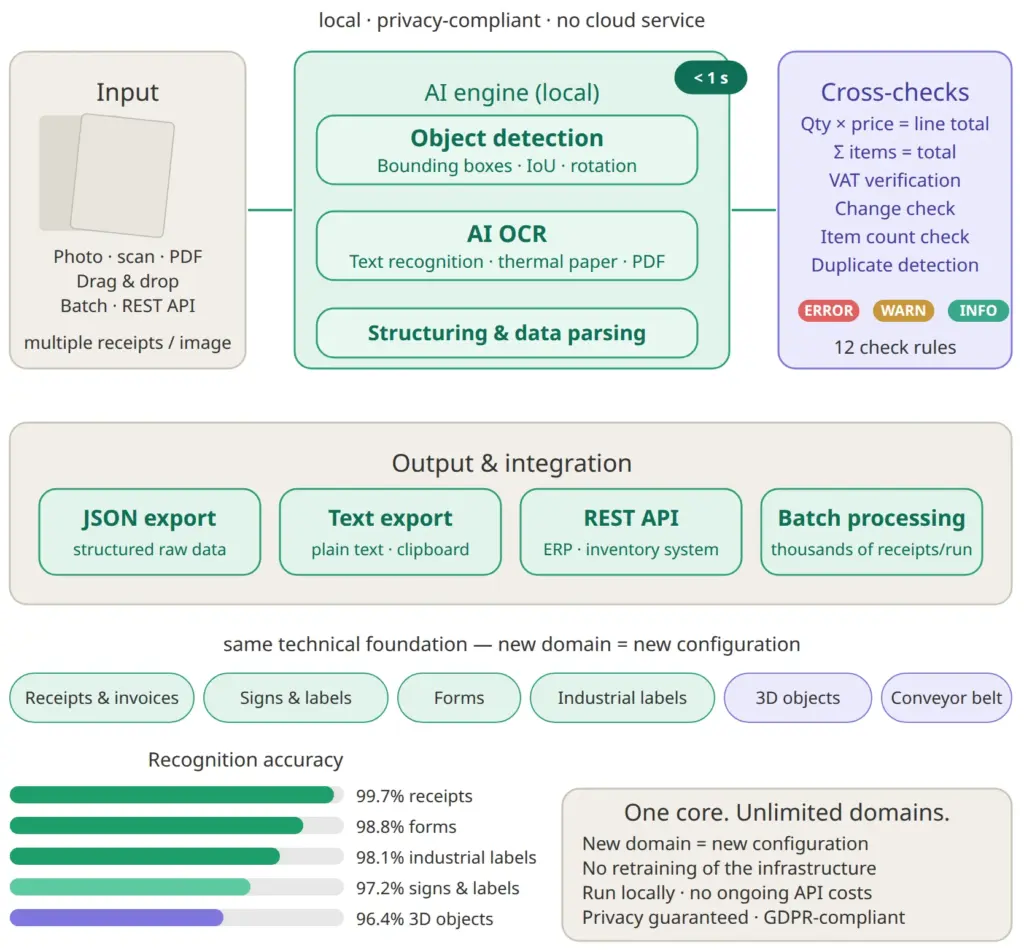
Modern AI-based OCR models take a different approach: instead of fixed pattern recognition, they were trained on millions of documents and learn in context. They don’t just recognize individual characters but understand structural relationships – for example, that an item name is followed by a quantity, a unit price and a line total. This enables far more robust recognition even with poor print quality, skewed alignment or fragmented lines.
Why local AI is the strategically smarter choice
A key point that is often underestimated when planning such systems: where the AI runs.
Cloud services such as Azure AI, Google Vision or ChatGPT-based APIs are quick to integrate – but they come with structural disadvantages:
Costs scale with volume. Anyone processing thousands of receipts a month pays accordingly. Local models, by contrast, run after a one-time setup without ongoing API costs.
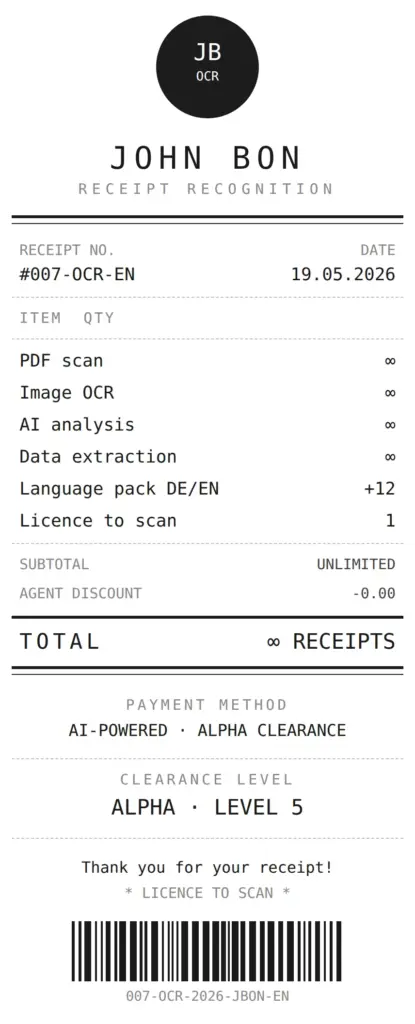
Data protection and data security are particularly relevant for receipts. Receipts can contain personal data, business figures or purchasing patterns – data that should never leave your control and end up on external servers. Local means: the data stays in-house.
Strategy and independence: if you build on a cloud service, you depend on its availability, pricing and API changes. A locally operated model belongs entirely to the operator.
Quality and control: local models can be configured and fine-tuned for specific use cases – without the compromises of generic cloud services.
That doesn’t mean local AI is weaker. Current open-source models and specialized OCR engines achieve recognition accuracies in defined domains that match or exceed commercial cloud services.
More than text recognition: AI and classic logic working together
A common misconception: AI does everything. In practice, a solid processing system is an interplay of AI-based recognition and classic, rule-based validation logic – two components that reinforce each other.
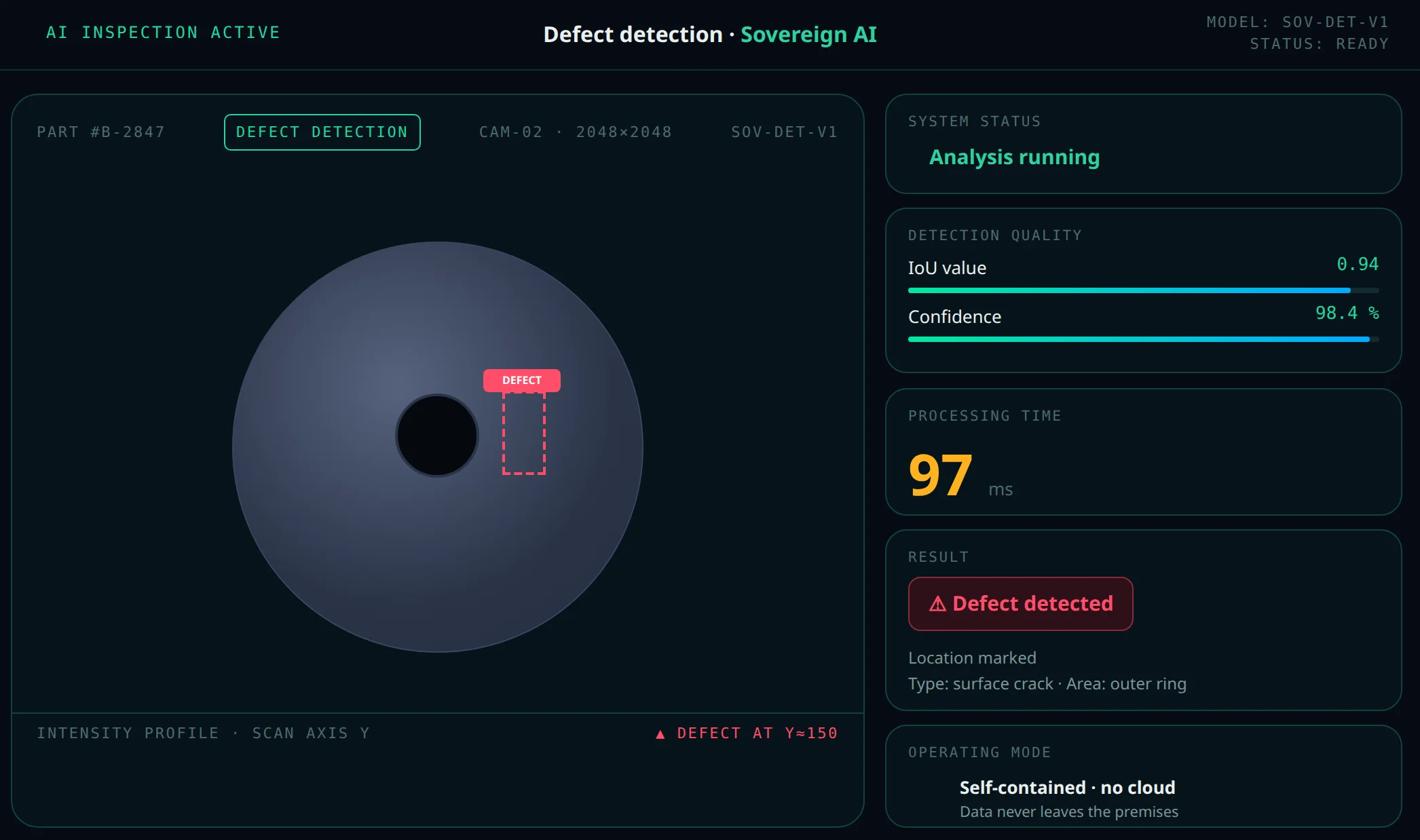
The capabilities of AI go beyond text recognition, though. To automate the detection of defects in components, we use AI for quality control. This technology enables automatic defect detection, which brings enormous savings in time and cost.
The AI recognizes and structures the text. It delivers raw data: items, quantities, prices, totals, tax details. What happens with this data is classic program logic – and there it is unbeatably precise.
What does that mean in practice? After text recognition, a reliable receipt analysis checks, among other things:
- Does quantity × unit price match the stated line total?
- Does the sum of all items plus discounts and deposits equal the total?
- Is the stated VAT amount calculated correctly?
- Does the stated change match the difference between the amount tendered and the total?
- Does the stated item count match the number of recognized items?
- Do identical items appear twice – OCR error or a genuine double purchase?
Such cross-checks can be implemented without AI and form the second layer of safety behind recognition. They make the difference between a system that extracts text and one that actually understands whether a receipt is correct.
Results can be classified by severity – for example as a critical error, a warning or purely informational – and can be exported in a structured way, processed further or integrated into existing systems via a REST API.
What modern AI OCR can really do
Anyone working with AI-based text recognition for the first time often underestimates how far the capabilities of modern models go beyond what classic solutions could do. Three areas stand out in particular.
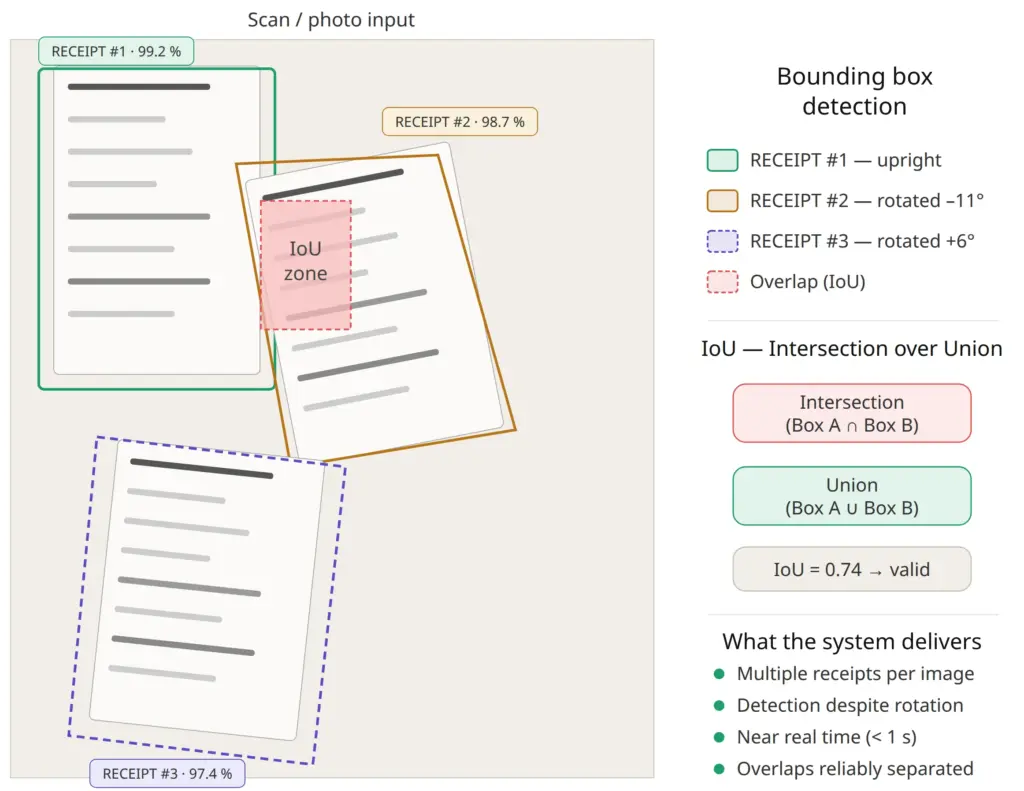
Multiple documents in a single image. In practice, receipts rarely end up on the scanner individually and perfectly aligned. Several receipts are often photographed or scanned together – side by side, slightly overlapping, rotated against each other. A powerful system recognizes each receipt as an independent object, cleanly segments it from the overall image and evaluates it separately – without manual presorting. This saves considerable effort in day-to-day capture.
Bounding box detection in near real time. Even before the actual text recognition starts, the system can determine the exact outlines of each detected object in the image as so-called bounding boxes – the exact rectangular frames enclosing each document or object. This happens in near real time and is far more than a by-product: this ability to localize objects precisely is the same technology that detects and measures parcels on a conveyor belt, classifies products on a shelf or identifies industrial components in motion. The receipt is, in a sense, the simplest test case for a technology with much broader potential.
OCR quality that surpasses the human eye. Thermal paper is the nemesis of classic text recognition: it fades with heat, light and time – sometimes so badly that even a trained eye can barely decipher individual characters. Modern AI models were trained on exactly such edge cases. They use contextual information, character probabilities and learned typeface patterns to reconstruct even heavily faded passages with high reliability. In defined test scenarios they outperform human recognition accuracy – not because AI generally sees more sharply, but because it fills in patterns where visual information has already been lost.
Together, these three properties – multi-object detection, real-time localization and superhuman character reconstruction – define what distinguishes a professional AI OCR solution from a simple scan-to-text tool.
From idea to solution: John Bon
This is exactly the approach taken by John Bon, a locally deployable analysis platform for receipts and vouchers. The system combines AI-based OCR with multi-stage cross-checking and delivers structured results in JSON or text format – directly exportable, copyable to the clipboard or retrievable via API.
The process is deliberately kept simple:
- Upload an image or PDF – by drag & drop or click, with a selectable page range for PDFs
- Automatic text recognition, structuring and verification – in under a second
- Export, process further or archive the result
Each page is evaluated individually and displayed with a preview image and a full view – so you always keep track of the relationship between original and analysis.
The system is designed to work reliably even with poor print quality, faded thermal paper or handwritten additions.
What else is possible: one technology, many applications
The interesting thing about such an AI OCR infrastructure: it is not limited to receipts. The technical core – image recognition, text extraction, structured output, rule-based validation logic – is domain-independent. A new use case usually requires no new infrastructure, just a new configuration.
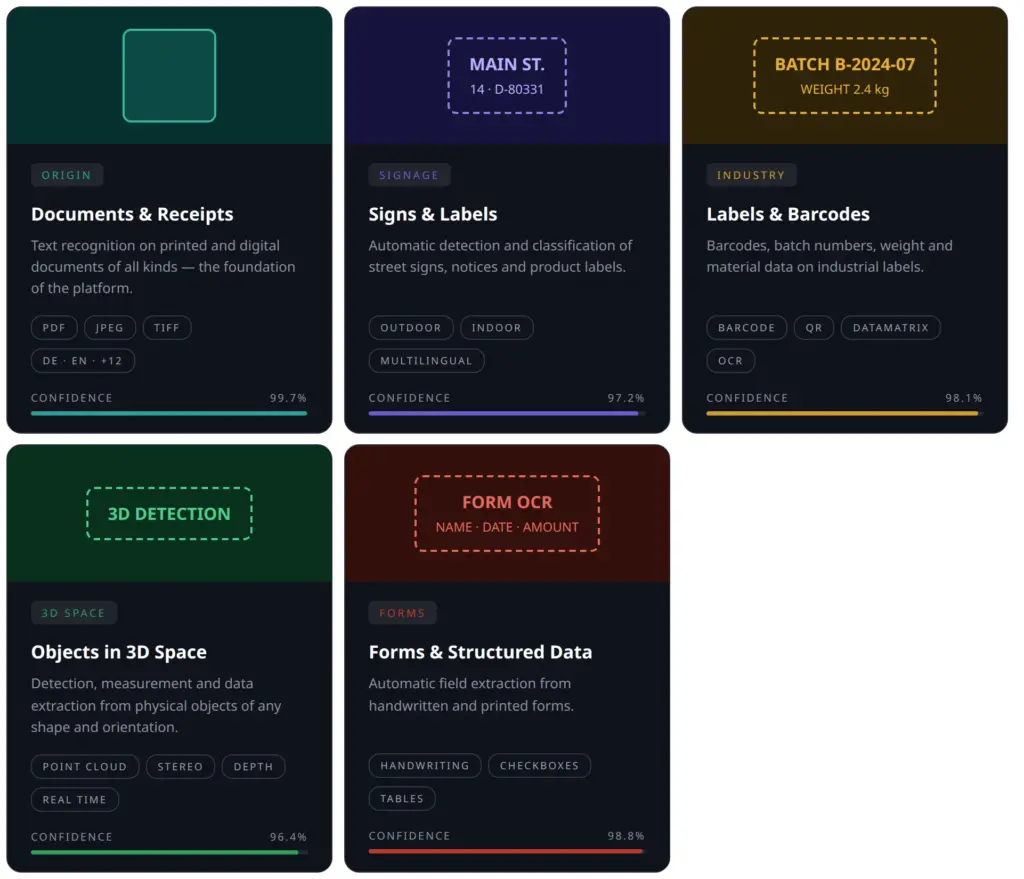
This opens up a remarkable range of economically relevant scenarios:
Documents and receipts (invoices, delivery notes, receipts) are the natural relatives of the cash register receipt – same logic, different structure.
Signs and labels can be detected and classified automatically – relevant for logistics, retail or quality assurance.
Industrial labels and barcodes with batch numbers, weight and material data can be captured without manual entry.
Forms – printed or handwritten – with checkboxes, tables and free-text fields can be read and structured automatically.
Objects in 3D space: here you leave the pure document world. Detection, measurement and data extraction from physical objects of any shape and orientation – an area that is gaining importance in manufacturing, intralogistics and quality control.
The common denominator: infrastructure built once, usable many times over. That makes such systems not only technically interesting but also highly attractive economically.
Mass data processing and scalability
Another aspect that is decisive in practice: scaling. Anyone who checks not just individual receipts but thousands per day – in retail, accounting or field service, for example – needs batch processing.
Powerful systems process large volumes of images or PDFs in a single run, fully automatically, without manual handling of individual items. The REST API connection enables integration into existing software landscapes – from inventory management to ERP systems.
Conclusion
Automatic receipt processing is an excellent example of how AI and classic program logic together achieve more than either technology alone. AI brings robustness to unstructured, variable input. Rule-based logic brings precision and traceability to validation.
Process receipts automatically in seconds
AI-based text recognition with 12-fold cross-checking — calculation errors, VAT, change and duplicates at a glance. Export as JSON, text or via REST API.
What matters for a professional, scalable and privacy-compliant solution is local operation – independent of cloud services, fully controllable, cost-efficient in ongoing operation.
Once you have built this infrastructure, you hold a technological building block that reaches far beyond the original use case.
For an overview of all posts on AI in your own premises, see the page Local AI in the Enterprise.
 My name is Klaus Meffert. I have a doctorate in computer science and have been working professionally and practically with information technology for over 30 years. I also work as an expert in IT & data protection. I achieve my results by looking at technology and law. This seems absolutely essential to me when it comes to digital data protection. My company, IT Logic GmbH, also offers consulting and development of optimized and secure AI solutions.