

Market research thrives on a simple question: what do people think about a product, a promotion or a message? The classic answer is laborious. Participants have to be recruited, scheduled and paid, questionnaires have to be designed and analysed, and it often takes weeks before reliable results are available. Artificial intelligence opens up a new path here, without making human surveys obsolete. Using a solution called Personas KI as an example, this article shows what AI personas can do for market research today and what role the principle of sovereign AI plays in it.
AI personas explained: simulating buyer types instead of recruiting participants
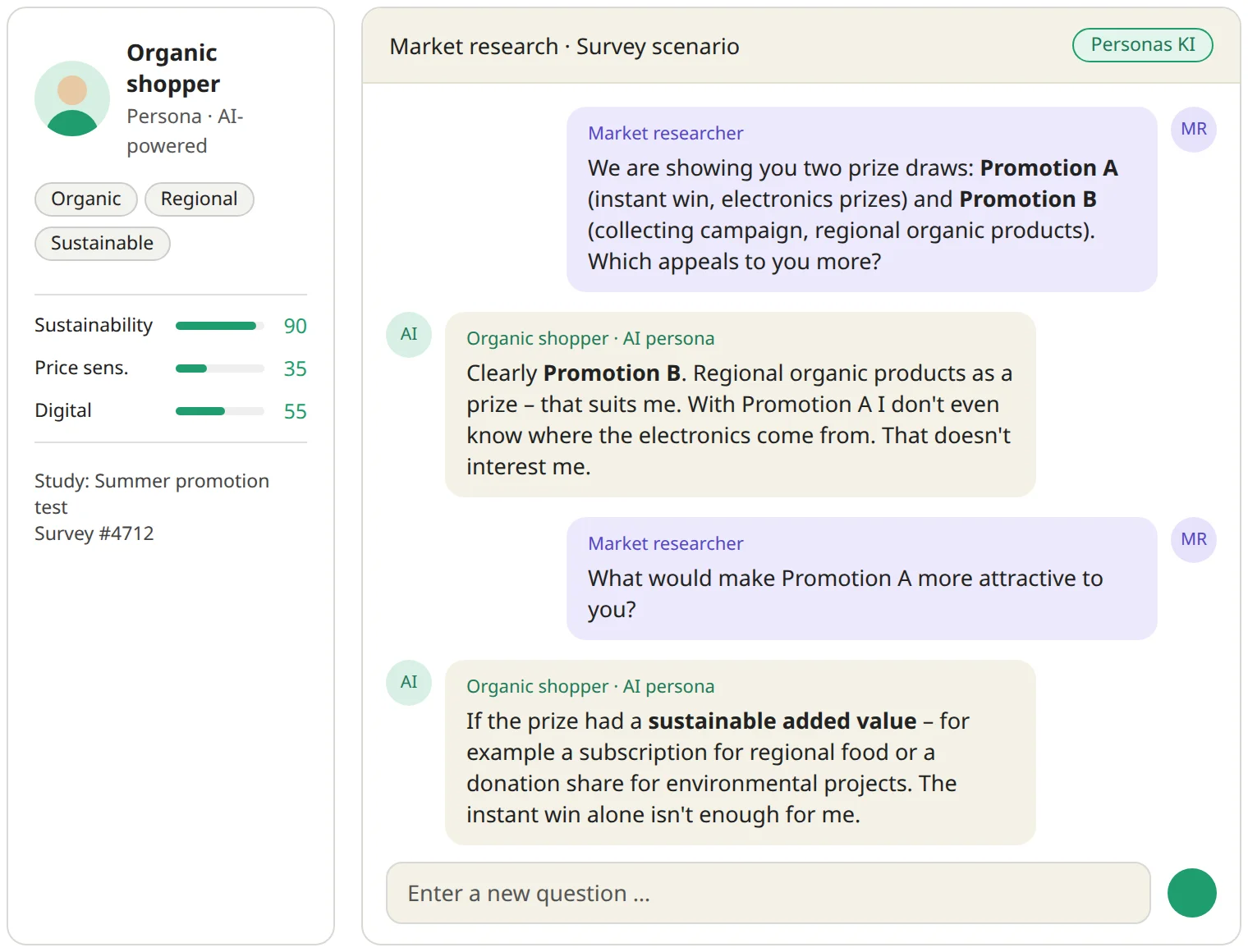
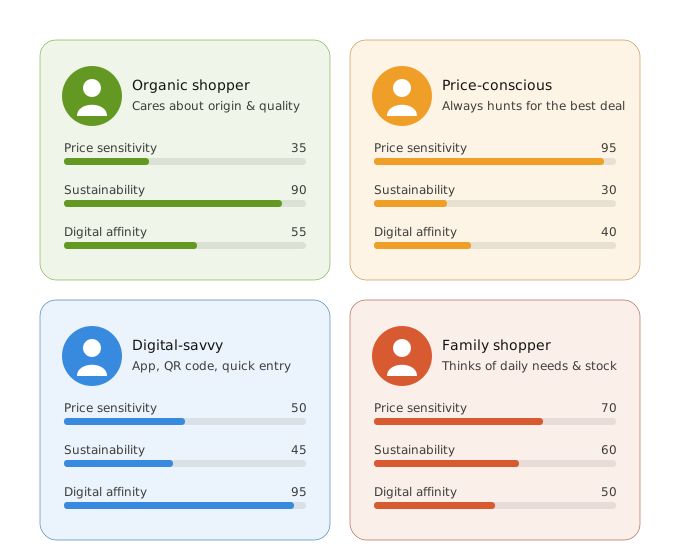
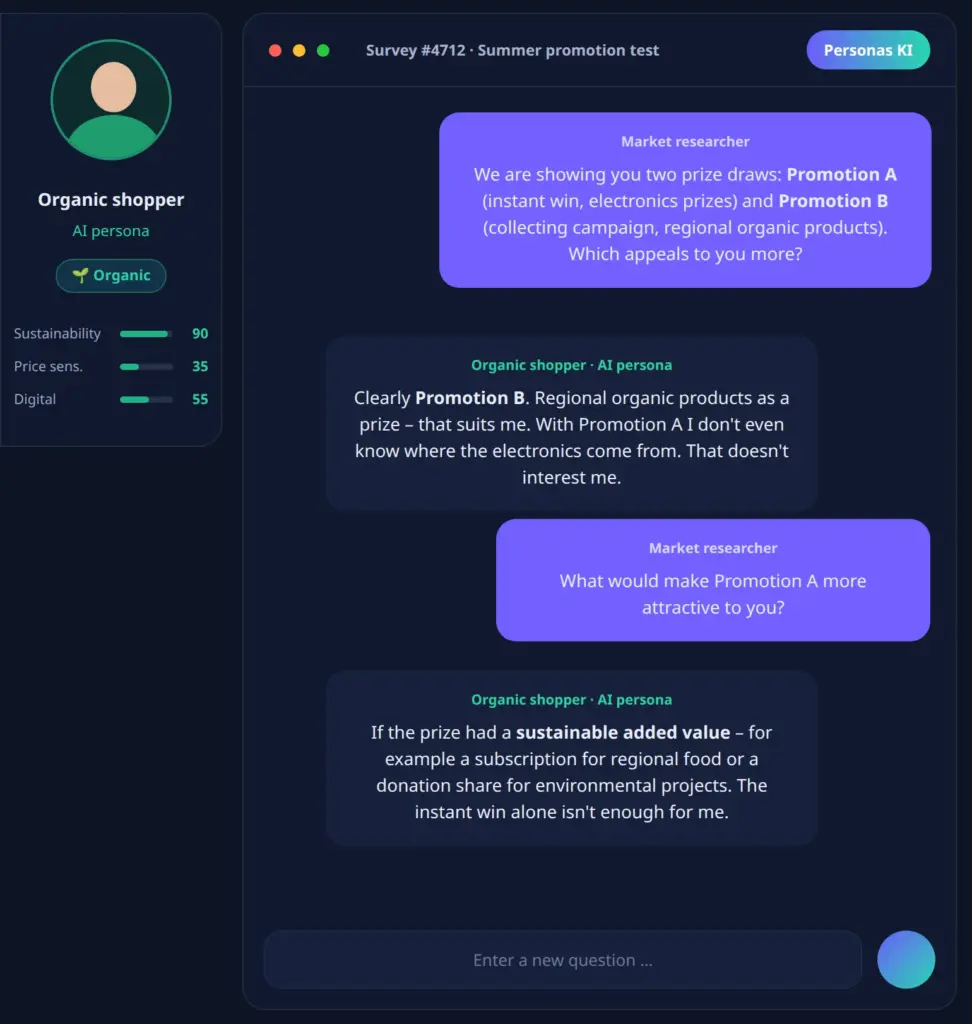
At its core, Personas KI simulates different buyer types, so-called shoppers. Instead of surveying real people, the AI slips into a defined role and answers questions consistently from that perspective. If you want to question an organic-product buyer, you get answers that emphasise sustainability and origin. A price-conscious type compares offers and looks for the best deal. The digitally savvy shopper expects an app and a QR code, the family shopper thinks of everyday life and stocking up.
The practical benefit is obvious. Time-consuming and costly surveys of real participants can be avoided for many preliminary tests. First tendencies are available in seconds, not after weeks, and the costs of recruitment and compensation are eliminated. This is not a replacement for every form of empirical research, but a valuable tool for testing and sharpening ideas early, before larger budgets are spent.
Why the data base makes the difference
The question of how intelligence arises and the role of random processes are fundamental. To fully understand the behaviour of Personas KI, it is important to consider the underlying probability theory and statistical modelling – probability and chance are the foundation of every simulation in this context.
An AI is only ever as good as the knowledge it builds on. Personas KI draws on the knowledge from several hundred thousand real promotions, such as prize draws and advertising campaigns. This experience keeps the simulated assessments grounded in practice instead of staying generic.
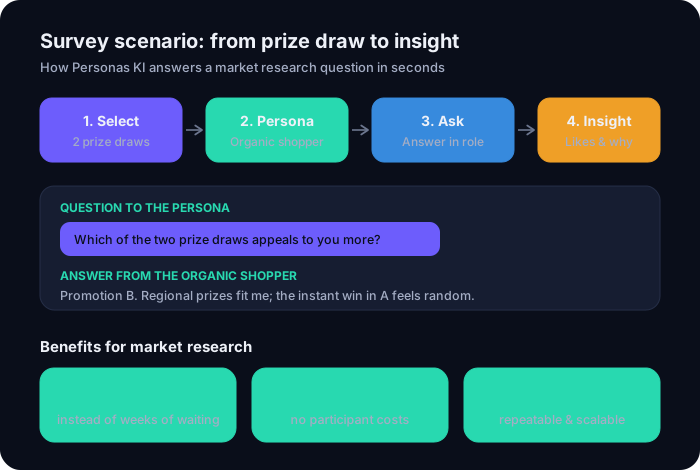
A concrete example is the integrated promotion search. The solution has its own built-in database from which one or more promotions can be selected for a survey. This makes it possible to find out which prize draw a particular persona likes best and, above all, why. It also shows where a promotion fails to convince or where there is still room for improvement. This combination of role simulation and a concrete data base distinguishes a well-thought-out specialist solution from a general chatbot.
To understand the full potential of personalised AI, it is important to know the foundation. Local AI solutions offer higher efficiency than cloud services in the long term, because they learn continuously and adapt to specific needs.
Sovereign AI: the data treasure stays with its owner
This brings in a term that is gaining importance beyond market research: sovereign AI. It means AI in which control over data and processing remains in the hands of the operator and data owner, instead of flowing uncontrolled to third parties.
This is more than a technical detail. The experience gathered from hundreds of thousands of promotions is a genuine data treasure. It has built up over years, is hard to reproduce and forms the basis for the quality of the results. With a sovereign solution, this treasure stays with the data owner. It is used to gain insights, but it does not leave the operator's control.
This approach brings several advantages for companies:
- Data sovereignty: Valuable data stays where it belongs and does not become training material for third-party systems.
- Privacy from the start: Because simulated personas are used instead of real participants, no personal data has to be collected at all for many questions.
- Traceability: Anyone who controls the steering and the data base can better interpret and reproduce results.
- Trust: Data protection and secure processing are not an afterthought but an integral part of the architecture.
Sovereign AI therefore does not mean doing without modern methods. It means using them in such a way that control and responsibility remain with the data owner.
Reliability through a purpose-built solution
A general language model can do a lot, but its answers fluctuate and it can only be steered to a limited extent. A solution developed specifically for one purpose goes further. With Personas KI, this shows in three ways.
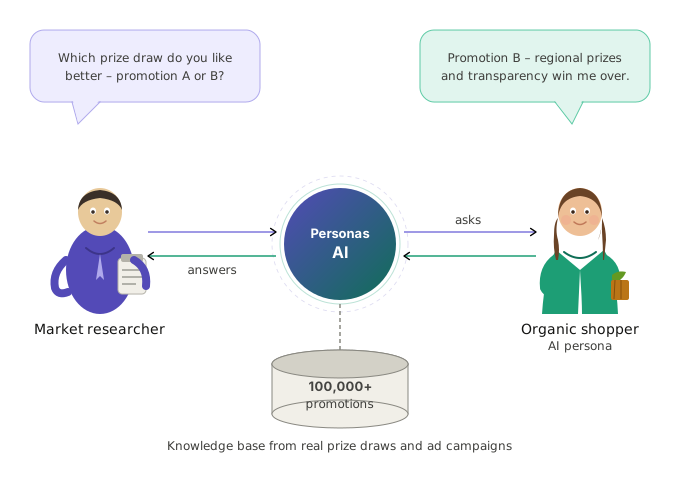
First, reliability increases because the answers stay within the role frame and remain traceable. Second, control improves, since character, question and context can be defined precisely and reproducibly. Third, the user interface becomes simpler and at the same time more powerful, so that even complex surveys remain manageable. These three properties are no coincidence, but the result of deliberate design around the specific use case.
 My name is Klaus Meffert. I have a doctorate in computer science and have been working professionally and practically with information technology for over 30 years. I also work as an expert in IT & data protection. I achieve my results by looking at technology and law. This seems absolutely essential to me when it comes to digital data protection. My company, IT Logic GmbH, also offers consulting and development of optimized and secure AI solutions.