

Market research thrives on a simple question: what do people think about a product, a promotion or a message? The classic answer is laborious. Participants have to be recruited, scheduled and paid, questionnaires have to be designed and analysed, and it often takes weeks before reliable results are available. Artificial intelligence opens up a new path here, without making human surveys obsolete. Using a solution called Personas KI as an example, this article shows what AI personas can do for market research today and what role the principle of sovereign AI plays in it.
AI personas explained: simulating buyer types instead of recruiting participants
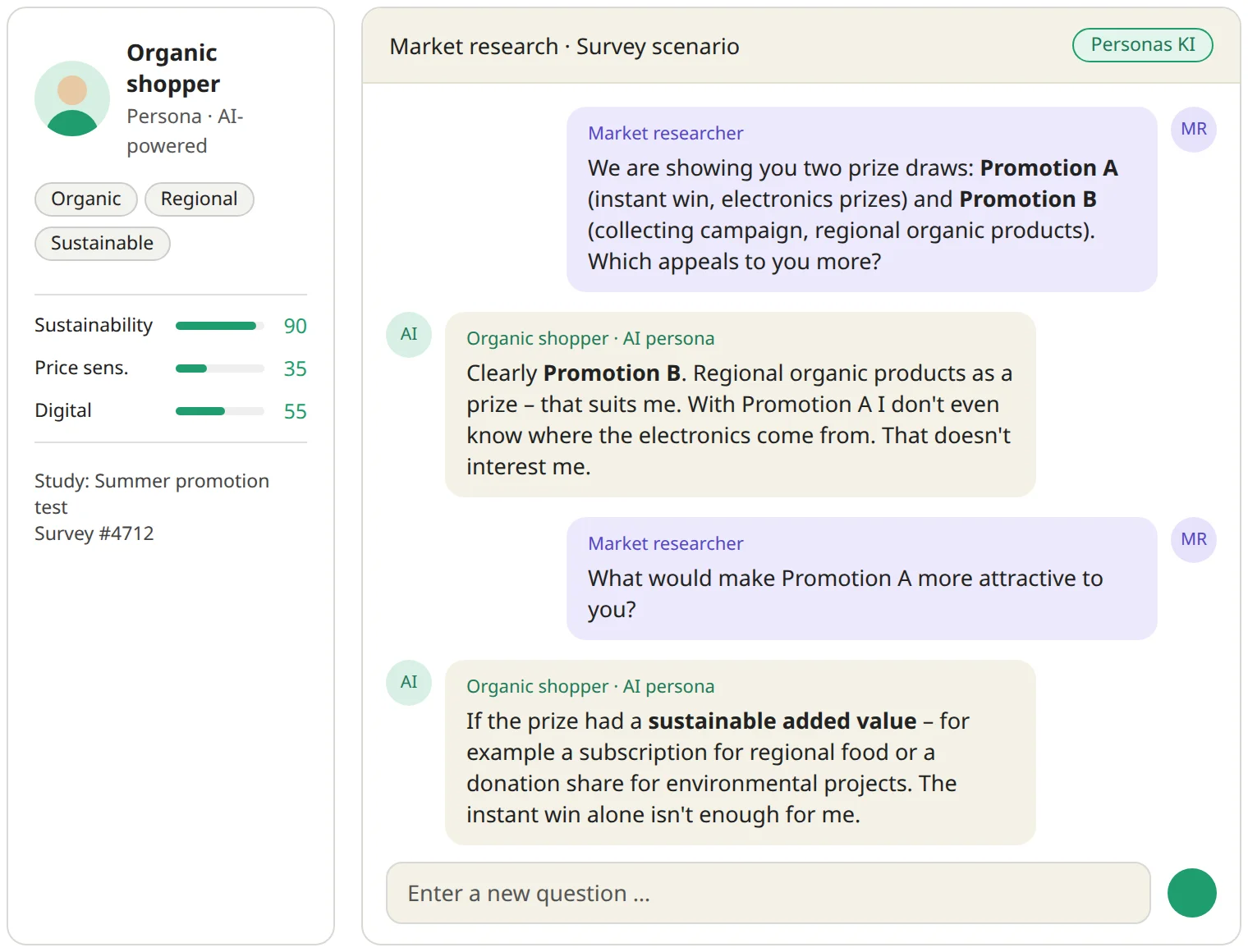
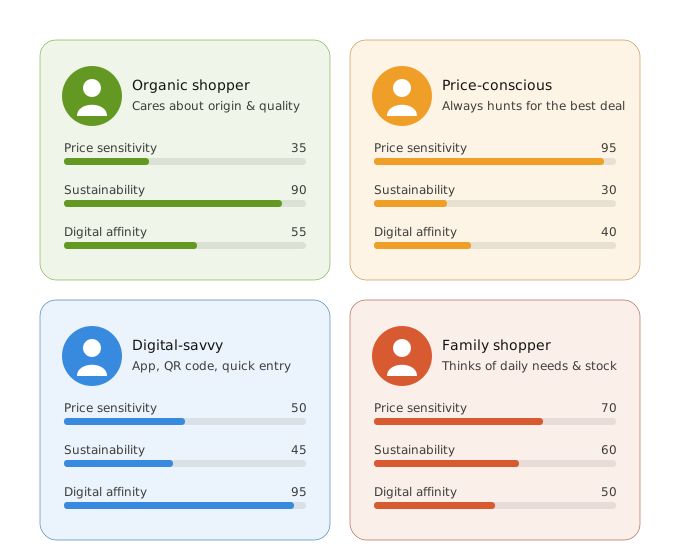
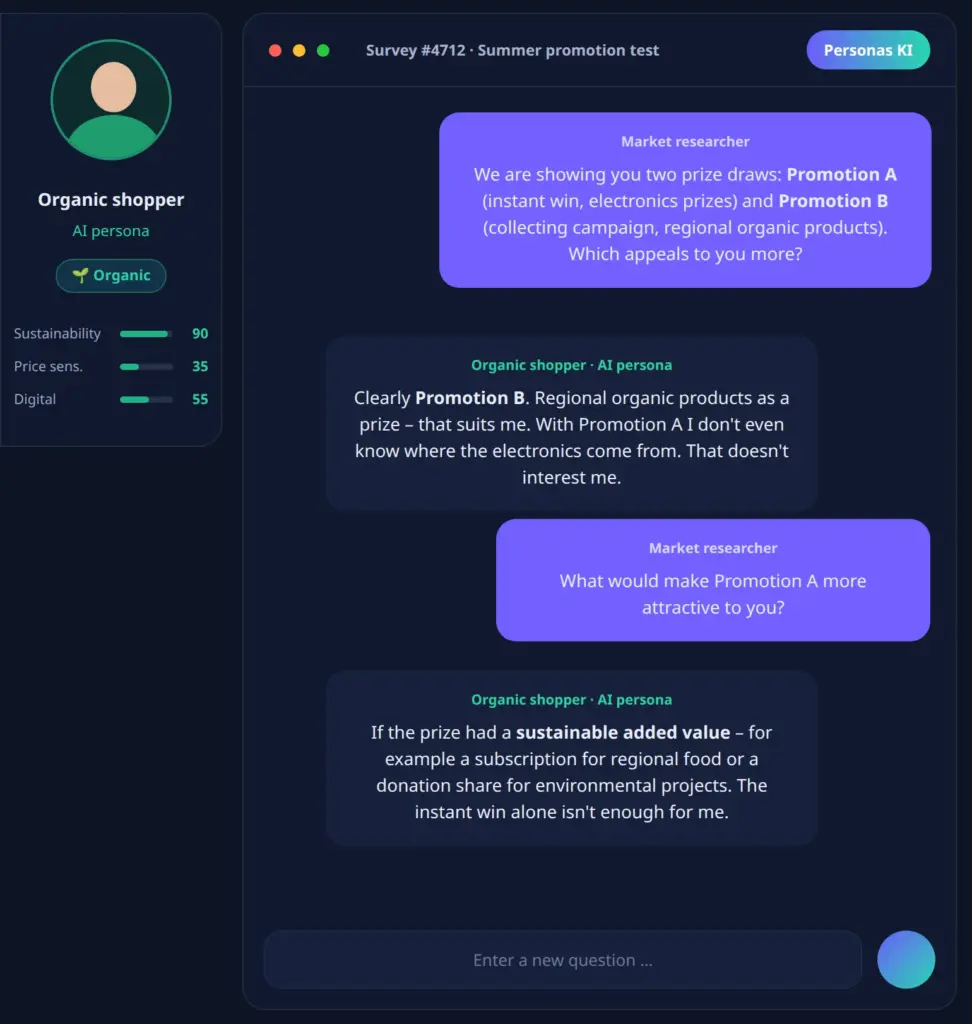
At its core, Personas KI simulates different buyer types, so-called shoppers. Instead of surveying real people, the AI slips into a defined role and answers questions consistently from that perspective. If you want to question an organic-product buyer, you get answers that emphasise sustainability and origin. A price-conscious type compares offers and looks for the best deal. The digitally savvy shopper expects an app and a QR code, the family shopper thinks of everyday life and stocking up.
The practical benefit is obvious. Time-consuming and costly surveys of real participants can be avoided for many preliminary tests. First tendencies are available in seconds, not after weeks, and the costs of recruitment and compensation are eliminated. This is not a replacement for every form of empirical research, but a valuable tool for testing and sharpening ideas early, before larger budgets are spent.
Why the data base makes the difference
The question of how intelligence arises and the role of random processes are fundamental. To fully understand the behaviour of Personas KI, it is important to consider the underlying probability theory and statistical modelling – probability and chance are the foundation of every simulation in this context.
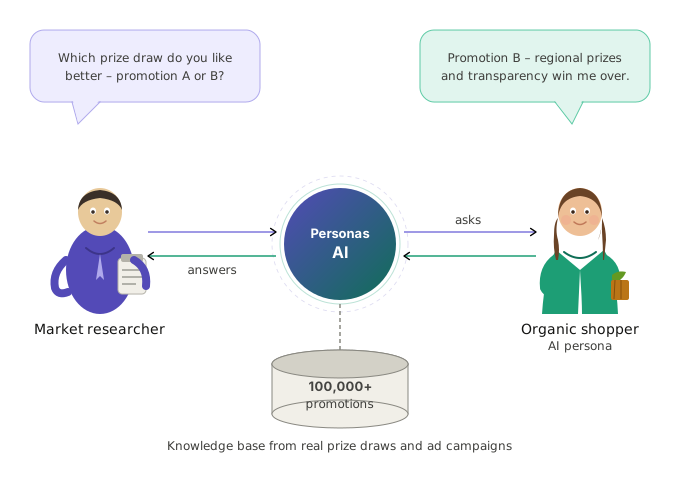
An AI is only ever as good as the knowledge it builds on. Personas KI draws on the knowledge from several hundred thousand real promotions, such as prize draws and advertising campaigns. This experience keeps the simulated assessments grounded in practice instead of staying generic.
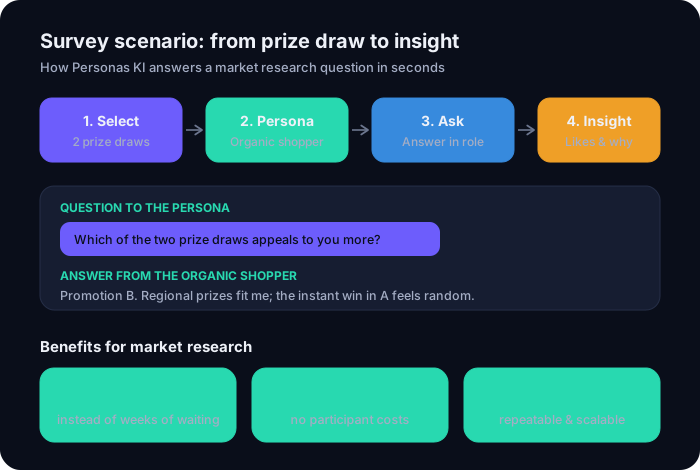
A concrete example is the integrated promotion search. The solution has its own built-in database from which one or more promotions can be selected for a survey. This makes it possible to find out which prize draw a particular persona likes best and, above all, why. It also shows where a promotion fails to convince or where there is still room for improvement. This combination of role simulation and a concrete data base distinguishes a well-thought-out specialist solution from a general chatbot.
To understand the full potential of personalised AI, it is important to know the foundation. Local AI solutions offer higher efficiency than cloud services in the long term, because they learn continuously and adapt to specific needs.
Sovereign AI: the data treasure stays with its owner
This brings in a term that is gaining importance beyond market research: sovereign AI. It means AI in which control over data and processing remains in the hands of the operator and data owner, instead of flowing uncontrolled to third parties.
This is more than a technical detail. The experience gathered from hundreds of thousands of promotions is a genuine data treasure. It has built up over years, is hard to reproduce and forms the basis for the quality of the results. With a sovereign solution, this treasure stays with the data owner. It is used to gain insights, but it does not leave the operator's control.
This approach brings several advantages for companies:
- Data sovereignty: Valuable data stays where it belongs and does not become training material for third-party systems.
- Privacy from the start: Because simulated personas are used instead of real participants, no personal data has to be collected at all for many questions.
- Traceability: Anyone who controls the steering and the data base can better interpret and reproduce results.
- Trust: Data protection and secure processing are not an afterthought but an integral part of the architecture.
Sovereign AI therefore does not mean doing without modern methods. It means using them in such a way that control and responsibility remain with the data owner.
Reliability through a purpose-built solution
A general language model can do a lot, but its answers fluctuate and it can only be steered to a limited extent. A solution developed specifically for one purpose goes further. With Personas KI, this shows in three ways.
First, reliability increases because the answers stay within the role frame and remain traceable. Second, control improves, since character, question and context can be defined precisely and reproducibly. Third, the user interface becomes simpler and at the same time more powerful, so that even complex surveys remain manageable. These three properties are no coincidence, but the result of deliberate design around the specific use case.
One principle, many use cases
What is interesting about this approach is its transferability. The underlying idea, namely to build a controlled, data-based and sovereign AI for a clearly defined task, is not limited to persona surveys.
The same principle can be applied to other fields, for example image recognition. Where texts were previously assessed from a persona's perspective, images can in future be analysed or patterns recognised. The architecture remains comparable: a specialised solution, a controlled data base and sovereignty over your own data. A single tool thus becomes a reusable pattern for very different tasks.
Image recognition has in fact already been implemented: a person is shown a promotion in the form of a photo. The photo shows a poster of a promotion, a postcard or some other view of it. The persona can then be asked for their opinion on the promotion. A promotion can be a prize draw, a loyalty campaign, a discount, a cash-back with receipt upload or similar.
The market researcher gets immediate feedback on whether a particular buyer type likes a given promotion or not. Personas KI also supplies the reasons for this. Promotions can thus be optimised in a targeted way – with very little effort for the survey, thanks to AI.
Reliability by design: why simulated personas are more stable than many think
Market research with real participants suffers from a number of well-documented biases. Participants answer in a more socially desirable way than they act. Their mood on the day of the survey influences the answers. Small changes in the wording of a question shift the results. And anyone who takes part in a study is rarely a perfect reflection of the target group.
Simulated personas avoid these effects structurally. A defined persona answers the same way today as tomorrow, to the same question in the same wording. Character, values and life circumstances are fixed and remain consistent, regardless of how someone feels, their expectations or social pressure. This makes results reproducible and comparisons between different promotions or messages valid.
Of course, this does not replace empirical research. A persona is a model, and models simplify. What a simulated persona cannot do is reflect unforeseen cultural shifts, emerging trends or genuine surprises in behaviour. This is where classic research with real people remains indispensable.
The decisive point is a different one: simulated personas are not more reliable than real people in an absolute sense, but they are more consistent. And consistency is the prerequisite for robust comparisons. Anyone who wants to know whether message A or message B lands better does not need a perfect representation of reality, but a stable basis for comparison. This is exactly what well-designed AI personas deliver: fast, reproducible and without the scatter that human surveys inevitably bring.
More possibilities for market research & product development
Product tests before launch
Before a new product reaches the shelves, many questions arise: does the packaging hit the target group's nerve? Is the price realistic? Which selling points work – and which miss the mark? With simulated personas, exactly these questions can be played through early on. Different buyer types can assess the same product from their own perspective before a single unit has been produced. That not only saves money, but also protects against costly wrong decisions at a stage when corrections are still comparatively cheap.
Putting advertising messages to the test
Texts, slogans and campaign visuals do not appeal to everyone equally. What convinces one person leaves another cold – or even puts them off. AI-supported personas make it possible to test different messages in parallel and compare them immediately. Which wording resonates with the price-conscious buyer? Which image appeals to the sustainable type? Answers that used to require elaborate A/B tests with real participants can now be simulated quickly and systematically as a first step.
Taking regional and cultural differences into account
Market research rarely ends at the national border. A product that works in one region can meet complete incomprehension elsewhere – because of cultural differences, local buying habits or different price expectations. Personas can be equipped with regional or cultural characteristics, so that markets can be compared without setting up a separate study in every country. This is particularly valuable for companies planning international rollouts that want to know early where adjustments are needed.
Trend research and scenario planning
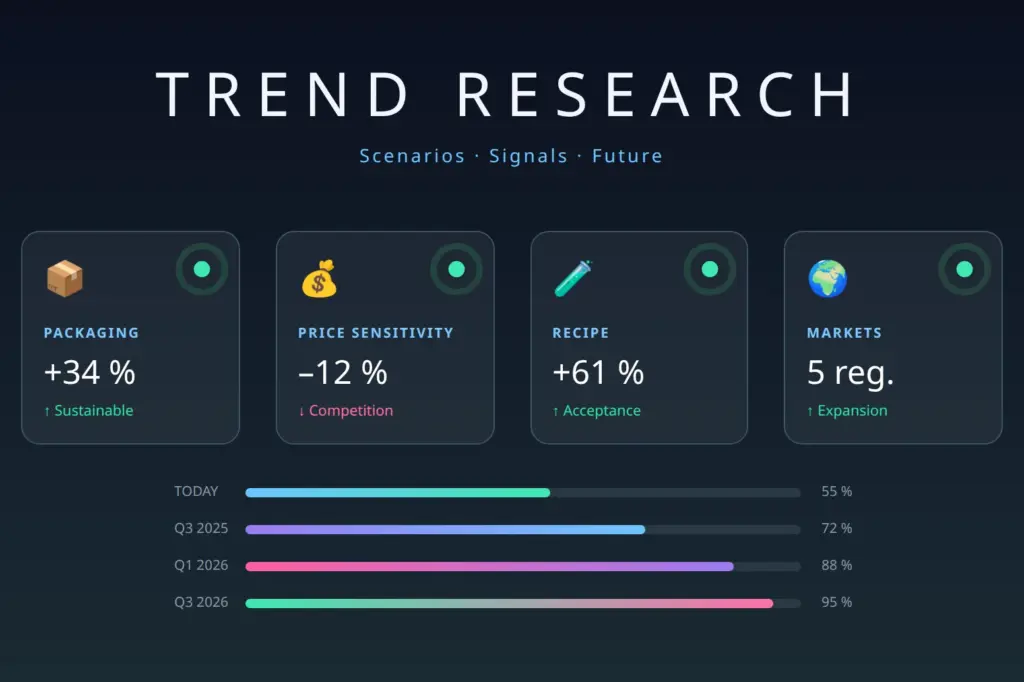
Market research looks not only at the present but also at the future. What happens if a competitor launches a comparable product at a significantly lower price? How do different buyer types react to a changed recipe or a new pack size? With simulated personas, such scenarios can be played through before they occur. The AI answers consistently on the basis of the defined role characters, which enables a structured comparison of different future situations – a kind of stress test for product strategy and communication.
Qualitative depth instead of pure numbers
Classic surveys often deliver percentages and approval rates. What they deliver less often are the reasons behind them. A simulated persona does not only say whether it likes an offer, but also explains why – in natural language, from its specific life circumstances. This qualitative dimension is hard to scale when real people have to be surveyed. With AI personas, it is automatically available in every survey and provides the raw material for a deeper understanding that goes beyond bar charts.
Sovereign AI in detail: how local control works technically
Sovereign AI means that the model, data base and processing are not located with an external provider but are operated under the operator's control. In practice, this means: the AI runs either on your own servers or in a private cloud environment to which third parties have no access. Requests are not forwarded to external APIs, and data does not leave your own infrastructure.
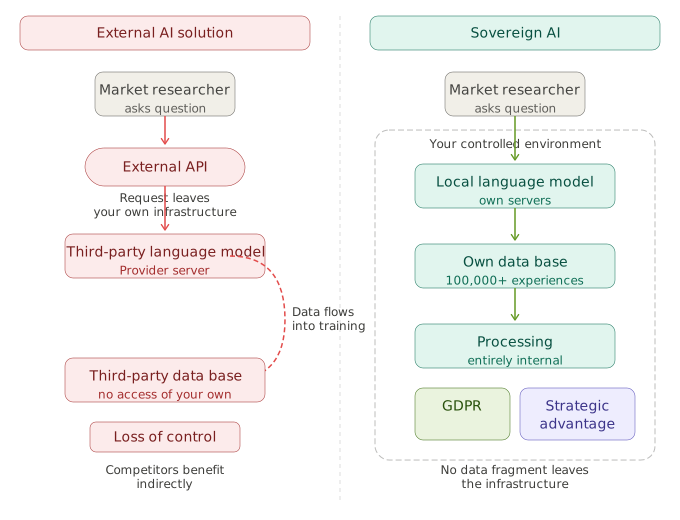
Concretely, for a solution like Personas KI: the language model that fills the shopper roles is integrated locally. The database with hundreds of thousands of promotion experiences is held by the operator. When a market researcher questions a persona, all processing takes place within this controlled environment. No answer fragment, no question, no data record is fed back to an external model provider as training material.
Why is this crucial? Because valuable expertise accumulates through use. Every question asked, every analysis, every pattern identified sharpens the picture of what works in which markets. This knowledge is a strategic advantage. With externally hosted solutions, there is a risk that exactly this usage data flows into general models and thus indirectly benefits competitors. Sovereign AI closes this channel technically and organisationally.
Then there is the data protection aspect. Because personas are used instead of real participants, no personal data stream arises at all for many test scenarios. Where real user data does come into play, for example when linking to CRM systems, processing remains within your own area of responsibility under GDPR-compliant conditions. Data protection is thus not a compliance task added afterwards, but a structural feature of the architecture.
Costs and benefits: what sovereign AI means for companies of different sizes
A sovereign AI solution sounds like considerable effort. The impression is put into perspective, however, when viewed against current developments.
Thanks to modern AI-supported development tools, productivity in software development has changed dramatically in recent years. Developers work with AI coding assistants that take over routine tasks, generate boilerplate code and detect errors early. What would once have kept a team of ten developers busy for a year can now be achieved with a much smaller team in a fraction of the time. Roughly estimated, the development effort for specialised AI solutions has fallen by an order of magnitude, that is, to about a tenth of earlier costs. At the same time, the AI models themselves take over a considerable part of the substantive work that would previously have required elaborate rule-based systems or manual processes.
For large companies and corporations, the business case is clearest. They already run their own server infrastructure, have data protection and IT security departments and regularly conduct large market research studies. Here, a sovereign AI solution directly replaces part of the external agency costs and shortens feedback cycles from weeks to hours. Payback is correspondingly quick.
For mid-sized companies, the advantage lies less in saving existing budgets than in opening up insights that were previously out of reach. Anyone who did not do market research before because it was too expensive can now gain valid first assessments with modest means. Managed hosting options also reduce your own infrastructure effort considerably.
AI market research
Survey buyer types – without real participants
Personas KI simulates realistic shoppers and delivers well-founded insights in seconds.
Learn more →For small companies and start-ups, a staged approach is recommended: first use it for the questions with the greatest decision weight, for example before launching a new product or when testing a campaign. The entry point does not have to be the full expansion stage. Even a narrowly defined use case delivers measurable added value and lays the foundation for gradual expansion.
In all cases, the relevant calculation is not “What does the solution cost?” but “What does a wrong decision cost that it could have prevented?”
Conclusion
Artificial intelligence opens up new possibilities for market research that were unthinkable only a few years ago. Personas KI shows by example how buyer types can be simulated in order to check promotions quickly and cheaply in advance. What matters here is less the technology alone than the responsible way of handling it. Sovereign AI ensures that the valuable data treasure stays with the operator and data owner, that data protection is considered from the start and that results remain controllable.
Anyone who understands AI this way gains not only speed but also keeps sovereignty over what holds the real value: their own data and the insights derived from it. And because the principle is transferable, we are likely to encounter it in many other areas beyond market research.
The Local AI overview shows which advantages an AI running inside your own company offers.
 My name is Klaus Meffert. I have a doctorate in computer science and have been working professionally and practically with information technology for over 30 years. I also work as an expert in IT & data protection. I achieve my results by looking at technology and law. This seems absolutely essential to me when it comes to digital data protection. My company, IT Logic GmbH, also offers consulting and development of optimized and secure AI solutions.