

Emails are often compared to postcards: anyone reading along on the way sees everything. Email encryption decides whether that is true. This post describes what transport encryption and end-to-end encryption achieve, what courts and supervisory authorities have said about them and which technology makes the difference in practice.
The post takes into account court rulings, technology and the requirements of large mail providers up to the end of October 2026.
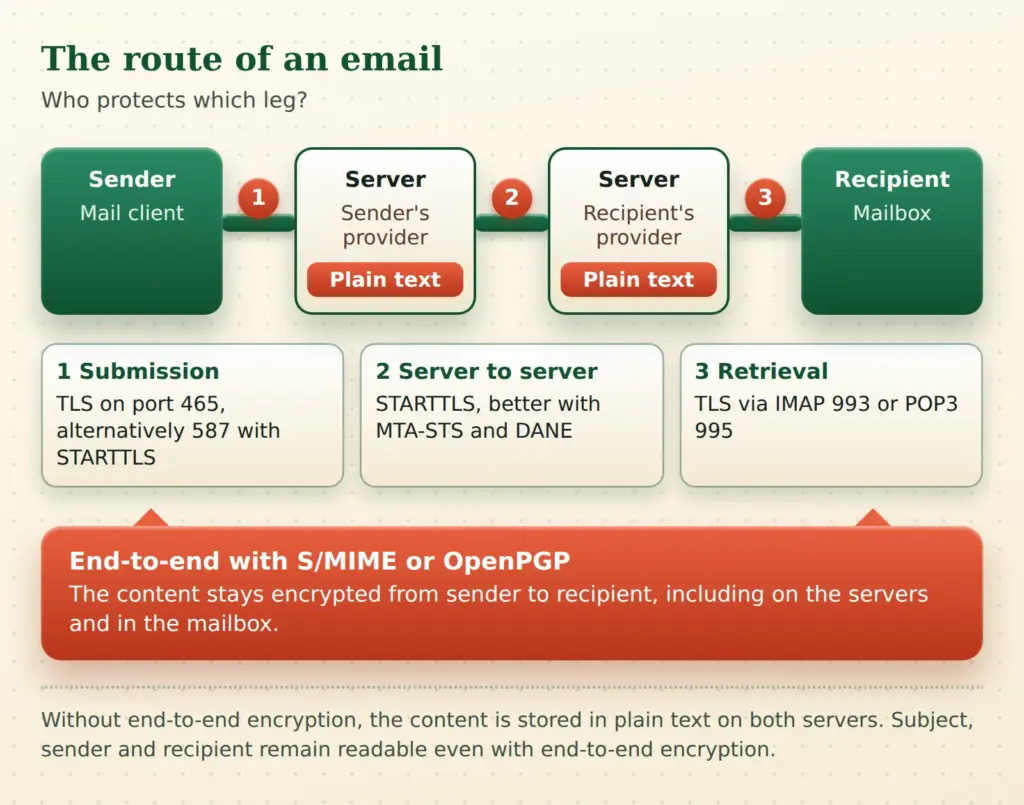
The structure of the post follows the route of an email. It starts with the legal standard and the terms, followed by case law and the view of the supervisory authorities. Then it turns to the technology: transport encryption, checking the mail header, protection against forged senders and end-to-end methods such as S/MIME and OpenPGP. At the end there is a decision aid showing which encryption suits which type of email.
Email encryption and the GDPR: what the standard is
Personal data must be processed in a way that protects it against unauthorised access. This is laid down in Art. 5(1)(f) GDPR. Under paragraph 2, the controller must also be able to demonstrate this. How the protection looks in concrete terms is governed by Art. 32 GDPR: measures must reflect the state of the art and be appropriate to the risk. The provision does not prescribe a specific method. Encryption is merely mentioned there as a possible measure.
Special categories of data such as health data fall under Art. 9 GDPR. There, the need for protection is higher from the outset. But even seemingly harmless emails contain personal data: the sender address with a real name is enough.
In 2026, the legal situation can be summarised as follows: there is no general obligation to use end-to-end encryption for every email. Nor is there a general green light for unencrypted emails. What matters is the risk to the data subjects and the question of what is reasonable according to the state of the art. Anyone who sends personal data by email therefore needs a reasoned decision that can be presented if in doubt.
Transport encryption, end-to-end encryption and signatures clearly separated
In everyday life, three things are mixed up that do different jobs.
Transport encryption secures the connection between two stations. It uses TLS (Transport Layer Security), the successor to SSL. On each leg, the content is transmitted in encrypted form. On the mail server itself, however, it is stored in plain text, because the server has to process and store the email.
End-to-end encryption (E2E) encrypts the content in the sender's mail client. Only the recipient can decrypt it. Servers in between only see data they cannot make sense of. S/MIME and OpenPGP have become established for this.
A signature is something else: it does not encrypt anything, but proves who an email comes from and that it was not altered on the way. It plays an important role in key exchange, because public keys are usually passed on via signed emails.
Both methods share one limitation: subject, sender and recipient usually remain readable. The guidance of the German Data Protection Conference points out that these circumstances of the communication may also need protection.
Case law on email encryption: when transport encryption is sufficient
German courts have ruled on the question several times in recent years, with seemingly contradictory results. On closer inspection, the rulings follow a common line: the greater the potential damage, the higher the requirements.
The oldest case in the series dates from 2020. On 17 December 2020, the Administrative Court of Mainz decided (case no. 1 K 778/19.MZ) whether a lawyer may send emails to clients with transport encryption only. The decision is classified under Art. 32 and Art. 5 GDPR. According to the headnote, transport encryption is sufficient for lawyers' email communication. End-to-end encryption is therefore only necessary in individual cases with increased risk.
Also frequently cited, but only of limited relevance, is the decision of the Federal Court of Justice of 22 March 2021 (AnwZ (Brfg) 2/20). It concerns the special electronic lawyers' mailbox (beA). Its security architecture is based on dedicated hardware security modules. There is no entitlement to end-to-end encryption there. The decision can hardly be applied to ordinary emails.
| Court, date | Facts | Outcome |
|---|---|---|
| Administrative Court of Mainz, 17 Dec 2020, 1 K 778/19.MZ | Lawyer sends emails to clients with transport encryption only | Transport encryption sufficient at normal risk |
| Higher Regional Court of Karlsruhe, 27 Jul 2023, 19 U 83/22 | Invoice email from a car dealer, fraudsters swap the bank details | Standard is the security expectation of business partners, buyer has to pay again |
| Higher Regional Court of Schleswig, 18 Dec 2024, 12 U 9/24 | Final invoice emailed to a consumer, manipulated bank details | TLS alone insufficient for a high amount, damages raised as a defence |
The case before the Higher Regional Court of Karlsruhe shows the line taken in business dealings. A hacker had taken over a car dealer's email account and sent the buyer a manipulated invoice with a different account number. The buyer paid into the wrong account. On 27 July 2023, the court ruled (case no. 19 U 83/22) that the necessary protective measures depend on the legitimate security expectations of the business partners. The payment to the fraudster did not discharge the buyer, who had to pay a second time. The Regional Court of Mosbach had decided differently at first instance.
 My name is Klaus Meffert. I have a doctorate in computer science and have been working professionally and practically with information technology for over 30 years. I also work as an expert in IT & data protection. I achieve my results by looking at technology and law. This seems absolutely essential to me when it comes to digital data protection. My company, IT Logic GmbH, also offers consulting and development of optimized and secure AI solutions.