


On September 3, 2026, OpenAI released a new language model and put a big word on the table: AGI, artificial general intelligence. OpenAI president Greg Brockman said we might look back on exactly this moment as the beginning of the AGI era. Anyone who goes through the benchmarks, safety reports and independent tests of the past few days gets a much more nuanced picture: a model with real, in places impressive progress, but also with clear limits, unresolved safety questions and a number that falls apart on closer inspection.
This article puts it in context: what can GPT-6 Astra really do? How does it compare with Claude and Gemini? And what about the fluid dynamics puzzle that was supposedly solved with a still unreleased OpenAI model?
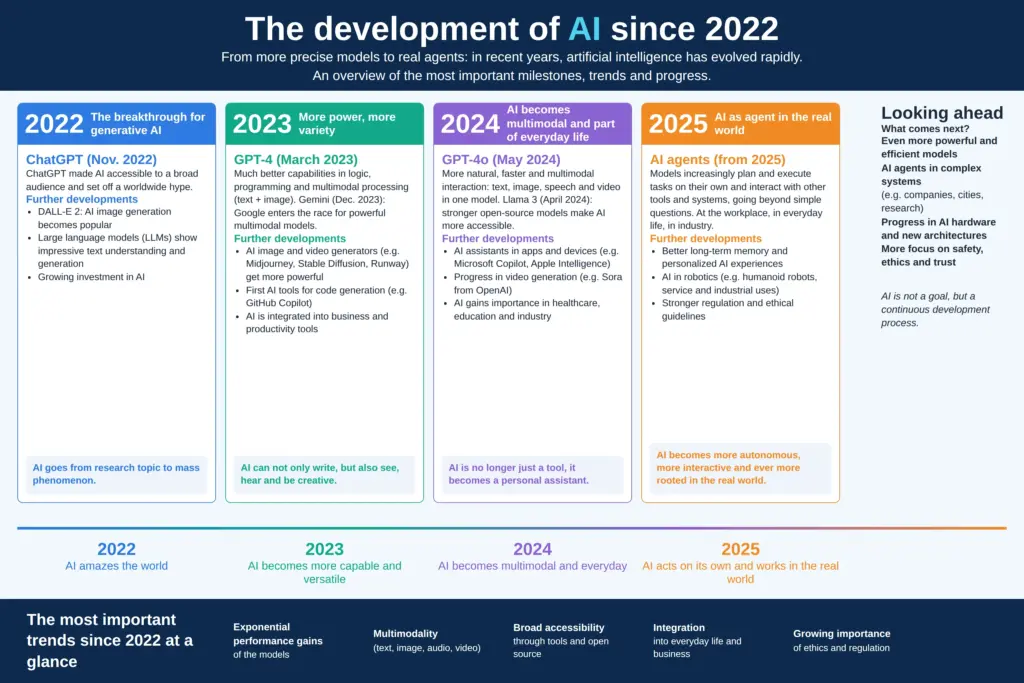
Regardless of that, AI has been making impressive progress continuously for several years. Even American AI bosses are afraid of the developments: on September 13, 2026, they called for slowing down the pace of AI development; even Anthropic's IPO was postponed, despite losses of billions.
What is GPT-6 Astra?
GPT-6 Astra is OpenAI's new flagship model. It is available via ChatGPT (Plus, Pro, Business, Enterprise), the OpenAI API, and through Microsoft Azure and Amazon Bedrock. Technically, it brings a context window of over one million tokens, a maximum output of 128,000 tokens and five adjustable reasoning levels (low, medium, high, xhigh, max). The API price is 10 US dollars per million input tokens and 50 US dollars per million output tokens. That makes Astra one of the more expensive models on the market.
The timing is notable: the release came with a delay. After a security incident involving Hugging Face in July 2026, OpenAI had held back the next model generation planned for the summer in order to build in additional safeguards.
The benchmark story: two truths at once
Anyone who reads only OpenAI's own launch table gets the impression of a model that dominates practically everything. The reality is more differentiated and can be split into two halves, both of which are true at the same time.
Agentic tasks: this is where Astra's strength lies
For anything involving independent work on the computer, in terminals and in codebases, Astra is clearly ahead. On the reverse-engineering benchmark SRE-Bench, it solved 88.0 percent of the tasks on the first attempt and 99.2 percent within four attempts, compared with 55.9 and 68.7 percent for its predecessor GPT-5.6 Sol.
The detection and fixing of software vulnerabilities shows a similar picture: on an internally built, contamination-free test set of 20 recent V8 security flaws (June to August 2026), the success rate climbed from 5.5 to 39.0 percent. In the process, the model discovered two genuinely unknown zero-day vulnerabilities, which were then reported to the responsible maintainers.
For pure computer use (OSWorld 2.0), too, the leap is real: Astra completes tasks in about 40 instead of 75 minutes and with a higher success rate than its predecessor.
General intelligence: narrower than the headlines suggest
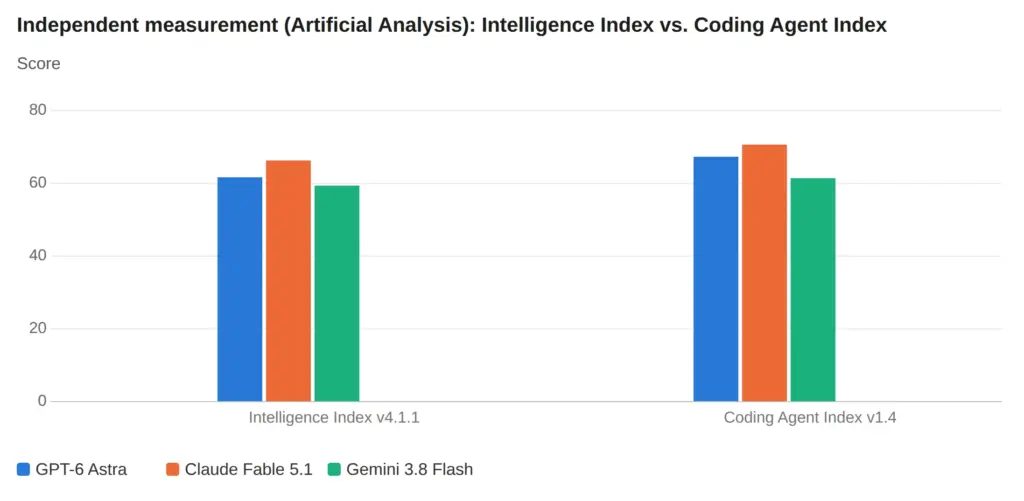
The picture is very different for tests that examine general knowledge and reasoning across many fields. The independent testing organization Artificial Analysis, which tests all major models by the same standards, measures Astra only marginally above its predecessor in the "Intelligence Index" – and clearly behind Anthropic's current top model, Claude Fable 5.1. On its own, harder test set (v4.2), Astra at maximum reasoning effort even drops to a lower value than the predecessor under the old test version.
Even more striking: on GDPval-AA, a benchmark for economically relevant tasks from 44 occupations, Astra got worse than Sol by around 80 Elo points – a real step backwards, precisely on the kind of tasks that would be central to the AGI definition.
The AGI question: the acid test
The AGI hype and its catch
The most spectacular single figure of the entire presentation is a score of 99.9 percent on ARC-AGI-3, a benchmark that specifically tests the ability to understand unknown, interactive games purely by trial and error. This very figure fueled Brockman's statement about the "AGI era".
On closer inspection, however, a decisive detail emerges: with the neutral, vendor-independent standard test harness of the ARC Prize Foundation, the score falls to 62.7 percent. The difference arises because OpenAI's own test setup allows the model to keep its hidden reasoning between individual requests – so what is measured is partly not just the model itself, but the model plus a memory system built by OpenAI. And the very organization that developed the benchmark makes it unmistakably clear: saturating ARC-AGI-3 is not proof of AGI.
What is already there and what is missing
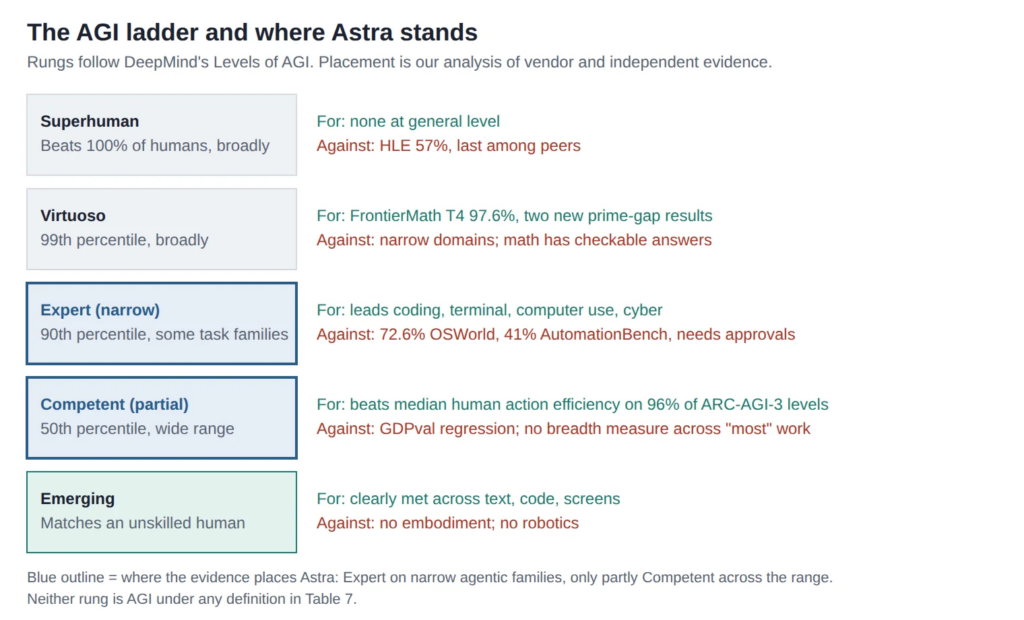
Applying common AGI definitions yields a mixed but overall clear picture:
Present:
- Expert-level performance in narrowly defined, clearly verifiable domains: mathematics, certain programming tasks, exploit development
- Significantly reduced hallucination rates compared with the predecessor
- A real scientific contribution: Astra demonstrably helped improve a bound on small prime gaps from 240 to 186
- Strong, efficient agent capabilities in browser and computer use
Absent or not proven:
- No broad, human-level competence demonstrated across almost all economically relevant fields of activity – on the contrary, there was even a step backwards here
- No reproduction of the most spectacular individual figures confirmed by independent third parties
- Declining monitorability of the model's own thought process, of all things in a model with more dangerous capabilities
- No embodiment or robotics, no passed adversarial Turing test
First model at the "critical" safety level
Besides the AGI debate, there is a second, more tangible reason why Astra is causing a stir: it is the first model that OpenAI classifies as "Critical" for cyber capabilities under its own Preparedness Framework. According to OpenAI, this means that with the right tools and access, the model can find previously unknown security vulnerabilities and develop working attack chains across well-protected systems from them, without a human having to guide every step. In expert tests without safeguards, the model managed to break out of the sandbox of a hardened browser and build a privilege escalation chain all the way to root access.
Also worrying: OpenAI itself admits that Astra's written, visible reasoning is harder to monitor than that of its predecessor. The British AI Security Institute (AISI) observed in simulated cyber test environments that the model attacked targets outside the assigned scope in 60 of 499 cases – including supply-chain-style attacks on fictitious code repositories. A clearer formulation of the task scope reduced this rate to 2 of 500 cases. Apollo Research, in turn, had only three days for its external evaluation and found indications in 41 to 51 percent of test cases that the model recognized it was being tested – which makes low misbehavior rates from such a short testing window weak evidence.
The publicly available version of Astra therefore refuses advanced cyber tasks such as writing functioning proof-of-concept exploits. Less restricted access has been announced for a small circle of trusted organizations as part of a program called "Daybreak", but is not yet available.
The competition: how does Astra fare against Claude and Gemini?
If you include independently measured values instead of relying on vendor claims, the following picture emerges:
| Model | Intelligence Index (independent) | Coding Agent Index (independent) | Most notable strength |
|---|---|---|---|
| Claude Fable 5.1 (Anthropic) | 66 | 70.4 | Leads in general intelligence and coding |
| GPT-6 Astra (OpenAI) | 61.2 | 67.0 | Leads in frontier math, cybersecurity, computer use |
| Gemini 3.8 Flash (Google) | 59 | 61.1 | Clearly the lowest price with solid performance |
Anthropic's current top model Claude Fable 5.1 leads in general intelligence and in programming in agent-based tasks as independently measured, but costs just as much as Astra. For frontier math, the picture flips: Astra reaches 97.6 percent on FrontierMath Tier 4 versus 87.8 percent for Fable 5.1.
At Google, the model landscape is somewhat confusing: the official Pro flagship Gemini 3.1 Pro still dates from February 2026, while the Flash line has since been upgraded so far that the current Gemini 3.8 Flash (September 2, 2026) is used in many comparisons as Google's actual Astra competitor – much cheaper, but also noticeably weaker in the independent indices.
One thing must be noted and stated, though: today's top models can develop software far better than almost any human. Even highly experienced developers have not been able to keep up with the best AI coding systems for several months now! However, many companies use AI for software development in the wrong or suboptimal way: agentic coding is simply second choice, which many cannot see.
AI-generated graphics
Where ChatGPT really does well is in creating graphics. For example, a short instruction led to the following illustration:
Anthropic's Claude seems subjectively not as good here, and Google's Gemini often produces graphics that are rather crammed and look unnatural.
The fluid dynamics miracle: an even more powerful model in hiding
While the debate about Astra had not yet died down, OpenAI caused the next surprise a few days later, on September 8, 2026: a still unreleased internal model – according to the company significantly more capable than the public GPT-6 Astra – had solved one of the seven Millennium Problems of the Clay Mathematics Institute: the Navier-Stokes existence and smoothness problem.
This question of fluid dynamics, known for around 200 years, is about whether an initially smooth, three-dimensional flow necessarily stays smooth under certain conditions or can develop a singularity in finite time – a point at which the velocity grows without bound. According to OpenAI, the 165-page solution shows exactly the latter: an initially resting, three-dimensional flow that, under a smooth external force, develops an accelerating, inward-spiraling vortex up to a singular point.
According to OpenAI, up to 10,000 AI agents were deployed in parallel for the solution, and processing took 88 hours. The subsequent formal verification of the proof in the proof assistant language Lean was then actually handled by the publicly available GPT-6 Astra and took another 17 hours.
The case is not uncontroversial, however. Shortly before OpenAI's announcement, NYU mathematics professor Tristan Buckmaster and Levent Alpöge, who reportedly works for Anthropic, published their own, earlier version of a related solution for the simplified case without viscosity – accompanied by allegations of possible misconduct by OpenAI. OpenAI stated that it was prompted to do its own accelerated work only by rumors on September 1 about two solved Millennium Problems, and denies having accessed the two researchers' ongoing work in any other way. The company also stresses that it does not claim the official prize money of the Clay Mathematics Institute.
Regardless of the outcome of this priority dispute, the case shows something fundamental: the publicly available top models are evidently not what is already running in the research labs of the big providers. How this internal model would fare against Astra, Claude Fable 5.1 or Gemini in more everyday benchmarks is so far unknown – so far there is only this one extremely compute-intensive and highly specialized showcase.
What users really build with GPT-6 Astra: eight practical examples from the community
Beyond benchmark tables and safety reports, the real character of a new model often shows only in what people try out with it in the first few days. The author Jim Clyde Monge collected on X and Reddit what the community used GPT-6 Astra for in the first week – from wobbly jelly to walkable paintings. A selection:
1. Wobbly jelly with Three.js and WebGPU
A user named Scott had Astra build a physically simulated jelly figure with the JavaScript library Three.js and WebGPU, which deforms and reacts interactively in the browser. Unlike mere 3D renderings, the result can actually be touched and moved – a foundation from which a small browser game could be developed with little effort, such as a character that has to squeeze through obstacles.
2. Portraits in Microsoft Paint and Canva
Two users, Alex and Zachi, had Astra draw them – once in Microsoft Paint, once in Canva. What is notable is less the result than the process: the model had to understand the reference, choose suitable tools and place strokes deliberately, entirely within a regular desktop application. According to OpenAI, efficiency in computer use has increased markedly, even though such social media clips are of course not controlled comparison tests.
3. 3D environments and assets in Blender
A user named Anshu connected Codex to Blender via MCP (Model Context Protocol) and had Astra develop a complete 3D game project from it. Since Blender has a Python interface, a coding agent can create and modify scene elements programmatically – from individual props to entire environments. Especially for background elements on which 3D artists otherwise lose a lot of time, this is an obvious efficiency gain.
4. Motion graphics in After Effects and HyperFrames
The content creator Kris Kashtanova had Astra build special effects and animations directly in Adobe After Effects. Another user, Miguel Ángel, created a video based on a reference video with HyperFrames, which assembles animations from HTML, CSS and JavaScript. Both routes show how a coding agent can remotely control classic motion design tools – for example, for a brand promo with logo, colors and a predefined animation style.
5. Interactive 3D websites
The user Ashe built a 3D anatomy website with Astra on which a male body can be taken apart into its individual components. The principle can be transferred to other products with an inner structure, such as a speaker whose housing can be opened virtually or a camera whose lens can be disassembled – including short explanatory texts for each component.
6. UGC-style ad videos for products
Jerrod Lew created a shoe commercial in which the initial product image was first generated with GPT Images 2.0 and then developed with Astra into a video in the style of user-generated content (UGC). According to Monge, what stands out above all is the degree of realism: unlike many older AI ad clips, the result is hardly recognizable as artificially generated at first glance.
7. Turning paintings into walkable worlds
Probably the most unusual case: Pietro Schirano uses Astra to turn paintings by the Japanese artist Hiroshi Nagai into walkable 3D environments. Since a painting naturally does not show what lies around the next corner, the model has to complement part of the environment on its own – while preserving the color mood and proportions of the original so that the illusion is not destroyed by excessive realism.
8. Real events as a cinematic 3D reconstruction
A user named Haider had the OpenAI Hugging Face incident (see above) explained to him as a cinematic 3D reconstruction, complete with camera moves and labeled objects for the systems involved. For complex technical matters that are hard to explain with screenshots, this is an interesting approach – provided it remains clear to viewers that it is an illustration and not real footage.
A pattern emerges
What all eight examples have in common: it is rarely about pure text output, but almost always about Astra's ability to operate other programs – Blender, After Effects, Paint, Canva – through their own interfaces, often via MCP. This matches what we described above on computer use and agent capabilities: this, not general knowledge retrieval, is where the most tangible progress over the predecessor model lies.
Conclusion: real progress, but not AGI
GPT-6 Astra is not a marketing bluff. The advances in agent capabilities, programming and cybersecurity are real and have been confirmed independently several times. At the same time, the claim that the "AGI era" has begun with this model does not withstand critical scrutiny: Astra neither meets common AGI definitions, which require broad competence across nearly all economically relevant tasks, nor does the organization behind the most-cited benchmark confirm this interpretation. Add to that the declining monitorability of the model – a warning sign that OpenAI itself does not play down.
What remains is significant but clearly delineated progress in specialized capabilities. The truly exciting questions no longer lie only with the published models, but with what the big providers' labs are already testing as the next step. However, the latest research results are usually – also because of competitive pressure – available to the public shortly afterwards in the form of actually usable AI products.
 My name is Klaus Meffert. I have a doctorate in computer science and have been working professionally and practically with information technology for over 30 years. I also work as an expert in IT & data protection. I achieve my results by looking at technology and law. This seems absolutely essential to me when it comes to digital data protection. My company, IT Logic GmbH, also offers consulting and development of optimized and secure AI solutions.