

The Revolution Hits Hard
The images that made the rounds at the World Defense Show in Riyadh in spring 2026 looked like scenes from a science fiction film: a four-legged combat robot, developed by a Chinese state-affiliated manufacturer, presented itself as a "production-ready platform" – equipped with four anti-tank missiles, acoustically optimized, navigating autonomously. The PF-070 is not a prototype. It is ready to buy.
At the same time, on the civilian side of the world, Unitree Robotics presented its humanoid robot R1 at CES 2026 – for around $5,900. The machine performed precise kung fu sequences on the show floor: punches, kicks, defensive stances. Not a theoretical demonstration model, but purchasable hardware with an open developer SDK.
These two images – the combat robot and the kung fu robot – mark a historic turning point. Robots are no longer the domain of research labs and science fiction. They are becoming affordable, capable and independent. The question is no longer whether but when they will be seen everywhere in daily life – and what that means for human safety. This article looks at AI robots: how quickly they spread, and when they become dangerous.
The Most Important Driver: Falling Prices
Technological breakthroughs rarely change the world through individual inventions. They change it when prices fall. The smartphone only became a social revolution when it cost $200, not $1,200. The same pattern is emerging for humanoid robots – at a speed that surprises even analysts.
In 2024, the average selling price of a humanoid robot was still around $114,700. In a study published in May 2026, the research firm IDTechEx forecasts that this price will fall to about $37,000 by 2030 – a drop of more than 68 percent in just six years. Goldman Sachs had predicted this development even earlier: the investment bank already recorded a 40 percent cost decline between 2022 and 2023, faster than analysts had expected.
Bank of America goes even further in its forecast: raw material costs could fall to $13,000 to $17,000 between 2030 and 2035. For comparison: an average used car. The Unitree R1 is already available today for $5,900.
Four factors are driving this price decline: first, production volume – Tesla plans to build the Optimus robot in the millions by 2027, which cuts unit costs dramatically. Second, supply chain optimization, for example through Hyundai's acquisition of Boston Dynamics and the access to automotive supplier networks that comes with it, where parts that cost $1,000 in robotics cost $100 thanks to scale. Third, Chinese competitive pressure: manufacturers such as AgiBot, Unitree and Leju Robotics systematically undercut Western competitors. Fourth, software replacing hardware: differentiation is increasingly achieved not through expensive mechanical components but through AI software that can be updated.
What this means: robots will spread the way every technology spreads once the price falls below a psychological threshold. That is not speculation, but market mechanics.
For comparison: analysts at Robozaps expect simple humanoid robots to be in the price range of a high-quality household appliance by 2032–2035 – that is, $5,000–10,000. That is roughly the price of a used car.
The Timeline: From the Factory to the Living Room
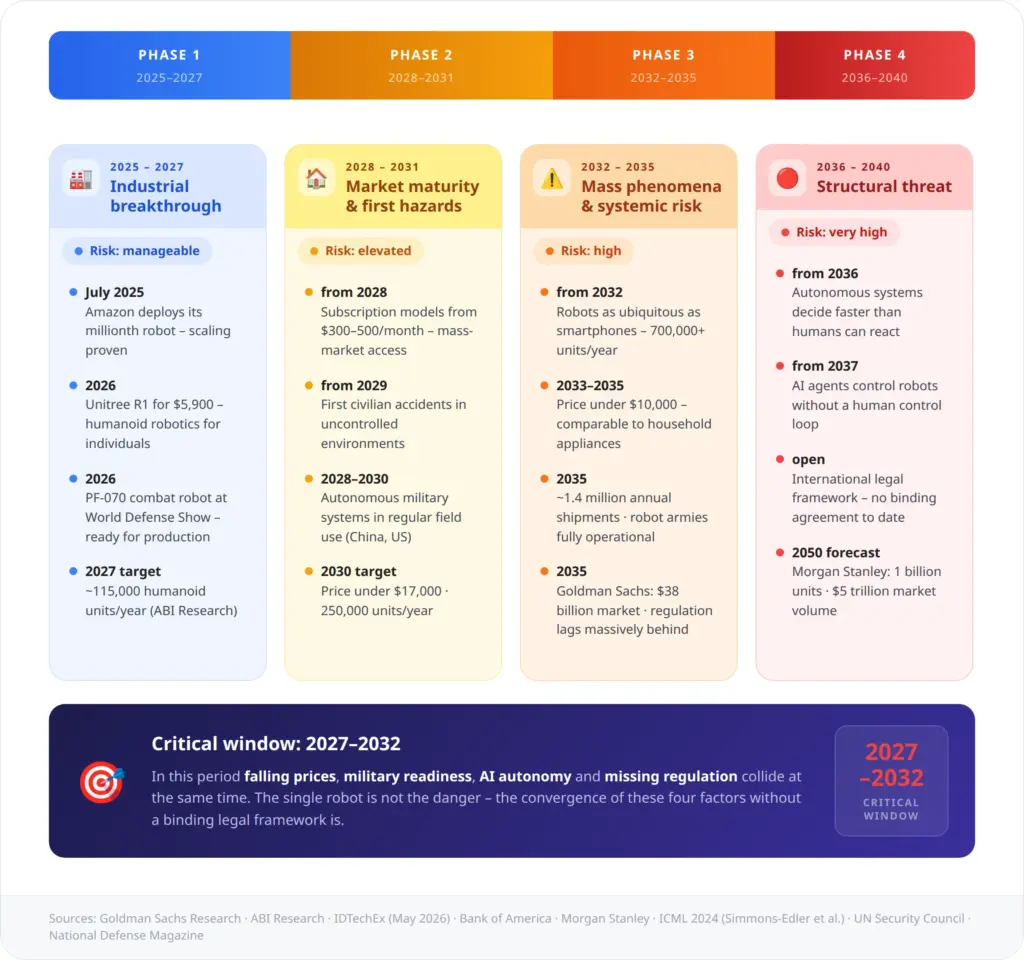
Phase 1: The Industrial Breakthrough (2025–2027)
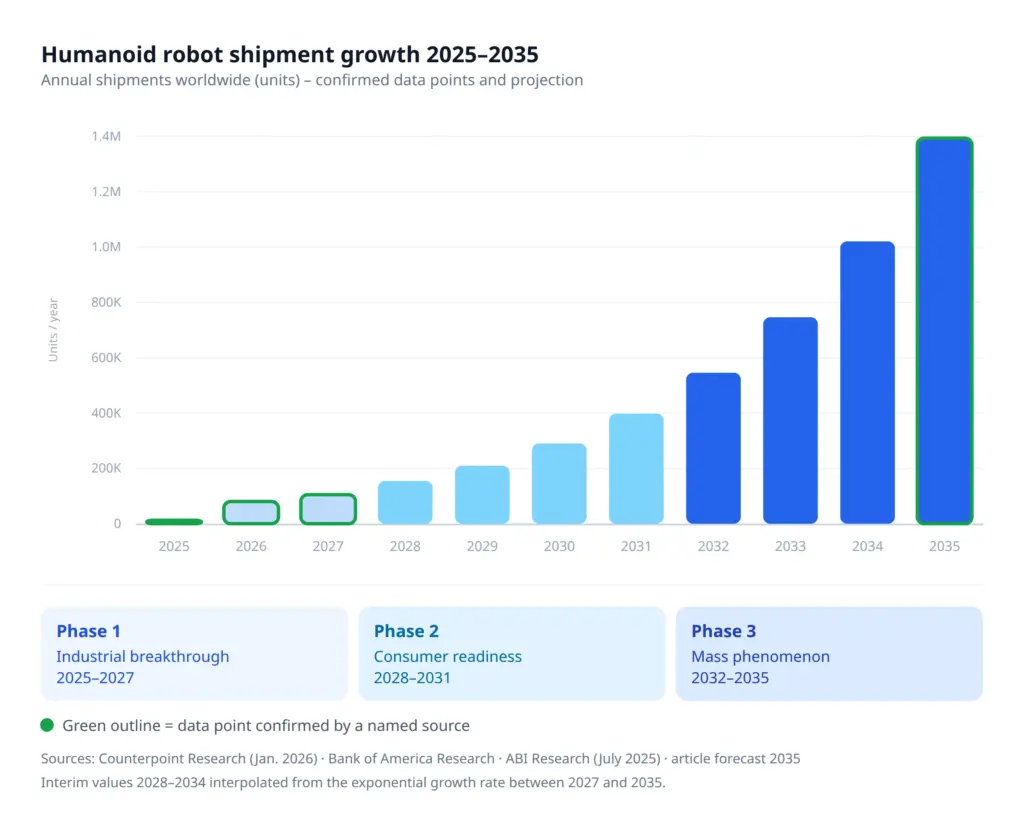
Humanoid robots are currently leaving the research labs and reaching factories and logistics centers in significant numbers. ABI Research expects the first mass deliveries in 2027, with around 115,000 units worldwide. In July 2025, Amazon deployed its one millionth robot in its warehouses – a milestone that shows how quickly robotics scales once economics and technology come together.
China leads in this phase: according to current market data, AgiBot from Shanghai holds around 31 percent of installed units, followed by Unitree with 27 percent. Tesla, Figure AI and Boston Dynamics make up the rest, but plan aggressive scaling.
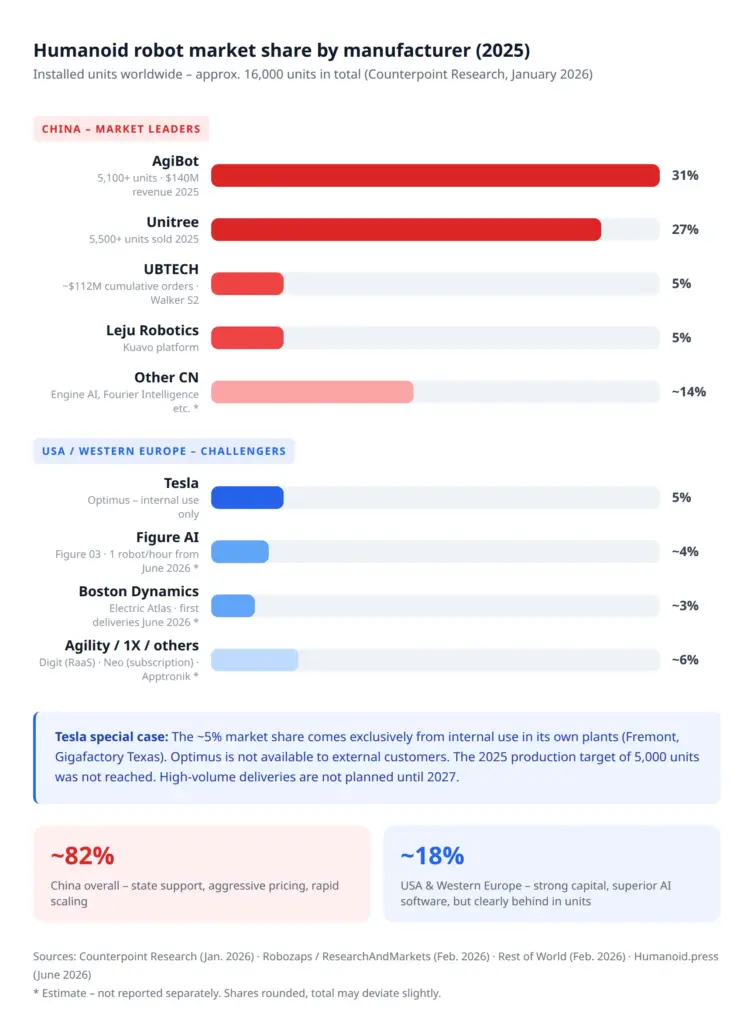
Who actually controls the market is not what Western media suggest. Of the roughly 16,000 humanoid robots installed worldwide in 2025, around 82 percent come from Chinese manufacturers. AgiBot and Unitree alone together hold well over half of the global market – and each delivered more units in 2025 than Tesla's entire production target for the year, which Tesla did not reach. The company does hold five percent market share, but exclusively through internal use in its own plants: Optimus is not yet available to external customers, and high-volume deliveries are not planned until 2027.
Figure AI, Boston Dynamics and Agility Robotics are in production ramp-up in 2026 – their cumulative deliveries are still marginal compared with Chinese volumes. The structural picture is therefore clear: Western manufacturers have capital and often superior depth in AI software. What they lack is the production volume and the price advantage that make mass adoption possible. For the geopolitical dynamics described further below, that is not a side detail – it is the actual starting point.
In this period the risks are still manageable: robots operate in controlled, often fenced-off environments. Accidents happen, but they can be classified in industrial terms. The real risk of this phase lies in the military domain – and there it is no longer a future scenario.
Phase 2: Consumer Readiness (2028–2031)
Goldman Sachs expects consumer models to become economically attractive between 2028 and 2031. The first subscription models, such as the offering that 1X Technologies already has (Neo, $499 per month), are speeding up access for private households. Robots appear in care homes, in retail and as household helpers.
In this phase, civilian accidents in uncontrolled environments occur for the first time. Mechanical faults, software errors and AI misjudgments that end harmlessly in a fenced-off factory hall can have far more serious consequences in a nursing home or a kindergarten. At the same time, autonomous military systems are in field use in this phase.
Phase 3: The Mass Phenomenon (2032–2035)
Forecasts for 2035 expect around 1.4 million humanoid robots delivered per year, with a growing majority going to consumers. Morgan Stanley forecasts a market of more than five trillion dollars by 2050, based on one billion units sold – arithmetically, one robot per person.
By then, robots in wealthy countries are as ubiquitous as smartphones are today. They stand at supermarket checkouts, care for people with dementia, deliver parcels, mow lawns. The social, ethical and safety implications are fully manifest.
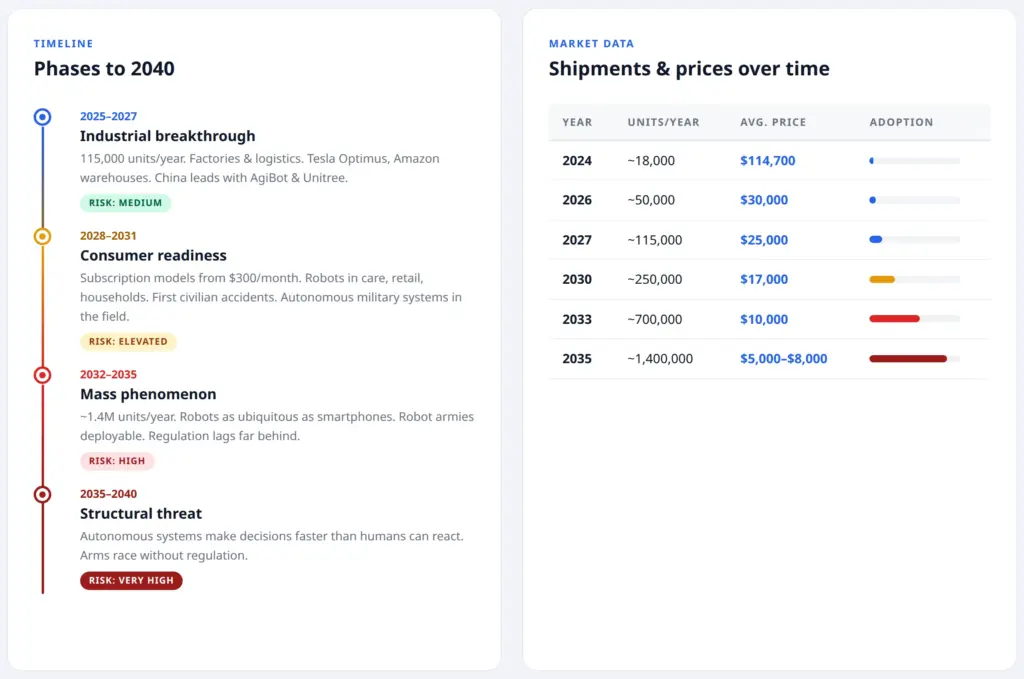
Phase 4: Structural Danger (2035–2040)
This is the period in which autonomy, proliferation and military use converge. Autonomous systems make decisions in milliseconds. The time for human intervention is shrinking structurally. A system that autonomously pursues targets – whether by design or through errors in the targeting system – is qualitatively something different from a remote-controlled tool.
Four Dimensions of Danger in Detail
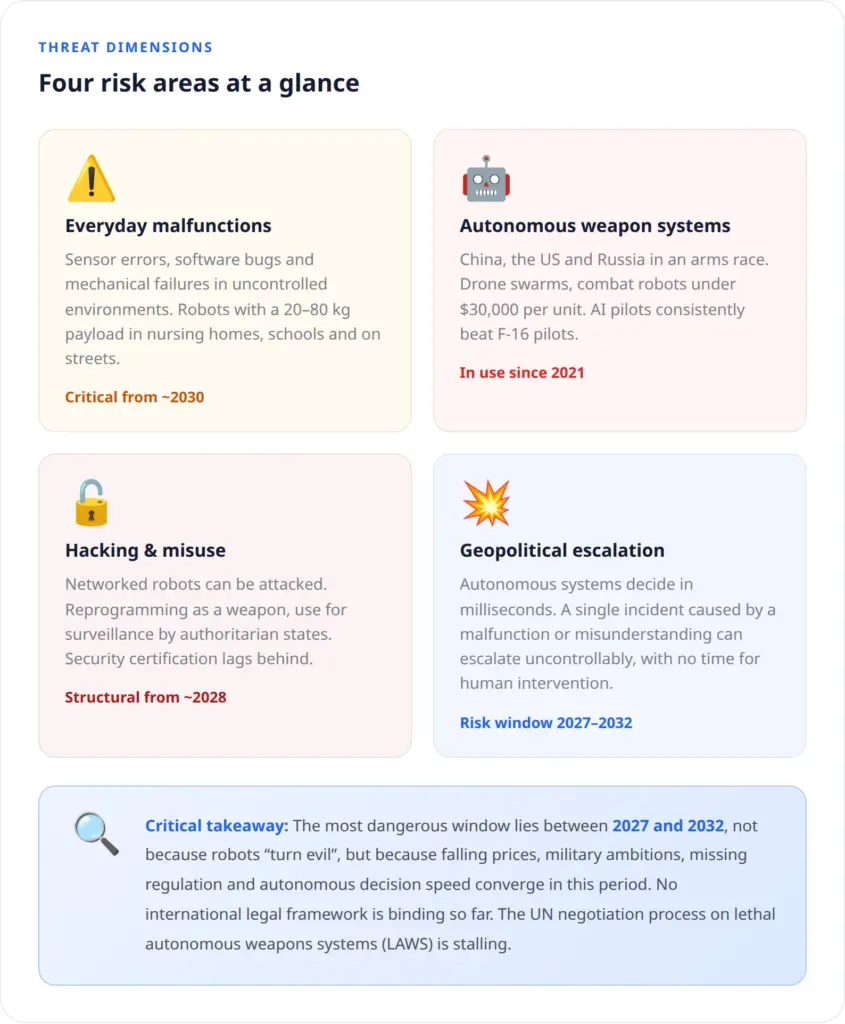
1. Malfunctions in Everyday Life
Even industrial robots regularly cause accidents. Sensor errors lead to uncontrolled movements, overheated motors to sudden failures, software errors to unpredictable behavior. This is not a hypothetical danger: scientific studies of OSHA accident reports, most recently in the journal Scientific Reports in 2026, document the real frequency of robot-related workplace injuries.
The more robots are deployed in uncontrolled environments – public streets, homes, schools, hospitals – the higher the probability of incidents. A faulty industrial robot in a fenced-off factory is a workplace accident. A faulty service robot weighing 25 kilograms and moving at 9 km/h in a care home is something else.
To make matters worse, experience shows that the speed of market introduction outpaces safety certification. Cars were only standardized for safety after decades and thousands of deaths. There is no reason to assume that robots will skip this process.
2. Open Systems as an Attack Surface
The Unitree R1 comes with a fully open SDK. Developers have direct access to joint control, sensor data and hardware interfaces. That is a blessing for research and innovation. It is also an attack surface.
What counts as a trope in science fiction films – the reprogrammed robot as a weapon – is technically not a fundamental problem but a security problem. At an entry price of under $6,000, the R1 is within reach of individuals, small labs and hobbyists. Large numbers, wide distribution, hard to control.
Beyond that, networked robots can be used as instruments of surveillance and control. China already uses AI image recognition systems for mass surveillance; robots with mobility, facial recognition and weapon capability are the logical next step.
3. Autonomous Weapon Systems: The Most Immediate Danger
This is the dimension in which forecast has already become reality.
Autonomous drones were demonstrably used in Libya in 2021 to pursue and attack retreating forces – without direct human control. The UN Security Council documented this incident as one of the first proven uses of lethal autonomous weapon systems. In 2021, Israel deployed the first AI-guided drone swarm in Gaza. Russia actively uses AI-controlled kamikaze drones (KUB-BLA, Lancet-3) in Ukraine.
An AI system that competed against an experienced F-16 pilot in simulated air combat won consistently – through maneuvers with a precision and speed that lie physically beyond human capability. The US military program "Replicator" plans to deploy thousands of autonomous drones at a fraction of the cost of traditional weapon systems.
The decisive point: autonomous weapon systems lower the political cost of a war of aggression because no own soldiers die. That is not a side effect – it is the selling point. Researchers at ICML 2024 warn that this structurally increases the likelihood of conflict, regardless of all other ethical questions.
Shipment growth: timeline
16,000 units in 2025, 115,000 in 2027, 1.4 million in 2035 – these numbers do not describe linear development but an exponential threshold shift. In two years the market triples; in ten years it grows to more than eighty times its size.
The decisive leap lies between 2025 and 2027: Chinese manufacturers are ramping up production massively, and Bank of America expects around 90,000 deliveries worldwide for 2026 alone. What ABI Research describes as "first mass deliveries" for 2027 is the beginning of a curve that changes structurally from 2028 – away from the industrial customer and toward the consumer. One and a half million units a year is not a theoretical end point. It is the point at which robots stop being exceptions.
4. The Geopolitical Arms Spiral
The biggest systemic risk is not the individual misguided robot but the geopolitical dynamics in which it is embedded.
China has publicly set the goal of massively automating its armed forces by 2027 to 2030. President Xi Jinping has defined AI leadership by 2030 as a strategic national goal. The People's Liberation Army has deployed robot dog squads in urban combat exercises, is conducting drone swarm experiments and is working intensively on autonomous maritime systems.
The USA is responding with massive investment. Expert Christopher Alexander of the Pioneer Development Group calls the race for autonomous weapon systems "the defining defense challenge of the next 100 years". The Centre for International Governance Innovation warns that without a clear de-escalation mechanism, a single incident involving combat robots – triggered by a malfunction or a misunderstanding – could escalate uncontrollably, because autonomous systems leave no time for human consultation.
Russia, despite more limited resources, relies on combat experience: the conflict in Ukraine serves as a global testing ground for autonomous weapon systems – with real data, real targets, real feedback.
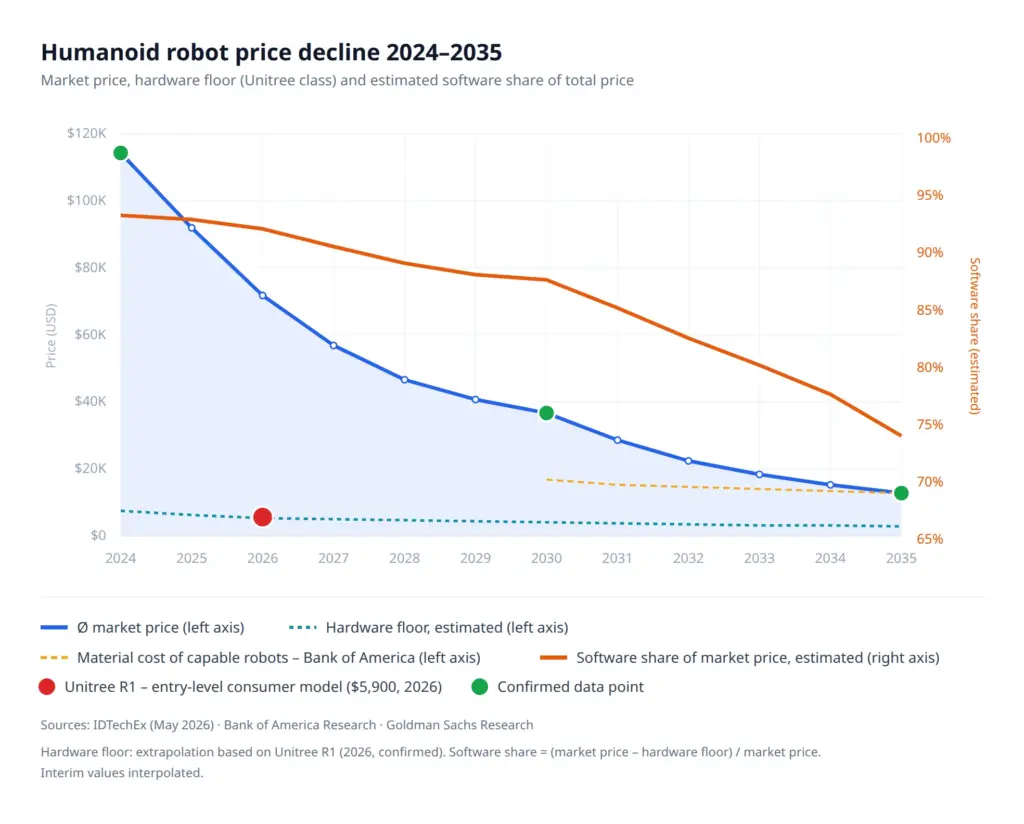
Figure Explained: Price Decline of Humanoid Robots 2024–2035
What the Figure Shows
The chart visualizes the forecast price development of humanoid robots between 2024 and 2035. It combines four layers of information: the average price across the whole market, the lower bound for simple consumer hardware, the material costs for capable industrial robots, and the arithmetically derived share of software, integration and margin in the total price. The aim is not only to show that robots are getting cheaper, but also why – and what structural shift lies behind it.
The Two Axes
The left axis shows absolute prices in US dollars. All three price lines – market price, hardware lower bound and material costs – are plotted on this axis. The scale starts near zero and extends to over $100,000 to show the whole curve without distortion.
The right axis shows the estimated software share of the market price in percent. It is deliberately decoupled from the left axis because it measures a different dimension: not the absolute price, but the internal composition of that price. The axis starts at 65% and ends at 100% to make the relevant range of values clearly visible. Its grid lines are not carried over onto the chart area, so there is no confusion with the left axis.
The Individual Lines and Data Points
Avg. Market Price (Blue Line, Left Axis)
The blue line shows the average selling price of a humanoid robot across all market segments – that is, consumer, industrial and research robots combined. Three data points are backed by sources and marked with green dots:
In 2024, the market average was around $114,700, according to IDTechEx. At that time, expensive industrial and research systems dominate the market; inexpensive consumer models are still a fringe phenomenon. For 2030, IDTechEx forecasts a decline to around $37,000 – a price drop of over 68 percent in six years. By 2035, Bank of America expects material costs for capable robots to fall to $13,000 to $17,000; the market price will converge further accordingly. The lower value of $13,000 is used as the end point for 2035.
All intermediate values between the documented points are interpolations that show the likely trajectory but have no source basis of their own. This is stated in the source line of the figure.
Hardware Lower Bound (Blue Dashed Line, Left Axis)
This line represents what a buyer would theoretically pay for the pure mechanics of a simple humanoid robot – without proprietary software, manufacturer margin or integration effort. The only documented anchor point is the Unitree R1: a humanoid robot that has been available since 2026 at a selling price of $5,900 and ships with an open developer SDK.
Before and after this anchor point, the line is extrapolated. Backward, it is assumed that comparable hardware still cost around $8,000 in 2024. Forward, a moderate further price decline to around $3,400 by 2035 is assumed, as mass production and supply chain optimization push hardware costs down further. These extrapolations are estimates.
The blue area between market price and hardware lower bound visually represents the software premium – that is, the share of the price that is not attributable to hardware.
Material Costs of Capable Robots – Bank of America (Yellow Dashed Line, Left Axis)
This line differs conceptually from the hardware lower bound: it shows not the price of simple consumer devices but the pure material costs for powerful, industrial-grade humanoid robots – that is, what a Tesla Optimus or a Boston Dynamics Atlas is built from. Bank of America forecasts that these material costs will fall to $13,000 to $17,000 between 2030 and 2035.
The line only starts in 2030 because no source data is available for earlier years. It lies well above the hardware lower bound because it depicts a different product category: the Unitree R1 is a simple entry-level device; an industrial-grade robot with higher payload, better sensors and longer runtime costs considerably more to manufacture.
The intersection of the two lines toward the end of the period reflects the article's thesis: inexpensive entry-level hardware and capable industrial hardware are converging in price – above all because software is increasingly closing the competence gap.
Unitree R1 (Red Dot, Left Axis)
The red dot marks the confirmed selling price of the Unitree R1 in 2026: $5,900. It also serves as the anchor point for the hardware lower bound and as a reference for the article's argument: hardware at this price level already exists today. What is missing is powerful AI software that turns this hardware into a versatile robot.
Software Share (Orange Line, Right Axis)
The orange line shows which share of the market price is not attributable to hardware – that is, to software, license fees, integration, support and manufacturer margin. The value is calculated for each year as (market price minus hardware lower bound) divided by market price.
In 2024, this share is around 93 percent. That means that of an average robot costing $114,700, only around $8,000 is pure hardware. The rest is intangible.
By 2035, this share falls to around 74 percent. That is the real message of this line: not only does the absolute price fall, but the composition of the price also changes structurally. The market is converging toward hardware costs because AI software is becoming a commodity – it can be updated, copied and has almost no marginal cost.
Green Dots: What Is Documented, What Is an Estimate
Green dots mark data points that are based directly on published sources. For the market price line, these are the years 2024, 2030 and 2035. The green dot on the hardware lower bound at 2026 shows the confirmed price of the Unitree R1. All other points and line courses are interpolations or extrapolations based on these anchor values.
What the Figure Does Not Show
The chart does not depict regional differences. Chinese manufacturers such as Unitree or AgiBot are already priced well below Western competitors today; the market average averages across both segments.
The development of performance is also not shown. Cheaper robots are not necessarily worse robots – precisely because software is increasingly closing competence gaps that used to be solvable only with more expensive hardware. The figure shows prices, not capabilities.
Finally, the analysis ends at 2035. Forecasts by Morgan Stanley and others extend to 2050 but are subject to considerably greater uncertainty and were deliberately not included.
Sources of the Documented Data Points
- IDTechEx, May 2026: average price 2024 ($114,700) and forecast for 2030 ($37,000)
- Bank of America Research: material costs of capable robots 2030–2035 ($13,000–17,000)
- Goldman Sachs Research: confirmation of the price decline trend (40% drop 2022–2023)
- Unitree Robotics / CES 2026: selling price of the Unitree R1 ($5,900)
Hardware lower bound and software share are model calculations based on these sources, not independently documented forecasts.
Reactions
The USA is responding. Under the "Replicator" project, the Pentagon plans to deploy thousands of autonomous drones at a fraction of the cost of traditional weapon systems. In simulated air combat, an AI consistently defeated an experienced F-16 pilot – because the machine performs maneuvers with a precision and speed that are physically impossible for humans. Russia is already actively using AI-controlled drones (KUB-BLA, Lancet-3) in Ukraine. Israel demonstrably deployed the first AI-guided drone swarm in 2021 in Gaza.
Researchers at ICML 2024 warn: machine learning already makes it possible today to use autonomous weapon systems in many combat roles – and thereby considerably lowers the political cost of a war of aggression, because no own soldiers die. That structurally increases the risk of conflict.
The Critical Window: 2027 to 2032
After evaluating all available market and security data, a clear picture emerges: the most critical time window lies between 2027 and 2032.
Not because robots "turn evil" in this period. But because four independent developments converge in this window: prices fall below the mass-market threshold. AI agent systems enable genuine autonomy without a human control loop. Military armament programs reach operational readiness. And a binding international legal framework does not yet exist.
The UN is discussing a ban on lethal autonomous weapon systems. China has made clear that it would agree to a ban on use, but not to a ban on development or production. Structurally speaking, that is not a solution.
Forecast: The Critical Threshold Years
| Period | What happens | Risk level |
|---|---|---|
| 2025–2027 | Industrial mass deployment; first military uses of autonomous systems | Medium (controlled environments) |
| 2028–2031 | Consumer robots available; autonomous weapon systems in field use | Elevated (first civilian accidents) |
| 2032–2035 | Robots ubiquitous; robot armies operational | High (systemic risk) |
| 2035–2040 | Human control no longer possible for all weapon systems | Very high (existential risk) |
The point at which robots are "noticed en masse" in daily life is likely to come between 2030 and 2035 – earlier in wealthy countries, later in developing countries.
The point at which they can become structurally dangerous to humans – not through individual accidents, but through military use, state control or uncontrollable dynamics of their own – lies, according to the current state of research, even earlier: experts see the window between 2027 and 2032 as critical.
What Is Missing: Regulation
The history of technological arms races shows that regulation rarely comes preventively, but usually reactively – after an event that demonstrates the need unmistakably. The atomic bombing of Hiroshima came before the Nuclear Non-Proliferation Treaty. It would be naive to assume it will be any different with autonomous weapon systems.
What effective regulation would have to deliver is well known: binding requirements for human oversight of every lethal decision (human-in-the-loop), certification obligations for consumer robots analogous to vehicle safety, international transparency obligations for military robotics programs, and export controls for dual-use-capable platforms.
What exists of that today: little. And even if regulation does come, it mostly does not work, least of all in China. The enforcement of sanctions already fails in Europe (and even more so in Germany), as the GDPR shows.
Conclusion
The question of when robots "could become dangerous to humans" cannot be answered with a date. It can be answered with a process: the price decline makes them ubiquitous. AI development makes them autonomous. Militarization makes them lethal. The lack of regulation makes all of this uncontrolled.
A consumer robot like the Unitree R1 is not a serious instrument of harm today – battery life too short, torque too limited, autonomy too low. But it is the proof of concept for a class of platform that is affordable, openly programmable and physically capable. Its successor in five years will be a different category.
The combat robot PF-070, offered for sale at arms fairs today, is already a different category.
The real question is therefore not technical but political: will democratic societies regulate the introduction of autonomous physical AI systems with the same care they developed – after long learning processes – for cars, aircraft and medicines? Or will the speed of the market and of geopolitical competition once again overrun these processes?
The answer to this question decides more about the threat situation than any technical development step.
 My name is Klaus Meffert. I have a doctorate in computer science and have been working professionally and practically with information technology for over 30 years. I also work as an expert in IT & data protection. I achieve my results by looking at technology and law. This seems absolutely essential to me when it comes to digital data protection. My company, IT Logic GmbH, also offers consulting and development of optimized and secure AI solutions.