



One of the most important strategic decisions in AI adoption is not "Which model is the best?", but: Do we run AI in the cloud, or ourselves? The answer depends on concrete criteria, not on trends. This article gives a practical overview and recommendations for the AI transformation of your organization.
Cloud AI or sovereign AI: the decisive fork in the road
Before a company puts AI into productive use, one fundamental question has to be answered: should the AI be used through an external cloud service, or should it run locally, independently and under your own control?
Both paths have their merits. Which one is right depends on four key criteria:
1. Data security and data protection
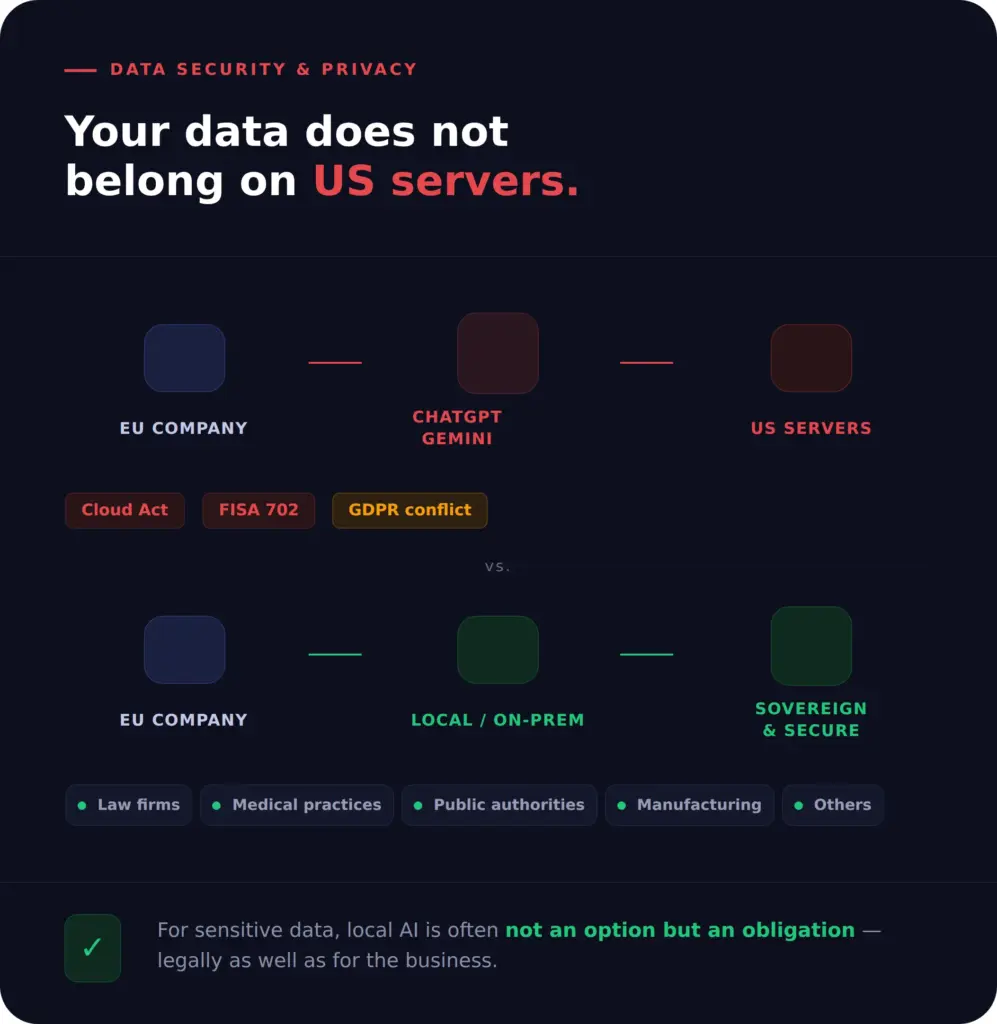
Anyone using AI services such as ChatGPT or Google Gemini sends data to servers in the USA. In many contexts this is a serious problem, and not just a perceived one but a legal one:
- Trade secrets must not be passed on to third parties without control in most industries.
- The GDPR sets strict requirements for processing personal data outside the EU.
- US laws such as the Cloud Act and FISA 702 allow US authorities, under certain circumstances, to access data stored on the servers of American companies, even if those servers are physically located in Europe or the provider is an Irish subsidiary of an American parent.
For companies with sensitive data (law firms, medical practices, public authorities, manufacturers with trade secrets, and in fact almost every company and institution), sovereign, locally operated AI is therefore often not an option but an obligation.
2. Costs and cost-benefit ratio
Cloud AI services such as ChatGPT or Gemini come in two fundamentally different usage models:
Model 1: web app (approx. €20/month):
Cheap, easy to access, with rate limits. Suitable for manual, occasional use by individual employees. No automation possible, no connection to your own systems.
Model 2: API:
Enables automation and connection to tools and agent systems such as OpenClaw or your own software. But with high data volumes, especially when processing many documents, the costs quickly become substantial and hard to predict. Anyone who wants to process hundreds of PDFs or reports every day is in for a nasty surprise.
Local AI, by contrast, has predictable costs:
- An AI server can be bought for about €7,000 or rented in Germany for a few hundred euros per month, sometimes as a fully managed solution.
- Alternatively, a sovereign AI API with top-tier models from Germany is available from €9 per month, GDPR-compliant and without US legal risks (see for example Mittwald).
3. The specific use case
Cloud AI has clear strengths for open, exploratory tasks, meaning where the requirements are not known in advance, where creative or linguistic variety is needed, or where many different tools are to be combined in the same workflow. In coding, for example, modern cloud models automatically integrate interpreters, search functions and debugging tools in a seamless loop. Today that is still a real advantage over most local solutions.
Local AI, on the other hand, wins where the use case is clearly defined and repeatable. And an important principle applies here: the more focused the use case, the better the results with local AI, and the more likely a well-configured local system is to outperform even the best cloud models in the world.
Examples where local AI often performs better:
- Querying your own documents (internal, secure, fast)
- Analyzing large volumes of your own documents: hardly possible with ChatGPT's web app; permanently expensive and legally sensitive via the API
- Company wiki with your own knowledge and your own processes
- Market research AI that simulates personas or analyzes target groups
- Deep research based on internal data
- Quality control in production, e.g. detecting defects in components (one of the few cases where AI training in the technical sense actually makes sense)
- Automated evaluation of receipts and vouchers: a focused use case where specialized local systems are measurably superior to cloud models
- Tasks with a known style or pattern, such as imitating a particular writing style or an image style (e.g. Rembrandt) when training data is available
- Complex, multi-step processes with many chained sub-steps that have to run reliably and reproducibly
4. Usage intensity and number of users
The more employees use AI intensively every day, the faster your own infrastructure pays off. A team of 20 people who regularly process documents can end up cheaper with a local AI server after a few months than with cloud subscriptions and API costs.
Decision tree: cloud versus local
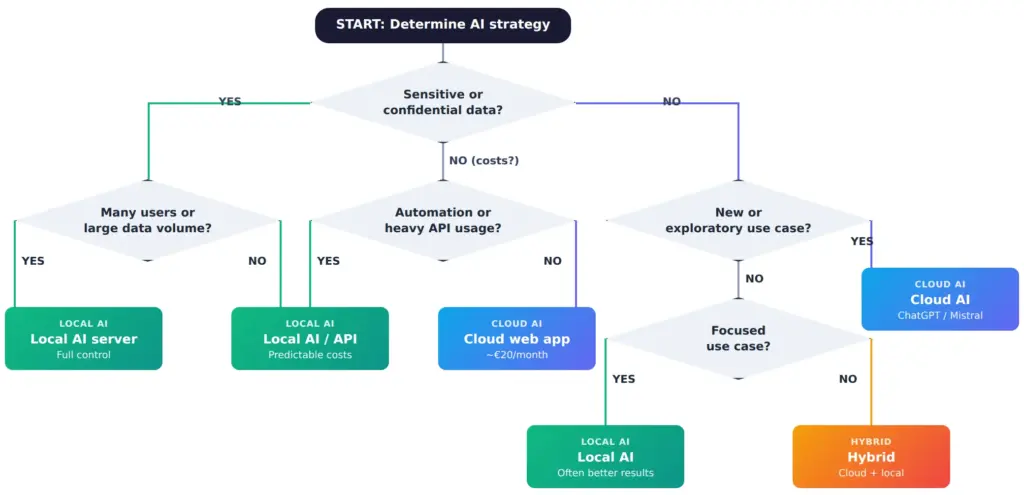
In professional use, cloud AI often performs less well than many would like or hope for. Whenever a higher degree of automation is the goal, for example, cloud AI is unreliable and often poorly suited or more expensive. Data security aside.
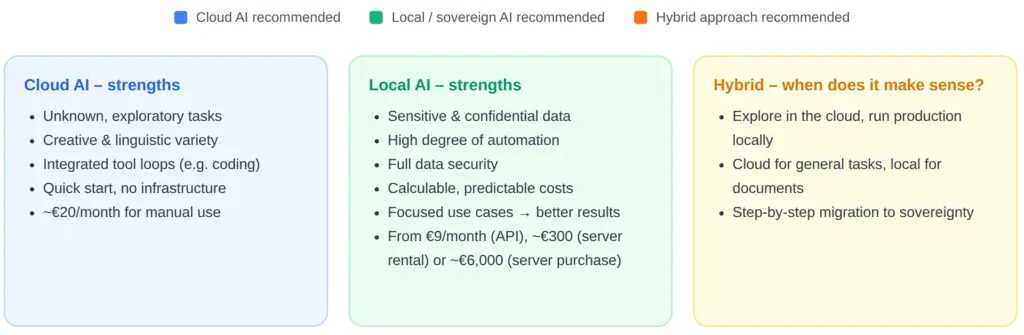
The strengths of each AI approach (cloud, local, hybrid) in a compact overview:
Open-source models: ever smaller, faster, better
A common misconception is that local AI inevitably means worse results. That is no longer true today.
Open-source models are improving at a rapid pace while becoming smaller and more efficient. Current models deliver excellent results for focused tasks on cheap, off-the-shelf hardware. The gap to proprietary cloud models keeps closing. Cloud models cannot be updated as quickly, but at the same time they serve as teacher models for smaller models, which can pull themselves up on the smart teacher.
The only reason cloud AI still has a future is the tool infrastructure, for instance in coding platforms. But this advantage will soon be replicated too. Compare the source code of Anthropic's coding platform or OpenClaw that has become public (even if agents should not be glorified).
In 2027, open-source models will have overtaken cloud AI.
Our own observation of the development of open-source models.
Only the tool chain will keep the cloud alive.
Transparency as an underrated advantage
Local AI can deliver more traceable answers than cloud AI, especially when the system is built to disclose its sources and processing steps. This matters in regulated industries, during audits, or anywhere decisions have to be documented and justified.
A good AI system is not a pure AI system
This point is often underestimated in practice: a reliable, production-ready AI system relies to a significant degree on conventional programming. AI provides linguistic intelligence, pattern recognition and flexibility, while classic code provides structure, validation, error handling and speed.
Load an AI model, query it. Done! How easy is that?
Wrong. It is guaranteed to be far from the optimum!
Because "simple" does not do justice to complex problems.
The result: higher reliability, faster response times and a system that is easier to maintain and develop further.
AI agents are dangerous and mostly unnecessary
Many people like to use agents because the expertise for mature AI applications is missing, or because it is a toy project.
An AI agent with many access rights is potentially powerful, and the power it is given allows it to do a lot of damage.
Agents with very few permissions, on the other hand, are not particularly powerful.
From experience, we find that agents are almost never advantageous. They are a quick shot, not a mature solution. Not least because, left unsupervised, agents drift further out of control and out of the acceptable quality zone with every iteration step.
AI training is almost never required: an important misunderstanding
When service providers or vendors say a company has to "train" its AI system, in practice they almost always mean the configuration of the system: loading in knowledge, defining roles, instructions and use cases.
This usually has nothing to do with AI training in the technical sense, the resource-intensive process of training a model on new data. Real AI training is laborious, costly and simply not necessary for most business applications. A good configuration and a well-thought-out system design are sufficient in the vast majority of cases.
Recommendation: approach your AI transformation incrementally
The most common mistake in AI adoption is not too little ambition, but too much at once. Starting with a clearly defined use case lets you gather real experience early, build trust in the team and expand the solution in a targeted way, without risking a complex infrastructure from the start.
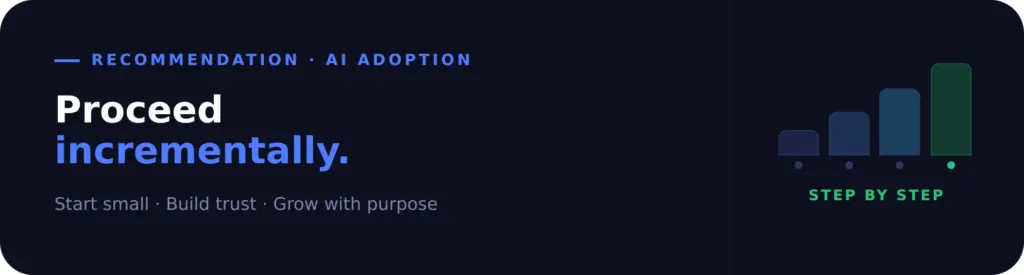
If no concrete use case is known yet, an internal chatbot based on your own documents is a good starting point, a so-called company wiki. Employees can query manuals, process descriptions, contracts or internal policies directly without searching for a long time. The benefit is felt immediately, the effort is manageable, and the system can be extended step by step.
An often underestimated factor is budget planning. Too little budget leads to half-baked solutions that do not work in daily practice and permanently damage acceptance in the team. Too high a budget, on the other hand, creates pressure of expectations, oversized systems and expensive complexity that nobody needs. A realistic budget appropriate to the use case is the foundation for a solution that really works and can then grow sensibly.
Conclusion: not either-or, but a strategic decision
Cloud AI and local AI are not mutually exclusive. For many companies a hybrid approach makes sense: cloud AI for exploratory, creative or general tasks, and local, sovereign AI for everything that requires sensitive data, high usage intensity or maximum reliability.
The decisive step is to make this choice deliberately and based on criteria, not on the principle of "everyone uses ChatGPT, so we do too".
The AI Act (AI Regulation), however, requires that clear rules for the use of AI are defined and followed. For example, the AI competence of the people who use AI in the company, the authority or the administration must be demonstrated. This is no rocket science, but it has to be done.
The AI Regulation is in any case much easier to comply with using local AI. The same applies to the legal side in general: nobody understands Microsoft contracts. And AI proxies such as OpenRouter or Langchain, which bundle various cloud models, are the worst-case scenario in this respect.
All articles on offline AI, open language models and company knowledge are collected in the Local AI overview.
 My name is Klaus Meffert. I have a doctorate in computer science and have been working professionally and practically with information technology for over 30 years. I also work as an expert in IT & data protection. I achieve my results by looking at technology and law. This seems absolutely essential to me when it comes to digital data protection. My company, IT Logic GmbH, also offers consulting and development of optimized and secure AI solutions.
