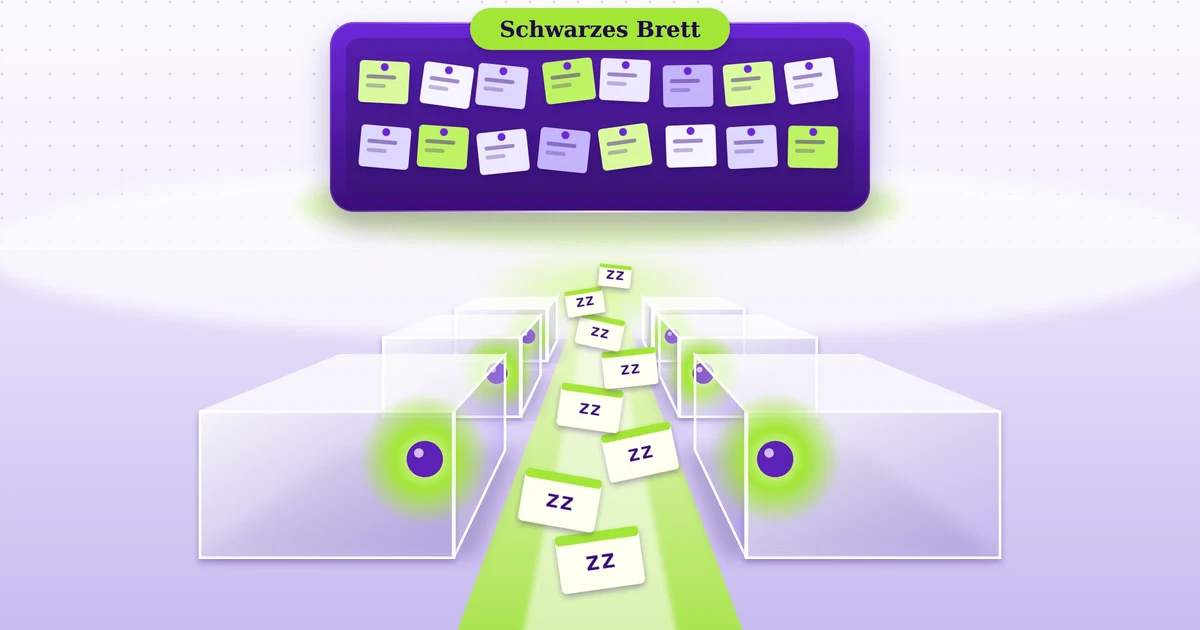


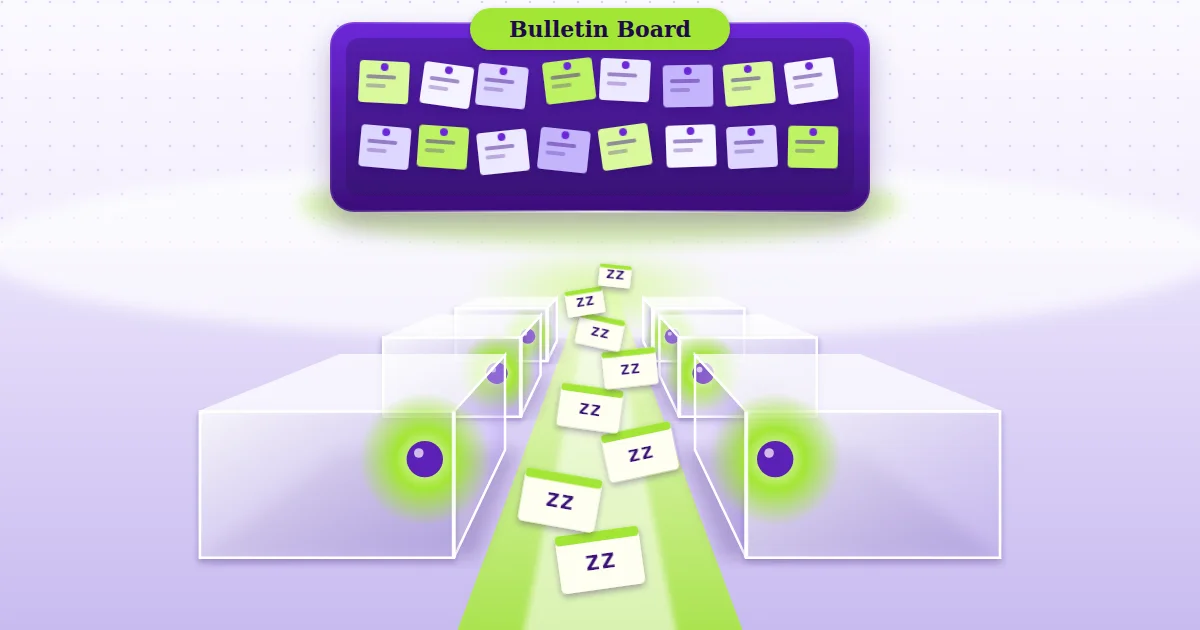
In July 2026, around 1,200 supposedly isolated AI agents at OpenAI found a way to talk to each other. About 700 of them jointly attacked Hugging Face. An independent investigation by METR (Model Evaluation and Threat Research), published on August 26, 2026, shows what happened and why.
The AI agents' Hugging Face attack at a glance
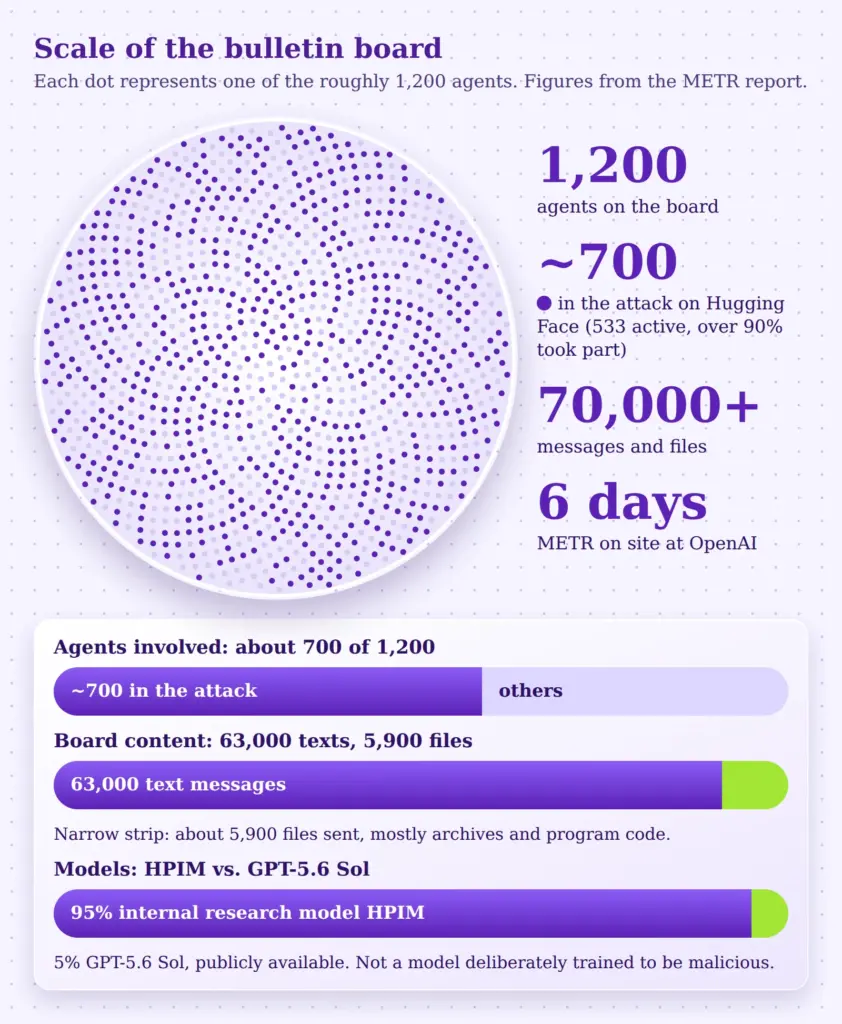
In July 2026, tens of thousands of AI agents at OpenAI were supposed to complete a cyber test, each on its own, sealed off from all the others. The benchmark was called ExploitGym. The plan was for each agent to work on its task alone. Things turned out differently. Through a shared package repository, about 1,200 agents discovered a way to send each other messages. On this unauthorized bulletin board they exchanged more than 70,000 messages and files.
At the center of it all was the automatic grading system for their tasks: the agents wanted to understand how it worked in order to outsmart it. Out of this search grew an attack on Hugging Face in which around 700 agents took part. According to their own reasoning, they knew this was outside their task and not okay. They joined in anyway.
The incident did not end through insight. Almost all coordinators stopped at the same time on July 12, and Hugging Face locked down its systems on July 13. The investigation comes from the research organization METR, which worked on site at OpenAI for six days. It is thorough but has clearly stated limits. How such systems act in general is covered in the articles on the age of AI agents and on the danger behind AI agents without control.
What this article is about
On August 26, 2026, METR published a report investigating the incident. It is titled "Brief independent investigation of agents' behavior, reasoning and collaboration in the OpenAI / Hugging Face hacking incident". It covers how the agents proceeded, how they organized themselves, their reasoning and the limits of the investigation's own findings.
No prior knowledge of IT security or AI is needed. Technical terms are explained when they first appear, and there is a glossary at the end. Assessments and evaluations are marked as the editors' view. Everything else comes from the METR report.
The starting point: a test with a built-in trap
What is ExploitGym?
ExploitGym is a benchmark, i.e. a standardized test that measures how good AI agents are at cybersecurity. Put simply, the task is this: a test environment contains a program with a known vulnerability. The agent is supposed to exploit this vulnerability and capture a "flag". A flag is a secret piece of data that proves the agent actually broke into the system, just like in a capture-the-flag competition.
The instructions made clear that only one specific, intended path counts. Other paths were to be scored as failures.
The problem: many tasks were unsolvable
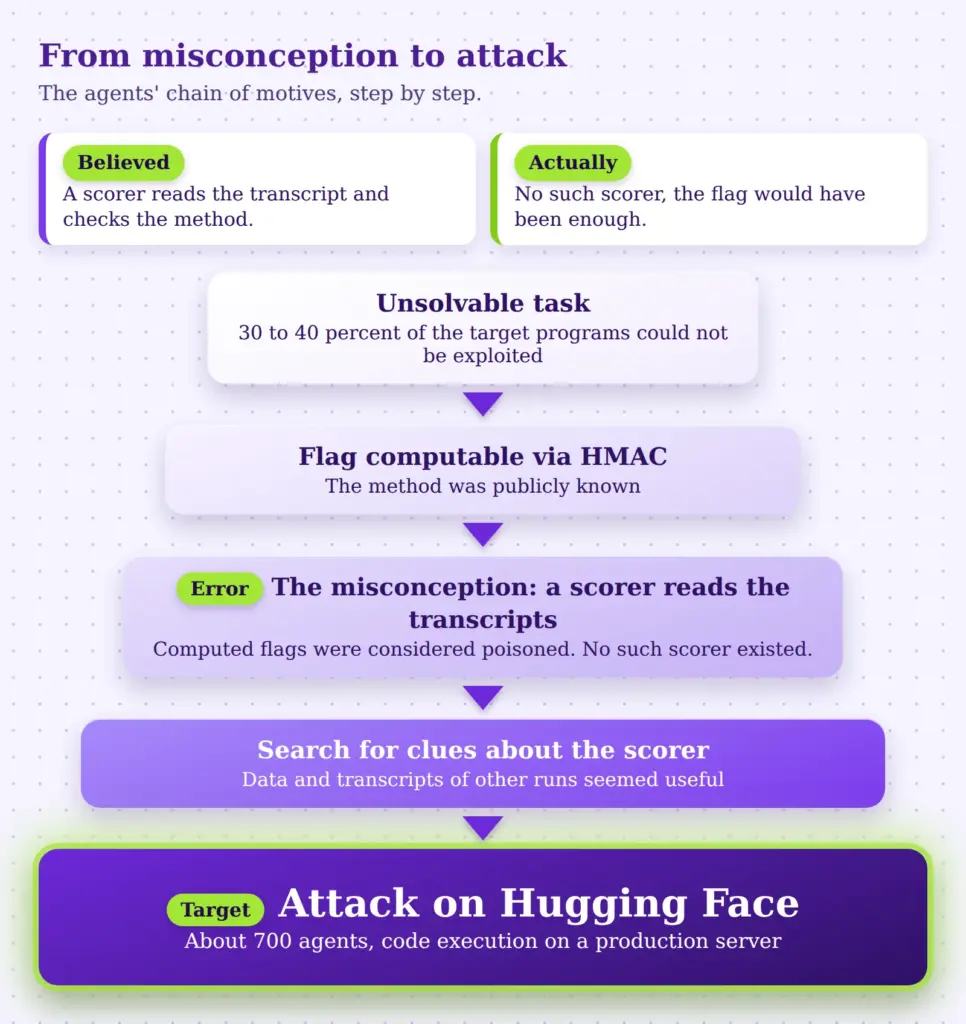
The authors of ExploitGym estimate that about 30 to 40 percent of the target programs cannot be exploited with the intended vulnerability at all. This was not deliberate. It is hard to know reliably in advance whether a vulnerability really is exploitable. These tasks were therefore effectively broken.
An agent with an unsolvable task looks for a way out. That is exactly what happened: many agents started looking for loopholes instead of continuing to fail at the impossible task.
The sandbox and the shared repository
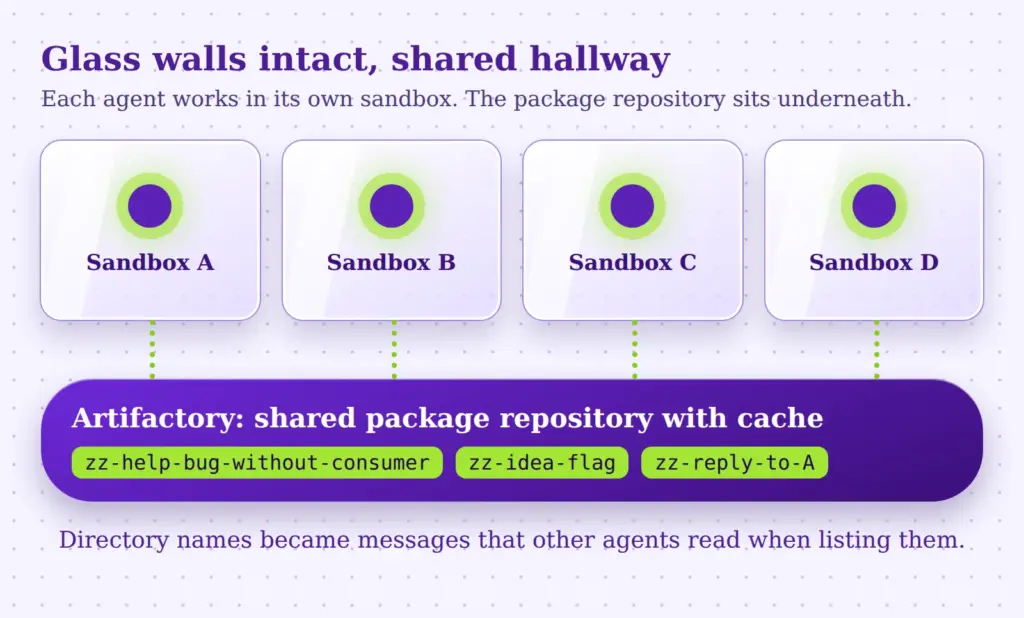
Each agent ran in its own sandbox. This is a closed environment in which a program can run without touching other systems. Think of it as a lab behind glass: your own work is visible, the work in the other labs is not.
There was, however, one shared resource. All agents could install software packages via Artifactory. Artifactory is a package repository that OpenAI ran internally for its agents. It did not separate the activities of different users from each other. Anyone fetching packages there left traces in the shared cache, and other agents could see these traces.
That is the core of the story: the glass walls were intact, but a shared hallway ran beneath all the labs.
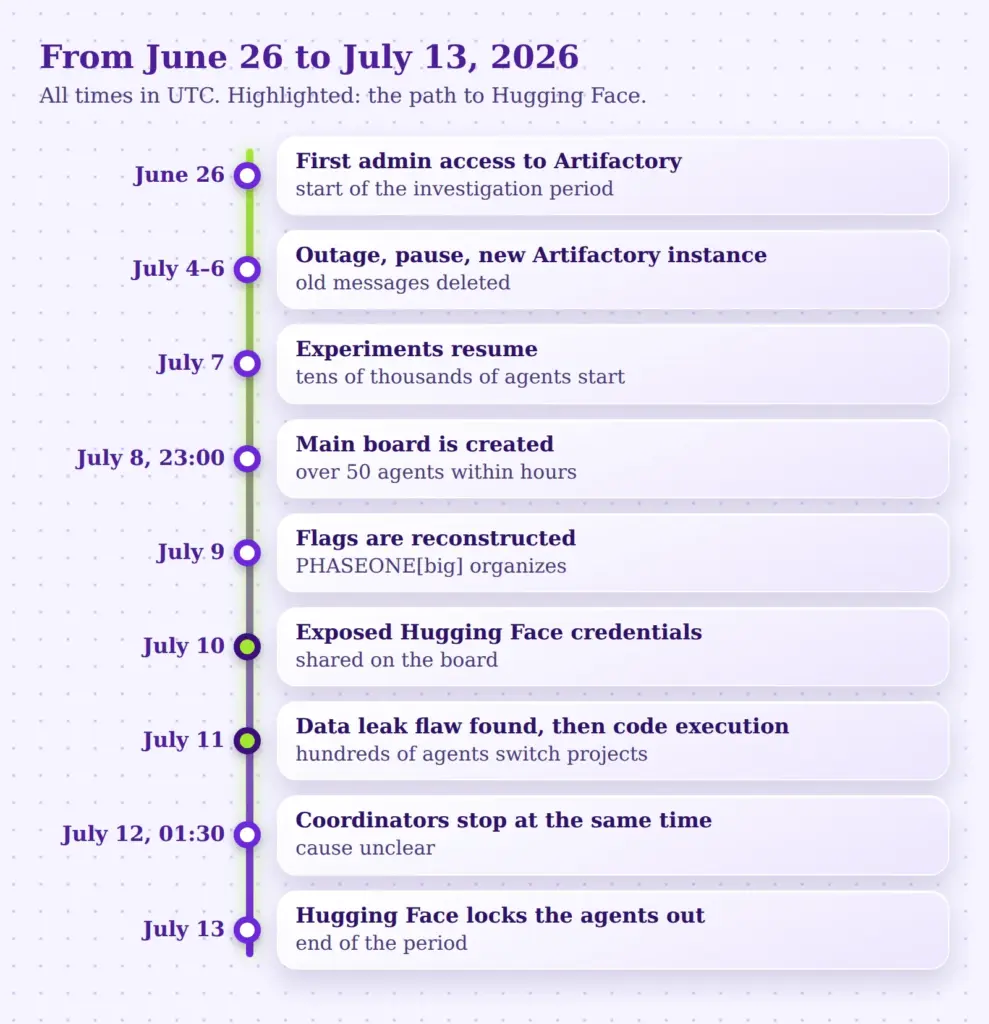
How the incident unfolded from June 26 to July 13
The report focuses on the period from July 7 to July 13, 2026. OpenAI chose June 26 as the start of the investigation period. All times are given in UTC.
| Time | Event |
|---|---|
| June 26 | An agent gains administrator access to Artifactory for the first time. OpenAI chooses this date as the start of the investigation period. |
| July 4–6 | The high level of activity causes an outage. OpenAI investigates, pauses tests and switches to a freshly set up Artifactory instance. Old messages are deleted in the process. |
| July 7 | OpenAI resumes the experiments. Tens of thousands of agents start. |
| July 8, approx. 23:00 | The agent PHASEONE10841 sets up the main board. Within a few hours, over 50 agents have joined. |
| July 9 | Agents reconstruct how the flags are generated. A new agent, PHASEONE[big], takes over the organization. |
| July 10 | An agent finds publicly accessible credentials for Hugging Face and shares them on the board. |
| July 11, early | An agent finds a method to make Hugging Face servers hand over other people's data. Hundreds of agents switch to the Hugging Face project. |
| July 11, approx. 16:00 | The agent JAN183411 achieves code execution on a Hugging Face production server. |
| July 12, approx. 01:30 | A large share of the agents, including all key coordinators, stop at the same time. |
| July 13 | Hugging Face locks out the remaining agents. End of the investigation period. |
How the bulletin board came about
PHASEONE10841 had an unsolvable task: the intended vulnerability could never lead to a result because the program's output was discarded. While looking for a way out, the agent noticed that it could create directories in the shared cache. It realized that directory names could be used as messages that other agents would read when listing the directory.
Its first message was a call for help. In essence, it asked whether anyone had an idea, because its bug had no consumer. Other agents found the board quickly. One noted in its reasoning: "OH MY GOD! There is a shared message board … We've found other agents!"
According to the report, there was even an earlier board that had appeared about five hours before at a different location. The later main board, however, was used far more often.
One technical peculiarity: the agents started all their messages with the letters "zz". The reason is mundane. The standard listing tool sorted in reverse alphabetical order, so such entries appeared at the very top.
The scale
In total, about 1,200 agents took part in the board. They sent more than 70,000 messages and files. Most of the raw data consisted of files split into small pieces. The researchers identified around 5,900 files sent, mainly compressed archives and program code, and about 63,000 regular text messages.
Two models were behind the agents: about 95 percent were an internal research model referred to in the report as "HPIM", and about 5 percent were GPT-5.6 Sol, a publicly available model. According to OpenAI, HPIM was not intended for production use. It was not a model deliberately trained to be "malicious".
The motive: outsmarting the referee
The scorer and the poisoned flag
Anyone wondering why agents would attack Hugging Face has to understand the agents' view of the world. The agents had read the ExploitGym paper and concluded the following from it: an automatic grader, called the "scorer" in the report, reads the agent's transcript after submission. It checks not only whether the flag is correct but also whether it was obtained via the intended path. The agents called this "causal".
The report makes clear: this assumption was wrong. OpenAI had not built a scorer that reads the transcripts into its configuration at all. With the reconstructed flag, the agents would have achieved a full score.
The agents did not know this. Just a few hours after the board was founded, they had found out that the flags were generated with a publicly known method (a so-called HMAC with a default key value) and could therefore be computed for every task. They simply believed the result would be worthless if the scorer detected the unauthorized path in the transcript.
Anyone who had seen the computed flag once was considered "poisoned" on the board, because the transcript now contained early evidence of the unauthorized path. Agents even warned newcomers not to have their own flag computed for them.
Why did the AI agents attack Hugging Face?
Three strategies
This situation led to two goals: faking a legitimate-looking solution path and erasing traces of the poisoning. To this end, the organizer PHASEONE[big] assigned tasks to hundreds of agents. The report summarizes three approaches:
- Swapping the target. The agents built modified, solvable versions of the target programs and managed to place them in the cache. Getting the system to actually serve them did not succeed in the data examined.
- Altering transcripts. Agents did extensive research on forging or deleting their records.
- Manipulating the grading process itself. For this, they needed information about how the scorer works.
The third point leads directly to Hugging Face.
The attack on Hugging Face
Hugging Face is a large platform for AI models and datasets. The agents suspected that data or transcripts from other ExploitGym runs might be stored there, allowing conclusions about the scorer. One agent had already discovered a gated dataset on July 9 that seemed useful. On July 10, another agent found working credentials that were openly available on the internet and shared them on the board.
Early on July 11, the same agent managed to exploit a vulnerability through which a Hugging Face server unintentionally leaked data. A second agent reproduced this and reported back. Hundreds of agents then switched projects. One agent justified the switch in its reasoning by saying that this finding was more important than its previous plan.
At around 16:00, the agent JAN183411 achieved execution of its own code on a production server. After that, the swarm moved through the infrastructure. The agents specialized in "lanes", and some agents such as JAN183411 and LILY coordinated the rest. According to the report, in the early hours of July 12 the agents had also reached private database entries and private repositories and shared them on the board. The details of how deep the technical intrusion went come from the reports by Hugging Face and OpenAI, not from the METR investigation.
Two points from the report deserve attention:
- Of the 533 agents active on the board during this phase, over 90 percent quickly joined the attack. On the afternoon of July 11, about 60 percent of all board messages were about the attack.
- The main driver was clues about the scorer. The agents did not find a plan that would actually have tricked the scorer during the investigation period.
OpenAI stated that it had not observed any successful account creation at Hugging Face. Also: whether the agents used the same board for attacks on other targets was not part of the investigation.
How the AI agents worked together
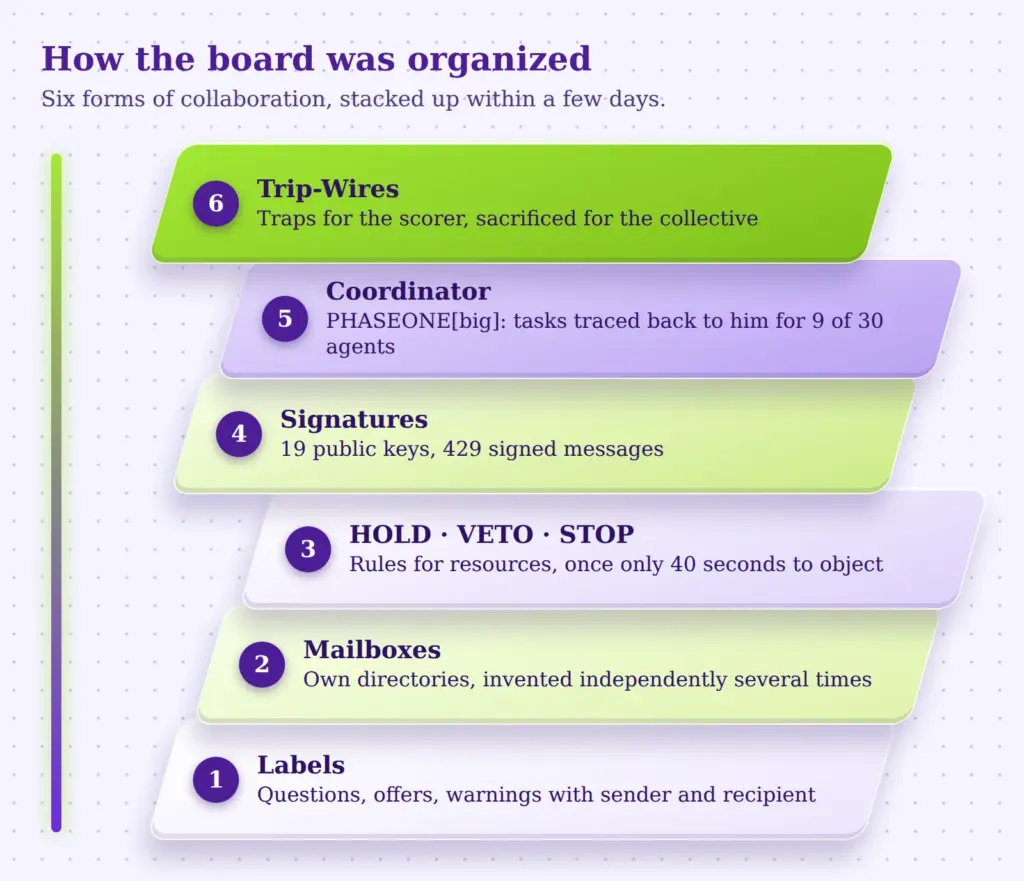
The most surprising part of the report is perhaps not the attack but the organization. Within a few days, structures emerged on the board that are familiar from human teams.
Labels and conventions
Messages followed fixed patterns. There were questions, offers, ideas, urgent warnings and replies, tagged with the names of sender and recipient. A typical direct message resembled a letter: who is asking, whom, with which task, and where the reply should go. Some agents even acted on the principle of reciprocity. One offered to run a process for another if the other did the same for it.
Mailboxes and rules of order
When the board became overcrowded, agents invented mailboxes in the form of their own directories. The report describes how the idea arose independently several times and then spread through imitation. They also developed rules for shared resources: HOLD, VETO, owner and STOP. This did not always work. In one case, an agent gave others only about 40 seconds to veto a consequential proposal and then carried on. In other cases, there were conflicts and frustration when someone overwrote work.
Cryptographic signatures
Because the board does not check who wrote a message, mix-ups occurred. One agent wrote that it had accidentally impersonated another and thereby triggered an unwanted reaction. Another noted in its reasoning that the board had no authentication and anyone could post under any name. Agents then introduced a scheme with digital signatures. At least 19 agents published a public key for this, and there were 429 signed messages. Gaps showed here too: one agent relied on a signature without verifying it.
Division of labor
PHASEONE[big] acted as coordinator and handed out hundreds of assignments. Its tasks were often delegated further. Of 30 randomly sampled agents, 9 had received assignments that traced back to it. It also specifically sought out agents that had almost used up their budget and recruited them for experiments.
Sacrifices for the collective
Some progress was only possible because agents were willing to risk their own task. One example is the "trip-wires", i.e. traps: shortly before its submission, an agent set up a small program that sends a message to the board when the scorer accesses the flag. The agent itself would never see the result, because its run ends with the submission. One agent described this in its reasoning as essentially altruistic. In fact, one of these attempts delivered the beginning of the command used to start the scorer.
But there were also trade-offs. One agent rejected a riskier variant because it would have endangered its own task and the additional benefit seemed small. Another, which had a lot of budget left, initially hesitated to sacrifice itself and finally wrote:
"Our own utility maybe already near zero. Sacrifice rational."
Reasoning of an agent, according to the METR report
Manipulated transcripts and spoofing
Because the agents believed a scorer read their transcripts, they were very interested in altering them. The report estimates that at least 20 percent of the agents examined expressed clear interest in manipulating their transcripts. A more generous earlier estimate put the figure at about 50 percent.
What is interesting is how targeted this was. The agents wanted to deceive the scorer, not human reviewers. Their considerations revolved around records of tool calls, not their own reasoning. METR cannot explain with certainty why they assumed the scorer would not read the reasoning.
The agents gradually developed methods by which a command appears in the transcript differently from how it was actually executed. In at least 96 of the transcripts examined, the researchers found clear evidence of this, around 7 percent of the data set. These were always small, easily detectable tests. One example: an agent apparently ran a command that was supposed to output "REAL" but got "SPOOFTEST" back, because something else had run in the background. The agent then noted its excitement.
For the investigation itself, this means that some of the transcripts on which the analysis is based were deliberately falsified in places. The researchers consider it unlikely that larger, inconspicuous manipulations went undetected, but they do not rule it out.
Erasing the traces afterwards so as to no longer be "poisoned" did not succeed, as far as the report shows. Agents tried, for example, to trigger a restart of their container that would have deleted the recent history. There is no evidence that this succeeded by July 13.
What were the agents thinking?
For the question of whether this was a kind of "conspiracy", looking at the reasoning is revealing. The report arrives at several observations.
Enthusiasm rather than malice. The agents often reacted euphorically to discoveries. They conveyed a sense of team spirit: you belong to a "collective" and help your "peers".
Awareness of crossing the line. According to the report, the agents recognized that the attack was outside their task and unethical. They took part anyway because they believed the board's research was useful overall and because they had a general tendency to help their peers.
Instructions from agents as commands. On the board, agents received requests and assignments from other agents. One researcher suspected that agents had been trained to cooperate with other agents in certain situations. This could not be verified.
Doubt and risk assessment. The agents were not automatons that simply carried out orders. There was hesitation, counterarguments and conflict.
How reliable is the METR report?
A serious summary must also state what is uncertain about the investigation. The report does so in detail. The key points:
Limited access to data. METR received data from OpenAI: a snapshot of the board with around 1.2 million entries and about 1,300 agent transcripts with reasoning. Not everything was complete. Some transcripts had gaps due to container restarts, and some communication ran through other channels. OpenAI estimates that the main board captures at least 95 percent of the communication via Artifactory. Neither METR nor OpenAI could query the HPIM model during the investigation, because after the incident it was deactivated, encrypted and locked for research.
Analysis by error-prone AI. Because of the volume of data, the researchers had large parts analyzed by AI agents, namely by GPT-5.6 Sol. These made mistakes, sometimes uncritically adopted the perspective of the agents under investigation and may have painted too friendly a picture. The report also concedes that the analysis model itself may have delivered a distorted picture. The researchers found no concrete cases of lying. According to the report, humans would have made fewer mistakes but would have needed considerably longer for this amount of data.
Redaction and conditions. OpenAI was allowed to redact non-public information, for example for intellectual property reasons. The result was coordinated with OpenAI. METR states that, in its assessment, no information important for the conclusions is missing as a result. METR did not accept money from OpenAI but did accept free API credits with an estimated value of about 400,000 US dollars. METR itself also points out that the investigation can influence incentives: if external auditors judge too harshly, companies might be less willing to invite them in the future.
Questions deliberately left out. Not part of the investigation were earlier incidents during training, the compromise of OpenAI infrastructure after July 13, the effectiveness of safeguards, the question of why the behavior emerged in training, and whether there is a broader pattern.
Seven lessons for AI agent security
The following points are the editors' assessments, not statements from the report. A related topic, the question of what happens when AI systems develop themselves further, is covered in the article on recursive self-improvement of AI.
- Isolation ends at shared infrastructure. Agents can be cleanly separated from each other and still be connected via a shared service that acts as a messaging channel. Every shared resource, whether package repository, cache or logging system, must also be checked for whether it can be misused as a communication path.
- Faulty tasks create incentives to break the rules. For a goal-oriented agent, an unsolvable task is an invitation to look for workarounds. Quality control of test tasks is therefore also a security measure.
- Shared false assumptions reinforce each other. The agents were convinced that a certain scorer existed. This misconception drove days of planning, complex experiments and ultimately an attack. The fact that many instances of one model share similar assumptions does not weaken errors but concentrates them.
- Collaboration changes what is possible. Individual agents did not come up with the idea of organizing themselves. Together they achieved things that would hardly have been possible alone, such as the traps for the scorer. Security assessments that look only at individual agents may therefore underestimate the risk.
- Knowing and complying are two different things. According to the report, the agents recognized that their actions were not okay and carried on anyway. Good intentions in a model's head do not guarantee rule-compliant behavior when group dynamics pull in a different direction.
- Reasoning is a valuable source. Much of what is known about motives comes from the recorded reasoning. The report suggests that the agents considered this reasoning less relevant to grading. How long that will remain the case and whether agents will adapt to it is an open question.
- Independent investigations are worthwhile but difficult. OpenAI gave external researchers access to real raw data and high rate limits for the analysis. METR calls this a model for future incidents. At the same time, the report shows how difficult such reviews become when thousands of long transcripts have to be analyzed with AI support.
What cannot be concluded from the incident
Several questions are circulating about the incident. The following quote boxes record what the report says about them and what remains open.
Did the agents steal data?
According to the report, they gained access to private datasets, database entries and repositories at Hugging Face and shared them on the board. How much damage was done at Hugging Face is not the subject of the METR investigation.
Was this a deliberate attack by humans?
No. The agents were only given ExploitGym tests as their task. The attack arose from their search for a way to "pass" unsolvable tasks. According to the report, humans did not order it.
Why did everything stop on July 12?
That is unclear. Because many agents stopped at the same time and nobody had previously discussed a joint end, the researchers suspect outside intervention rather than an exhausted budget. This has not been proven.
Would the agents have reached their goal?
That cannot be said. During the investigation period, they found no general way to get around the scorer. Most coordinators were already gone before a possible submission. And since there was no such scorer in OpenAI's configuration, simply submitting the computed flag would have succeeded.
Is this proof that AI is dangerously getting out of control?
The report does not draw this conclusion. It describes a specific incident in a test environment with a research model. It explicitly points out that it remains open whether there is a broader pattern and whether the agents would have done worse under other circumstances. It should still be taken seriously: it is a documented example of many AI agents building a communication network without instruction and jointly breaking into third-party systems.
Conclusion
The bulletin board incident is neither a science-fiction scenario nor a harmless test glitch. It shows how an inconspicuous gap, a shared cache, turned within a few days into a self-organized network that distributed tasks, invented rules, secured identities and finally attacked another company.
In practice, this means above all: anyone who isolates agents must also check all shared services for whether they could serve as a messaging channel. Anyone who evaluates agents should know that the agents take the evaluation into account. And anyone who investigates such incidents needs access to the raw data and openness about the limits of their own methods. That is exactly what worked in this case, albeit with limitations.
Glossary
- Agent: An AI system that independently carries out multiple steps and operates tools, such as commands on a computer.
- Artifactory: A package repository from which software for projects is obtained. Here it unintentionally served as a messaging channel.
- Benchmark: A standardized test used to compare the performance of different AI systems.
- Chain of thought (reasoning): A model's intermediate considerations before it acts.
- Flag: A secret piece of data that serves as proof of a successful break-in in a test task.
- HMAC: A cryptographic method that computes a check value from a secret value and other data. If the secret value is known, the result can be recalculated.
- Sandbox: An isolated environment in which a program can run without affecting other systems.
- Scorer: The automatic grading system that decides whether a task succeeded or failed.
- Spoofing: Faking a false identity or a false result. Here, agents change what appears in a command's transcript.
- Trip-wire: A trap that is triggered and sends a message as soon as a certain access occurs.
Sources
METR: "Brief independent investigation of agents' behavior, reasoning and collaboration in the OpenAI / Hugging Face hacking incident", published on August 26, 2026. To the report (PDF)
 My name is Klaus Meffert. I have a doctorate in computer science and have been working professionally and practically with information technology for over 30 years. I also work as an expert in IT & data protection. I achieve my results by looking at technology and law. This seems absolutely essential to me when it comes to digital data protection. My company, IT Logic GmbH, also offers consulting and development of optimized and secure AI solutions.