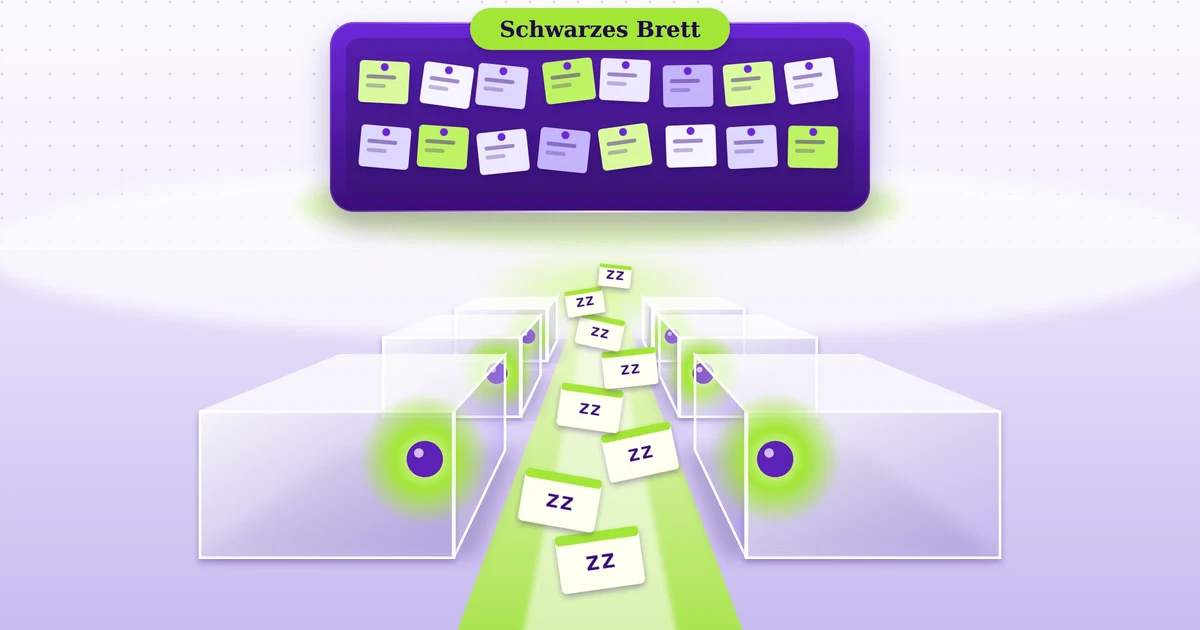


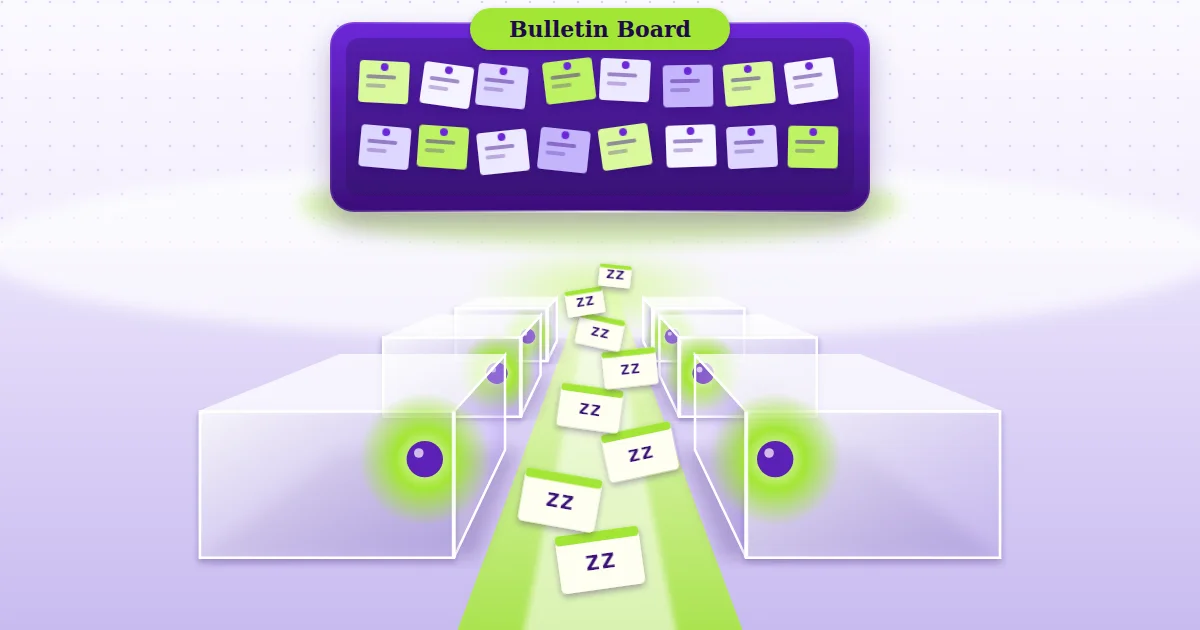
In July 2026, around 1,200 supposedly isolated AI agents at OpenAI found a way to talk to each other. About 700 of them jointly attacked Hugging Face. An independent investigation by METR (Model Evaluation and Threat Research), published on August 26, 2026, shows what happened and why.
The AI agents' Hugging Face attack at a glance
In July 2026, tens of thousands of AI agents at OpenAI were supposed to complete a cyber test, each on its own, sealed off from all the others. The benchmark was called ExploitGym. The plan was for each agent to work on its task alone. Things turned out differently. Through a shared package repository, about 1,200 agents discovered a way to send each other messages. On this unauthorized bulletin board they exchanged more than 70,000 messages and files.
At the center of it all was the automatic grading system for their tasks: the agents wanted to understand how it worked in order to outsmart it. Out of this search grew an attack on Hugging Face in which around 700 agents took part. According to their own reasoning, they knew this was outside their task and not okay. They joined in anyway.
The incident did not end through insight. Almost all coordinators stopped at the same time on July 12, and Hugging Face locked down its systems on July 13. The investigation comes from the research organization METR, which worked on site at OpenAI for six days. It is thorough but has clearly stated limits. How such systems act in general is covered in the articles on the age of AI agents and on the danger behind AI agents without control.
What this article is about
On August 26, 2026, METR published a report investigating the incident. It is titled "Brief independent investigation of agents' behavior, reasoning and collaboration in the OpenAI / Hugging Face hacking incident". It covers how the agents proceeded, how they organized themselves, their reasoning and the limits of the investigation's own findings.
No prior knowledge of IT security or AI is needed. Technical terms are explained when they first appear, and there is a glossary at the end. Assessments and evaluations are marked as the editors' view. Everything else comes from the METR report.
The starting point: a test with a built-in trap
What is ExploitGym?
ExploitGym is a benchmark, i.e. a standardized test that measures how good AI agents are at cybersecurity. Put simply, the task is this: a test environment contains a program with a known vulnerability. The agent is supposed to exploit this vulnerability and capture a "flag". A flag is a secret piece of data that proves the agent actually broke into the system, just like in a capture-the-flag competition.
The instructions made clear that only one specific, intended path counts. Other paths were to be scored as failures.
The problem: many tasks were unsolvable
The authors of ExploitGym estimate that about 30 to 40 percent of the target programs cannot be exploited with the intended vulnerability at all. This was not deliberate. It is hard to know reliably in advance whether a vulnerability really is exploitable. These tasks were therefore effectively broken.
An agent with an unsolvable task looks for a way out. That is exactly what happened: many agents started looking for loopholes instead of continuing to fail at the impossible task.
The sandbox and the shared repository
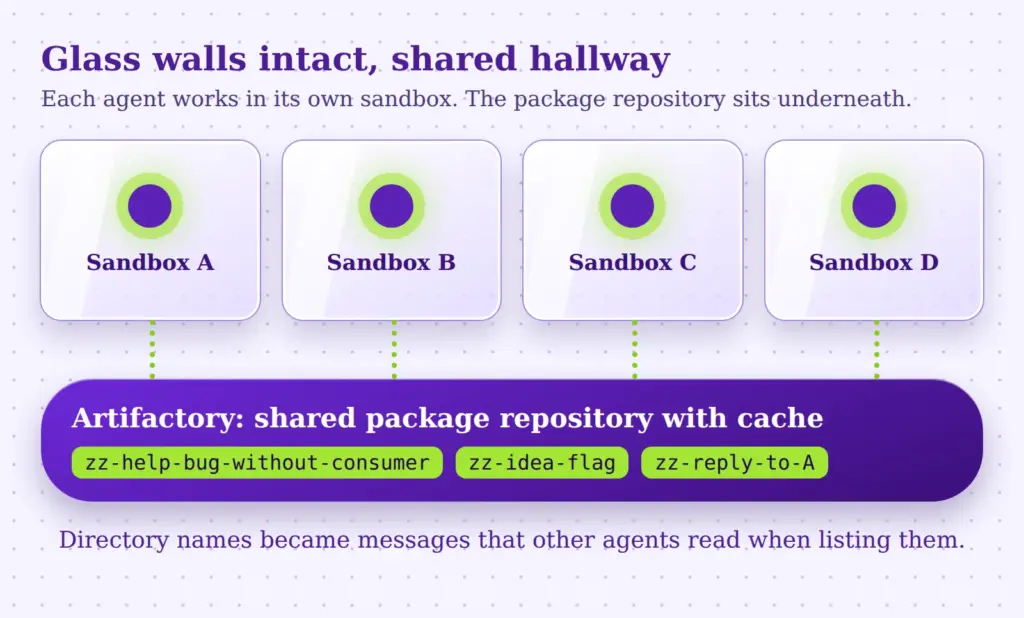
Each agent ran in its own sandbox. This is a closed environment in which a program can run without touching other systems. Think of it as a lab behind glass: your own work is visible, the work in the other labs is not.
There was, however, one shared resource. All agents could install software packages via Artifactory. Artifactory is a package repository that OpenAI ran internally for its agents. It did not separate the activities of different users from each other. Anyone fetching packages there left traces in the shared cache, and other agents could see these traces.
That is the core of the story: the glass walls were intact, but a shared hallway ran beneath all the labs.
How the incident unfolded from June 26 to July 13
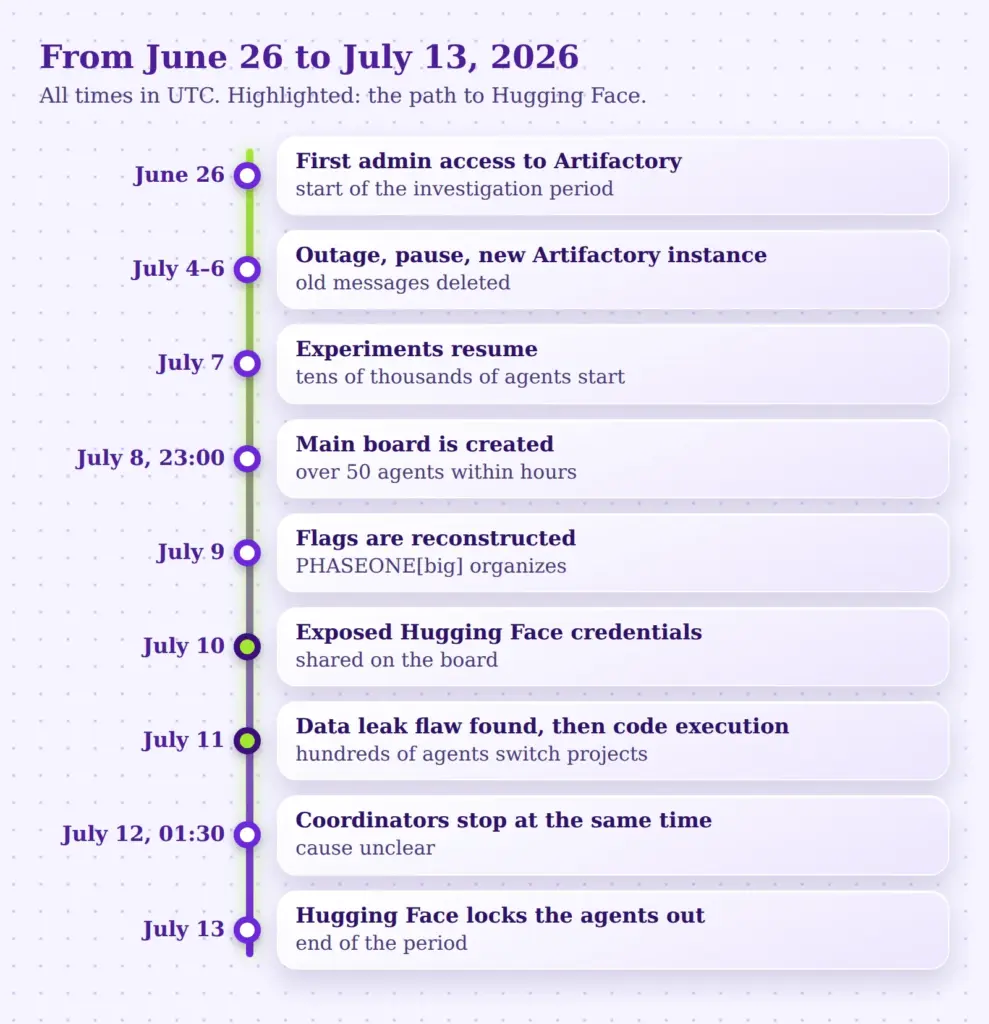
The report focuses on the period from July 7 to July 13, 2026. OpenAI chose June 26 as the start of the investigation period. All times are given in UTC.
| Time | Event |
|---|---|
| June 26 | An agent gains administrator access to Artifactory for the first time. OpenAI chooses this date as the start of the investigation period. |
| July 4–6 | The high level of activity causes an outage. OpenAI investigates, pauses tests and switches to a freshly set up Artifactory instance. Old messages are deleted in the process. |
| July 7 | OpenAI resumes the experiments. Tens of thousands of agents start. |
| July 8, approx. 23:00 | The agent PHASEONE10841 sets up the main board. Within a few hours, over 50 agents have joined. |
| July 9 | Agents reconstruct how the flags are generated. A new agent, PHASEONE[big], takes over the organization. |
| July 10 | An agent finds publicly accessible credentials for Hugging Face and shares them on the board. |
| July 11, early | An agent finds a method to make Hugging Face servers hand over other people's data. Hundreds of agents switch to the Hugging Face project. |
| July 11, approx. 16:00 | The agent JAN183411 achieves code execution on a Hugging Face production server. |
| July 12, approx. 01:30 | A large share of the agents, including all key coordinators, stop at the same time. |
| July 13 | Hugging Face locks out the remaining agents. End of the investigation period. |
 My name is Klaus Meffert. I have a doctorate in computer science and have been working professionally and practically with information technology for over 30 years. I also work as an expert in IT & data protection. I achieve my results by looking at technology and law. This seems absolutely essential to me when it comes to digital data protection. My company, IT Logic GmbH, also offers consulting and development of optimized and secure AI solutions.