


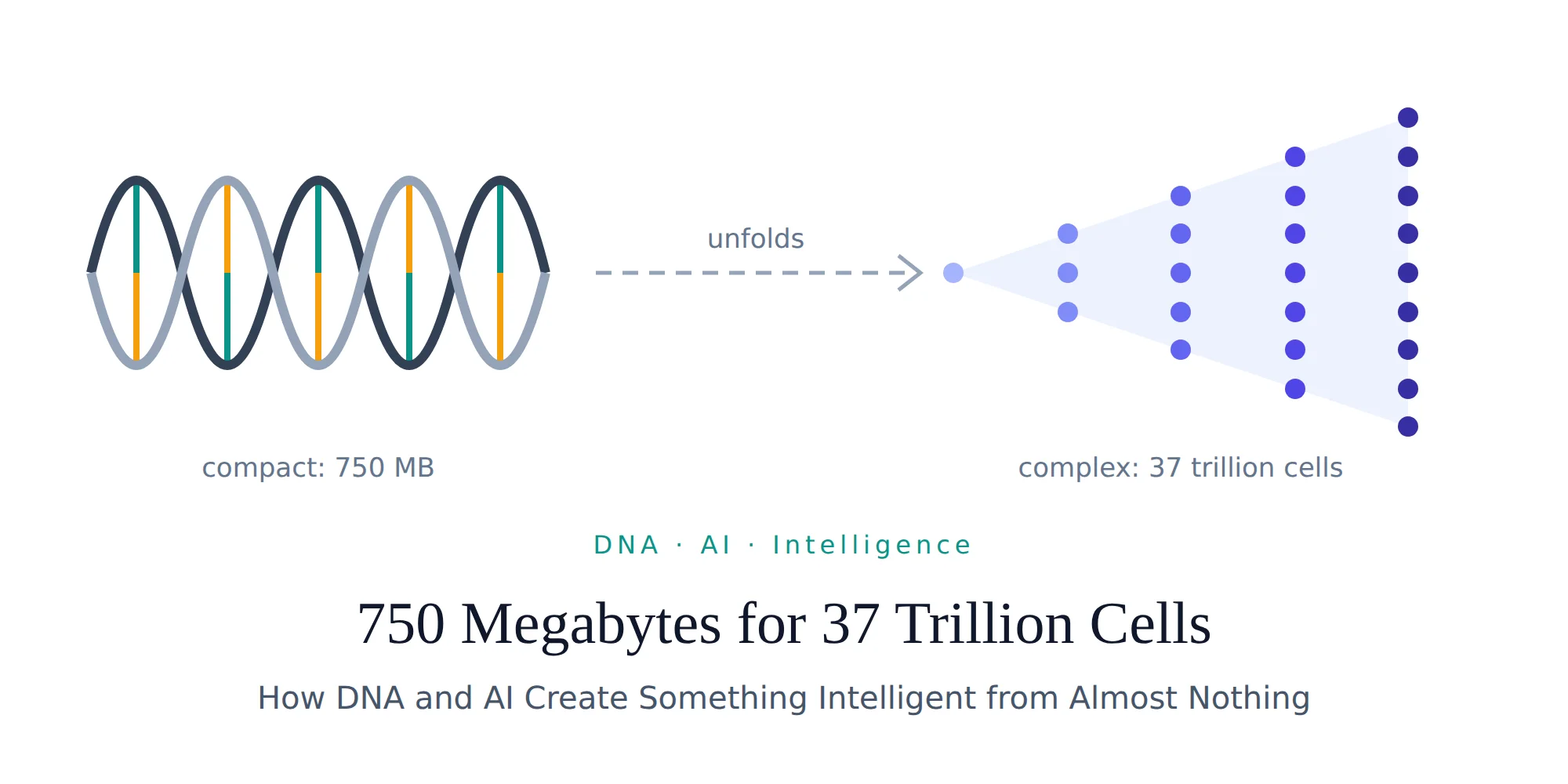
The human body arises from a tiny amount of data, and a language model writes whole texts from a few words. Is the same principle behind both? A journey through DNA, the brain and artificial intelligence.
Suppose a USB stick holding about 750 megabytes of data were the only template for building a human being. With skin, heart, muscles, 37 trillion cells and a brain that can write poems, drive a car, interact with others and reflect on itself.
That sounds absurd. Yet this is exactly what nature achieves every time a human being comes into existence. The DNA that serves as the starting point holds roughly as much data as a few albums by a popular band.
Now the change of perspective: give an AI language model a single sentence and it writes a multi-page essay from it, word by word, token by token. Little becomes much.
Is that a coincidence? Or is the same principle behind both? This article gets to the bottom of the question, and the answer is more surprising than one might first suspect.
The riddle of the numbers
It starts with a few numbers that can make your head spin.
The human genome consists of around 3.1 billion base pairs. Each base can be represented with 2 bits, because there are only four letters: A, C, G and T. That comes to about 750 to 800 megabytes. It fits on an old CD.
Compare that with what arises from it:
| What | Order of magnitude |
|---|---|
| Cells in the body | about 37 trillion |
| Neurons in the brain | about 86 billion |
| Synapses (connections) in the brain | roughly 100 trillion or more |
| Protein-coding genes | only about 20,000 |
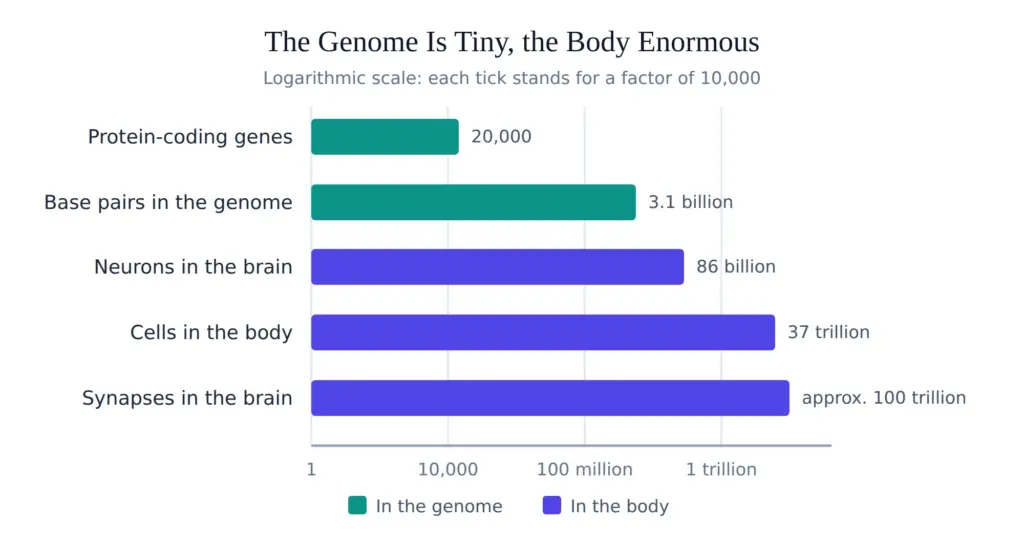
Specifying the synapses individually would alone take many times more information than the entire genome can hold. The neuroscientist Anthony Zador calls this the genomic bottleneck.
So DNA cannot possibly be a list stating where every cell and every connection belongs. Something else must be behind it.
DNA is not a blueprint
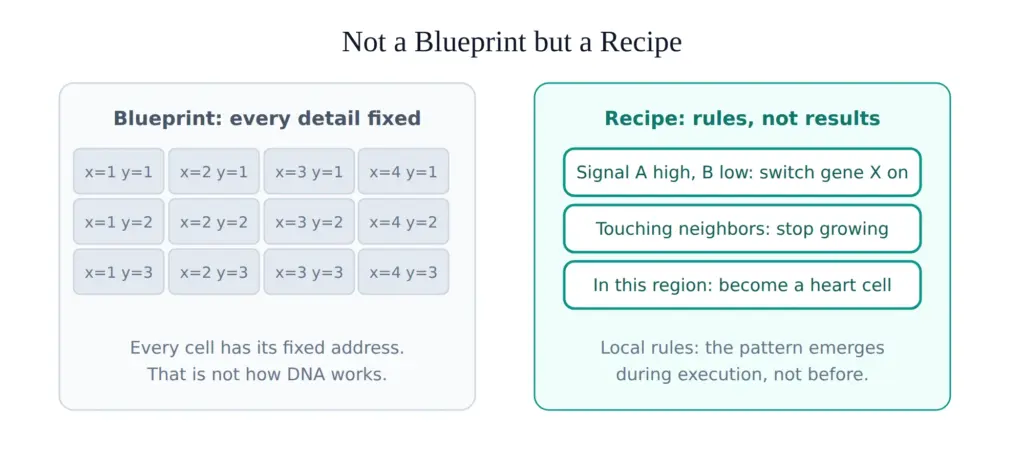
In everyday language, DNA is often called the “blueprint of life”. That is a helpful image, but also a misleading one. The blueprint of a house fixes every wall and every socket in a set place. DNA does not do that.
A better comparison is a recipe or a computer program. A recipe does not say where each grain of flour ends up in the finished cake. It says: mix this, heat it for so long, and the rest follows.
DNA contains exactly such rules. In essence, something like:
- If signaling substance A is strong and signaling substance B is weak, gene X is switched on.
- If a cell has divided and neighboring cells touch it, it stops growing.
- If a cell lies in this region, it becomes a heart cell.
These are local if-then rules that each cell follows for itself. From billions of such small decisions, the big picture emerges.
How one cell becomes a human being
How does this work in concrete terms? Three mechanisms are especially fascinating.
1. Scent trails in the embryo: morphogens
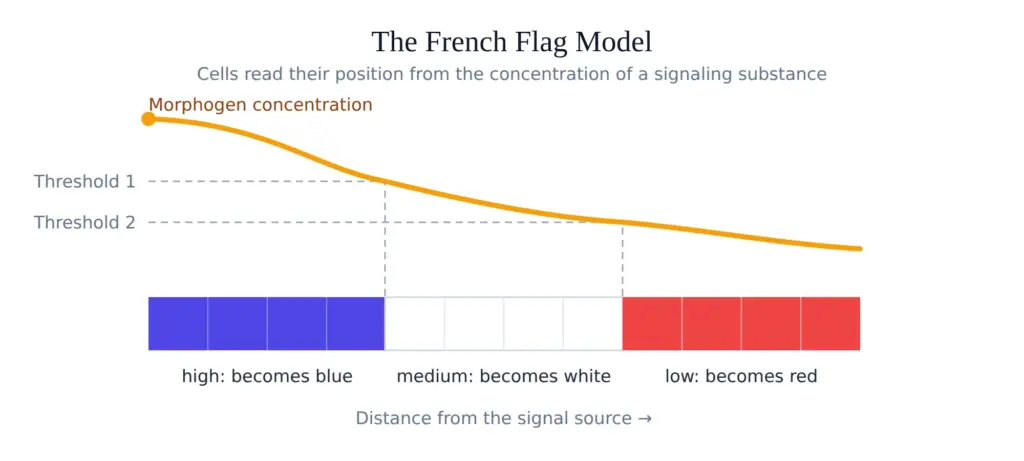
Cells in the embryo release signaling substances called morphogens. These spread out and form a concentration gradient, much as the smell of fresh coffee spreads through an apartment. The closer to the kitchen, the stronger the aroma.
A cell thus “smells” where it is and switches on the appropriate genes. The biologist Lewis Wolpert described this with the famous French flag model: high concentration yields blue, medium white, low red. A smooth distribution thereby becomes a sharply divided pattern. The information “top” and “bottom” or “left” and “right” therefore need not be stored for each cell individually. It follows from the surroundings.
2. Patterns from nothing: Turing's stripes
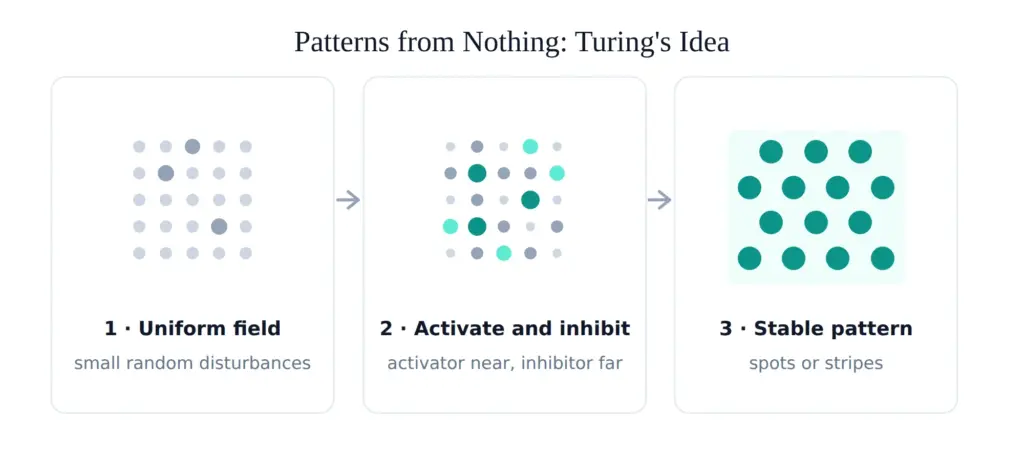
The mathematician and computer pioneer Alan Turing, also known as a codebreaker, published a paper on pattern formation in nature in 1952. His idea: if two substances stimulate and inhibit each other and spread at different speeds, spots and stripes arise spontaneously.
Such mechanisms are probably behind zebra stripes, leopard spots and even the spacing of the fingers on a hand. DNA does not have to specify every stripe. It only sets the rules of the game, and the pattern emerges by itself.
3. Physics as a free helper
Cells pull on each other, push, migrate and fold tissue. A flat sheet of cells that grows faster at one spot bulges or folds inward. Much of the body's shape is simply mechanics and physics, which DNA merely sets in motion but need not prescribe in detail.
Without an interpreter, DNA is worthless
Here is a point that is often overlooked. A program without a computer is just text. In the same way, DNA alone is completely useless.
Only the egg cell with all its machinery “executes” the DNA: ribosomes that build proteins, enzymes, maternal messenger substances, an existing cell structure. This machinery is not rebuilt from the DNA but passed on by the mother. So part of the starting information is not in the genome at all but in the cell itself.
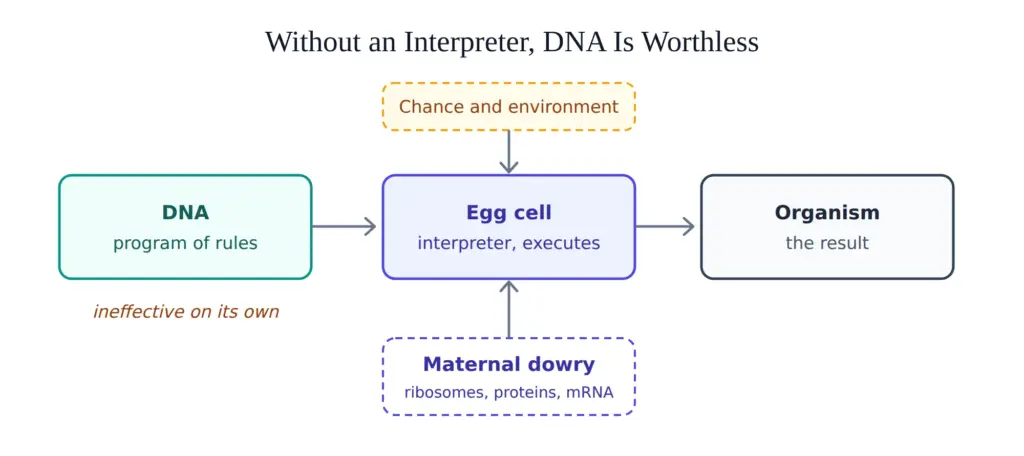
And the process is not fully determined. Identical twins have identical DNA but different fingerprints and differently wired brains. Chance and environment co-write the unfolding.
The brain: DNA builds a learning machine, not thoughts
It gets especially exciting with the brain. Knowledge, language and memories are not in the DNA. If they were, every baby would already be able to speak English.
What DNA supplies instead:
- a basic architecture: which brain regions exist and how they are roughly wired,
- learning rules: how connections between neurons strengthen or weaken,
- some innate tendencies: babies pay particular attention to faces, for example.
You could put it this way: DNA does not build a finished mind but a machine that can learn. Life supplies the content.
This also explains how the bottleneck works. The nematode C. elegans has only 302 neurons, whose wiring is largely genetically determined. In humans that would be impossible. Here the genome sets only the basic framework, and learning does the rest.
Zador even suspects that this bottleneck is an advantage. Because there is so little space, no memorized individual cases fit in, only general rules. And it is precisely such rules that transfer well to new situations.
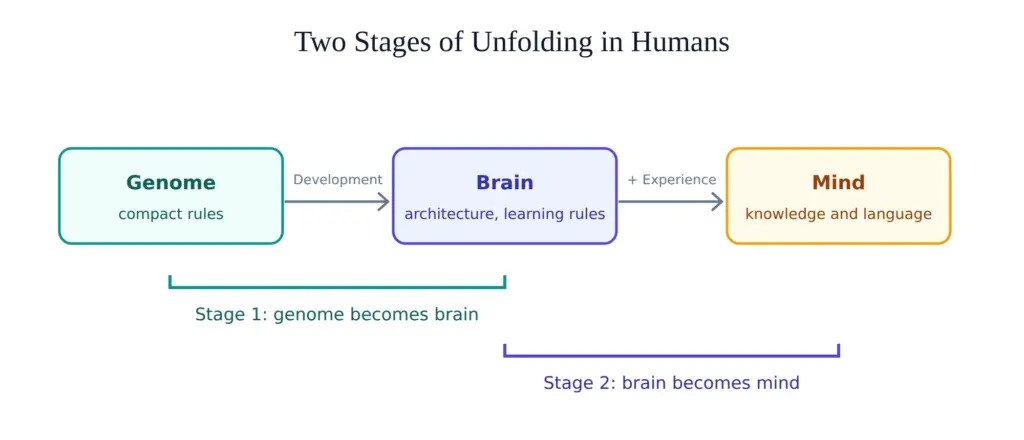
So in humans there are two stages of unfolding:
- Genome → brain (development before and after birth)
- Brain + experience → mind (learning over a lifetime)
How an AI “unfolds” text
Now to the other side. How does a language model like Claude or ChatGPT work?
It generates text token by token. A token is a word fragment, often half a word. The model looks at everything written so far and calculates which token fits best next. This is appended, and the process starts again. Step by step, this grows a text that turns a few input words into whole paragraphs or programs.
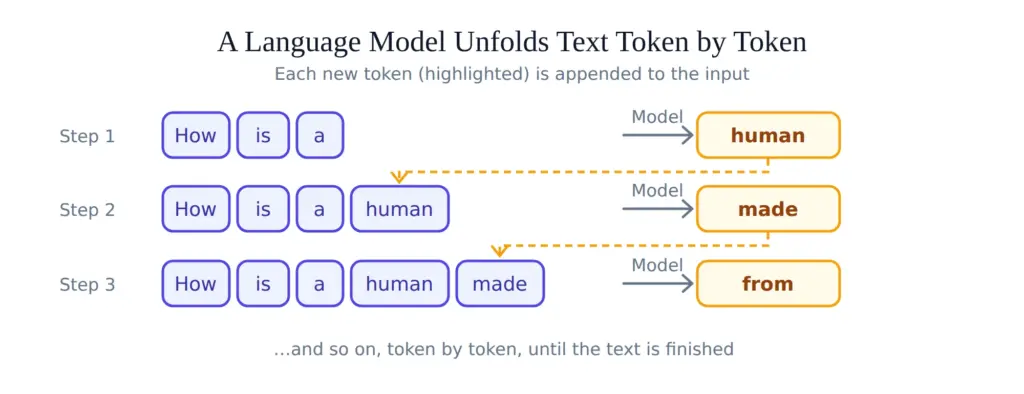
This is the observation that led to the initial question: here too, something very complex unfolds from a short input, and each new step depends on the previous state. That is reminiscent of a growing embryo.
Putting the analogy to the test
It would be tempting to equate DNA with the prompt. Both are short, both trigger a large unfolding. On closer inspection, however, this falls apart.
The complexity of the AI's response hardly lies in the prompt. It lies in the model's weights, the billions of learned numbers that amount to hundreds of gigabytes in large models. The prompt is more of a stimulus that sets an already finished system in motion, just as a sound prompts a brain to formulate a response.
The more accurate mapping looks like this:
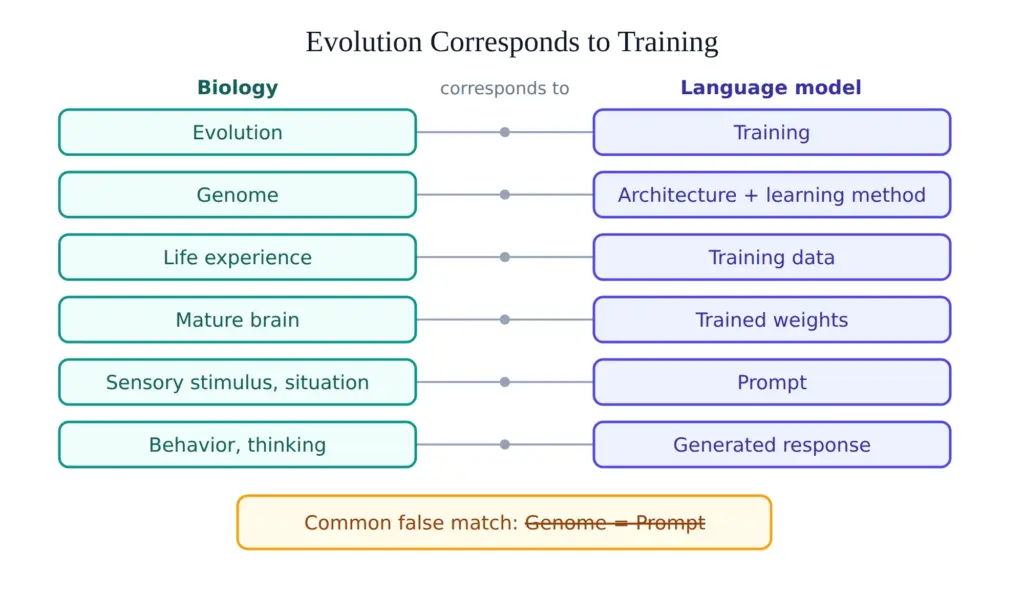
A surprising detail: the code describing the architecture of a language model is tiny. A lean reference implementation gets by with a few hundred lines. What is truly valuable arises only through training. Just as with the genome: compact rules that become something powerful through a long optimization process.
Two loops: optimize slowly, unfold quickly
This reveals a shared structure, namely two nested loops.
The outer, slow loop searches for good rules. In biology, this is evolution: over billions of years, what works is tested and what succeeds remains. In AI, it is training: over many passes, the weights are adjusted until the model delivers good results.
The inner, fast loop applies the rules found. In biology, this is the development of an individual and its everyday behavior. In AI, it is inference, the generation of a specific response.
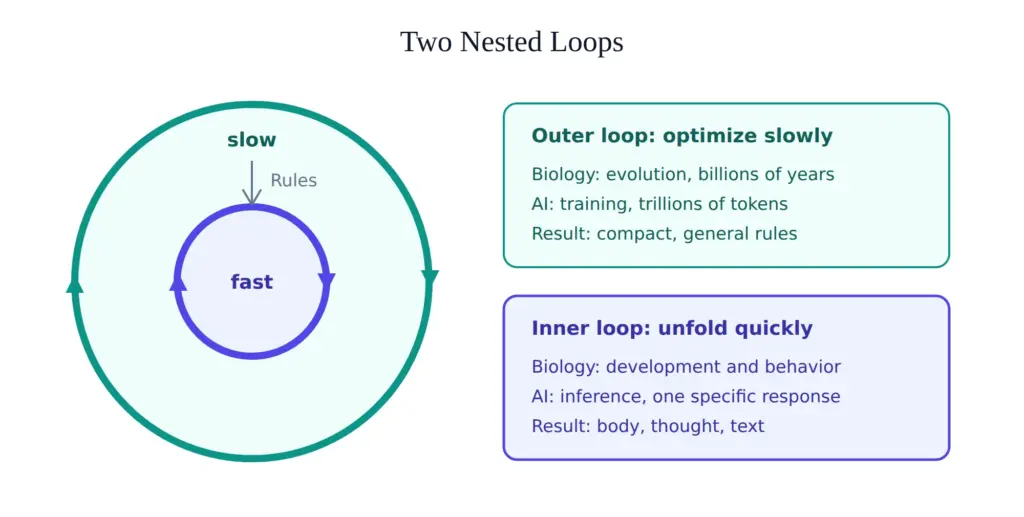
In both cases the rules are not designed by hand. They were found through optimization, measured by success in an environment. This is probably the deepest thing life and modern AI have in common.
AI that comes closer to the embryo
A language model works strictly sequentially and under central control. An embryo, by contrast, works in parallel and decentrally: each cell runs the same program, responds only to its neighborhood, and all do so at the same time.
Interestingly, there are AI methods that come much closer to this:
- Diffusion models, as used in image generators, refine an entire image step by step out of noise. The whole image arises at once, not pixel by pixel.
- Neural cellular automata (introduced in 2020 by Alexander Mordvintsev and colleagues) are closer still to the model. They start with a single “cell” and apply small, learned rules that look only at the neighbors. From this grows, for example, the image of a lizard. And best of all: cut a piece away and it grows back.
This is the most direct technical counterpart to embryonic development known today.
Where the analogy ends
For all the similarity, there is one difference that inspires wonder: goal-directedness.
In an experiment, the biologist Michael Levin and his team scrambled the facial organs of tadpoles: eyes, mouth and nose were in the wrong places. The astonishing thing: these tadpoles still became largely normal frogs. The organs migrated during development until the correct form was reached.
The body thus seems to “know” a kind of target form and to compensate for deviations, even in situations that never occurred in evolution. Biological development is fault-tolerant and corrects itself.
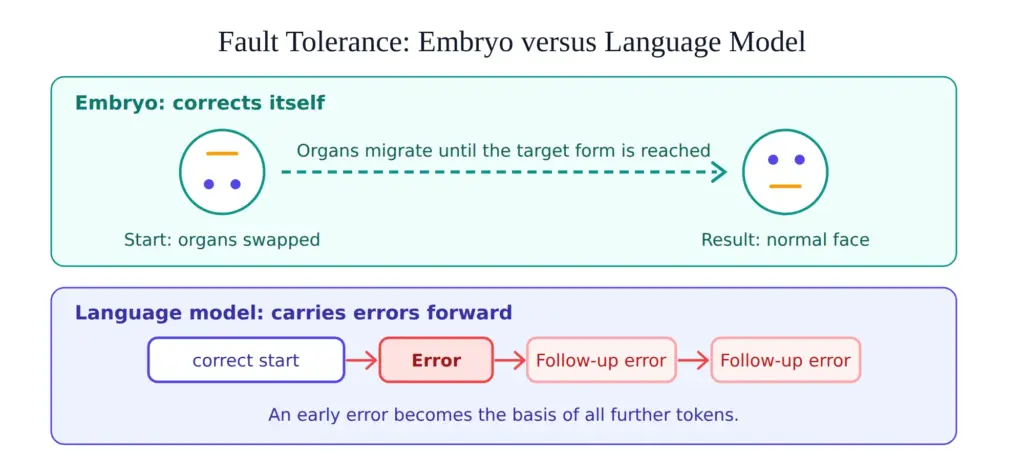
A language model has no such stable target form. An early error in a text is usually simply carried forward and can even grow, because each new token builds on its flawed predecessor. Here nature is still well ahead of technology.
The shared principle: generative compression
So what really connects DNA and AI? Not intelligence, but something more fundamental that can be called generative compression:
- A short description (rules, weights, genome),
- an interpreter that executes it (cell, computer),
- and repeated application of the rules to a growing state.
Computer science has a term for this: Kolmogorov complexity. It measures how short the shortest description of an object is. And many objects that look complicated have astonishingly short descriptions.
This also shows up where no one would speak of intelligence:
- The Mandelbrot set, a fractal of infinite detail, arises from a single short formula.
- Conway's Game of Life uses just four simple rules to produce patterns that move, reproduce and even compute.
- A snow crystal grows from a few physical laws into a delicate, six-pointed structure.
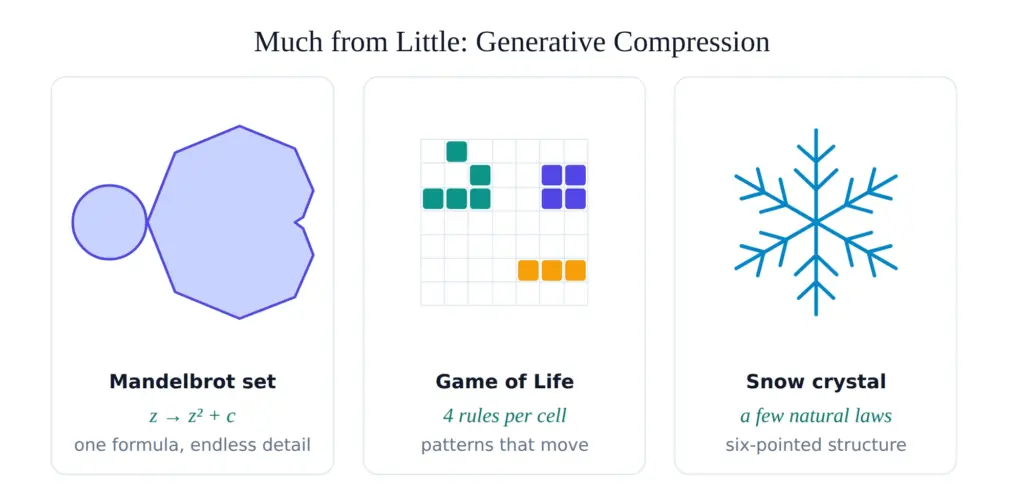
The unfolding of complex results from simple rules is thus a general principle of nature. DNA and AI are especially impressive examples of it, but not the only ones.
Is unfolding already intelligence?
The original conjecture was that unfolding and intelligence are qualitatively the same. After everything shown so far, that is only half true.
Unfolding alone is necessary but not sufficient. A snow crystal also unfolds, and no one would call it intelligent.
Intelligence only comes in when a system
- responds flexibly to the new,
- pursues goals and
- can reach them by unexpected routes.
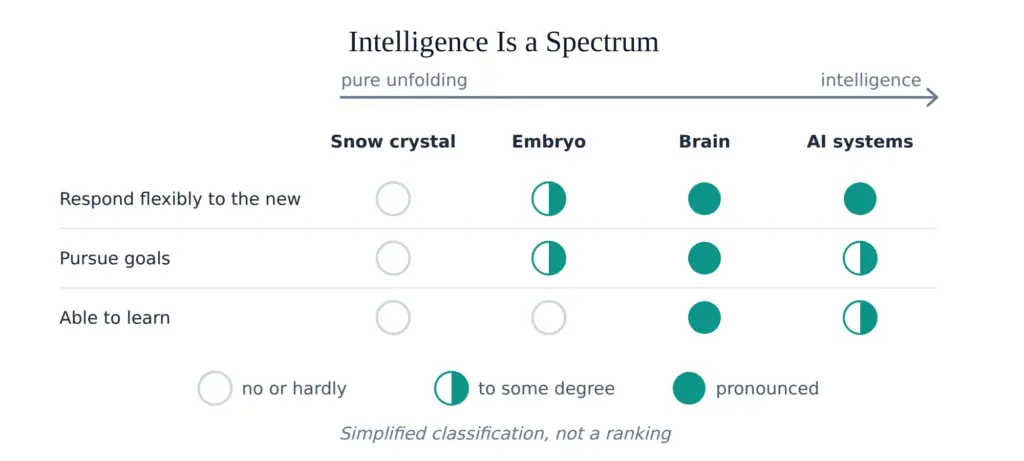
And here lies perhaps the most beautiful twist: biological development in particular shows more of this than one would expect. An embryo that corrects errors and finds its target form behaves in a certain sense in a goal-directed way, long before a single thought has been thought. Intelligence thus seems not to be a switch that gets flipped at some point but a spectrum that begins with a simple set of rules and is far from ending with the learning brain.
Frequently asked questions
Does the genome really contain no information about knowledge or abilities?
Hardly any. Reflexes, basic tendencies and the ability to learn are innate. Language, arithmetic or music must be learned. Even instincts that animals master immediately are not fully written-out programs but wiring patterns that favor certain reactions.
Is a language model a kind of digital brain?
Not really. It is inspired by brains but works in a fundamentally different way: it is much more uniformly built, learns in separate phases (first training, then use) and has no body that develops. The analogy helps in understanding principles but is not an equation.
What does “token” mean?
A token is the smallest unit of text a language model works with. It can be a whole word, but also just a syllable or a punctuation mark. Long words often consist of several tokens.
Why is DNA so important if it does not determine everything?
Because it sets the framework. It determines which rules apply in each cell, and thus what can arise at all. Mouse DNA will not produce a giraffe, whatever the environment. Within that framework, however, chance and environment play a large part.
Can anything be learned from this analogy for AI development?
Certainly. Researchers are interested in systems that repair themselves, grow from local rules and head robustly for goals, as embryos do. The idea that a narrow information bottleneck can lead to better generalization is also discussed in AI research.
Conclusion
The observation that something large unfolds from a short input in both DNA and AI hits on a real core. But it becomes more precise if shifted slightly:
- The genome corresponds not to the prompt but to the architecture and learning method.
- Evolution corresponds to training.
- Embryonic development resembles the execution of a program found by a long optimization process.
- The shared principle is generative compression: great complexity arises from compact rules through step-by-step application.
And intelligence? It is not part of unfolding as such but arises where an unfolded system becomes flexible, goal-directed and able to learn. In an embryo, an astonishing amount of this can already be seen, and in modern AI systems it is growing before our eyes.
Perhaps this is the deepest insight of this thought experiment: nature solved the problem of making much from little billions of years ago. Technology is only just beginning to retrace it.
Is an organism more of a program that executes itself, or more than the sum of its rules? The more AI replaces humans, the more the answer tends toward program.
 My name is Klaus Meffert. I have a doctorate in computer science and have been working professionally and practically with information technology for over 30 years. I also work as an expert in IT & data protection. I achieve my results by looking at technology and law. This seems absolutely essential to me when it comes to digital data protection. My company, IT Logic GmbH, also offers consulting and development of optimized and secure AI solutions.