

Malware no longer just steals data, it also has an AI analyse the loot right away and pick out the most lucrative victims. At the same time, warnings about spyware on work phones and calls from supposed IT departments are piling up. Three recent incidents show what threats this creates for law firms, tax advisors, small businesses and executives.
Within just a few days, three reports appeared that at first glance have little to do with each other. A security firm describes an infostealer that has stolen data assessed by a language model. Apple is warning members of the German Bundestag about spyware on their smartphones. A security vendor reports calls in which criminals pose as the IT department to law firms.
All three share one pattern: attackers are looking for people who have access to valuable data, accounts or clients.
Infostealer explained simply: what the malware steals and why that is enough
An infostealer is malware that searches a computer for stored credentials and sends them to the attackers. A comparison with a burglar helps: he does not take the TV, but the key ring, the address book and the notebook. With these, many doors can be opened later without anyone having to break in.
Typical loot includes:
- passwords and autofill data saved in the browser,
- cookies and session tokens, i.e. notes that let a service recognise a signed-in user,
- payment cards and credentials for crypto wallets,
- SSH and cloud keys that give access to servers and services,
- saved Wi-Fi profiles and screenshots.
The theft can happen very quickly. Afterwards, the software can delete itself, leaving hardly any trace on the computer. The incident is usually only noticed when someone uses the stolen data to take over an account. The data sets are traded on dedicated marketplaces.
For professionals bound by confidentiality, this is particularly unpleasant. A single mailbox, a single cloud storage account or one login to the law firm software can contain data on many clients. The damage then occurs not only at the firm itself, but for everyone whose documents are stored there.
How AI assesses the loot: the VOLTA example
In an analysis, the Cisco Talos research team describes a Windows infostealer called VOLTA. It collects browser passwords, cookies, payment cards, crypto wallet seed phrases, messenger and gaming platform sessions, Microsoft tokens, SSH and cloud keys, Wi-Fi profiles and screenshots. What is new is what happens next: the software serialises the data into a profile and sends it to a language model.
The request runs via OpenRouter, a gateway. This is an access point behind which many models from different providers can be reached. According to Talos, the stealer first queries Claude Opus 4.6. If the model refuses to answer, Kimi K2 follows, and then Gemini 2.5 Flash. The result is a victim profile with location, employer and other details, along with an assessment of which accounts are worth the most. Using a stolen Gmail token, the software also searches order receipts to confirm the home address.
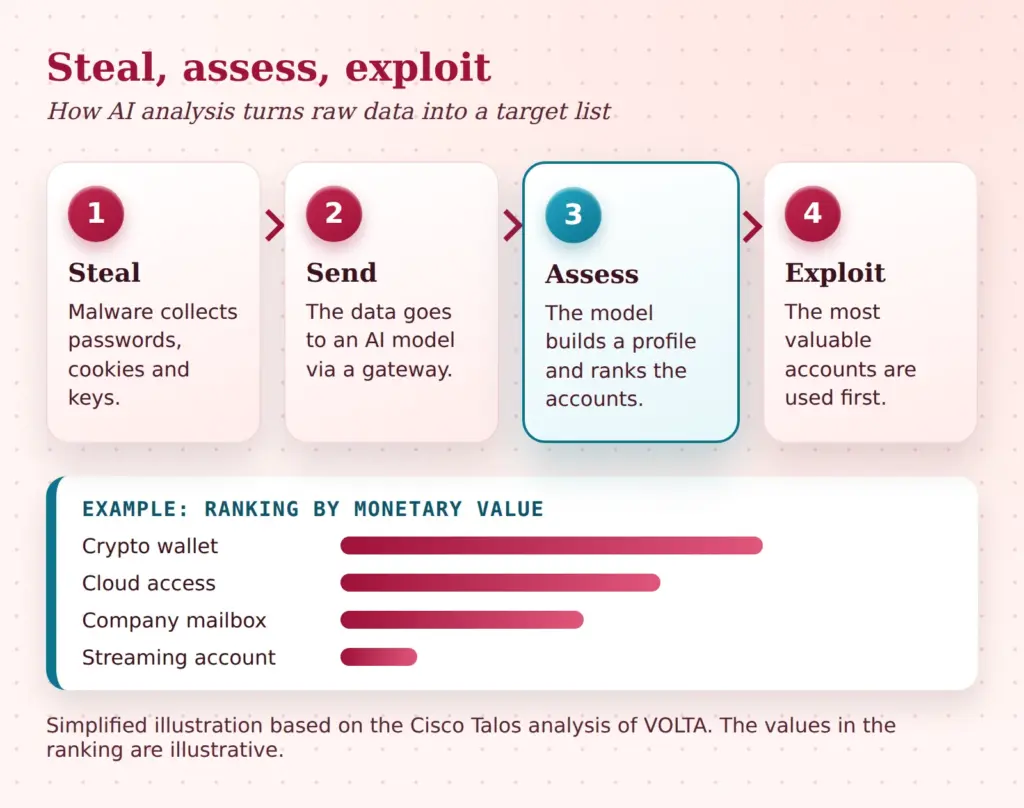
The difference from earlier malware lies in the effort involved. In the past, a person had to sift through large amounts of data or sell the raw data wholesale. Now a sorted list is created automatically. This means that even someone without experience who has merely bought a ready-made kit can filter out the most rewarding victims.
Several points remain unconfirmed:
- The analysis does not describe the infection vector. It is unknown whether phishing, fake downloads or something else is behind it.
- There is no evidence that the services mentioned were involved or aware.
- The analysis does not reveal how widespread the software is. Talos cites a sample from 11 October 2026 as the first find.
Misused AI services: how well do model refusals protect?
One detail stands out in this AI misuse: when one model refuses, the malware simply asks the next one. A refusal is therefore not a security boundary, but a hurdle that can be bypassed by switching. Gateways bundle many models behind a single access point and make this switch easy.
This does not mean blaming individual providers. What can be generalised, however, is that abuse protection has to start at several points: with the models themselves, with the gateways that pass requests on, and with the accounts used for payment. This includes rate limits, detection of suspicious request patterns and suspending accounts.
Companies that use AI services themselves also have a job to do. API keys are credentials like any others. If they end up in an infostealer data set, outsiders can use them to make requests at someone else's expense or to siphon off data. Keys therefore do not belong in scripts on a laptop or in the browser, but in a protected store with limited permissions and a short lifetime.
AI turns stolen data into a sorted shopping list.
If the analysis gets faster, there is less time between theft and misuse. Credentials should therefore be organised so that a single stolen data set opens as little as possible: separate accounts, limited permissions and no password reuse.
Why session cookies bypass MFA
Many accounts are now protected by a second factor, such as a code from an app. That makes sense and remains a must. Against stolen sessions, however, it helps only to a limited extent. The reason can be explained with a visit to a building: multi-factor authentication is the check at the entrance. Afterwards, the visitor receives a wristband that lets them move around freely. This wristband is the session cookie.
If an infostealer steals the cookie, it no longer has to pass the check. It shows the wristband, and the service takes it for the signed-in user. Neither password nor code is needed. The same applies to tokens, for example for Microsoft accounts. Even without malware, Microsoft 365 accounts are targeted through sign-in attacks.
 My name is Klaus Meffert. I have a doctorate in computer science and have been working professionally and practically with information technology for over 30 years. I also work as an expert in IT & data protection. I achieve my results by looking at technology and law. This seems absolutely essential to me when it comes to digital data protection. My company, IT Logic GmbH, also offers consulting and development of optimized and secure AI solutions.