

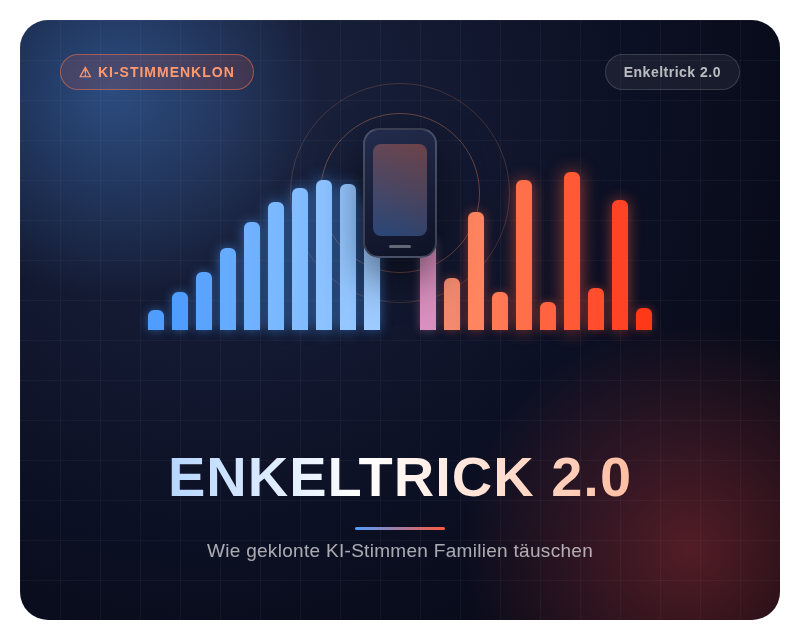
The phone rings. On the other end is a voice that silences every doubt at once, because it sounds exactly like your own child or grandchild. The person is crying, out of breath, talks about an accident or an arrest and needs money within the next few minutes. Thousands of families in Germany are currently going through exactly this scenario every month, and in a growing share of cases the familiar voice does not come from a human being at all, but from a piece of software. The classic grandparent scam, known in Germany as the “Enkeltrick” and around since the 1990s, has received a technological upgrade. Experts now speak of the grandparent scam 2.0.
This article explains how criminals use artificial intelligence for this type of fraud, what is behind it technically, which safeguards exist – and why they still often come too late when it matters.
From the grandparent scam to the grandparent scam 2.0: what is new?
The original grandparent scam worked through psychology, not technology. A caller opened the conversation with a question such as “Guess who this is?” and let the victim come up with a name, which the fraudster then adopted. Anyone who listened closely could often spot the fraud by the unfamiliar voice or the lack of detailed knowledge. The new generation of the scam undermines exactly these two safeguards.
Today, a few seconds of audio are enough for a convincing voice clone, often taken from a publicly accessible social media video. This is all it takes to create a synthetic copy that reproduces not only the sound but also the speech melody, the emphasis and even emotional nuances such as crying or trembling. The most important giveaway of the old scam, the unknown voice, disappears completely.
Criminals currently use the technology in three typical variants:
- Modernised grandparent scam: The cloned voice of a child or grandchild calls with an alleged emergency.
- CEO fraud: Employees receive a supposedly urgent instruction from management, usually linked to a money transfer.
- Shock call: An alleged police or official voice uses a dramatic scenario to create immediate pressure to act.
How voice cloning works: the technology behind the deception
To understand why this type of fraud has become so effective, it is worth looking at the technology. Two methods are involved that are often confused:
Text-to-Speech (TTS) converts written text into spoken language, usually with a ready-made, generic AI voice. This is familiar from navigation devices or read-aloud functions.
Voice Cloning goes one step further: it reconstructs the voice of one specific, real person. To do this, a model analyses a short reference recording and extracts what is known as a voice embedding, a mathematical representation of pitch, timbre, speaking rate and characteristic quirks. With this embedding, the system can then speak any new text in exactly this voice, including pauses for breath and emotional colouring.
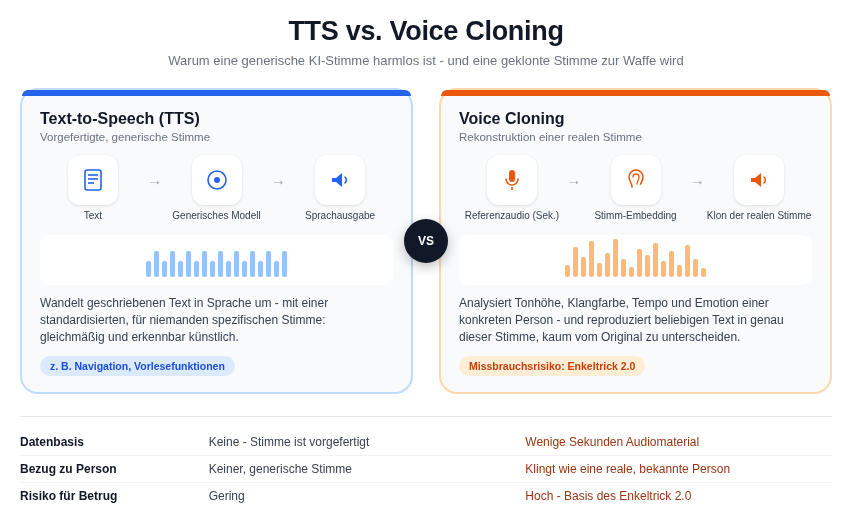
Until a few years ago, a convincing clone still required several minutes of clean audio. Today, professional and criminal providers alike sometimes need only a few seconds from an Instagram video or a voice message. This lower technical barrier is the real reason why the grandparent scam 2.0 is spreading so quickly.
The invisible tool chain: what happens behind the scenes of every AI request
What many people do not know: behind every request to an AI system, whether it is a harmless chat or speech synthesis, a multi-stage processing chain runs in the background. With reputable providers, this tool chain is active regardless of what the AI is being used for, and it explains both the strengths and the weaknesses of today’s safeguards.
Input and normalisation. First, the input is technically prepared. For voice cloning services this means, for example, that uploaded audio is brought to a uniform volume level and cleaned of background noise so that the downstream model can work properly.
Check before processing. Even before the actual AI request is handled, many providers run an upstream safety filter. It checks whether a request violates the usage policies, for instance because someone else’s voice is to be cloned without authorisation. Reputable providers now require proof of consent: the person whose voice is to be cloned has to speak a sentence specified by the system, which is then matched against the request and stored as evidence.
The actual model inference. Only then does the actual AI model process the request. In speech synthesis, the desired text is first translated into a phonetic structure, combined with the previously extracted voice embedding and converted into an actual audio waveform by what is known as a vocoder.
Check after processing. After generation, a further downstream filter often evaluates the result once more before it is delivered. In this step, many providers now also embed invisible watermarks in their audio output so that AI-generated content can later be identified as such.
Logging and abuse detection. In the background, providers also evaluate usage patterns in order to detect suspicious clusters, such as a conspicuously high number of cloning requests for prominent or public figures.
This entire chain runs in fractions of a second for every single request, no matter whether someone is generating a voice for an audiobook, a commercial or indeed a scam call. But this is also exactly where the limits of this protection system lie: it only works if the provider has actually implemented the chain. Criminals instead fall back on freely available, open-source cloning tools without consent checks, run their own unregulated infrastructure or use services outside the EU that do not adhere to the standards described here. Current research also shows that even technical safeguards such as acoustic interference signals, which are meant to prevent a voice from being cloned, can in part be circumvented again with specialised cleaning methods. The tool chain is therefore not a sure-fire success, but a race between safeguards and their circumvention that continues across the industry.
KI-Beratung, KI-Lösungen
Leistungsangebot:
- Erstberatung inkl. Machbarkeitsaussagen
- Schulungen und Workshops für Führungskräfte, Berufsgeheimnisträger, Angestellte, Entwickler
- KI-Lösungen mit und ohne ChatGPT/Azure. Cloud oder eigener KI-Server
 My name is Klaus Meffert. I have a doctorate in computer science and have been working professionally and practically with information technology for over 30 years. I also work as an expert in IT & data protection. I achieve my results by looking at technology and law. This seems absolutely essential to me when it comes to digital data protection. My company, IT Logic GmbH, also offers consulting and development of optimized and secure AI solutions.