

Eleven days, a swarm of agents, 13 million lines of code: an AI has made the proof of Fermat's Last Theorem machine-checkable. What mattered most was not computing power but a checker that lets no error through.
Around 1637, Pierre de Fermat jotted a claim in the margin of a book, for which he supposedly had a proof. It was never found. It took until 1995 for Andrew Wiles to publish a complete proof. On 4 September 2026, Anthropic announced that a swarm of Claude agents had fully formalized this proof in the proof language Lean. This was made possible by the Lean proof assistant, which checks every step of a proof by machine.
This article puts the announcement into context. It explains what a proof assistant is and why a result from Lean is considered reliable. It describes how the agents worked together and places the announcement alongside Olympiad problems and Erdős problems. Verified figures, vendor claims and open questions are kept apart. The thesis: what is new is not merely that an AI does mathematics. What is new is the combination of a model that is free to experiment and a program that rigorously signs off on every step.
Fermat's Last Theorem: what Anthropic actually announced
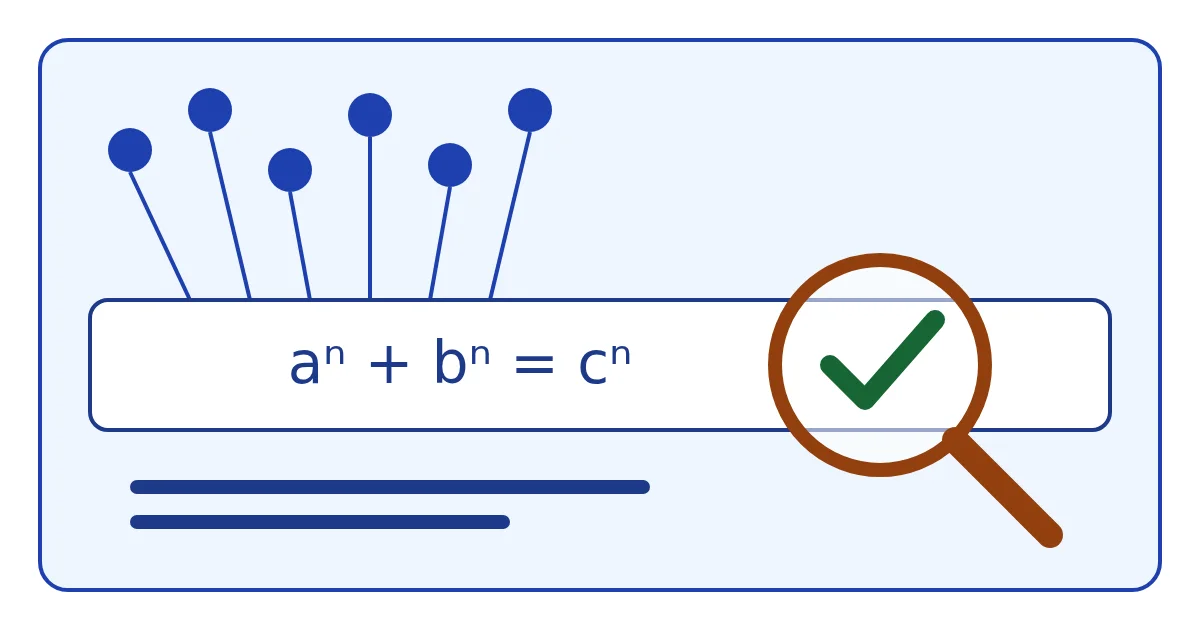
The theorem states that the equation aⁿ + bⁿ = cⁿ has no solution in positive integers for an exponent n greater than 2. The statement is easy to understand and was extremely hard to prove for centuries. In 1908, a prize of 100,000 gold marks was offered, and according to Anthropic, 621 false proofs were submitted in the first year alone. Wiles presented a proof in 1993, found a gap and closed it together with Richard Taylor. The publication followed in May 1995.
The latest announcement concerns the question of how certain this proof is when every step is checked by a machine. The key figures from Anthropic's publication are shown in the table.
| Feature | According to Anthropic |
|---|---|
| Result | Computer-checked proof of Fermat's Last Theorem in Lean |
| Duration | 11 days, largely autonomous |
| Size | 13 million lines of Lean code, more than five times the size of Mathlib |
| Theorems | 29,500 intermediate results in the final proof, 30,300 proven theorems in total |
| Axioms | Only Lean's three standard axioms |
| Agents | Several dozen Claude agents in parallel |
| Compute | About six billion output tokens from an internal, non-public research model |
| Human contribution | Occasional high-level instructions from Tianyi Peng |
| Code | Complete proof publicly available on GitHub |
| Verification | A comparator tool confirmed the statement, Kevin Buzzard reviewed the proof |
A token is a small unit of text that a language model generates, such as part of a word. The source does not state any monetary costs. All figures come from the vendor and have not been independently recounted in this form.
The distinction is important. This is a formalization, not a new proof. The theorem had been proven since 1995. According to Anthropic, the agents built on a simplified version of Wiles's proof by Darmon, Diamond and Taylor and reused parts of the Imperial College formalization project and the flt-regular project. Anyone reading about an AI solution to Fermat's Last Theorem should therefore think of verification, not of a new mathematical discovery. Anthropic explicitly distinguishes the result from the AI work on the Riemann hypothesis, where something new was said to have been discovered.
Has an AI proven Fermat's Last Theorem anew?
What is the Lean proof assistant? A checker that skips no step
The Lean proof assistant is an open-source programming language that lets you write mathematical proofs in a way a computer can check. The project website lean-lang.org describes Lean as a programming language and proof assistant with a minimal, trusted kernel that guarantees correctness. Lean was developed by Leonardo de Moura and released as open source in 2013, as the Simons Foundation reports. Since 2023, the non-profit Lean FRO has been working on its further development, supported among others by 5 million US dollars from the Simons Foundation International.
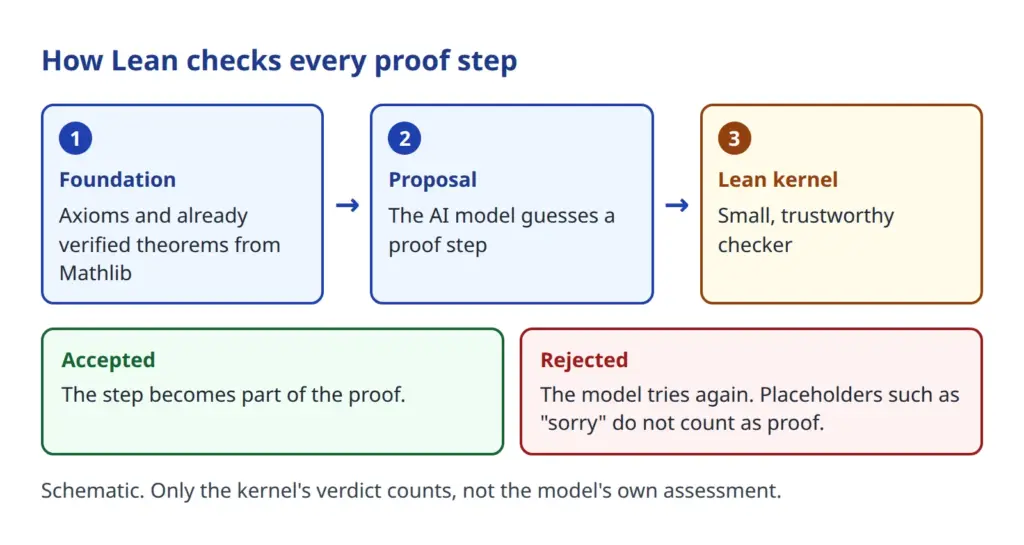
The principle can be put in everyday terms. A proof in Lean is a program. Lean's kernel checks step by step whether each inference follows from the axioms and from theorems already checked. Axioms are the basic assumptions of mathematics that hold without proof. A step that does not follow is rejected, no matter how convincing it sounds. Where a proof is still missing, Lean uses the placeholder "sorry". A proof containing such placeholders counts as incomplete.
This is exactly what makes Lean so useful for AI models. Language models can phrase things convincingly and still make mistakes. In mathematics that is a problem, because an error in step 400 can invalidate everything after it. With a proof assistant like Lean, the question of whether to believe the model no longer arises.
The model may guess, fail and start over. Only what the checker accepts makes it into the result.
Human peer review works differently. Experts read a proof, find it plausible and rely on their experience. That is valuable, but it takes time and leaves room for oversights. As early as 2021, a community project in Lean validated a complex proof by Peter Scholze, as the Simons Foundation describes. Checking by the proof assistant does not replace mathematical understanding, but it does provide certainty about correctness.
 My name is Klaus Meffert. I have a doctorate in computer science and have been working professionally and practically with information technology for over 30 years. I also work as an expert in IT & data protection. I achieve my results by looking at technology and law. This seems absolutely essential to me when it comes to digital data protection. My company, IT Logic GmbH, also offers consulting and development of optimized and secure AI solutions.