

No sooner is a new AI model out than the next one is announced. Almost every week, OpenAI, Google, Anthropic and a growing number of challengers report new records: faster answers, larger context windows, better programming skills. To outsiders, this often looks like a race with no visible goal. And indeed, this race has neither a finish line nor a pause button.
This article looks behind the scenes of that race. In the first part, we put into context who is currently playing and why the pace is so high. In the second, deliberately timeless part, we explain something that repeats with every new model but that hardly anyone sees: the complex tool chain that runs in the background as soon as you click “Send”.
A Race Without a Finish Line
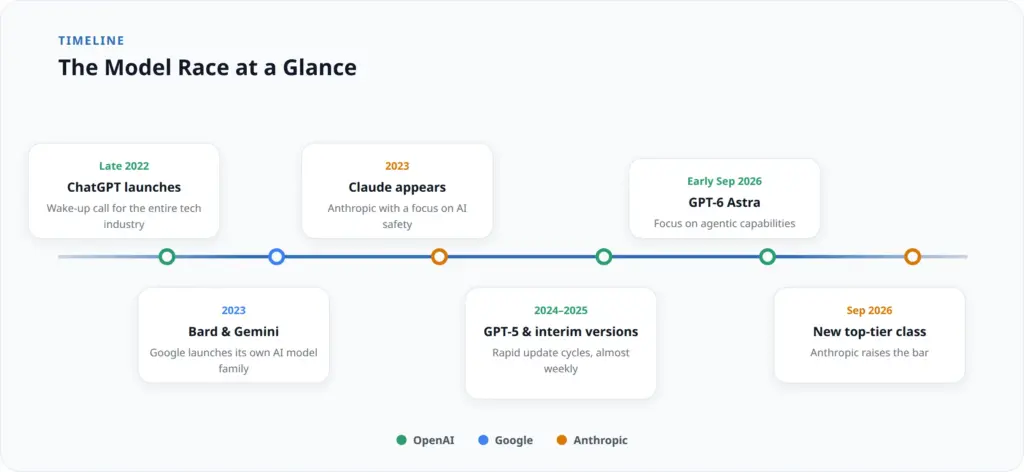
When OpenAI released ChatGPT in late 2022, it was a wake-up call for the entire technology industry. Google, which had been working on its own AI research for years, soon launched Bard and later the Gemini model series. Anthropic, founded by former OpenAI employees with a focus on AI safety, released its Claude models. Within a few years, what had been a niche topic for research labs turned into an arms race worth billions.
What makes this race so special is its pace. Where classic software products used to have annual or biennial update cycles, some AI model generations are now only a few weeks apart. A model that was still considered the front-runner in spring can belong to the second tier by autumn. That is exactly why it is worth understanding not only the current names but also the mechanisms behind them, because those are far more stable than the model designations.
The Current Heavyweights at a Glance
A snapshot of the situation in September 2026 shows how broad the field has become.
OpenAI: From Chatbot to Agent Operating System
OpenAI has developed its GPT model series in rapid succession over recent months, from GPT-5 through several interim versions to the current flagship model GPT-6 Astra, which was rolled out in early September 2026. The focus is increasingly on agentic capabilities: the model is no longer meant merely to answer questions but to complete multi-step tasks on its own, such as carrying out long research projects and writing code across several work steps while retaining context over long sessions. Because of its growing cybersecurity capabilities, OpenAI has for the first time imposed stricter access restrictions on security-critical functions for this model.
Google: Gemini Grows into Every App
Google is pursuing a different strategy: instead of a few large model versions, the company releases many specialized variants of its Gemini series, from lean “Flash” models for quick everyday tasks to more powerful “Pro” and “Deep Think” variants for complex reasoning. It is striking how deeply Gemini is now embedded in existing Google products, from searching your Gmail inbox through photo management to voice control on Android devices. In the background, Google is already working on the next major model generation.
Anthropic: Safety as a Selling Point
Anthropic explicitly positions its Claude models around safety and reliability, especially for use in business. The current model family ranges from compact, fast variants to a new, particularly powerful model class above the previous flagship models. One technical detail is remarkable: to meet the new labeling requirements of the EU AI Act, Anthropic has built an invisible watermark into the word choice of its models, which allows AI-generated texts to be identified statistically after the fact, without any visible characters or additional tokens.
The Challengers: xAI, Meta, Mistral, DeepSeek and Alibaba
Alongside these three providers, a broad field of challengers has established itself. xAI (Grok) relies on a connection to real-time information from social networks and trains its models on one of the largest known compute clusters. Meta continues to take an open approach with its Llama model family: the model weights can be downloaded and run locally, which is particularly interesting for companies with their own data protection requirements. Mistral from France is considered the most important European alternative, with a focus on efficiency and European data infrastructure. From China, DeepSeek and Alibaba’s Qwen series are driving development, often with surprisingly good performance at significantly lower computing cost, which makes them an inexpensive alternative, albeit with their own questions about data security and state influence.
What Drives the Race
Behind the weekly headlines are four factors that hardly change, no matter which model is currently in the lead.
Computing power. Larger and more capable models need more training and computing capacity. The major providers are therefore building their own data centers in the gigawatt range, some with hundreds of thousands of specialized chips.
Capital. Training a top-tier model now costs hundreds of millions to billions of euros. Anyone who wants to keep up needs either very deep pockets or strong investors behind them.
Data and talent. Good training data and the best AI researchers are as fiercely contested as computing power, one reason for the repeatedly sensational salaries and poaching in the industry.
Energy. The power consumption of AI data centers is growing so strongly that it has become a site-selection and climate issue in its own right, with consequences for electricity prices and grid expansion far beyond the tech industry.
The Invisible Engine Room: What Really Happens with Every Prompt
Most of the article so far will be outdated in a year. New model names will have replaced the ones mentioned here. What stays largely the same, however, is the technical architecture that every single request runs through, whether you use ChatGPT, Gemini or Claude. The language model itself is only one building block among many.
1. Process the input
The text is broken down into small units (tokens), while a first filter roughly checks for problematic content.
↓
2. Build the context
An invisible system prompt, earlier messages, stored user settings and, if needed, freshly retrieved web content are merged.
↓
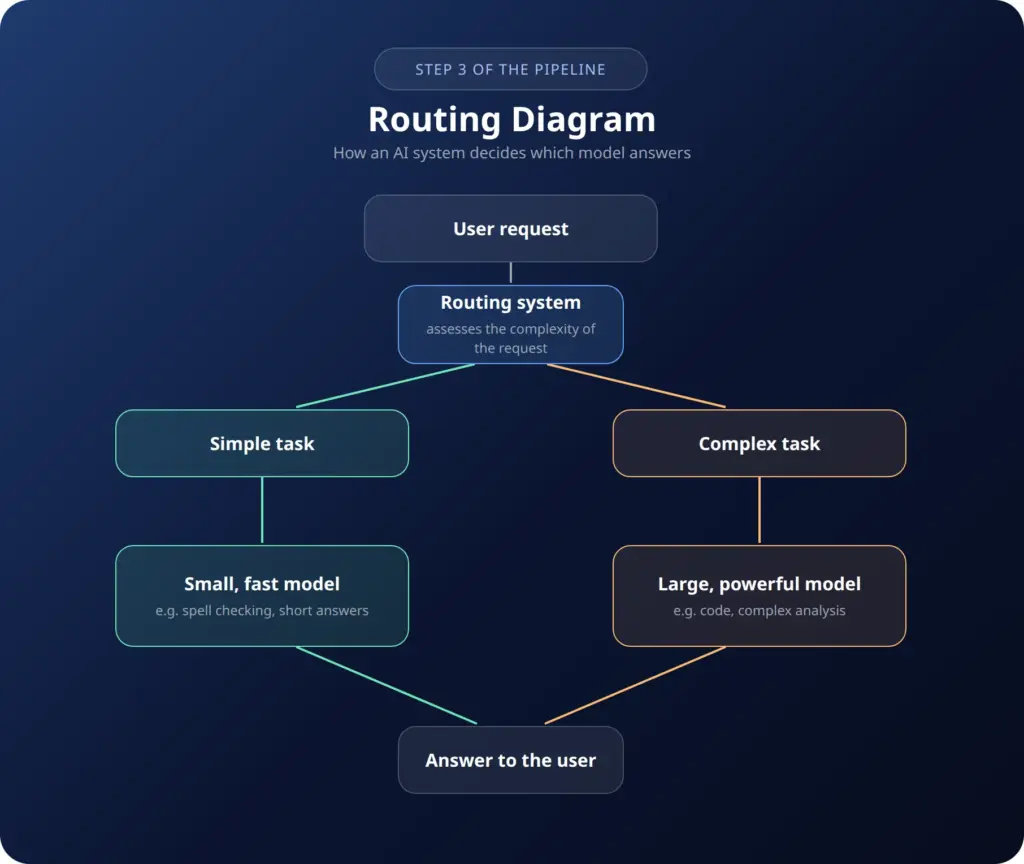
3. Select a model (routing)
An upstream system decides whether a simple question goes to a small, fast sub-model or whether the largest, most expensive model is needed for a complex task.
↓
4. Generate the answer
The actual language model predicts word by word what should come next, and with “thinking” models this includes internal intermediate steps before the actual answer.
↓
5. Call tools
If the answer needs current information, a calculation or executed code, the system calls external tools for it and builds their result into the answer.
↓
6. Check the output
Further filters scan the finished answer for rule violations, add an invisible watermark at some providers and format the text.
↓
7. Deliver & learn
The answer is streamed word by word to the user interface, and anonymized feedback flows into the improvement of future model versions.
These seven steps run for every single request, usually within a few seconds, distributed across thousands of specialized chips in different data centers. Three aspects deserve a closer explanation.
Routing: Not Every Question Gets the Largest Model
A widespread misconception is the idea that an AI product is backed by exactly one model. In fact, the major providers usually run a whole family of models of different sizes at the same time. A simple spelling correction is often answered by a small, inexpensive model, while a complex programming task is automatically passed on to a much larger, more expensive model. For users this switch is usually invisible, but it has a direct effect on answer quality, speed and the cost the provider bears per request.
Tool Calls: Why the AI Cannot Do Math on Its Own
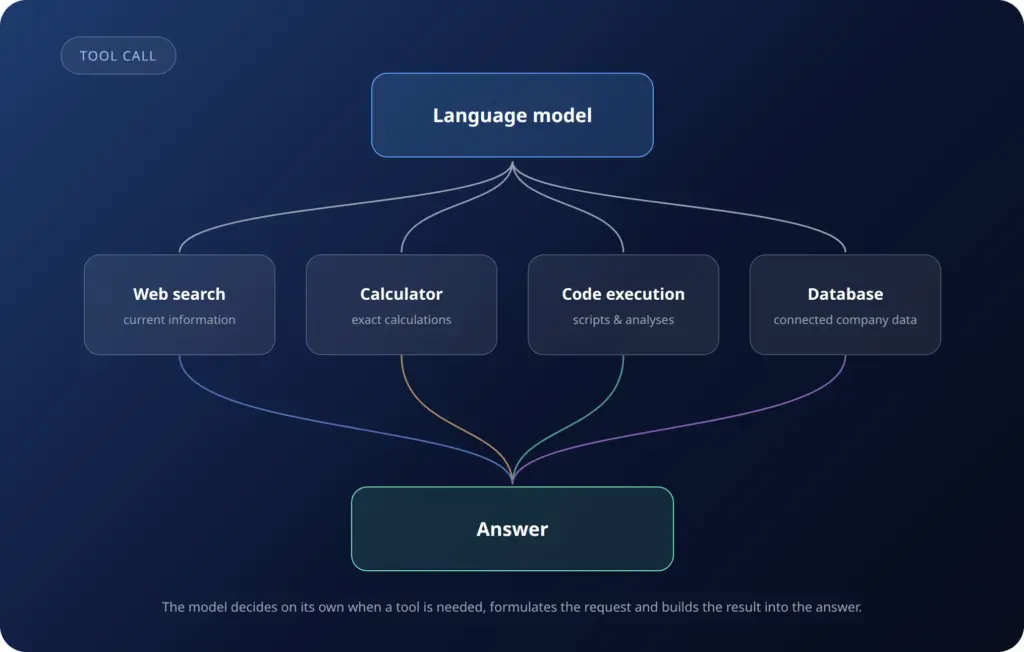
At its core, a language model only predicts the statistically most likely next word. That is unsuitable for exact calculations, current news or executable code. Modern AI systems have therefore learned to call external tools when needed: a calculator, a web search, a code execution environment or a connected company database. The model decides for itself when a tool is needed, formulates a structured request to that tool and then builds the result into its answer. This very ability is behind the current trend toward “AI agents” that no longer just answer but complete multi-step tasks on their own.
Safety Classifiers: The Second Opinion in the Background
Alongside the actual language model, every provider runs additional, much smaller models whose only job is to check inputs and outputs for problematic content, from obviously harmful requests to subtler manipulation attempts in which someone tries to override the system’s actual rules by a detour (for example hidden instructions in a web page that is retrieved). This protective layer is one of the reasons why an AI provider rarely trains just one model but operates a whole system of several interlocking models.
Why the Model Alone No Longer Matters
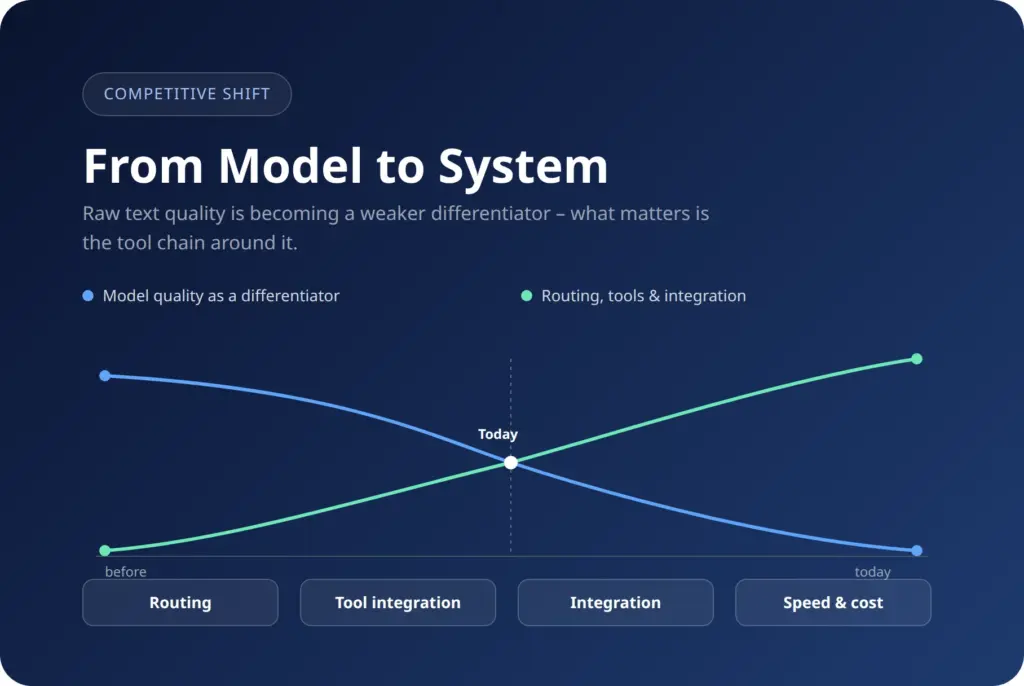
This is exactly where the real competition shifts. The pure text quality of a model is getting harder and harder to sell as a differentiator, and the differences between the top models are often barely noticeable to laypeople in everyday use. Instead, the race is increasingly moving to the tool chain around them: How reliable is the routing? How good are the tool integrations? How deeply is the system integrated into existing software? How quickly and cheaply can the whole thing be operated at scale? A provider can have a technically impressive model and still come off worse in everyday use if the infrastructure around it is slower, more expensive or less reliable than the competition’s.
What Does This Mean for You as a User?
A few practical conclusions can be drawn from this look behind the scenes, and they apply regardless of the current model name.
Take benchmark numbers with a grain of salt. Providers almost always compare their new models with those of the competition and naturally choose tests in which they perform well. A lead in a single benchmark says little about real-world suitability for everyday use.
Don’t chase the newest name. Because a routing system decides behind every request which sub-model actually answers, the model version alone is rarely the decisive factor for the quality of a specific answer.
Pay attention to the tools, not just the model. Whether an AI assistant really helps in everyday life often depends more on which tools and data sources it may tap into than on which core model is running in the background.
Keep data protection in mind. Every additional step in the tool chain, such as a web search or access to your own mailbox, also means that data leaves your own device at that point. It is worth checking in the settings which tools and data accesses are enabled by default.
Outlook: Where Is the Race Heading?
Some developments are already emerging, regardless of which provider tops the leaderboard next month. The models themselves are converging on many standard tasks, while competition shifts more toward agent capabilities, specialization for individual professions and integration into existing software. At the same time, the pressure to make AI-generated content reliably identifiable is growing, driven in part by new legal requirements such as the EU AI Act. And finally, the energy demand of ever larger data centers is likely to become an increasingly limiting factor that co-determines the pace of the race, quite independently of how much capital individual providers can still raise.
Conclusion
The race between GPT, Gemini, Claude and the numerous challengers will not slow down any time soon. For everyday life, a second look is therefore worthwhile: away from the question of which model currently tops the leaderboard, toward the question of how the tool chain behind it is built, which data flows through it and which tasks you can sensibly entrust to such a system. This understanding remains valid, no matter which name is at the top of the list in a year.
Good news for everyone who wants to solve a specific problem with AI: local AI on your own hardware (or an affordable AI server rented from Germany) is perfectly suited for this. The results are often of higher quality than any cloud AI.
KI-Beratung, KI-Lösungen
Leistungsangebot:
- Erstberatung inkl. Machbarkeitsaussagen
- Schulungen und Workshops für Führungskräfte, Berufsgeheimnisträger, Angestellte, Entwickler
- KI-Lösungen mit und ohne ChatGPT/Azure. Cloud oder eigener KI-Server
 My name is Klaus Meffert. I have a doctorate in computer science and have been working professionally and practically with information technology for over 30 years. I also work as an expert in IT & data protection. I achieve my results by looking at technology and law. This seems absolutely essential to me when it comes to digital data protection. My company, IT Logic GmbH, also offers consulting and development of optimized and secure AI solutions.