


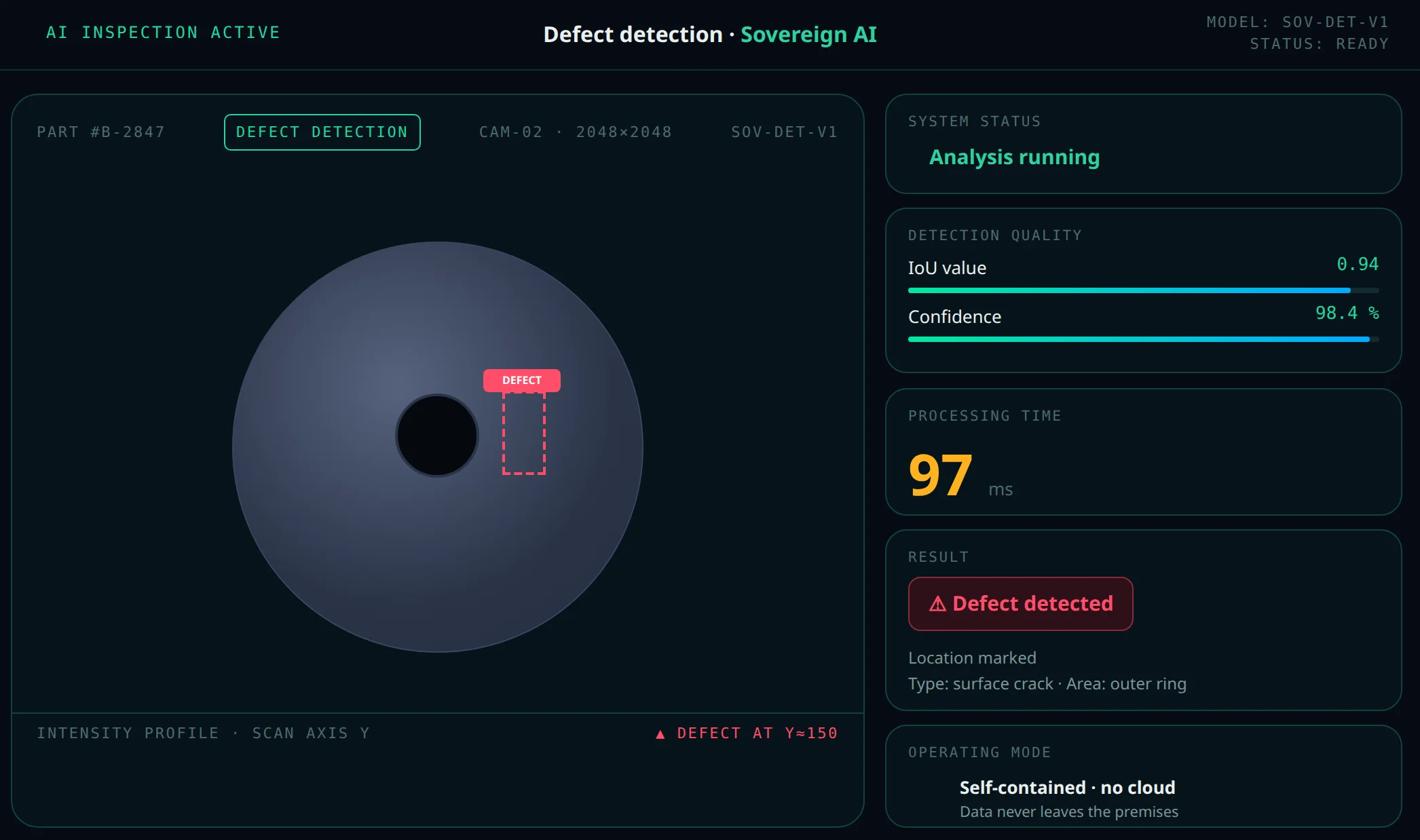
Machines see more sharply than the human eye ever could – at least when they are trained properly. Modern AI-based image analysis detects defects in components in real time, with measurable precision and entirely within the company's own network. This article shows what that means, how it works and why sovereign AI requires no compromises for quality control.
Why automated quality control?
Industrial quality control is time-critical, especially in manufacturing. Faulty components that go undetected cause scrap, complaints, rework and, in the worst case, safety risks. At the same time, classic visual inspection by humans reaches its limits: fluctuating concentration, fatigue, subjective differences in judgement and the sheer number of parts to inspect make seamless manual checks almost impossible in practice.
AI-based image analysis is an effective tool for automating this task – and not just since yesterday. Computer vision, the machine processing and interpretation of image data, has matured into an established technology in recent years. Convolutional Neural Networks (CNNs) and more modern architectures such as Vision Transformers have raised detection accuracy to a level that can match or exceed human expertise in many inspection tasks. Using a concrete defect detection solution as an example, this article describes what is possible with sovereign AI today.
What the solution delivers
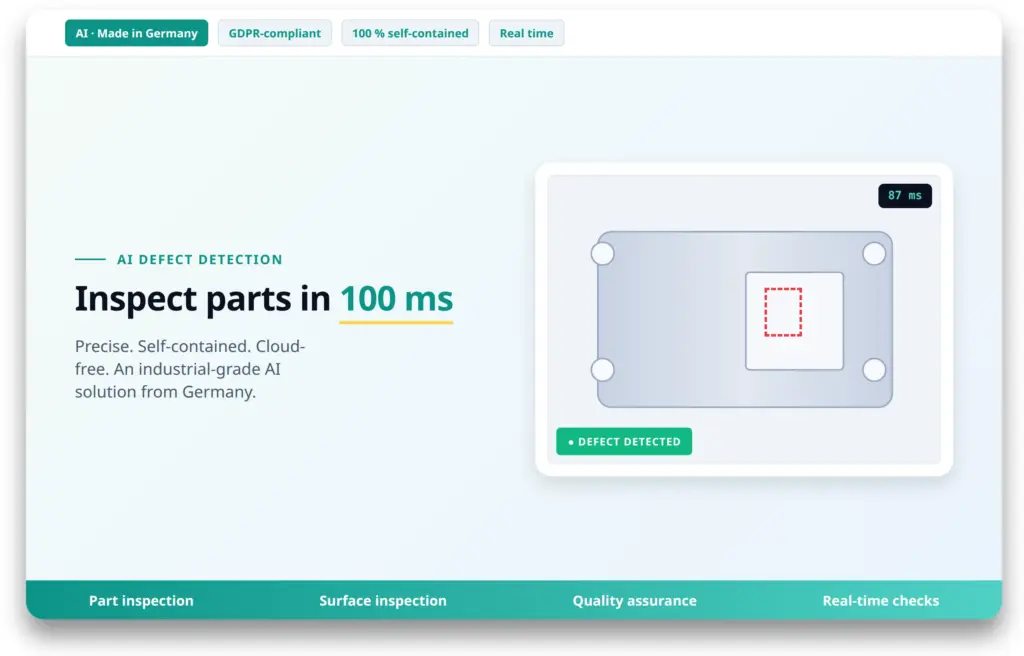
The solution detects within about 100 milliseconds whether an image of a component shows a defect. If a defect is found, the AI draws it onto the image. The result can therefore be checked visually at once – by the human inspector as well as by downstream systems.
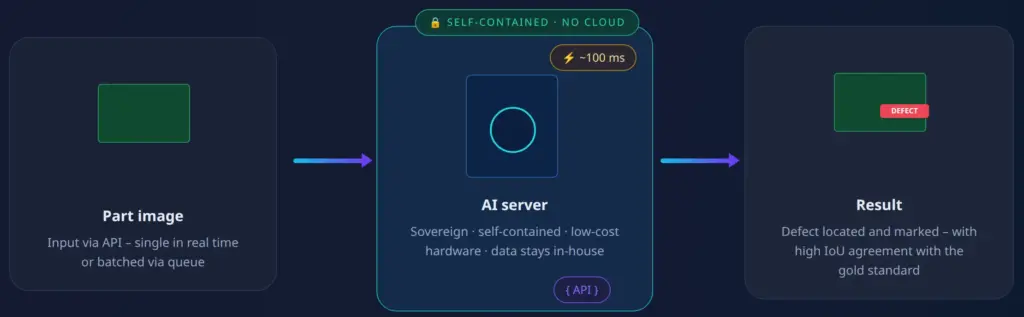
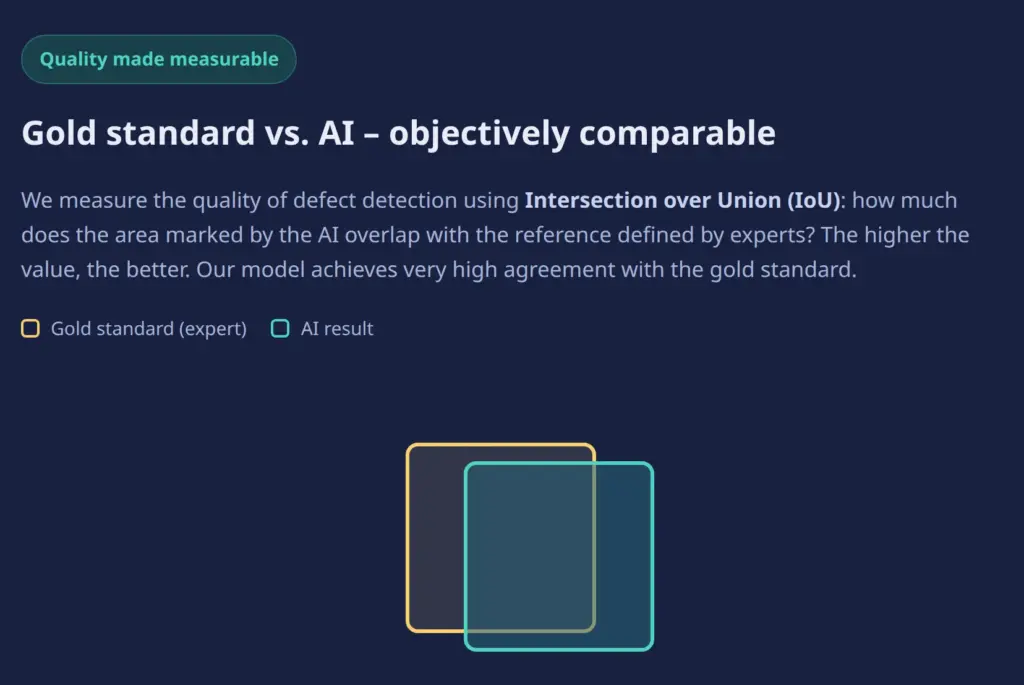
Even the smallest anomalies are captured reliably. Accuracy can be assessed not only subjectively but also measured with an established metric: the IoU value (Intersection over Union). This value quantifies the overlap between the manually marked reference (gold standard) and the AI detection. High IoU values mean that the AI does not just find the defect "somewhere" but locates it precisely where it actually is – with the right shape and the right extent.
Other common metrics are precision (how many of the defects found are actually defects?) and recall (how many of the existing defects were found?). In practice, the key is to bring both values into a sensible balance – depending on the use case, a high recall can matter more than high precision or vice versa.
From images to a production-ready model in a few steps
The path to a ready-to-use AI model follows a clear sequence:
Step 1: Collect sample images: A few hundred annotated examples are enough as a starting point. If the stock is smaller, it can be sensibly extended through synthetic manipulation (more on this in the next section).
Step 2: Annotate defects: A purpose-built annotation tool, optimised for speed and comfort, makes it efficient to mark the defects in the training images. Anyone who has had to annotate several hundred images by hand knows how much time and frustration a well-designed tool saves at this point.
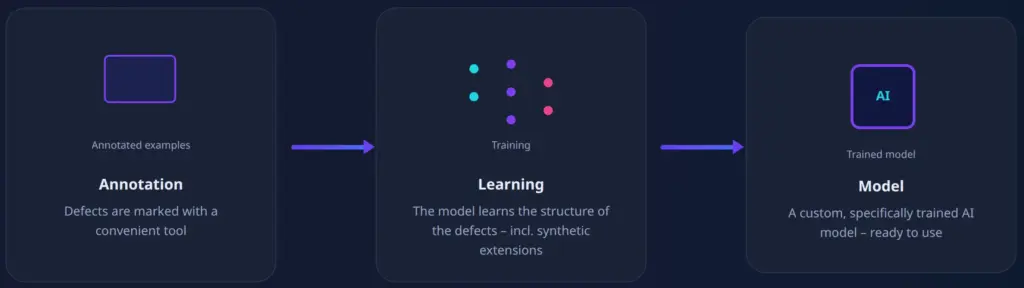
Step 3: Train the AI model: A tailor-made model is trained that is designed specifically for particular components and defect classes. Three-dimensional recordings (stereography) are also possible – for example, to recognise parcels on a conveyor belt, separate them with a robot and sort them automatically.
A dedicated AI model behind the solution
The solution does not rely on a generic cloud service. At its core works a specially trained AI model tuned to the specific task.
A few hundred annotated sample images are enough for training. When data is scarce, the stock can be sensibly extended by synthetic manipulation: variations in lighting, perspective, image noise, scaling or colour produce additional training images without reducing their value. In some projects this means getting by with far fewer real originals than one would initially assume.
This technique is also called data augmentation and is an established method in machine learning. It is particularly valuable when real defect images are rare – which is common in industrial practice, because a well-running production process naturally produces little scrap.
Integration into existing processes
An AI solution is only useful if it fits into existing workflows. For this, an API is available through which customer systems can address defect detection directly. Two operating modes cover the typical requirements:
- Real-time requests for single images or small batches, for example in an ongoing inline inspection – with a response time of around 100 ms.
- Job-based processing with a queue for large volumes of data, where orderly throughput matters more than the latency of a single request.
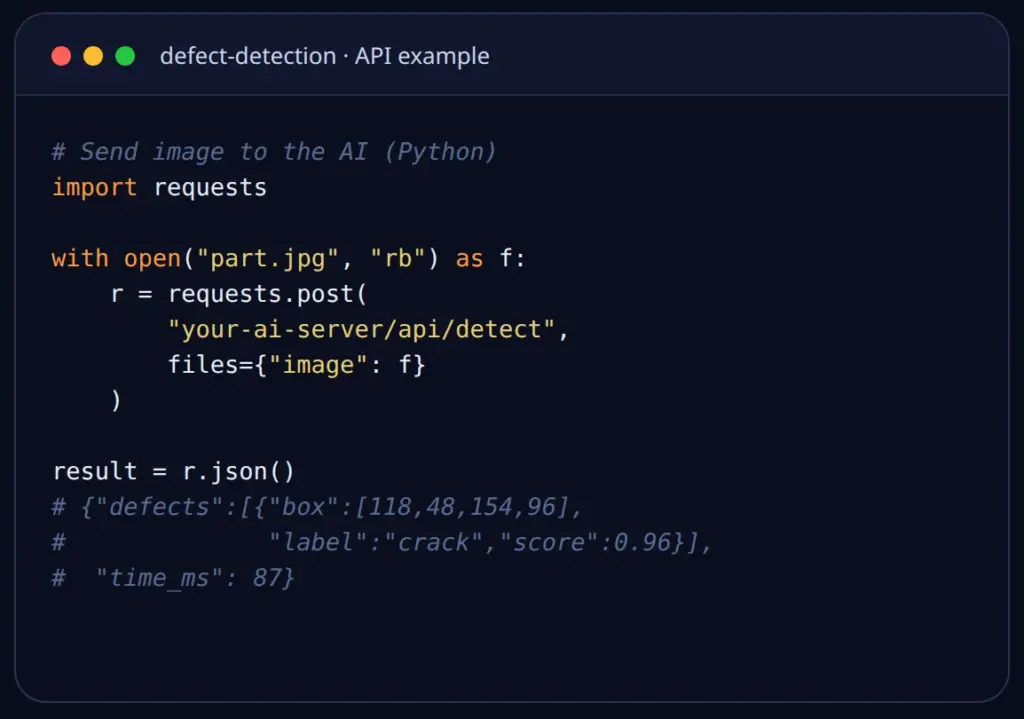
This covers both in-line production checks and downstream bulk evaluations, without needing different systems for them.
Hardware: a low entry threshold
An entry-level AI server is enough to run it. An expensive GPU farm is not required. The server works self-contained in your own network – without an internet connection to external AI services. No ChatGPT, no Azure service and no other cloud provider is contacted. The AI runs entirely in-house.
This has two practical consequences: first, there are no ongoing usage fees per request. Second, the solution remains available when the internet connection fails or an external provider changes its services.
Why sovereignty matters
In this context, sovereign AI means something very concrete: the data does not leave the company. Images of components and the insights gained from them stay with the operator of the AI, who is also the owner of the data. There is no silent exploitation by third parties, no unilaterally changed terms of use that suddenly permit new uses of data, and no geopolitical risks around access to a foreign cloud.
In industry in particular, images of components are more than mere pixels. They can allow conclusions about manufacturing processes, materials, tolerances and design details – information a company has good reasons not to share. A cloud solution demands trust here that is often hard to justify. A locally operated solution simply does not demand it.
The solution described here was developed entirely in Germany. That is not an end in itself but has practical consequences for data protection, contract law and the accessibility of those responsible for the solution.
Transferability to other use cases
Perhaps the most important point for the longer-term perspective: the structure of the problem has fundamentally been solved. What the solution does at its core – find a specific pattern in an image, locate it and mark it – can be transferred to a whole class of similar tasks: classification, object detection, counting, sorting and more.
Conceivable fields of application include:
- Detection of solder joint defects in electronics manufacturing
- Quality control of injection-moulded and cast parts
- Detection of surface defects on sheet metal, films or painted surfaces
- Anomalies in food production (foreign objects, deviations in shape and colour)
- Visual inspection in wood, glass or textile processing
- Evaluation of microscope images or material samples
- Weld seam inspection and packaging control
- Parcel recognition and automatic sorting on conveyor belts with robot integration
- Object counting and quality documentation
The effort of adapting to a new use case is economically feasible because the architecture of the solution is already in place. What is needed is suitable training data for the new task – and here, too, synthetic data generation helps where necessary to turn a manageable stock of real examples into a viable training dataset.
What determines quality
Three factors largely decide how well such a solution works in a specific project:
- Quality and representativeness of the training data. The AI learns what it sees. If the examples are unbalanced or one-sided, it learns the wrong thing.
- Care in annotation. Clean, consistent markings are the foundation of a reliable model. Sloppy annotations lead to sloppy results.
- Suitable configuration of the model for the task at hand – knowing which levers work where.
None of these points is trivial, but none is unsolvable either. With a structured approach, very good detection quality can be achieved in many tasks.
Conclusion
Sovereign AI for industrial image recognition works – today, on affordable hardware, in your own network, without cloud dependency and with data that never leaves the company. Defect detection in components is an illustrative and already production-proven example. But the underlying methodology goes much further: anyone with a visual recognition problem that is structurally similar is on ground that is already passable.
Manufacturing AI: detect defects in 100 ms
Your own AI model on your own server – no cloud, no data dependencies. Smallest defects, measurably precise, economically adaptable.
What matters is that getting started requires no large upfront investment. A few hundred sample images, a structured annotation process and a model tailored to the task are enough to reach measurable, reliable results in a short time. The question is no longer whether AI-based quality control is technically possible – it is. The exciting question is which concrete problem can be solved with it next.
Further use cases for AI in image analysis include the recognition and evaluation of receipts, for example. John Bon detects the position and content of receipts on scanned or photographed documents, even when receipts overlap or the thermal paper is badly faded or crumpled.
 My name is Klaus Meffert. I have a doctorate in computer science and have been working professionally and practically with information technology for over 30 years. I also work as an expert in IT & data protection. I achieve my results by looking at technology and law. This seems absolutely essential to me when it comes to digital data protection. My company, IT Logic GmbH, also offers consulting and development of optimized and secure AI solutions.