


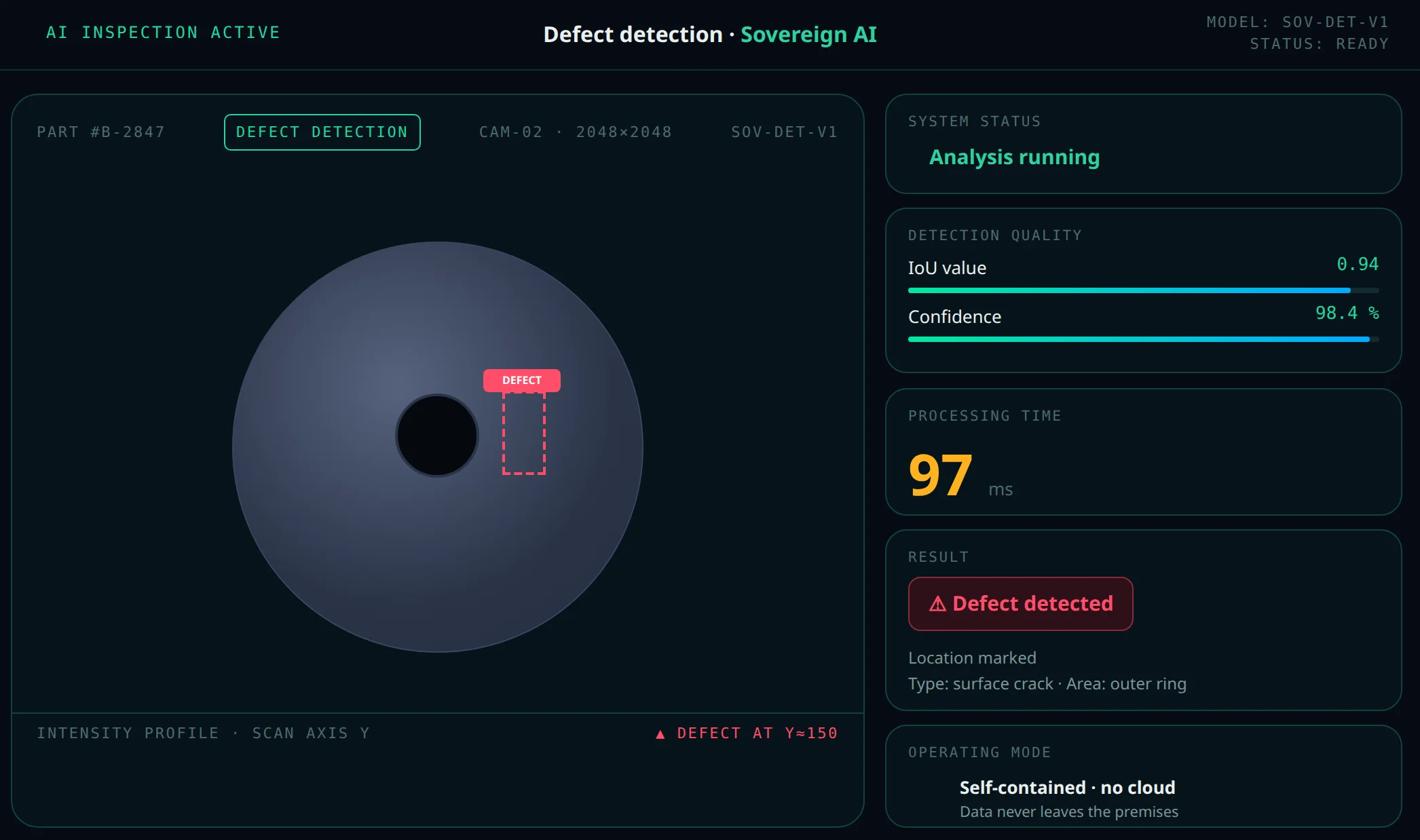
Machines see more sharply than the human eye ever could – at least when they are trained properly. Modern AI-based image analysis detects defects in components in real time, with measurable precision and entirely within the company's own network. This article shows what that means, how it works and why sovereign AI requires no compromises for quality control.
Why automated quality control?
Industrial quality control is time-critical, especially in manufacturing. Faulty components that go undetected cause scrap, complaints, rework and, in the worst case, safety risks. At the same time, classic visual inspection by humans reaches its limits: fluctuating concentration, fatigue, subjective differences in judgement and the sheer number of parts to inspect make seamless manual checks almost impossible in practice.
AI-based image analysis is an effective tool for automating this task – and not just since yesterday. Computer vision, the machine processing and interpretation of image data, has matured into an established technology in recent years. Convolutional Neural Networks (CNNs) and more modern architectures such as Vision Transformers have raised detection accuracy to a level that can match or exceed human expertise in many inspection tasks. Using a concrete defect detection solution as an example, this article describes what is possible with sovereign AI today.
What the solution delivers
The solution detects within about 100 milliseconds whether an image of a component shows a defect. If a defect is found, the AI draws it onto the image. The result can therefore be checked visually at once – by the human inspector as well as by downstream systems.
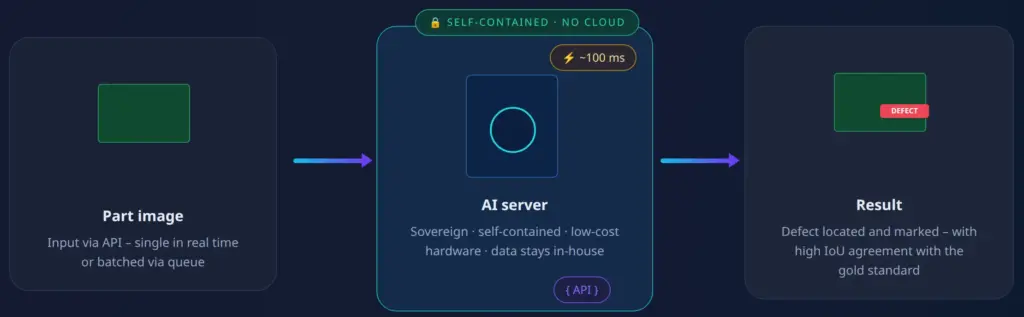
Even the smallest anomalies are captured reliably. Accuracy can be assessed not only subjectively but also measured with an established metric: the IoU value (Intersection over Union). This value quantifies the overlap between the manually marked reference (gold standard) and the AI detection. High IoU values mean that the AI does not just find the defect "somewhere" but locates it precisely where it actually is – with the right shape and the right extent.
Other common metrics are precision (how many of the defects found are actually defects?) and recall (how many of the existing defects were found?). In practice, the key is to bring both values into a sensible balance – depending on the use case, a high recall can matter more than high precision or vice versa.
From images to a production-ready model in a few steps
The path to a ready-to-use AI model follows a clear sequence:
Step 1: Collect sample images: A few hundred annotated examples are enough as a starting point. If the stock is smaller, it can be sensibly extended through synthetic manipulation (more on this in the next section).
Step 2: Annotate defects: A purpose-built annotation tool, optimised for speed and comfort, makes it efficient to mark the defects in the training images. Anyone who has had to annotate several hundred images by hand knows how much time and frustration a well-designed tool saves at this point.
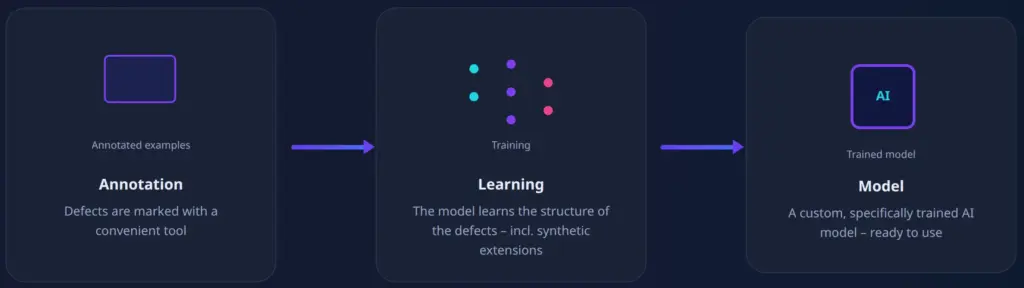
Step 3: Train the AI model: A tailor-made model is trained that is designed specifically for particular components and defect classes. Three-dimensional recordings (stereography) are also possible – for example, to recognise parcels on a conveyor belt, separate them with a robot and sort them automatically.
A dedicated AI model behind the solution
The solution does not rely on a generic cloud service. At its core works a specially trained AI model tuned to the specific task.
A few hundred annotated sample images are enough for training. When data is scarce, the stock can be sensibly extended by synthetic manipulation: variations in lighting, perspective, image noise, scaling or colour produce additional training images without reducing their value. In some projects this means getting by with far fewer real originals than one would initially assume.
This technique is also called data augmentation and is an established method in machine learning. It is particularly valuable when real defect images are rare – which is common in industrial practice, because a well-running production process naturally produces little scrap.
Integration into existing processes
An AI solution is only useful if it fits into existing workflows. For this, an API is available through which customer systems can address defect detection directly. Two operating modes cover the typical requirements:
- Real-time requests for single images or small batches, for example in an ongoing inline inspection – with a response time of around 100 ms.
- Job-based processing with a queue for large volumes of data, where orderly throughput matters more than the latency of a single request.
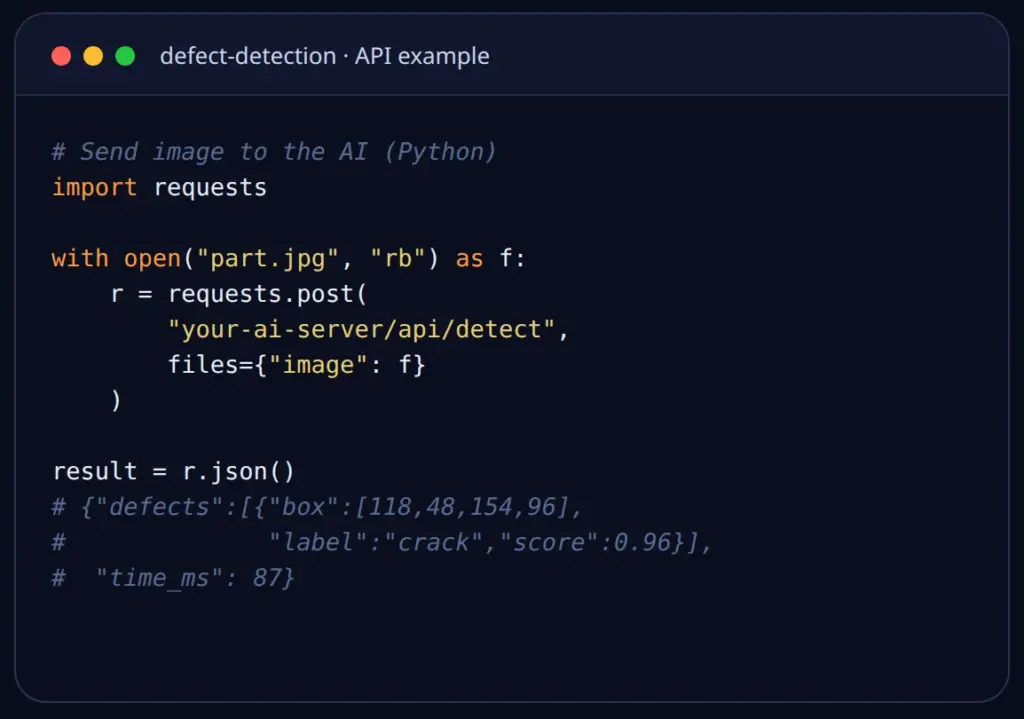
This covers both in-line production checks and downstream bulk evaluations, without needing different systems for them.
 My name is Klaus Meffert. I have a doctorate in computer science and have been working professionally and practically with information technology for over 30 years. I also work as an expert in IT & data protection. I achieve my results by looking at technology and law. This seems absolutely essential to me when it comes to digital data protection. My company, IT Logic GmbH, also offers consulting and development of optimized and secure AI solutions.