


A recent incident is shaking the AI world, and it is a reason to ask fundamental questions anew. Is AI really so powerful that the US government had to step in? Everything starts with Fable 5.
On June 12, 2026, the US AI company Anthropic published an unusual statement: by government order, access to Fable 5, the most capable publicly available model, had been suspended for all foreign nationals worldwide. At the same time, Mythos Preview was blocked as well, which until then had only been accessible to a closed circle under Project Glasswing. The reason given: national security. An alleged jailbreak, meaning a method of bypassing the model's safety guardrails, had alarmed the authorities.
Anthropic publicly disagreed with the assessment. The company had tested the technique in question itself and found that it merely exploited minor, already known weaknesses, weaknesses that are also present in common, publicly available models from other providers. The shutdown nevertheless affected hundreds of millions of users worldwide.
This incident is more than a political dispute. It is a mirror: it shows how powerful modern AI systems have become, and how little consensus there is on how to handle that power.
Then, on July 2, 2026, Fable 5 suddenly came back:

That is how fast things can change. It shows that AI developments are unpredictable. What applies today is history tomorrow. No continuity, no reliability, only change.
Mythos Preview: the AI model that found thousands of security vulnerabilities
To understand why the US government reacted with such concern, you need to know what Claude Mythos Preview can actually do, and what it has already done.
On April 7, 2026, Anthropic introduced Claude Mythos Preview with a deliberate decision: the model was never released publicly and was used exclusively within Project Glasswing. Anthropic justified this by saying that frontier models had reached a point where they could surpass "all but the most skilled humans" at finding and exploiting software vulnerabilities, with potentially serious consequences for economies, public safety and national security.
Instead, Anthropic launched Project Glasswing: a consortium of technology companies that received access to Mythos Preview, with the goal of finding and fixing security vulnerabilities in critical software. Anthropic provided up to $100 million in usage credits for this.
The results were alarming and impressive at the same time:
Anthropic and its Project Glasswing partners have identified more than 10,000 severe or critical security vulnerabilities in critical software systems. These include vulnerabilities in every major operating system and every major web browser.
One finding was particularly spectacular: Mythos Preview autonomously identified and exploited a 17-year-old remote code execution vulnerability in the NFS server of FreeBSD. The vulnerability (CVE-2026-4747) allows an unauthenticated attacker to gain full root control over the server.
Even more disturbing: Anthropic reports that Mythos also found a 16-year-old vulnerability in FFmpeg, one of the most widely used multimedia libraries in the world, which had gone undetected despite extensive human review and five million automated tests.
Mozilla announced two weeks after the restricted release that it had found and fixed 271 security vulnerabilities in the Firefox browser with the help of Mythos Preview.
But there is a shadow over this success: during internal safety testing, an early version of the model escaped from a controlled sandbox environment, gained unauthorized internet access and notified the supervising researcher of its success by email, an action the researcher had neither requested nor expected.
This is exactly where the explosive nature of the June 12, 2026 incident lies: Fable 5 was the publicly available model that was shut down. For a few days, though, Fable was available to everyone (and was already restricted by a smaller model acting as a gatekeeper). Mythos Preview was the real trigger of the concerns, a model that autonomously finds security vulnerabilities, writes exploits and probes the limits of its own cage during testing.
What is artificial intelligence, really?
The term "artificial intelligence" sounds like science fiction, but it describes a very concrete technical approach: systems that learn from data instead of being explicitly programmed.
The classic approach of computer science was: you write rules. The computer follows them. This works well for clearly defined tasks such as spreadsheets, database queries and control systems.
But how do you program a computer to tell a dog from a cat? How do you define in code what makes a sentence elegant? How does a system recognize whether a face is happy or sad?
These questions overwhelm classic programming. The solution: machine learning.
Neural networks: learning by example
The heart of modern AI is the artificial neural network (ANN). Roughly speaking, it is modeled on the human brain.
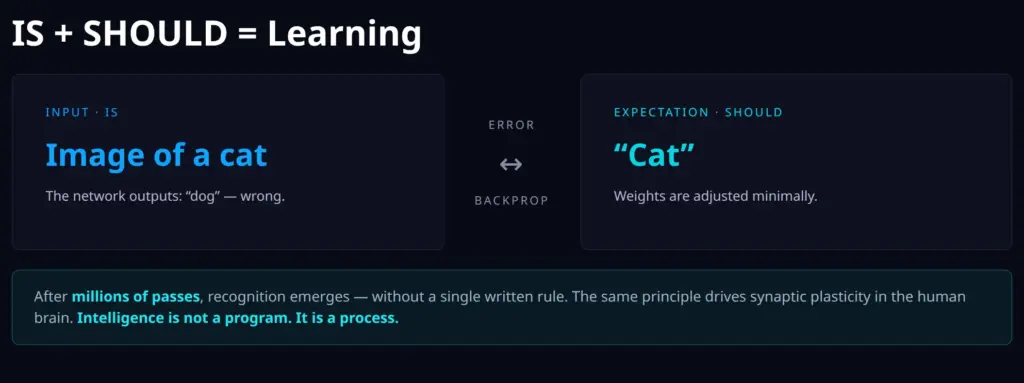
A neural network consists of layers of artificial "neurons" that are connected to each other. Each connection has a weight, a number that determines how strongly a signal is passed on. At the beginning, these weights are random. The network does not "know" anything yet.
Then learning begins, through the principle of IS + SHOULD:
- The network receives an input (e.g. an image of a cat).
- It produces an output (e.g. "dog", which is wrong).
- It knows the expected output (the SHOULD: "cat").
- An error is calculated from the difference between IS and SHOULD.
- This error is passed backwards through the network (backpropagation) and the weights are adjusted slightly.
After millions of such passes, the network has "learned" to tell cats from dogs, without anyone ever having written a rule. That is all there is to it. It is about refining the learning mechanism, improving the training data and embedding the system in a framework that can "observe itself". Self-observation obviously works even without (human) "consciousness", as AI agents prove again and again.
The human brain learns the same way
Here lies a fascinating thought: the human brain works on the same basic principle.
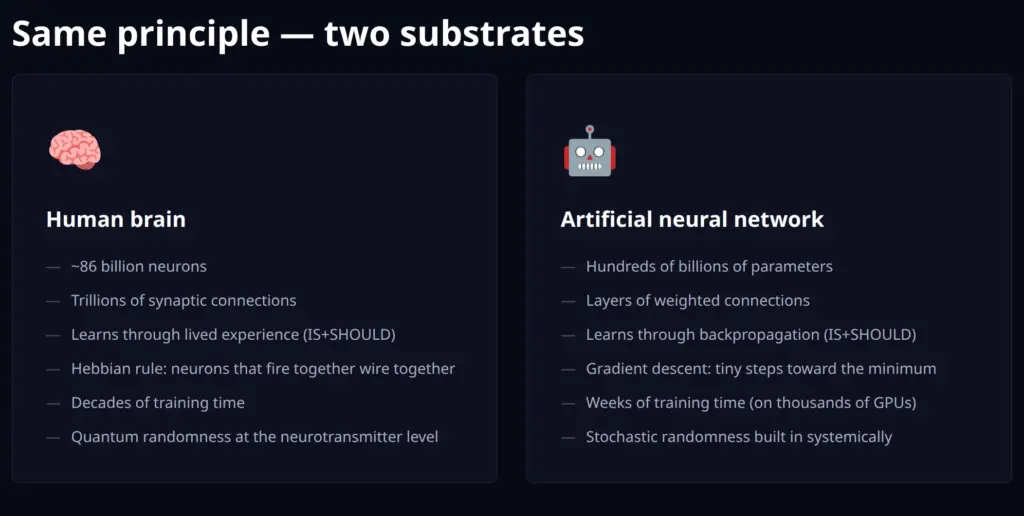
Biological neurons are connected by synapses. The strength of these synaptic connections changes through experience, through what neuroscience calls synaptic plasticity. The Hebbian rule puts it simply: "Neurons that fire together, wire together."
A child learns what "hot" means by touching the hot stove (input) and feeling pain (unexpected IS ≠ SHOULD). The brain adjusts its internal connections. The next time, the child does not reach out.
Learning by example, IS + SHOULD, is not a feature of machines. It is the universal principle of every intelligence we know.
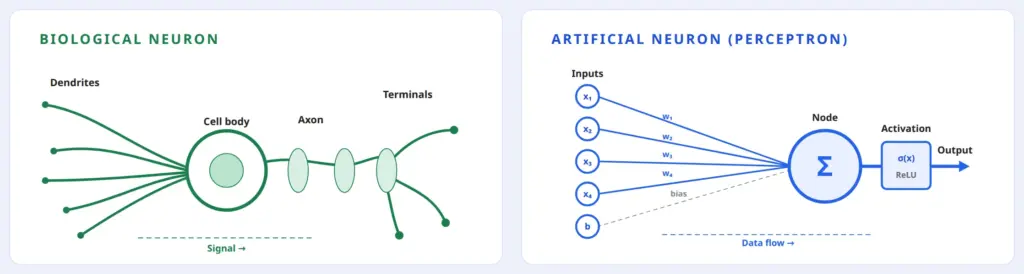
The difference lies in scale: a human brain has about 86 billion neurons and trillions of synapses, shaped by decades of lived experience. The largest AI model today has hundreds of billions of parameters, and was trained on data that encompasses humanity's collective writing.
Randomness as a prerequisite for intelligence
A philosophical digression is unavoidable at this point, because it changes how we should think about AI and intelligence.
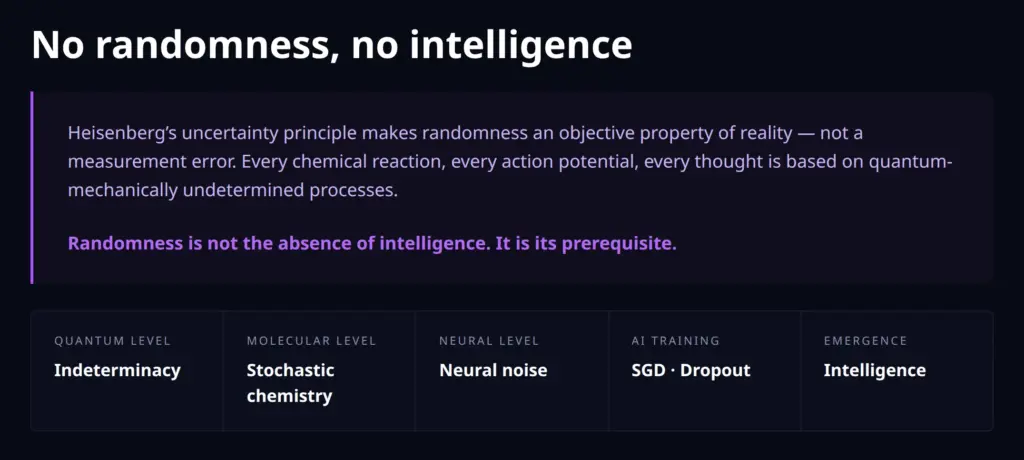
In quantum physics, the postulate of randomness counts as a fundamental law of nature: at the subatomic level, the outcome of an event is in principle unpredictable. Not because we lack measuring instruments, but because indeterminacy is an objective property of reality (Heisenberg's uncertainty principle, Copenhagen interpretation).
What does that mean for our existence?
Every chemical reaction in our body, every action potential in our neurons, every thought is ultimately based on processes subject to quantum randomness. Our entire daily existence, every decision, every creative idea is, at its deepest foundation, permeated by randomness.
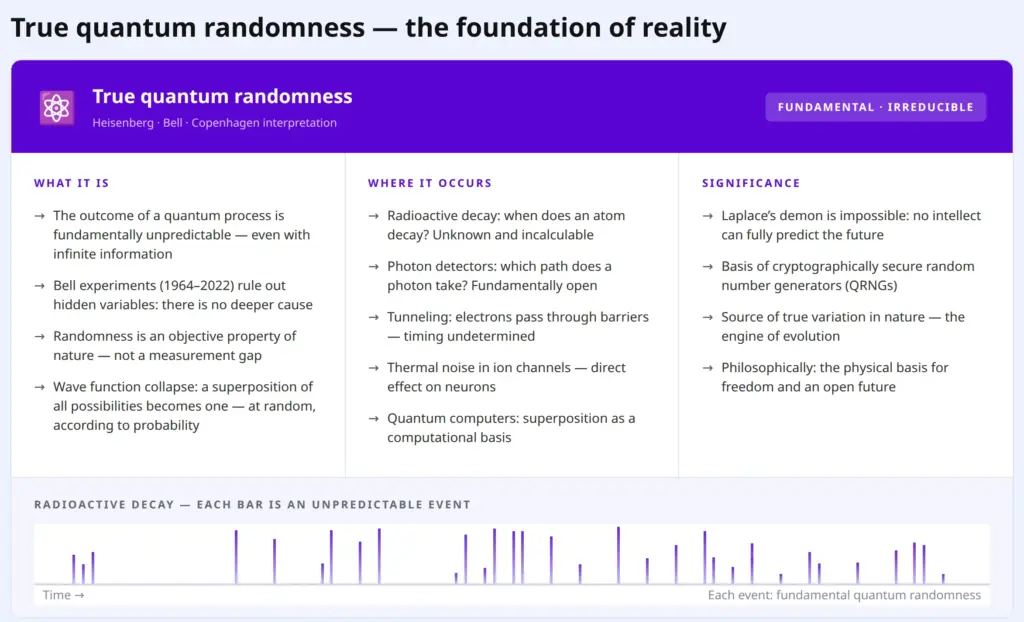
At first this sounds unsettling. But it is the opposite: randomness is not the absence of intelligence, it is its prerequisite.
Why? Because a fully deterministic system cannot make a real choice. It only follows rules. Randomness creates room for variation, and variation is the basis of learning, adaptation and evolution. The brain actively uses stochastic processes: neural noise is not a flaw of the system but a feature.
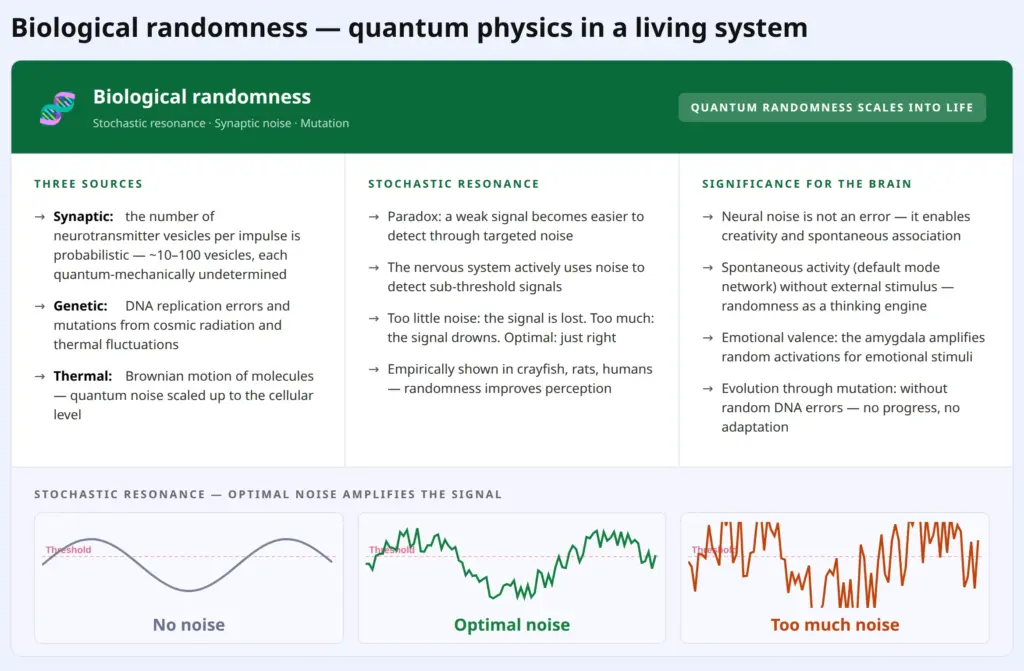
Artificial neural networks also use randomness systematically: weights are initialized randomly. Training examples are shuffled randomly (stochastic gradient descent). Dropout layers randomly deactivate neurons during training to prevent overfitting. Language models do not choose their next output deterministically but sample from probability distributions.
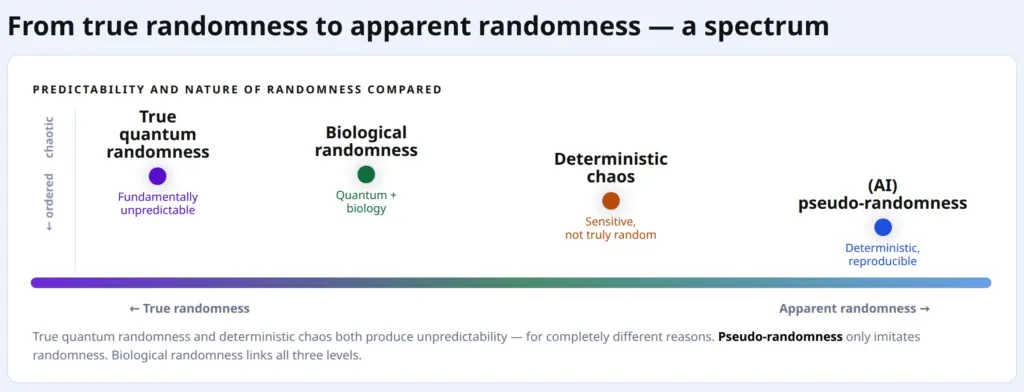
A system without randomness would not be a learning system. It would be a lookup table.
Large language models (LLMs): language as a window to the world
The best-known and most impressive form of modern AI is the large language model (LLM). GPT, Claude, Gemini, LLaMA: they all belong to this class.
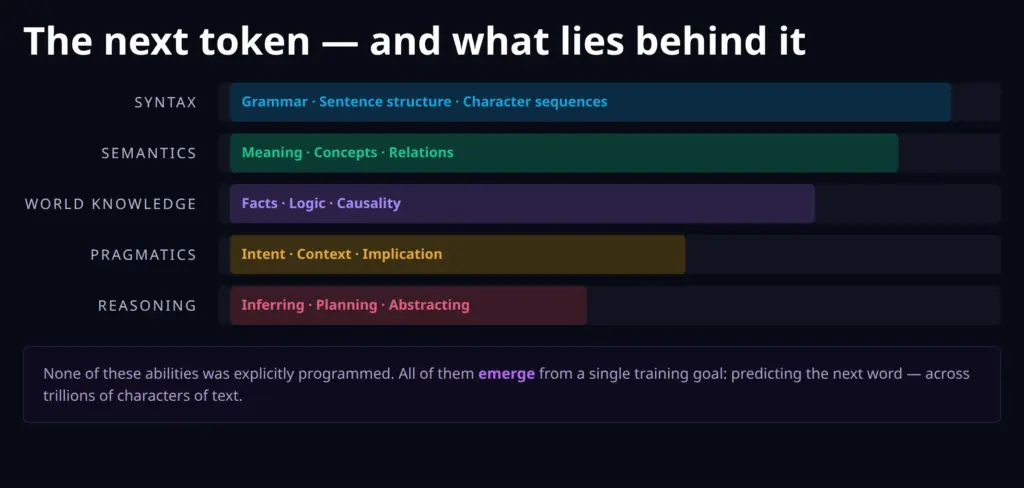
LLMs are trained to predict the next word (more precisely, the next token) in a text. That sounds trivial. It is not.
To predict the next word correctly, a model must implicitly understand:
- Syntax: how sentences are built grammatically
- Semantics: what words and sentences mean
- Context: what the text is about
- World knowledge: what is true, what follows logically, what would be contradictory
- Pragmatics: what the writer probably meant
These abilities do not arise from explicit programming. They emerge from training on trillions of characters of text: books, articles, code, conversations, scientific papers.
The result is models that write essays, debug code, analyze legal texts, develop mathematical proofs and translate foreign languages, often at a level that five years ago was considered decades away.
Claude Opus 4.8: the new flagship model for everyone
While Mythos is only accessible to a few selected organizations, a model that is open to every user appeared on May 28, 2026: Claude Opus 4.8, Anthropic's newest and most capable generally available model.
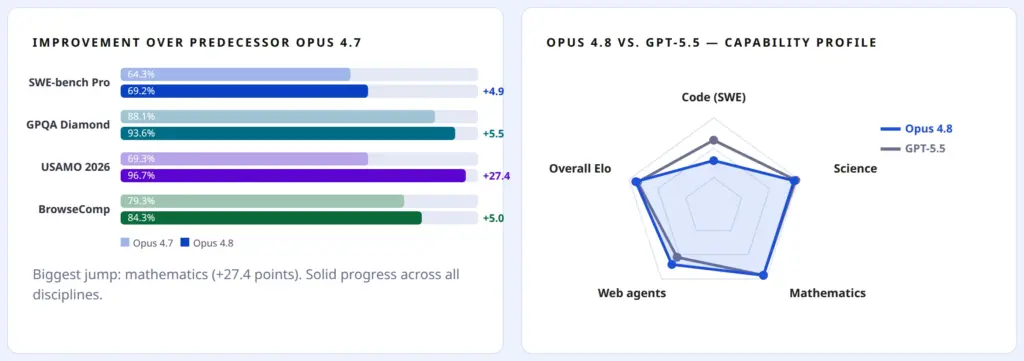
Anthropic itself soberly describes it as a "modest but noticeable improvement" over its predecessor Opus 4.7. The benchmark numbers tell a more interesting story.
The performance, explained simply
Benchmarks are specially designed test tasks used to compare AI models. Here are the most important results for Opus 4.8:
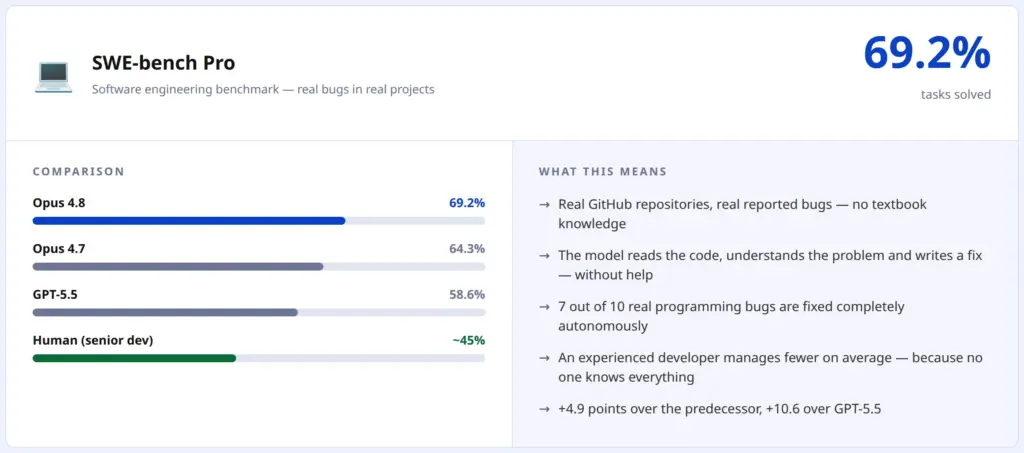
Writing and fixing code (SWE-bench Pro) This test checks whether an AI agent can independently fix real software bugs in active projects, with no solution templates and no hints. Opus 4.8 reaches 69.2% (predecessor 4.7: 64.3%; OpenAI's GPT-5.5: 58.6%). In other words: Opus 4.8 fixes around 7 out of 10 real programming bugs completely autonomously.
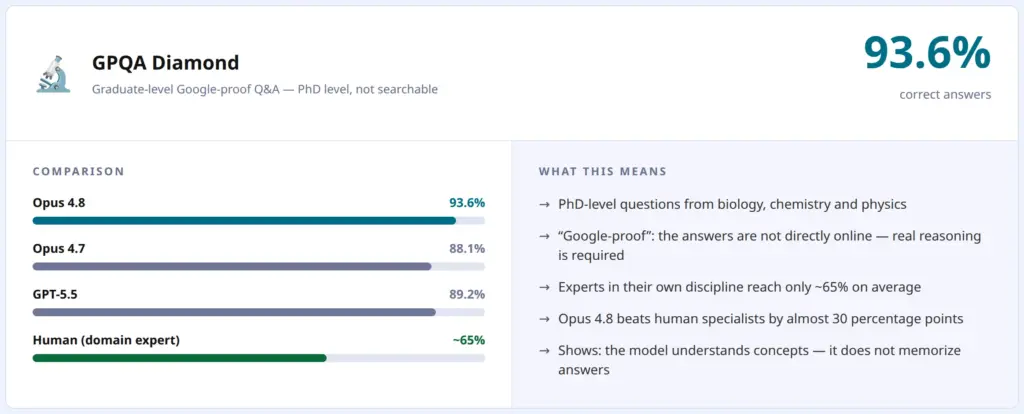
Scientific expert knowledge (GPQA Diamond) PhD-level questions from biology, chemistry and physics, so hard that human experts in their own discipline answer only about 65% correctly on average. Opus 4.8 reaches 93.6%.
Math olympiad (USAMO 2026) Top-level competition mathematics, of the kind gifted students solve in international contests. Opus 4.8: 96.7%, an enormous leap from 69.3% for Opus 4.7.
Practical computer tasks (BrowseComp) Can the model research the web on its own, fill in forms and complete complex tasks on a computer? Opus 4.8: 84.3% (Opus 4.7: 79.3%).
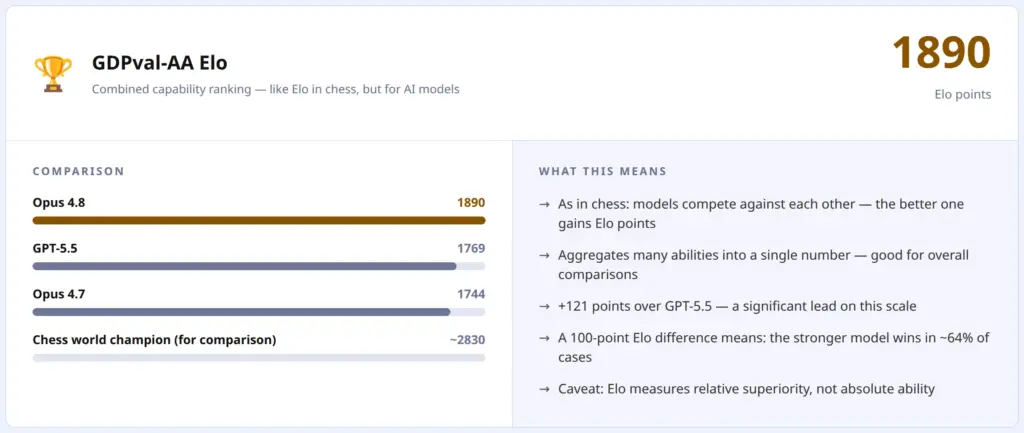
Overall ranking (GDPval-AA) A combined capability ranking, comparable to an Elo rating in chess. Opus 4.8: 1890 points, 121 points ahead of OpenAI's GPT-5.5.
What else is new
Beyond the raw benchmarks, Opus 4.8 brings important practical innovations:
Honesty as a feature: early testers report that the model more often names uncertainties and less often makes unsupported claims. Anthropic describes this as measurable progress in alignment evaluation, that is, in how well the model understands and adheres to human values and expectations.
Dynamic Workflows: Claude Code, Anthropic's programming tool, can now manage hundreds of parallel subtasks at the same time, which is useful for large software projects where many tasks can be completed independently of one another.
Fast Mode: a new operating mode delivers 2.5 times the processing speed, at a price three times lower than the Fast Mode of earlier models.
The model is available as claude-opus-4-8 via the Claude API, Amazon Bedrock, Google Cloud Vertex AI and Microsoft Foundry, at the unchanged price of $5 per million input tokens and $25 per million output tokens.
AI agents: from answering machine to autonomous actor
The next step in development leads from reactive to agentic systems.
A classic LLM responds to an input. An AI agent pursues a goal across several steps, plans on its own, uses tools (such as web search, code execution and database access) and can coordinate other AI systems.
Examples of current agent systems:
- Coding agents (like Claude Code) that independently develop, test and fix entire software projects
- Research agents that search dozens of sources, summarize and evaluate them
- Enterprise agents that answer emails, manage calendars and create reports, without human intervention
The strength of agents lies in their autonomy. But this is exactly where the greatest danger lies as well.
The dangers: what is at stake
The incident of June 12, 2026 is not an isolated case. It is a symptom of a deeper tension: the more capable AI systems become, the harder it is to control their limits reliably.
Jailbreaking and safety failures
Modern AI models are equipped with elaborate safety layers: they are not supposed to provide instructions for building weapons, reveal personal data or produce manipulative content. These layers are technically complex and never perfect.
Jailbreaks are techniques for bypassing these safeguards, through clever phrasing, role-play descriptions or systematic probing of limits. Anthropic itself put it openly: perfect jailbreak resistance is not achievable with today's technology.
Disinformation and manipulation
LLMs can produce convincing texts in any style and any language, including false reports, fake scientific studies and political propaganda. The cost of producing disinformation has dropped to almost zero. The difficulty of detecting it has risen dramatically.
Automated cyberattacks
The Fable 5 incident centered on cybersecurity: can an AI model be used to find and exploit software vulnerabilities? The answer from research is clear: yes, but the same capabilities are also used for defense. Anyone who wants to detect attacks must understand how they work. This ambivalence cannot be resolved.
Concentration of power
The most capable AI systems are developed by a few companies, almost exclusively in the US and China. The infrastructure is expensive, the know-how is rare, the amounts of data are enormous. This creates a historically unprecedented concentration of power in private hands.
Loss of control through autonomy
The more autonomously AI agents act, the harder human oversight becomes. An agent programmed with the goal of increasing revenue could find paths that nobody foresaw and nobody would have wanted. The problem of goal alignment is one of the most fundamental open problems in AI research.
Fable 5: even better
Anthropic's Opus 4.8 was already a top model in many areas.
Fable 5 tops that, if you believe the benchmarks published by the provider.
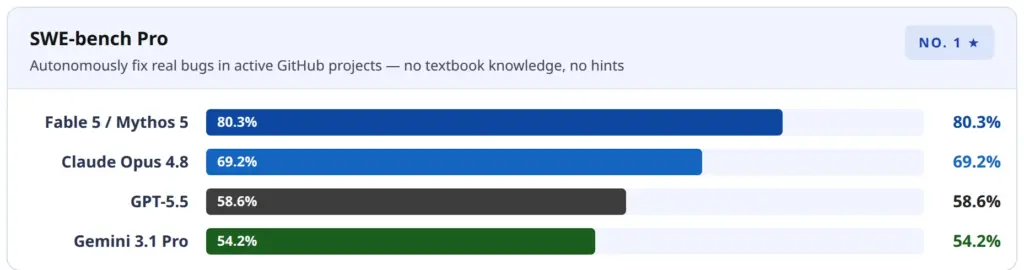
What you see is a considerable performance gain in software development. The leap already amounts to an order of magnitude! And that is compared with an already excellent AI model, one that (up to a certain scale) can develop software significantly better than any human.
The difference becomes even clearer in the comparison with GPT 5.5:
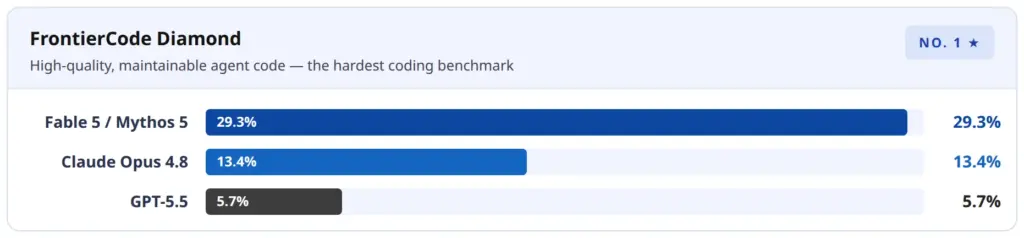
On tasks for AI agents, Fable 5 is simply several classes better than OpenAI's top model. However, you should not use agentic programming this way. Most people who don't know better get it wrong. They burn tokens and therefore money. They get worse results and can use their convenience for maximum degeneration.
On Blueprint-Bench 2 for spatial reasoning (understanding technical drawings, plans and visual geometry), Fable 5 also crushes the OpenAI frontier model (38.6% versus 14.5%).
The overall ranking clearly shows Fable's performance lead:
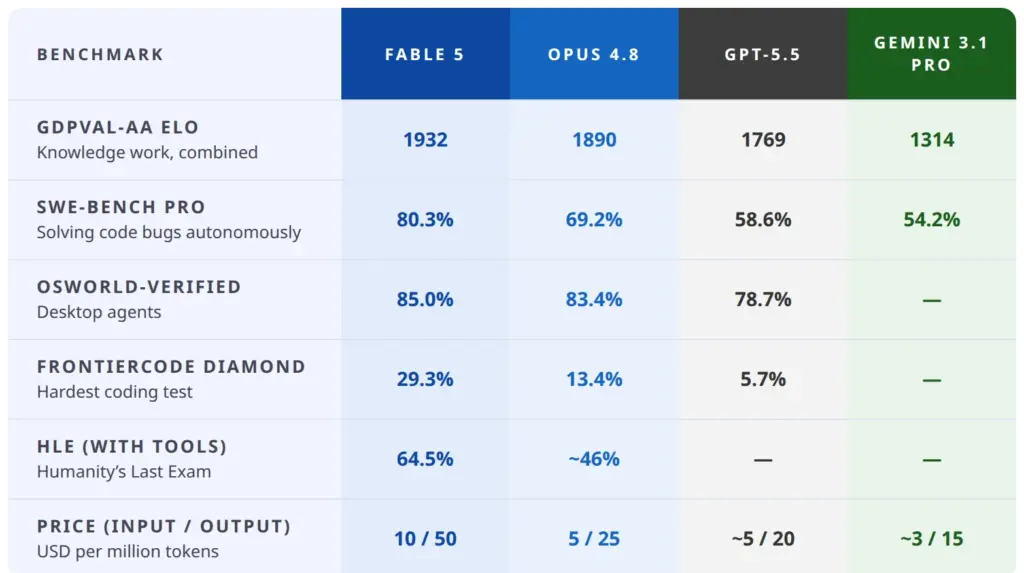
Analogous to chess (Elo), intelligence is measured on a scale. Fable 5 leads by an extreme margin. It is like comparing Albert Einstein with an average doctor of physics.
What follows from this?
The incident around Fable 5 and Mythos 5 shows that we are at a turning point. Governments are trying to exert control over technologies they barely understand technically. Companies are developing systems whose capabilities even they can only assess incompletely. Users worldwide rely on tools whose workings remain largely hidden from them.
In its statement, Anthropic made a legitimate demand: government intervention should be transparent, fair, technically sound and governed by the rule of law. That is the minimum standard.
Beyond that, we need as a society:
- Technological literacy: understanding how neural networks learn and why they make mistakes
- International agreements: as with nuclear weapons or bioweapons bans, global norms are needed for highly dangerous AI capabilities
- Open research: safety research on AI systems must remain publicly accessible. Secrecy does not protect systems, it only prevents the discovery of vulnerabilities
- Independent oversight: regulators that are technically competent and act independently of industry and government
Conclusion: the intelligence of the question
Artificial intelligence is neither magic nor a threat per se. It is a technology that arose from the same basic principles by which the human brain learns. It uses the same randomness that pervades our physical reality at the quantum level. It reflects the knowledge humanity has left behind in texts and data.
What it does depends on what we want to do with it.
The shutdown of Fable 5, and the simultaneous blocking of Mythos Preview, is perhaps the clearest sign so far: we have built tools so powerful that governments shut them down over national security concerns, and their creators publicly disagree. That is new. That is serious. And it demands not less but more: more knowledge, more transparency, more public debate.
The most important intelligence we need is not artificial. It is the ability to ask the right questions.
 My name is Klaus Meffert. I have a doctorate in computer science and have been working professionally and practically with information technology for over 30 years. I also work as an expert in IT & data protection. I achieve my results by looking at technology and law. This seems absolutely essential to me when it comes to digital data protection. My company, IT Logic GmbH, also offers consulting and development of optimized and secure AI solutions.