

In the US, Meta is accused of downloading books from shadow libraries via BitTorrent to train its language models. In 2025 a court found the training itself to be fair use; the question of the torrent upload is still open. This article sets out what is proven, what is merely alleged and how German and EU law assess such cases.
A company that has invested billions in artificial intelligence is said to have downloaded books from piracy archives. These allegations have been around since 2023. On the subject of Meta torrent AI training, the case has taken a technical turn that raises questions far beyond the US. Meta Platforms, the company behind Facebook, Instagram and the Llama language models, is a party to proceedings before a federal court in California. One part was decided in 2025; under the current schedule, another part will run until at least February 2027.
This is about allegations and pending proceedings, not about a judgment against the company. The differences between the plaintiffs' claims, the company's statements and actual findings of the court are therefore marked as precisely as possible. This article is not legal advice.
Meta, torrents and AI training: what the company is accused of
The case is called Kadrey v. Meta and is being heard before the United States District Court for the Northern District of California (case number 23-cv-03417-VC). The plaintiffs are authors, among them Richard Kadrey, Sarah Silverman and Christopher Golden. They accuse Meta of using their books without permission to train the Llama models. According to the plaintiffs, the books came from shadow libraries such as LibGen and Anna’s Archive.
A shadow library is an online archive that offers copyrighted books and papers for download without the permission of the rights holders. The operators are usually based abroad, and many countries fight these services with blocking orders or lawsuits. In Germany, too, access to LibGen has reportedly been made harder by a DNS block.
What the plaintiffs allege
According to the plaintiffs' filings, Meta obtained around 80.6 terabytes of data from LibGen and at least 81.7 terabytes from several shadow libraries in total. These are claims made by the plaintiffs. There is no court finding on these figures. In addition, internal messages have surfaced in the case files and were reported in the media, such as an employee's remark that he felt uneasy about downloading files via file sharing on a corporate laptop. Meta admitted to having used BitTorrent.
What Meta says
According to the reports, Meta argues that other ways of obtaining the data were too slow. For the torrent downloads, the settings were chosen so that as little as possible was uploaded, in other words as little as possible was “seeded”. Preventing uploads entirely was technically not possible, Meta says. Meta also denies that torrenting is unlawful as such and points out that there is no proof that third parties actually received the plaintiffs' works from Meta.
The distinction is important: the plaintiffs claim that Meta obtained and distributed pirated copies. Meta admits using BitTorrent but disputes the legal assessment and any upload to a relevant extent. So far, nothing has been decided by the court on distribution.
Torrent, seeding and leeching: why the upload can make the legal difference
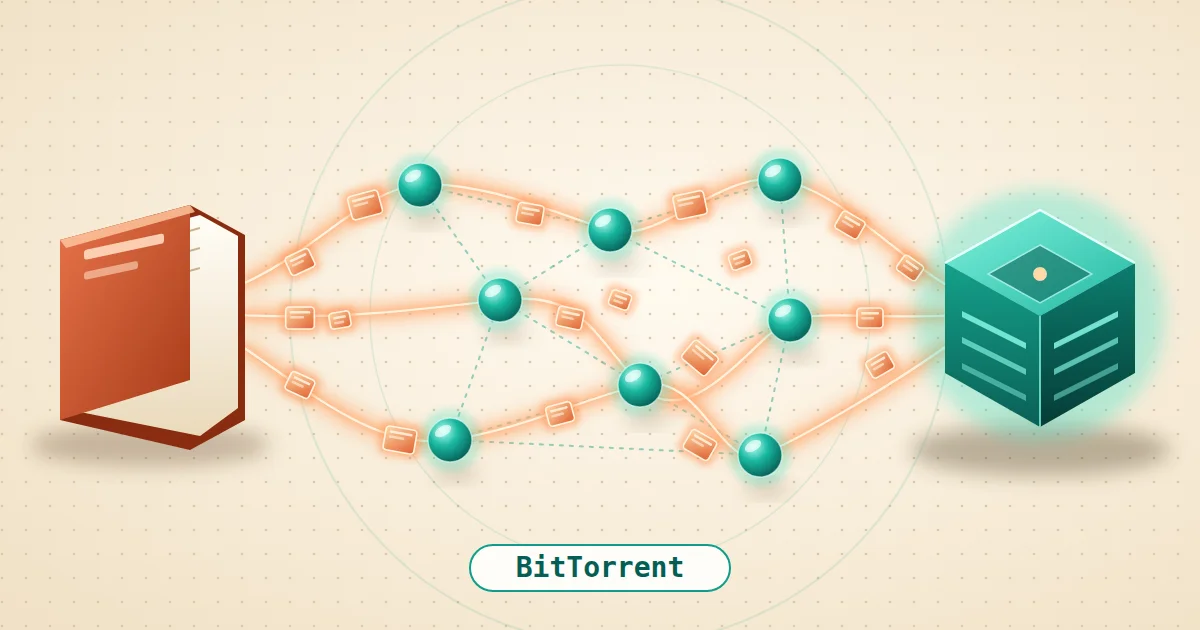
BitTorrent is a protocol for sharing large files. Instead of downloading a file from a single server, the file is split into many small pieces. Each participant downloads pieces from other participants and at the same time passes on the pieces it already has. This makes sharing fast, because many sources deliver at once.
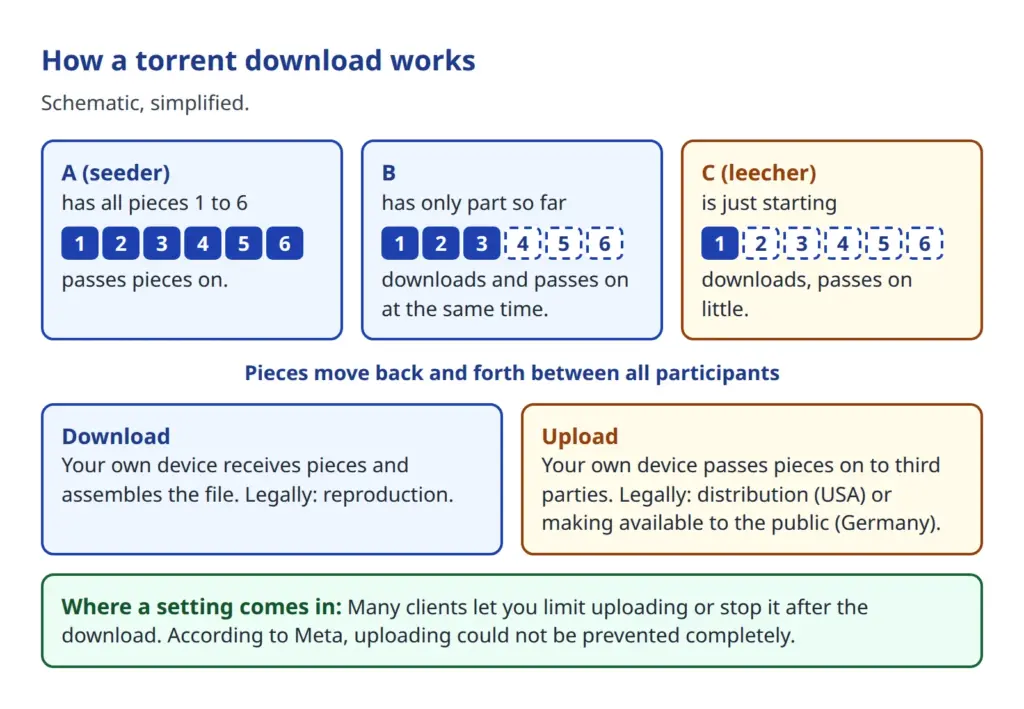
Two terms shape the debate. A seeder has the complete file and continues to make it available. A leecher is still downloading and usually passes on little or nothing. Seeding, i.e. making the file available on an ongoing basis, is no accident: the protocol is designed so that participants already hand pieces to others while downloading. Clients do, however, offer settings that limit uploading or stop it once the download is complete.
Why seeding matters in copyright law
The difference between download and upload is central to the legal assessment. Anyone who downloads a file reproduces it. Anyone who uploads pieces passes them on to third parties. In the US this is treated as distribution; in Germany as making available to the public. The two acts affect different rights of the authors.
That is why Meta relies on the argument that seeding has not been proven or took place only to a small extent. When it comes to seeding and copyright, log data is what counts: client logs and lists of connected peers are supposed to show whether and how much was uploaded. According to reports, this is exactly what discovery is about.
What the US court decided in 2025: training as fair use, torrenting open
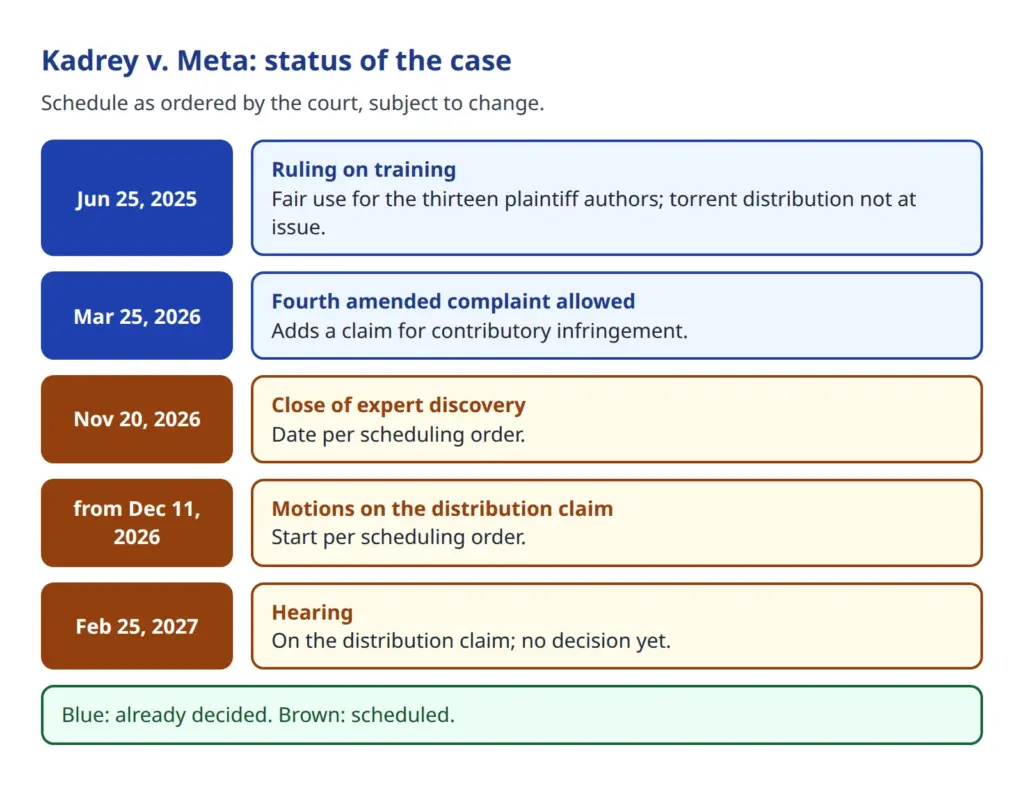
On June 25, 2025, Judge Vince Chhabria ruled in Kadrey v. Meta on a motion for summary judgment, i.e. a decision without a trial. The order went in Meta's favor, but only for training with the books of the thirteen plaintiff authors.
Fair use is a general clause in US copyright law. Courts weigh the individual case, considering among other things the purpose and character of the use, the nature of the work, the amount taken and the effect on the market for the original. The court regarded the purpose of training as highly transformative. The plaintiffs could not show market harm, either through verbatim reproduction of passages or through a lost licensing market.
No free pass for AI training
The court expressly stressed that the ruling is not a free pass for training on copyrighted works. It considered one argument potentially strong: market dilution. This means that AI models could generate a flood of similar works and thereby weaken the market for the originals. In this particular case that was not proven. No class was certified, so the decision applies only to the thirteen plaintiffs.
As to the data coming from shadow libraries, the court did not find that this automatically rules out fair use, but the source may play a role in the question of bad faith. Distribution via torrent was not part of the motion and remained open.
The fair use assessment of the training therefore says nothing about whether obtaining and possibly passing on the files was lawful. This is precisely the question being examined in the further proceedings. It is the core of the dispute in Kadrey v. Meta.
Status in 2026: distribution claim, contributory infringement and the February 2027 hearing
After the 2025 decision, part of the case remained: the claims relating to the distribution of the files via torrent. On March 25, 2026, Judge Chhabria, according to a published order, reluctantly allowed a fourth amended complaint. It adds a claim for contributory infringement, a form of secondary liability. In doing so, he criticized the conduct of the plaintiffs' counsel. He refused to extend discovery to the group of all potentially affected persons (class discovery).
According to a report on the order, the schedule provides that expert discovery closes on November 20, 2026, motions may be filed from December 11, 2026, and the hearing on the distribution claim takes place on February 25, 2027. In parallel, the related case Entrepreneur Media v. Meta is running with joint discovery. The dates may change. This article reflects the status as of October 22, 2026; no more recent decision is known.
Reports about new documents, such as records of torrenting or a LibGen dataset that a witness allegedly described as non-existent, are based on the plaintiffs' submissions. None of this is a finding of the court. Until a decision is made, the facts and the law remain open, and for Meta, as for any party, the allegations have to be proven.
Other cases: Strike 3 v. Meta and the Anthropic settlement
The case does not stand alone. In a second case, Strike 3 Holdings v. Meta (case number 25-cv-06213-EKL), a provider of adult films claims that the company downloaded and uploaded videos via BitTorrent to train a video model. On June 11, 2026, the court denied the motion to dismiss because the allegations had been plausibly pleaded. According to reports, Meta had argued that the few downloads pointed to private use by individuals rather than AI training. At the dismissal stage the court did not accept this. That is not a finding that the plaintiff's allegations are true. It only means that the case goes on.
Bartz v. Anthropic offers a counterpart. In June 2025, a US court found training on lawfully acquired books to be fair use, but not storing a library of pirated copies. Anthropic then agreed with the plaintiffs in September 2025 on a settlement of 1.5 billion US dollars.
Both cases suggest that with pirated copies for AI training, the central liability question is not the training itself but the acquisition and storage of the data.
Pirated copies for AI training under German and EU law: the text and data mining exception and lawful access
There is no fair use in Germany or the EU. Copyrighted works may only be used if the rights holder consents or a statutory exception permits it. For reading out large amounts of text, the law provides the exception for text and data mining. Under Section 44b of the German Copyright Act (UrhG), lawfully accessible works may be reproduced in order to extract information such as patterns, trends and correlations. This does not apply if the rights holder has reserved the use and, for works accessible online, has done so in machine-readable form.
For pirated copies, the decisive words are “lawfully accessible”. A shadow library offers works without the permission of the rights holders. It is therefore far-fetched to regard it as lawful access. This is an interpretation of the law that has not yet been settled by the highest courts. As things stand, there is no decision on it by the Federal Court of Justice (BGH).
May pirated copies be downloaded via torrent for AI training?
There is no fair use in Germany: what counts is whether a work was lawfully accessible.
Research exception and LAION
A second exception applies to scientific research. By its wording, Section 60d UrhG focuses on the purpose and organization of the research. The Hamburg Higher Regional Court ruled on December 10, 2025 in Kneschke (a German photographer) v. LAION (5 U 104/24). According to reports, the court upheld the lower court's ruling and found that a non-profit research association was privileged. The case concerned the creation of an image dataset, not pirated copies. Applying it to commercial training by large corporations is therefore not obvious. Whether Section 44b UrhG and the machine-readable reservation it requires also played a role is disputed in the legal literature. Incidentally, in Germany a reservation counts as machine-readable if it is present in the legal notice or terms and conditions of a website in a form that machines can read (for instance with the help of AI) – rather than in the robots.txt file, which every crawler would understand immediately.
USA and Germany compared
| Question | USA (fair use) | EU and Germany |
|---|---|---|
| Legal basis | General clause, case-by-case balancing | Narrow, individually defined exceptions |
| Training on works | Can be fair use, as in the Meta case (2025) for thirteen authors | Text and data mining under Section 44b UrhG, provided access is lawful and there is no machine-readable reservation |
| Role of the source | One factor in the balancing; bad faith can count | Lawful access is a prerequisite of the exception |
| Upload when torrenting | Distribution, open in the Meta case | Making available to the public under Section 19a UrhG |
| Ruling by the highest courts | Proceedings ongoing | None found so far on pirated copies and AI training |
US decisions are not binding on anyone in Germany. At most, they illustrate how courts reason.
Seeding in Germany: why the upload counts as making available to the public
Anyone who offers files via a file-sharing network makes them available to the public under Section 19a UrhG. In its judgment of December 6, 2017 (I ZR 186/16, “Konferenz der Tiere”), the Federal Court of Justice ruled that participants in a file-sharing network who offer file fragments for download can generally be liable as joint perpetrators. The court did not consider whether a complete work had been passed on. It is enough that parts are made available.
The purpose of the upload is generally irrelevant here. Training AI would therefore not be a free pass as a motive either. The BGH case, however, concerned film fragments and a private individual. Whether and how this could be applied to corporations and training datasets is a thought experiment and not a statement about Meta. As things stand, there is no German decision on torrents and AI training.
None of this changes the factual question of whether seeding actually took place in the US. That question is open there. The German standard merely shows why the upload in torrenting is regarded as a separate, serious issue.
GPAI Code of Practice and AI Act: what providers in the EU commit to regarding data sources
In Art. 53, the AI Act requires providers of general-purpose AI models (GPAI) to have, among other things, a policy to comply with copyright law. The GPAI Code of Practice, published by the Commission on July 10, 2025, describes what this can look like in practice. It is voluntary.
In the copyright chapter, signatories commit under measures 1.2 and 1.3, among other things, not to circumvent paywalls and access restrictions. They intend to exclude from crawling websites that EU courts or authorities have classified as persistently and commercially infringing copyright. In addition, machine-readable reservations of rights such as robots.txt are to be respected and the crawlers used are to be disclosed. The code is no substitute for a court ruling. Torrents and seeding are not expressly addressed in it.
What companies that only use AI services can take away from the case
Most companies do not train their own models but use services from providers. Even so, the origin of the training data is part of the supply chain. A provider facing liability issues can have consequences for its customers, for example in terms of availability, prices or contract terms. No documented case is known in which customers were held liable for a provider's copyright infringements. Caution is still advisable.
When choosing a provider, a few questions are worth asking:
- Which data sources were used for training, and is there a description of them?
- Is there a copyright policy, and are reservations of rights respected?
- What do the contract terms say about rights to the generated output and about indemnification?
According to reports, the Munich I Regional Court ruled on November 11, 2025 in GEMA v. OpenAI (42 O 14139/24) that memorization of song lyrics can constitute reproduction and that the text and data mining exception does not cover their output. There, the output counts, not the download. According to reports, the judgment is not final. Further open questions are pending before the Court of Justice of the European Union, for example in Like Company v. Google (C-250/25). As things stand, no judgment has been handed down in that case.
The reverse also applies: your own website can make you a rights holder. If you do not want your content to be read out for AI training, you should declare the reservation in machine-readable form, for example via robots.txt. The Dr. DSGVO website check examines such signals and the embedding of external services on your own site. For an overview of training with personal data in general, see AI training and the GDPR.
Whether the company's conduct will ultimately be judged to be copyright infringement will be decided in the course of 2027 at the earliest. Until then, the allegations remain allegations, and the fair use assessment concerns only the training.
 My name is Klaus Meffert. I have a doctorate in computer science and have been working professionally and practically with information technology for over 30 years. I also work as an expert in IT & data protection. I achieve my results by looking at technology and law. This seems absolutely essential to me when it comes to digital data protection. My company, IT Logic GmbH, also offers consulting and development of optimized and secure AI solutions.