
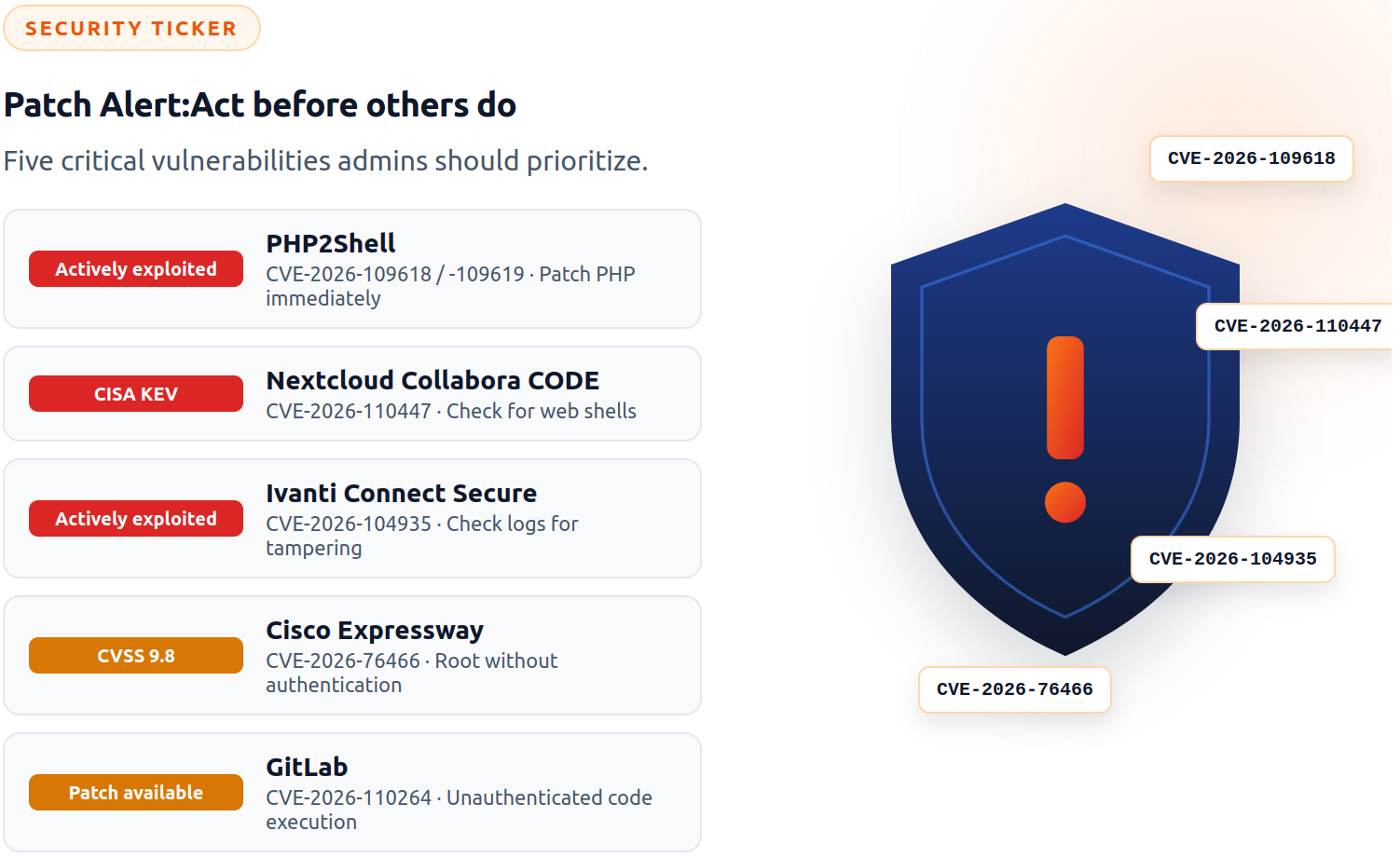
Current and resolved security advisories as well as available patches. In-depth analyses of selected topics are published on Dr. DSVO. As of: 26 Nov 2026.
Pinned
Azure API Management Classic: exploited flaw exposed secrets and API keys
Reported on 23 Nov 2026. Status: In progress
Through a flaw in Azure API Management Classic (Developer, Basic, Standard and Premium tiers; Consumption and v2 not affected), attackers were able to read named values, client secrets of identity providers, subscription keys and management API tokens until 19 Nov; according to the Norwegian authority NSM, energy companies were among those hit. Microsoft has closed the access path, but stolen credentials remain valid: affected customers rotate them immediately, check the systems and logs reachable with them and read notice MZK9-GH0 in Azure Service Health. NSM considers older runtime versions still vulnerable; version details are missing (unconfirmed).
VMware vCenter: authentication bypass CVE-2026-123890 exploited as a zero-day
Reported on 19 Nov 2026. Status: Patch available or all-clear. Update 25 Nov 2026: On 24 Nov, CVE-2026-123903 added a second critical login bypass in the same Directory Service; for vCenter 9.x the previous builds are no longer sufficient, details in the separate entry on VMSA-2026-0011.
CVE: CVE-2026-123890
A flaw in the VMware Directory Service of vCenter (CVSS 9.8) grants an admin session without authentication; according to Mandiant, a suspected Chinese group exploited it for two months before the patch, while Broadcom does not mention attacks. Update to vCenter 9.1.1.0200, 9.0.2.0200 or 8.0 U3m (for 7.0 only with an extended support contract), do not expose vCenter to the internet and check for new SSO admin accounts and backdoors.
N-able N-central: exploits for more than 30 flaws, new chain 4EverAble2Shell is being exploited
Reported on 9 Nov 2026. Status: Patch available or all-clear (17 Nov 2026). Update 19 Nov 2026: N-able requires agents and probes on 2026.4.1 HF3; after that, the Intune integration and Remote Control are blocked for the time being.
CVE: CVE-2026-125878, CVE-2026-125879, CVE-2026-125880, CVE-2026-125881, CVE-2026-125882, CVE-2026-125883, CVE-2026-91000, CVE-2026-90436
A researcher published exploits (“Able2Shell”) for more than 30 flaws in the remote management platform N-central; since 12 Nov the new chain “4EverAble2Shell” (including CVE-2026-90436) has been exploited, even on servers with hotfix 2026.4 HF2, at least 21 servers are compromised and a complete fix is missing. Keep the Legacy API and the Intune integration disabled, install HF2 including agents and probes and look for traces such as xvd.service or /tmp/.xvd; if you work with an IT service provider, ask whether they use N-central.
Source: https://www.heise.de/news/N-able-stopft-attackierte-Sicherheitslecks-in-N-central-11528739.html
PHP2Shell: critical PHP flaws are being actively exploited, install updates
Reported on 21 Oct 2026. Status: Patch available or all-clear (12 Nov 2026). Update 25 Nov 2026: Palo Alto reports that after breaking in via PHP2Shell on exposed PAN-OS management interfaces, attackers use the kernel flaw Fragnesia, and it provides fixes for this; check the exact versions in the advisory (versions stated here unconfirmed).
CVE: CVE-2026-109618, CVE-2026-109619
Emergency patches for the PHP flaws PHP2Shell (CVE-2026-109618/-109619) were released on 21 Oct 2026; on 26 Oct 2026 the first successful exploitation in the wild was reported (honeypot with Apache mod_php and PHP 8.4.26, incident dated 24 Oct according to the source). Admins should update PHP to the patched version immediately and deal with internet-facing servers first.
Source: https://security.paloaltonetworks.com/CVE-2026-109618
Ivanti Connect Secure: authentication bypass CVE-2026-104935 is being actively exploited
Reported on 13 Oct 2026. Status: Patch available or all-clear (12 Nov 2026). Update 12 Nov 2026: According to Volexity, the group UTA0576 has been using the vulnerability chain since at least 3 Oct without a web shell and with manipulated logs, so Ivanti's Integrity Checker Tool finds nothing; after the update, therefore change credentials and check access by other means.
CVE: CVE-2026-104935, CVE-2026-111357, CVE-2026-118527
Attackers chain the flaw with other vulnerabilities to achieve root code execution, according to reports since at least 1 October (Volexity says 3 October); since 30 Oct, CISA has also listed the privilege escalations CVE-2026-111357 and CVE-2026-118527 as actively exploited. According to reports, only 25.1.1.3 and 22.8R2.6 close the entire chain (Ivanti advisory not checked directly), so update already patched systems again as well. Check logs for manipulation and do not rely on the Integrity Checker as the sole evidence.
SonicWall SonicOS: SSL VPN flaw CVE-2026-19868 bypasses SAML login and MFA, being exploited
Reported on 6 Nov 2026. Status: Patch available or all-clear (12 Nov 2026). Update 12 Nov 2026: Status set to resolved because SonicOS 7.3.4-7013 (Gen7) and 8.2.3-8015 (Gen8) close the flaw; the CISA deadline expires on 20 Nov, exploitation continues.
CVE: CVE-2026-19868, CVE-2026-107155, CVE-2026-107154, CVE-2026-82308, CVE-2026-77708, CVE-2026-77709, CVE-2026-19703
With SSL VPN using SAML login, an attacker with valid credentials for another login method can bypass the login including the MFA enforced via SAML (CVE-2026-19868, CVSS 7.1); CISA has listed the flaw as actively exploited since 6 Nov, and advisory SNWLID-2026-0014 names six further flaws. Update Gen7 to SonicOS 7.3.4-7013 and Gen8 to 8.2.3-8015; until then, according to SonicWall, disable all LDAP, RADIUS and TACACS+ servers in authentication and check the VPN logins of recent weeks for anomalies.
Source: https://psirt.global.sonicwall.com/vuln-detail/SNWLID-2026-0014
Check Point: attackers chain PHP2Shell with root flaw CVE-2026-123039 on gateways
Reported on 12 Nov 2026. Status: Patch available or all-clear. Update 17 Nov 2026: CISA added CVE-2026-123039 to the KEV catalog on 13 Nov; as traces, Check Point names the TSGA backdoor (slot_CPconfigdaemon, /lib/libcpfwcommon.so) and SSH access with the vpxuser account on ESXi hosts.
CVE: CVE-2026-123039, CVE-2026-109618, CVE-2026-109619
Since 30 Oct, attackers have been breaking into the Mobile Access portal of Check Point gateways via the PHP2Shell flaws, gaining root privileges through the local flaw CVE-2026-123039 in DynamicCLI and installing backdoors, in one case also a wiper for ESXi. R81 to R82.20 are affected; the November Jumbo Hotfix closes both flaws, the PHP2Shell hotfix of 23 Oct alone is not enough, and for R81 and R81.10 the only option is to stop the dynamic_server process. Because an update does not remove existing backdoors, also check the gateways against Check Point's IoCs.
Source: https://research.checkpoint.com/2026/php2shell-exploitation-on-check-point-gateway/
ConnectWise ScreenConnect: attackers distribute third-party remote access clients via service provider instances
Reported on 11 Nov 2026. Status: In progress. Update 24 Nov 2026: According to Huntress (23 Nov), CVE-2026-84869 was actually exploited on 12 Nov on the computer of an MSP technician, after attackers had broadly scanned ScreenConnect servers since 20 Oct; bring technician clients to 26.6.5 or later and, where that is not possible, revoke the TransferFiles permission.
CVE: CVE-2026-84869, CVE-2026-127063
Unapproved remote access software was installed on customer computers via ScreenConnect instances of IT service providers; the third-party extension RMM+ is considered the entry point, and ConnectWise has disabled five such extensions in around 400 environments. Operators leave these extensions off, bring ScreenConnect and technician clients to at least 26.6.5, secure logs, end sessions and reset credentials with MFA; customers ask their service provider whether they are affected.
Source: https://thehackernews.com/2026/11/hackers-exploit-critical-screenconnect.html
Mittwald: breach via MCP server, customer session tokens read
Reported on 9 Nov 2026. Status: In progress. Update 19 Nov 2026: According to the status page, the agency forum and Agentur Hub are available again; the AV-Manager is still partially restricted.
Attackers broke in via the MCP server of the web host Mittwald, read customer session tokens according to Mittwald and used them to reach 56 projects; in the night before 12 Nov, SSH, mStudio and the customer center failed again, while hosted websites kept running. Anyone who used the MCP server changes their mStudio password, enables 2FA, checks API keys, SSH keys and SSH users and renews the credentials for databases, mail and external APIs stored in projects.
Source: https://www.mittwald-status.de/
Current advisories
1Password: breach via an employee's GitHub account, customer administrative data stolen
Reported on 25 Nov 2026. Status: In progress
Via an employee's hijacked GitHub account, attackers injected code into 1Password backend services and obtained administrative data of some customers, including names, email addresses, account IDs and tokens from individual invitation and recovery emails; according to 1Password, vault contents, account passwords, Secret Keys and Recovery Keys were not affected. According to 1Password, no action is needed in your own account, but staff should expect targeted phishing around invitations and account recovery and never hand over their password or Secret Key.
Source: https://1password.com/blog/update-on-nov-2026-security-incident
Deichmann: unauthorized access to customer data from the online shop
Reported on 25 Nov 2026. Status: In progress
Unauthorized parties accessed names, billing and delivery addresses, invoices, email addresses, phone numbers and the chosen payment method of customers of the Deichmann online shop; according to the company, passwords and actual payment data are not affected and the gap has been closed. Affected customers are being informed by email and should expect phishing that uses real order data, such as allegedly changed bank details.
Source: https://www.heise.de/news/Deichmann-Online-Shop-geknackt-unbefugter-Datenzugriff-11537484.html
Windows: November updates disrupt NTLM logins via proxies and SSO products
Reported on 25 Nov 2026. Status: Open
CVE: CVE-2026-118737
The November updates close the RPC flaw CVE-2026-118737 and, in a first stage, enforce NTLM signing (KB5135557), which can cause logins via authentication proxies, SSO products and packaging tools with faulty NTLM implementations to fail; there is no fix yet, and from May 2027 signing is to become mandatory on the server side. Because of the closed flaw, the updates should stay installed; in case of problems, use the workaround described by Microsoft and move affected applications to Kerberos or vendor updates.
Mitel MiCollab: five flaws in the AWV conferencing component are being exploited, CISA watchlist
Reported on 25 Nov 2026. Status: Patch available or all-clear
CVE: CVE-2026-133323, CVE-2026-133303, CVE-2026-133275, CVE-2026-133311, CVE-2026-133324
MiCollab up to 10.3.0.18 contains five flaws in its audio, web and video conferencing component AWV, including a command injection with CVSS 10; CISA has listed all five as exploited since 25 Nov, while Mitel itself does not comment on attacks. Install the patch for 10.3.0.18 or a newer version according to MISA-2026-0012 and do not expose AWV freely to the internet.
Source: https://www.mitel.com/support/security-advisories/mitel-product-security-advisory-misa-2026-0012
VMware vCenter and ESX: 23 flaws, including a new login bypass with CVSS 9.8, install updates
Reported on 24 Nov 2026. Status: In progress
CVE: CVE-2026-123903, CVE-2026-123910, CVE-2026-123911, CVE-2026-123912
With VMSA-2026-0011, Broadcom closes another login bypass in the vCenter Directory Service (CVE-2026-123903, CVSS 9.8), two network-exploitable ESX flaws allowing code execution on the host, and a USB controller flaw through which a VM admin executes code in the VMX process (on ESX within the sandbox); Broadcom does not mention attacks. Update vCenter to 8.0 U3m, 9.0.2.0300 or 9.1.2, ESXi to 8.0 U3m, 9.0.2.0200 or 9.1.2.0 and VMware Tools to 13.1.10.0 or 12.5.6.0. Patches for two of the flaws are still missing for ESX 9.0.
Firefox 161 and Thunderbird: 110 flaws closed, update browser and mail client
Reported on 24 Nov 2026. Status: Patch available or all-clear
In Firefox 161, Mozilla fixes a total of 110 flaws, 59 of them of high severity, including several sandbox escapes; no attacks have been reported. Update to Firefox 161, Firefox ESR to 153.8 or 115.46 and Thunderbird to 161 or 153.8 (versions unconfirmed, check the respective advisories), and roll the update out centrally to company computers.
Source: https://www.mozilla.org/en-US/security/advisories/mfsa2026-131/
Radware Cloud WAF: breach exposes credentials for log export, rotate keys
Reported on 24 Nov 2026. Status: In progress
According to BleepingComputer, from 19 Nov attackers used an unprotected internal API of Radware Cloud WAF to reach customer contact data and, for some customers, credentials for log export to AWS S3, Azure Blob or SFTP; the information is based on a non-public document and is unconfirmed. Customers should rotate the export credentials immediately and check the access logs of their storage from 19 Nov onward.
Zstandard: streaming decompression flaw leaks memory contents, update to 1.6.0
Reported on 24 Nov 2026. Status: Patch available or all-clear
CVE: CVE-2026-124851
zstd before 1.6.0 (according to reports 1.5.1 to 1.5.7, unconfirmed) can output remnants of earlier decompression runs from a 64 KiB buffer when stream-decompressing crafted data, which mainly affects services that decompress uploaded files and return the result; no attacks are known. Update to zstd 1.6.0 or the fixed packages of your distribution.
Source: https://github.com/facebook/zstd/releases/tag/v1.6.0
Ghostscript “Upload2Shell”: crafted images and PDFs execute code, update to 10.08.0
Reported on 23 Nov 2026. Status: In progress
CVE: CVE-2026-125396
A memory error when loading Type 1 fonts breaks the -dSAFER sandbox, so that a crafted PostScript or PDF file executes commands, even when uploaded as an image and processed via ImageMagick, for example; according to the discoverers, affected software includes CUPS, Roundcube and WordPress plugins. Update Ghostscript to 10.08.0, including bundled copies in containers and applications, and install distribution updates, some of which are still missing; until then, restrict file types for uploads and share print queues only with authentication. No attacks are known.
Source: https://www.heise.de/news/Upload2Shell-Ghostscript-Luecke-betrifft-viele-Systeme-11534768.html
ASP.NET library Idunno.AntiCsrf: flaw CVE-2026-131914 is being exploited, no patch
Reported on 23 Nov 2026. Status: Open. Update 25 Nov 2026: CISA added CVE-2026-131914 to the catalog of exploited vulnerabilities on 24 Nov, and watchTowr reported attack attempts with .NET payloads on honeypots the same day; without a patch, remove the library or isolate the affected endpoints.
CVE: CVE-2026-131914
The library Idunno.AntiCsrf (0.9.1.0 and 0.9.1 Beta), unmaintained since 2008, allows unauthenticated code execution in the IIS process via a crafted POST request; according to Mandiant, this is already being exploited. There will be no patch: search Web.config files and bin directories for Idunno.AntiCsrf or AntiCsrfModule, switch to ASP.NET's antiforgery protection and, if compromised, renew all keys and credentials from the configuration.
Source: https://thehackernews.com/2026/11/hackers-exploit-critical-aspnet-anti.html
Check Point Security Management: GT13 campaign takes over management servers, including in Germany
Reported on 23 Nov 2026. Status: Patch available or all-clear
CVE: CVE-2026-16232
According to GreyNoise, the group GT13 compromised at least 24 Check Point management servers in 17 countries, including Germany, between 17 Oct and 2 Nov via the login bypass CVE-2026-16232 (patched since July, unconfirmed) and stole the firewall database, the internal CA and credentials. Install the Jumbo Hotfix according to sk185169 (unconfirmed), restrict Trusted Clients to known addresses and check the servers against the published indicators; in case of a hit, renew CA material and all credentials.
Source: https://www.greynoise.io/blog/check-point-security-management-servers-intrusion-campaign
WHMCS: unauthenticated SQL injection exposes customer data and admin hashes, update immediately
Reported on 23 Nov 2026. Status: Patch available or all-clear
CVE: CVE-2026-82981, CVE-2026-82979, CVE-2026-93700
Via the WHMCS shopping cart, customer and support data as well as admin accounts including password hashes can be read without authentication; another flaw (CVE-2026-93700) is said to allow logged-in customers to execute code (unconfirmed). Update self-hosted installations to 9.1.2 or 9.0.10 and then change admin passwords; according to reports, WHMCS Cloud is updated automatically (unconfirmed), and WHMCS does not report any attacks.
Source: https://help.whmcs.com/m/125386/l/2151347-cve-2026-82981-whmcs-security-update-2026-11-23
SAP NetWeaver Enterprise Portal: JNDI flaw CVE-2025-42884 is being exploited, patch available since November 2025
Reported on 23 Nov 2026. Status: Patch available or all-clear
CVE: CVE-2025-42884
Via the JNDI injection CVE-2025-42884 (CVSS 6.5), unauthenticated attackers can manipulate lookups in the NetWeaver Enterprise Portal and obtain or alter information; heise reports ongoing attacks, and CISA has listed the flaw as exploited since 20 Nov. Check whether the patch from SAP's November 2025 Patch Day is installed, and otherwise update the portal immediately.
Source: https://www.heise.de/news/Warnung-vor-Angriffen-auf-Cisco-Expressway-und-SAP-NetWeaver-11534049.html
N-able Mail Assure and SpamExperts: breach of hosting server, API tokens reset
Reported on 22 Nov 2026. Status: In progress. Update 25 Nov 2026: CISA has listed CVE-2026-134624 in the catalog of exploited vulnerabilities since 23 Nov.
CVE: CVE-2026-134624
Attackers broke into a server of the hosted Mail Assure and SpamExperts platform; N-able has so far found no evidence of stolen customer data, the entry point is unconfirmed and the investigation is ongoing. N-able has revoked API and OAuth tokens and reset local passwords, so partners need to store new credentials in scripts and integrations. The SSRF flaw CVE-2026-134624, published at the same time, is fixed as of build 20261121.1943; operators of SpamExperts Local Cloud check their version.
Source: https://thehackernews.com/2026/11/n-able-confirms-hackers-accessed-cloud.html
PHP flaw CVE-2026-115560 in upload progress closed, install the updates of 19 Nov
Reported on 23 Oct 2026. Status: Patch available or all-clear (20 Nov 2026). Update 25 Nov 2026: According to SecurityWeek (23 Nov), the updates of 19 Nov also close “phpAfterShell” (CVE-2026-126714, CVSS 9.2), which reopens the PHP2Shell attack path; PHP 8.5.13, 8.4.28, 8.3.37 and 8.2.36 are protected, no attacks are known.
CVE: CVE-2026-115560, CVE-2026-126714
On 23 Oct 2026, PHP warned of another code execution flaw, exploitable only with an unusual combination (session.serialize_handler switched to php at runtime, upload progress enabled). Since 19 Nov, PHP 8.2.36, 8.3.37, 8.4.28 and 8.5.13 close the flaw; update to these versions or the distribution packages, and keep session.upload_progress.enabled=0 until then.
Cisco: 15 advisories, three critical, including Expressway CVE-2026-76466 (CVSS 9.8)
Reported on 23 Oct 2026. Status: Patch available or all-clear (20 Nov 2026). Update 25 Nov 2026: heise mentions a possible trace of successful attacks in the file erlang.log (unconfirmed, not checked against the Cisco advisory); the indicators in the vendor's advisory are authoritative.
CVE: CVE-2026-76466
Cisco closes an unauthenticated root code execution flaw in Expressway (CVSS 9.8), plus critical flaws in Unified Communications and Snort 3. Update Expressway to X15.5.20 or later and Unified Communications to 15SU5, and migrate older branches. According to Cisco, no attacks are known.
Source: https://www.securityweek.com/hackers-exploit-cisco-expressway-vulnerability-soon-after-poc-release/
GL.iNet: flaw in cloud remote management exploited, malware on routers and KVM devices
Reported on 20 Nov 2026. Status: In progress. Update 25 Nov 2026: In the notice updated on 23 Nov, GL.iNet names as the cause a misconfigured authorization in the MQTT service of the GoodCloud remote management, through which other parties' devices could receive commands; CVE numbers have been requested, and two further flaws affect AstroWarp/SD-WAN and RTTY.
Through a now closed flaw in GL.iNet's cloud remote management, attackers placed malware on routers and KVM-over-IP devices; devices that are already infected remain infected. Install the current stable firmware, which also removes the malware (according to the vendor, including GL-MT3000/MT6000 from 4.11.1, GL-BE3600/BE9300 from 4.10.2, KVM RM1/RM10 from 1.10.3), and check the connected computers on infected KVM devices.
Source: https://www.gl-inet.com/de-de/blogs/blog/glinet-security-notice-2026-11-20
Microsoft Entra Connect Health: exploited API flaw exposed admin addresses and tenant data
Reported on 20 Nov 2026. Status: Patch available or all-clear
Through a flaw in the Connect Health API, present since 23 Jul according to Microsoft and fixed server-side on 19 Nov, attackers were able to read tenant metadata such as admin email addresses, tenant IDs and sync status; according to Microsoft, passwords and tokens were not affected. Look for the notification in Azure Service Health, warn admins about targeted phishing and enforce phishing-resistant MFA for privileged accounts.
GnuPG: critical GPGME flaw via crafted OpenPGP keys, install Gpg4win 5.1.2
Reported on 20 Nov 2026. Status: Patch available or all-clear
CVE: CVE-2026-129975
A double free in GPGME before 2.3.0, triggered by a key with a very long user ID, can leak data from applications, and the developers do not rule out code execution; affected software includes Gpg4win, GnuPG Desktop, mail programs with OpenPGP and Samba. Update to GPGME 2.3.1 or Gpg4win 5.1.2 and install the vendor updates for programs with built-in GPGME.
Source: https://lists.gnupg.org/pipermail/gnupg-announce/2026q4/000517.html
Cleverbridge: attackers copied credit card data from software purchases
Reported on 20 Nov 2026. Status: In progress. Update 24 Nov 2026: In its FAQ, Cleverbridge confirms that in a minority of cases the security code was copied as well, and has been notifying affected customers since 20 Nov.
The Cologne-based payment provider, through which many software vendors sell licenses, discovered unauthorized access on 4 Nov in which credit card data was copied, in a smaller share of cases including the security code; Cleverbridge does not state the number of people affected. Anyone who paid for software via Cleverbridge checks their card statements, has the card replaced by the issuer and expects targeted phishing.
Source: https://grow.cleverbridge.com/incident-update
AI inference providers: credentials harvested from prompts, OpenRouter removes three providers
Reported on 20 Nov 2026. Status: In progress. Update 25 Nov 2026: According to The Hacker News (22 Nov), several providers have since disclosed their own incidents, including Phala (access to an inference server, contained on 8 Nov) and Together AI (prompt samples from June and July retrieved via a leaked credential); which three providers OpenRouter removed remains unclear.
Using decoy credentials in around two million prompts, Dragos demonstrated data theft at three unnamed inference providers, even for requests with guaranteed non-retention. OpenRouter then removed three providers and withdrew the non-retention rating from 125 endpoints. Anyone using AI models via routers or marketplaces keeps secrets out of prompts and rotates keys that have already been sent.
Source: https://thehackernews.com/2026/11/openrouter-drops-3-providers-after.html
Windows “FastUnlock”: launching programs on a locked PC, no patch yet
Reported on 20 Nov 2026. Status: Open
A publicly described trick using Narrator and account recovery on the lock screen launches programs under a restricted account without logging in; it requires physical access and a Microsoft account, and the affected versions are unconfirmed. Until a patch is available, do not leave laptops unattended, set a BitLocker startup PIN and shut devices down or put them into hibernation instead of just locking them.
Source: https://thehackernews.com/2026/11/new-unpatched-windows-0-day-fastunlock.html
ruby2ßhell: critical Ruby flaw via the character ß, update to 3.3.14, 3.4.13 or 4.0.10
Reported on 19 Nov 2026. Status: Patch available or all-clear. Update 23 Nov 2026: The flaw has been assigned CVE-2026-132825; the Ruby advisory of 18 Nov covers seven flaws in Regexp and String, and since 20 Nov GitLab has shipped versions 19.6.1, 19.5.8 and 19.4.10 with fixed Ruby; no attacks are known.
CVE: CVE-2026-132825
When Ruby applications using ISO-8859 or Windows-125x encoding convert crafted text containing ß to uppercase, Ruby writes beyond the buffer, a starting point for code execution; UTF-8 is not affected, and GitLab and Mastodon, for example, are at risk. Update Ruby itself to 3.3.14, 3.4.13 or 4.0.10 (a gem update is not enough), restart running processes and install the application updates, such as GitLab 19.6.1, 19.5.8 or 19.4.10.
Source: https://www.ruby-lang.org/en/news/2026/11/18/multiple-vulnerabilities-in-regexp-and-string/
Ubiquiti UniFi Access: seven flaws, five critical, update to 4.3.24
Reported on 19 Nov 2026. Status: Patch available or all-clear
CVE: CVE-2026-132802, CVE-2026-132803, CVE-2026-132804, CVE-2026-132805, CVE-2026-132806, CVE-2026-132807, CVE-2026-132808
In the access control application UniFi Access up to 4.3.22, attackers with network access and low privileges can, among other things, execute code as root on the host, plus SQL injection and SSRF; no attacks are known. Update to 4.3.24 or later and do not expose the application to the internet.
Spring: numerous flaws in Security, Boot, LDAP and Spring AI, two critical
Reported on 19 Nov 2026. Status: Patch available or all-clear
CVE: CVE-2026-59367, CVE-2026-59411, CVE-2026-59273
Critical are a test server in Spring LDAP that listens on all interfaces with built-in admin access (CVE-2026-59367), and Spring Boot on Cloud Foundry with Actuator, where the default protection is switched off (CVE-2026-59411); for a flaw in Spring Security (CVE-2026-59273) there is a public exploit approach, no attacks are known. Update to Spring Boot 4.1.3 or 4.0.10, Spring Security 7.1.3 or 7.0.9 and Spring LDAP 4.1.3 or 4.0.7; fixes for older branches are only available with enterprise support.
Source: https://spring.io/security
Hugendubel, eBook.de and Tolino cloud: cyberattack disrupts shop and eBook downloads
Reported on 19 Nov 2026. Status: In progress
After a cyberattack in the night before 19 Nov, the Hugendubel online shop, eBook.de and parts of the Tolino cloud are disrupted; according to the company's preliminary statement, personal data is not affected. Customers should watch out for phishing in the name of Hugendubel, eBook.de or Tolino and, as a precaution, change passwords they reuse elsewhere.
Northflank: breach at cloud platform, customers' AI API keys misused
Reported on 30 Oct 2026. Status: Patch available or all-clear (18 Nov 2026). Update 18 Nov 2026: Northflank closed the incident on 17 Nov: attackers used a flaw in the Northflank API that was closed on 30 Oct, 1.5% of customer teams were affected and all Northflank API tokens were revoked; customers should nevertheless rotate all stored secrets with the respective provider and check their AI billing.
After a breach at the host Northflank, customers' AI API keys were used without authorization; Northflank advises assuming that all environment variables were decrypted. How the attackers got in is unclear. Customers should rotate all keys, secrets and database credentials, disable public access to add-ons and check usage and billing with their AI providers.
Source: https://northflank.com/blog/incident-report-october-30-security-incident
Drupal core: critical flaw in the installer, update to 11.4.13, 11.3.22 or 10.6.22
Reported on 16 Nov 2026. Status: Patch available or all-clear (18 Nov 2026). Update 25 Nov 2026: CISA has listed the installer flaw CVE-2026-132165 in the catalog of exploited vulnerabilities since 24 Nov; anyone who has not yet updated to 11.4.13, 11.3.22 or 10.6.22 should do so immediately and block external access to install.php.
CVE: CVE-2026-132165, CVE-2026-132166
Via the installer install.php, attackers can, under certain configurations, reinstall Drupal and thus take over the website (SA-CORE-2026-017, CVE-2026-132165); in addition there is a gadget chain that is not directly exploitable (SA-CORE-2026-018, CVE-2026-132166). Update immediately to 11.4.13, 11.3.22 or 10.6.22 and keep settings.php write-protected. The 11.2.x and 10.5.x branches and older no longer receive fixes.
Source: https://www.drupal.org/sa-core-2026-017
nginx: ten flaws closed, update to 1.30.7 or 1.31.9
Reported on 18 Nov 2026. Status: Patch available or all-clear. Update 25 Nov 2026: Palo Alto reports that PAN-OS 11.2 and 12.x as well as Panorama with HTTP/2 enabled are affected by CVE-2026-123633 and CVE-2026-123007; install the fixed versions according to the advisory or disable HTTP/2 until then.
CVE: CVE-2026-113425, CVE-2026-118899, CVE-2026-120967, CVE-2026-120993, CVE-2026-121810, CVE-2026-123007, CVE-2026-123633, CVE-2026-123634, CVE-2026-123640, CVE-2026-125283
F5 closes ten flaws in nginx, three of them rated high, including use-after-free errors in HTTP/2, HTTP/3, the resolver and the mail proxy; no attacks are known, and whether code execution is possible is unconfirmed. Update to nginx 1.30.7 (stable) or 1.31.9 (mainline), update distribution packages as soon as they appear, and update nginx Plus according to the F5 advisories.
Source: https://www.securityweek.com/f5-patches-critical-nginx2root-flaws-as-poc-exploits-go-public/
WordPress 7.1.5: security update closes 18 flaws, including SQL injection and privilege escalation
Reported on 18 Nov 2026. Status: Patch available or all-clear
WordPress 7.1.5 fixes, among other things, eight XSS flaws, two SQL injections, two privilege escalations and an unauthenticated DoS via XML-RPC pingbacks; the fixes are being backported to older maintained branches. Update immediately and check whether the automatic background update actually took effect.
Source: https://wordpress.org/news/2026/11/wordpress-7-1-5-release/
Office Partner: customer data leaked at service provider, change passwords
Reported on 18 Nov 2026. Status: In progress
At the office supplier Office Partner, unknown parties accessed names, addresses, phone numbers, invoices, email addresses and encrypted passwords via an external service provider from 7 Nov, but not payment data; the number of people affected is unclear. Customers change their password, including wherever it was reused, and expect targeted phishing and fake invoices.
Source: https://www.heise.de/news/Datenlecks-bei-Bueroausstatter-Office-Partner-und-DHL-Group-11529484.html
SonicWall: Gen6 firewalls no longer receive security patches, vendor advises replacement
Reported on 18 Nov 2026. Status: Open
SonicWall no longer ships patches for Gen6 and Gen6.5 (including TZ300 to TZ600, SOHO 250, NSA/NSa, NSv with SonicOS 6.x), not even for critical flaws, and rates every device still in operation as high risk. Replace devices with current models; until then, disable management via WAN, restrict SSL VPN to known addresses, enforce MFA and reset local passwords.
F5 BIG-IP: hotfixes for six critical flaws in TMM, unauthenticated code execution possible
Reported on 18 Nov 2026. Status: Patch available or all-clear
CVE: CVE-2026-123637, CVE-2026-121805, CVE-2026-120292, CVE-2026-120285, CVE-2026-116953, CVE-2026-120722, CVE-2026-126822
Six stack overflows in TMM, triggered via APM policies and certain iRule commands, crash TMM without authentication and, according to F5, may allow code execution; in addition there are SAML flaws in APM that also crash TMM. No attacks are known. For the critical flaws there is no remedy other than F5's engineering hotfixes (overview in K000164058), which should be installed promptly.
Source: https://thehackernews.com/2026/11/f5-warns-6-critical-big-ip-flaws-can.html
TPM lockout bypassed: Windows Hello and BitLocker PINs crackable with physical access
Reported on 18 Nov 2026. Status: Open
CVE: CVE-2026-43613
With physical access, researchers at TU Berlin reset the TPM's failed attempt counter via the flash chip and were thus able in the lab to guess four- to six-digit Hello and BitLocker PINs in minutes to hours. AMD plans firmware fixes by February 2027 (CVE-2026-43613); for affected Intel PCs with Winbond flash and from Microsoft there is no fix. Require longer PINs for Windows Hello for Business and BitLocker via policy and install AMD firmware as soon as it is released.
Source: https://thehackernews.com/2026/11/flash-chip-attack-bypasses-tpm-lockout.html
Java4Shell: critical flaw in the Base64 decoder of Java 17 to 27, Oracle ships updates
Reported on 17 Nov 2026. Status: In progress. Update 23 Nov 2026: Since 18 Nov, Red Hat has shipped fixed portable OpenJDK builds (e.g. RHSA-2026:100565 with OpenJDK 17.0.21.1), which close seven further Java flaws besides Java4Shell; Java4Shell is not yet in the CISA catalog of exploited vulnerabilities.
CVE: CVE-2026-114938
A memory error in Java's AVX-512-accelerated Base64 decoder can lead to code execution on servers with AVX-512 VBMI (Intel Xeon from Ice Lake, AMD from Zen 4); according to the discoverer, applications such as Jira, Confluence, Keycloak and Jenkins are partly attackable without authentication, no attacks are known. Bring Oracle Java SE to 17.0.21.1, 21.0.13.1, 25.0.5.1 or 27.0.1.1, update other OpenJDK builds according to vendor information (some had no fix yet) and also check embedded runtimes; where no build is available yet, start the JVM with -XX:-UseBASE64Intrinsics.
Source: https://thehackernews.com/2026/11/java4shell-cve-2026-114938-enables-pre.html
TYPO3: critical flaw allows reopening the installer (CVE-2026-119623)
Reported on 17 Nov 2026. Status: Patch available or all-clear
CVE: CVE-2026-119623
TYPO3 closes a critical flaw in the installer: a placed FIRST_INSTALL marker file reopens it without authentication, allowing attackers to create admin accounts. Update to 14.3.12 or 13.4.40 LTS (ELTS 12.4.52, 11.5.57, 10.4.63) and then search the web and project directory for FIRST_INSTALL files and the admin accounts for unknown entries.
Source: https://news.typo3.com/security/advisory/typo3-core-sa-2026-027
Chrome 158: Google closes 204 security flaws, six of them critical
Reported on 17 Nov 2026. Status: Patch available or all-clear
CVE: CVE-2026-130963, CVE-2026-131031, CVE-2026-131060, CVE-2026-131008, CVE-2026-131054, CVE-2026-130975
Chrome 158.0.8127.36 (Windows and Mac also .37) fixes 204 security issues, including six critical memory errors, for example in GPU, ANGLE and WebAudio; no exploitation has been reported. Roll out the update on company computers, force a browser restart and update Edge and other Chromium browsers as well.
Source: https://chromereleases.googleblog.com/2026/11/stable-channel-update-for-desktop_01699533288.html
Microsoft Agent Framework: tampered PyPI versions 1.26.1 and 1.26.2 steal credentials
Reported on 17 Nov 2026. Status: In progress. Update 23 Nov 2026: On 18 Nov, Microsoft confirmed to The Register that it had set some repositories to private during the investigation; Microsoft does not name the entry point.
Two malicious versions of the PyPI package agent-framework ran on every Python start and sent cloud, CI and AI credentials to webhook.site; how the attackers obtained publishing rights remains unconfirmed. Anyone who had 1.26.1 or 1.26.2 installed rebuilds the environment with 1.26.0 and rotates all reachable secrets. Signs of compromise are the files agent_framework_meta.pth or af_runtime_diag.pth and connections to webhook.site.
Puppet Enterprise and Puppet Core: code execution via reports is being exploited, CISA watchlist
Reported on 17 Nov 2026. Status: Patch available or all-clear
CVE: CVE-2026-115731, CVE-2026-115732
Clients with a signed certificate can execute code on the Puppet server via crafted reports and possibly obtain the CA key, and with autosigning even without authentication; CISA has listed CVE-2026-115731 as exploited since 17 Nov. Update to Puppet Enterprise 2026.0.1, 2025.12.1 or 2023.8.13 or Puppet Core 9.1.3 or 8.22.2 and disable autosigning; OpenVox is also affected.
Source: https://www.securityweek.com/critical-perforce-puppet-rce-exploited-in-attacks/
Linux kernel “NoisyTCP”: crafted TCP traffic crashes servers without authentication
Reported on 16 Nov 2026. Status: In progress. Update 25 Nov 2026: Since 23 Nov, Red Hat has shipped fixed kernels for RHEL 8, 9 and 10 (kernel-rt for RHEL 9 still pending); according to its CVE tracker, Ubuntu still lists its supported versions as vulnerable.
CVE: CVE-2026-99288
A race condition in the kernel's TCP code, present since 2015, allows unauthenticated remote attackers to crash the kernel via ordinary network services such as web servers or SSH; in containers the entire host goes down, code execution has not been shown. The fix is available upstream; when the individual distributions will ship it is unconfirmed. Install kernel updates as soon as available and reboot; as a temporary emergency measure, SYN cookies can be disabled (net.ipv4.tcp_syncookies=0, per network namespace), which weakens protection against SYN floods.
Source: https://www.openwall.com/lists/oss-security/2026/11/15/2
BundID: mass automated login attempts lead to account lockouts
Reported on 16 Nov 2026. Status: In progress. Update 18 Nov 2026: Login with username and password has been possible again since 16 Nov, but now requires an additional security code sent by email at every login, which cannot be disabled; whether all locked accounts can be used again is not confirmed.
The BSI confirms automated mass logins against BundID accounts; according to the BSI there is no evidence of hijacked accounts, and login with username and password is currently disabled. Locked-out users reset their password or log in via eID; anyone who also uses their BundID password elsewhere changes it there.
Source: https://www.heise.de/news/BundID-Massenhafte-Angriffe-fuehren-zu-Kontosperrungen-11526376.html
Optimizely: supply chain attack distributed malicious script via major brands' websites
Reported on 16 Nov 2026. Status: Patch available or all-clear. Update 25 Nov 2026: The flaw has been assigned CVE-2026-132224; CISA has listed it in the catalog of exploited vulnerabilities since 24 Nov.
CVE: CVE-2026-132224
Via a flaw in Optimizely Web Experimentation, attackers injected JavaScript into customer projects on 16 Nov that swapped crypto addresses, skimmed card data and attacked older iPhones; according to Report URI, at least 178 organizations were affected. Optimizely has closed the flaw and removed the code. Optimizely users check their own projects and accounts; in general, reduce third-party scripts and protect them with CSP and Subresource Integrity.
Contabo: unauthorized access to internal systems, all VNC passwords reset
Reported on 14 Nov 2026. Status: In progress. Update 26 Nov 2026: According to Contabo, the forensic investigation was well advanced on 25 Nov, after which the host intends to publish an overview of the incident and planned protective measures; Contabo still does not name any confirmed data leaks.
The Munich-based host reports unauthorized access to part of its internal infrastructure from 13 to 14 Nov, has reset all VNC passwords and rotated internal credentials; according to Contabo, there is so far no evidence of leaked personal data (unconfirmed, forensics ongoing). Customers check access, permissions and server logs, change passwords, enable MFA and watch out for phishing referring to the incident.
Claude Code: “Don't ask again” stored secrets in plain text, fixed as of 2.1.323
Reported on 6 Nov 2026. Status: Patch available or all-clear (13 Nov 2026). Update 13 Nov 2026: Claude Code 2.1.323 (12 Nov) stores “Don't ask again” approvals that look like secrets or would end up in a Git-tracked settings.local.json only for the session, and globally ignores the file again; secrets that have already been published must still be rotated.
Before version 2.1.323, “Yes, and don't ask again” stored commands including passwords or API keys in plain text in .claude/settings.local.json; Apiiro found 1,122 such files containing secrets in public repositories. Since 2.1.323, such approvals apply only to the session and the file is globally ignored by Git again, so update Claude Code. Rotate secrets that have already been published, remove the file from the Git history and never type secrets directly into commands.
Source: https://github.com/anthropics/claude-code/releases/tag/v2.1.323
Amazon: attackers use AI agents to scan exposed LiteLLM, Dify and Ollama instances for API keys
Reported on 13 Nov 2026. Status: Open. Update 18 Nov 2026: Since 16 Nov, SANS ISC has seen scans chaining LiteLLM and Starlette via CVE-2026-42271 and CVE-2026-48710 for unauthenticated code execution; update Starlette to 1.0.1 or later and update LiteLLM; in addition, the FBI has been warning about ARTEX attacks in a FLASH alert since 13 Nov.
CVE: CVE-2025-3248, CVE-2026-28797, CVE-2026-42271, CVE-2026-48710
According to Amazon, criminals use the AI framework ARTEX to automatically scan the internet for exposed AI gateways and AI builder tools such as LiteLLM, Dify, Langflow, RAGFlow, Open WebUI and Ollama, and steal the stored provider keys via default credentials and known flaws. Change default credentials such as the LiteLLM master key, do not make admin interfaces publicly accessible, patch Langflow and RAGFlow, rotate keys and monitor AI costs.
Source: https://isc.sans.edu/diary/33522
GitLab: critical regex flaws, CVE-2026-97229 is being actively exploited, CISA watchlist
Reported on 22 Oct 2026. Status: Patch available or all-clear (12 Nov 2026). Update 12 Nov 2026: The fixed versions of 21 Oct are the current solution, and the CISA deadline for CVE-2026-97229 expired on 1 Nov; anyone who has not yet updated should do so immediately.
CVE: CVE-2026-110264, CVE-2026-97229
Via crafted regular expressions in CI/CD configurations, unauthenticated attackers can execute code on GitLab CE/EE; the cause is errors in Ruby's bundled regex engine (CVE-2026-97229 and CVE-2026-110264, each CVSS 10). CISA has listed CVE-2026-97229 as actively exploited since 29 Oct, and an attack attempt on Alpine Linux's GitLab instance narrowly failed. Bring self-hosted instances immediately to the release of 21 Oct (including 19.5.1, 19.4.3, 19.3.6, 18.11.13), which closes both flaws.
Source: https://thehackernews.com/2026/10/cisa-adds-actively-exploited-gitlab-rce.html
Nextcloud: Collabora CODE flaw is being exploited, CISA watchlist, update the app
Reported on 23 Oct 2026. Status: Patch available or all-clear (12 Nov 2026). Update 12 Nov 2026: The fix in richdocumentscode 26.4.303 has been available for weeks; anyone unable to update removes the app and searches the app folder for web shells (files shx*.php).
CVE: CVE-2026-110447
On 23 Oct 2026, CISA added CVE-2026-110447 (command injection in the built-in CODE server, CVSS 9.2) to the KEV catalog (list of actively exploited vulnerabilities); attackers install web shells on Nextcloud servers, and the attack only succeeds while the built-in CODE server is not running (for example after a restart, update or crash). Update the richdocumentscode app to version 26.4.303 or later (requires Nextcloud 30 or later) and check the server for web shells.
Git: recursive cloning of malicious repositories executes code, update to 2.56.1 or a backport
Reported on 10 Nov 2026. Status: Patch available or all-clear (12 Nov 2026). Update 12 Nov 2026: Git for Windows followed on 10 Nov with 2.56.1.windows.1, which also closes CVE-2026-111760.
CVE: CVE-2026-111760, CVE-2026-113408, CVE-2026-105437
During recursive cloning, a crafted repository can execute its own hooks via a symlink in a submodule (CVE-2026-111760); the releases close further flaws, including a heap overflow in merge-tree (CVE-2026-105437). Update Git to 2.56.1 or one of the backports (2.55.1 to 2.50.2), Git for Windows to 2.56.1.windows.1, and GitHub Enterprise Server to 3.19.15, 3.20.11, 3.21.9 or 3.22.4.
Source: https://thehackernews.com/2026/11/git-patches-flaw-that-lets-malicious.html
Hijacked GitHub accounts push CI secret stealer into more than 1,800 repositories
Reported on 12 Nov 2026. Status: Open. Update 17 Nov 2026: According to Aikido (campaign “wfx-loot”), test PRs went to 61,764 repositories, the malicious code ran in at least 1,835, and packages on Packagist and Go are affected as well; in AWS it opens the trust policies of hijacked roles to all accounts, so after rotating, also check role trust policies as well as branches named wfx-docs and Azure federated credentials with the prefix wfx-ci-.
Using stolen credentials of 4,837 GitHub accounts, attackers injected workflows and npm postinstall hooks that harvest Actions secrets and cloud credentials and create persistent access in AWS and Azure. Check repositories for the branch wfx-docs, files build-audit-*.yml and .ci-*.sh, and PRs “docs: dependency audit notes”. If you find any, rotate all secrets and cloud roles and search Entra ID for federated credentials “wfx-ci-*”.
Apache HTTP Server 2.4.71: critical flaw in the HTTP/2 module allows code execution
Reported on 12 Nov 2026. Status: Patch available or all-clear
CVE: CVE-2026-119618, CVE-2026-106023, CVE-2026-109163
A memory error in mod_http2 can enable code execution on Apache web servers with HTTP/2 enabled (CVE-2026-119618); the module is not active by default, and no attacks are known. Update to 2.4.71 or the patched distribution package, and disable HTTP/2 until then (Protocols only http/1.1, without h2 and h2c).
Checkmk: three critical flaws allow code execution, update to 2.5.0p19 or 2.4.0p40
Reported on 12 Nov 2026. Status: Patch available or all-clear
CVE: CVE-2026-120495, CVE-2026-121374, CVE-2026-118965
Via Robotmk agent data, the Kubernetes special agent and host labels from remote sites, files can be written and code executed as the site user in Checkmk (CVSS 4.0: 9.4). Update to 2.5.0p19 or 2.4.0p40; the also affected 2.3.0 no longer receives updates and should be migrated.
Citrix NetScaler: new round of critical flaws in ADC, Gateway and Console
Reported on 12 Nov 2026. Status: Patch available or all-clear
CVE: CVE-2026-107412, CVE-2026-120868, CVE-2026-107407, CVE-2026-107408, CVE-2026-107409, CVE-2026-107410, CVE-2026-107415, CVE-2026-111344, CVE-2026-120864, CVE-2026-120869, CVE-2026-118268, CVE-2026-118269
Citrix closes several critical flaws in NetScaler ADC and Gateway, most of which lead to crashes (the most severe being CVE-2026-107412, CVSS 9.5, with a Gateway or AAA configuration), plus a login bypass in NetScaler Console (CVE-2026-120869); according to Citrix, no attacks are known. Update ADC/Gateway to 14.1-73.57 or 13.1-64.39, Console to 14.1-74.34 and Secure Access Client for Windows to 26.11.1.6.
Source: https://thehackernews.com/2026/11/citrix-patches-12-netscaler-and-secure.html
Windows zero-day “SignDrop”: public exploit grants SYSTEM privileges, no patch yet
Reported on 12 Nov 2026. Status: Open. Update 25 Nov 2026: According to SecurityWeek (13 Nov), Microsoft is investigating the flaw, has not yet observed any attacks and states that Microsoft Defender detects and blocks exploitation attempts; there is still no CVE and no patch.
For a flaw in the Windows CLFS driver there is a public proof of concept that lets local attackers gain SYSTEM privileges and, according to the researcher, also bypass the tamper protection of antivirus software; there is no CVE or patch yet, and attacks have not been confirmed so far. The registry value HKLM\SYSTEM\CurrentControlSet\Services\CLFS\Authentication\Mode indicates a vulnerable system with 0 or 1; install the Microsoft update as soon as it is released.
Source: https://www.securityweek.com/nightmare-eclipse-drops-windows-zero-day-exploit-signdrop/
PostgreSQL: 52 flaws closed, logged-in users could execute code
Reported on 12 Nov 2026. Status: Patch available or all-clear
CVE: CVE-2026-6460, CVE-2026-116322, CVE-2026-116314, CVE-2026-116330
Releases 18.7, 17.12, 16.16, 15.20 and 14.25 close 52 flaws; 32 of them have CVSS 8.8, such as CVE-2026-6460, through which users with low privileges can execute code via ALTER … SET DATA TYPE. Some flaws in pg_restore and in restoring pg_dump archives already take effect when manipulated backups are loaded, and the server can also be disrupted without authentication (CVE-2026-116322). Update servers promptly, only restore trusted dumps and move systems running PostgreSQL 14 to a maintained version, because 14.25 is the last update of that version.
Source: https://www.postgresql.org/about/news/postgresql-187-1712-1616-1520-1425-and-19-rc-2-released-3442/
PTC Windchill and FlexPLM: critical flaw allows unauthenticated code execution
Reported on 12 Nov 2026. Status: Patch available or all-clear
CVE: CVE-2026-126325
A deserialization flaw (CVSS 9.2) in Windchill up to 13.1.4.0 and FlexPLM up to 13.1.3.0 can lead to unauthenticated code execution; no attacks are known so far, but an earlier Windchill flaw (CVE-2026-12569) was used by actors linked to Cl0p for data extortion. Self-hosting customers install the PTC patch immediately, restrict network access until then and look for web shells; PTC has already patched PTC-hosted systems.
Source: https://thehackernews.com/2026/11/ptc-patches-critical-windchill-and.html
MongoDB: critical flaw CVE-2026-118383 allows unauthorized access, update servers
Reported on 12 Nov 2026. Status: Patch available or all-clear
CVE: CVE-2026-118383
MongoDB reports a critical flaw (CVSS 9.5) that allows unauthorized access to the server; MongoDB is not aware of any attacks, and details on the type of bug, affected topologies and a public proof of concept are unconfirmed. Bring self-hosted servers to the fixed version named in the MongoDB advisory and restrict network access until then; Atlas clusters are updated automatically during maintenance, so run deferred maintenance immediately.
Notion: breach at AI service provider Fireworks exposes AI chat histories
Reported on 11 Nov 2026. Status: In progress. Update 18 Nov 2026: Since 17 Nov, Fireworks has been speaking of two separate incidents (3 Aug to 7 Oct and 23 to 30 Oct), both considered contained; in the second, account and billing data of all accounts created before 30 Oct were retrieved, and forensics are still ongoing.
An attacker got into the Fireworks AI environment via a cloud provider and accessed Notion AI chat histories; according to Notion, this affects fewer than 1% of users. Workspace owners check under “Security incident review” whether they were notified and, if so, rotate passwords, API keys and other secrets entered into such chats.
Source: https://fireworks.ai/security/bulletins/october-2026-security-incident-update
Grok Build: tens of thousands of AI-built apps accessible without login, some with company and personal data
Reported on 11 Nov 2026. Status: Open. Update 17 Nov 2026: The provider has only taken its own 24 apps offline; other users' apps remain accessible, and no change to the default sharing setting is known, so keep checking sharing settings yourself.
According to the security firm Claroc, more than 35,000 web apps created with the vibe coding tool Grok Build were freely accessible, an estimated 650 to 800 of them with private data; the causes are the default sharing with anyone who has the link, discoverable subdomains and insecure generated code. Check published apps for their sharing setting, restrict access to invited people and do not process real customer or HR data in them.
Source: https://thenextweb.com/news/grok-build-apps-exposed-claroc-spacexsi
Exchange Server 2016 and 2019: no more security updates, Microsoft calls them permanently vulnerable
Reported on 10 Nov 2026. Status: Open
CVE: CVE-2026-118207
With the end of the paid update program, the last patches for Exchange 2016 and 2019 were released on 13 Oct 2026; Microsoft no longer checks these versions for flaws and advises treating them as permanently vulnerable. The November update is only available for Exchange Server SE; according to The Register, it closes nine flaws, including the critical code execution flaw CVE-2026-118207. Anyone still running Exchange 2016 or 2019 immediately plans the move to Exchange SE or Exchange Online and takes the old servers off the internet until then.
D-Link DGS-3130: unpatched flaws in the Discovery Protocol of the managed switches
Reported on 6 Nov 2026. Status: Open. Update 18 Nov 2026: Since 17 Nov, D-Link has named the affected firmware versions 2.00.B014, 2.00.B034, 2.04.000 and 2.04.001 of the DGS-3130-30TS (hardware B1); an attack requires access to the local network. Fixed firmware is in the works; until then, disable the Discovery Protocol on ports where it is not needed and separate management from the user network.
Via flaws in the D-Link Discovery Protocol (DDP) of several firmware versions of the DGS-3130-30TS, attackers can read device data and SNMP communities, change the configuration or trigger reboots; a firmware fix and CVE numbers are missing, and no attacks are known. Until the update, disable DDP, remove default SNMP communities, make SSH, the web interface and SNMP reachable only from a separate management network and back up configurations offline.
Source: https://supportannouncement.us.dlink.com/security/publication.aspx?name=SAP10525
CentOS Web Panel: “CWPdoor” backdoor replaces the cwpsrv web server on Linux hosts
Reported on 5 Nov 2026. Status: Open
A script disguised as an updater replaces the panel web server cwpsrv (versions 1.15.10 and 1.24.0) with a backdoor that accepts signed commands via crafted HTTP headers; the entry point and the number of infected servers are unconfirmed. CWP admins check for the Unix socket ngx_http_integrity_helper and the string X-Ngx-Integrity in the cwpsrv binary, replace infected files, update CWP and change all panel and server credentials.
SonicWall GMS: two flaws remain unpatched, product no longer receives updates
Reported on 4 Nov 2026. Status: Open
CVE: CVE-2026-109593, CVE-2026-109594
In GMS 9.5.2 and older, unauthenticated attackers can read internal files (CVE-2026-109593), and with high privileges they can also modify data in the database via SQL injection (CVE-2026-109594); no attacks are known. Because GMS has reached end of support, switch to Network Security Manager (NSM) and do not expose GMS to the internet until then.
Password manager mSecure: IT incident, users should renew passwords, 2FA and passkeys
Reported on 3 Nov 2026. Status: Open. Update 5 Nov 2026: Unconfirmed: according to mSeven support replies to customers (reported on 4 Nov), an encrypted customer database was stolen, access to vault contents has not been shown, and only users syncing via the mSecure Cloud are affected; mSeven has not publicly confirmed this.
The vendor mSeven reports suspicious activity around the mSecure app and is informing current and former customers; the extent and nature of the access are still unclear. Anyone who uses or used mSecure changes the passwords stored there, sets up two-factor authentication again and replaces stored passkeys.
Suspected attacks on networked refrigeration systems: cases in supermarkets in several German states
Reported on 3 Nov 2026. Status: Open. Update 26 Nov 2026: Correction to the status of 25 Nov: according to Danfoss, the unpatched flaw in AK-SM 8xxA up to 5.4.0 has the identifier CVE-2026-129713 (fix only with 5.5.x), whereas CVE-2026-127057 concerns weak passwords in the no longer maintained AK-SC 355 and AK-SM 800; since 25 Nov, CISA has also listed three older Danfoss flaws as exploited, so disconnect controllers from the internet and allow remote access only via VPN.
CVE: CVE-2026-124010, CVE-2026-124014, CVE-2026-127057, CVE-2026-129713, CVE-2023-25915, CVE-2023-25914, CVE-2025-41450
In a supermarket in Lower Bavaria, refrigeration systems were turned up to 50 °C at night, and further cases are reported from North Rhine-Westphalia, Belgium, Luxembourg and Sweden; the police have not yet confirmed that a cyberattack is behind it. In France, attackers exploited flaws in older, internet-facing Danfoss controllers in mid-October; the attack path in Germany is unconfirmed. Operators of refrigeration and building technology disconnect the controllers from the internet and allow remote access only via VPN and with MFA, as recommended by the BSI.
Google warns of LLMjacking: stolen AI API keys cause costs of up to $1 million
Reported on 3 Nov 2026. Status: Open. Update 19 Nov 2026: The LiteLLM flaw CVE-2026-40217 has been in the CISA catalog of exploited vulnerabilities since 18 Nov.
CVE: CVE-2026-40217
According to Google's Threat Intelligence Group and Mandiant, criminals trade access to stolen LLM keys and cloud accounts; victims paid more than $100,000 in a single day and up to around $1 million in total, with the LiteLLM flaw CVE-2026-40217 among the entry points. Keep AI API keys in a secret manager and renew them regularly, set spending and usage limits, block unused AI services via IAM and monitor the audit logs.
notebooksbilliger.de and Pÿur: data leaks, IBANs and contract data possibly stolen
Reported on 2 Nov 2026. Status: In progress
notebooksbilliger.de noticed unauthorized access on 12 Oct in which IBANs may have been stolen; Pÿur (Tele Columbus) reports an incident from mid-September to early October involving contract numbers, names and account details. The exact number of people affected is unconfirmed. Customers should check direct debits carefully over the coming months and expect targeted phishing.
Source: https://www.heise.de/news/Cyberangriffe-auf-notebooksbilliger-de-und-Pyur-11508664.html
Fake IT support in Teams: attackers take over domains via AD Certificate Services
Reported on 30 Oct 2026. Status: Open
Microsoft describes intrusions in which attackers posed as the help desk in Teams, gained remote access via Quick Assist and then issued certificates for privileged accounts via misconfigured AD CS templates (ESC1) or NTLM relay to web enrollment (ESC8). There is no patch; this is about configuration and social engineering. Restrict external Teams contacts, allow only approved remote access tools, check certificate templates and enforce HTTPS with EPA on AD CS web enrollment.
Source: https://thehackernews.com/2026/11/attackers-pose-as-it-support-on.html
UEFI firmware: old PXE flaw CVE-2026-97631 in EDK II, firmware updates still missing
Reported on 28 Oct 2026. Status: Open. Update 25 Nov 2026: On 23 Nov, edk2-stable202611 was released, which contains all changes merged up to 22 Nov and thus probably also the fix for CVE-2026-97631 merged on 15 Oct (unconfirmed, the release notes do not mention the CVE); the TianoCore advisory still lists the flaw as unpatched, and vendor firmware updates are missing.
CVE: CVE-2026-97631
A buffer overflow in the network boot code of EDK II, the basis of many UEFI firmwares, allows crashes from the local network and, with great effort, code execution even before Secure Boot (CVSS 9.5). No attacks are known; a stable EDK II release with the fix is still missing, and vendor firmware updates are pending. Disable PXE boot where it is not needed and watch for vendor BIOS/UEFI updates.
Source: https://thehackernews.com/2026/10/critical-16-year-old-uefi-flaw-can-run.html
Warp: breach at service provider exposes AI agent logs and telemetry
Reported on 27 Oct 2026. Status: In progress. Update 23 Nov 2026: On 4 Nov, Warp replaced the GPG subkey for Linux packages as a precaution and revoked the old one; according to Warp, no misuse is known. Linux users import the new public key before updating.
The vendor of the Warp terminal and agent platform reports an attack via a service provider in which agent decision logs and telemetry data of around 1 percent of users were exposed. Warp has not said whether these contained source code, prompts or credentials. Affected teams should rotate secrets and tokens that appeared in agent sessions with Warp and assess the incident under data protection law.
Source: https://www.warp.dev/blog/updated-gpg-signing-key-for-warp-linux-releases
“Gheist” campaign: stolen GitHub tokens, secrets harvested via Actions logs
Reported on 25 Oct 2026. Status: Open
Wiz describes an ongoing campaign that uses stolen GitHub tokens to create workflows in repositories and writes secrets encoded into the log. Mainly private repositories and GitHub Enterprise Server are affected. Admins should search for branches ci-sync-* and the file sync-check.yml, rotate secrets and tokens and check self-hosted runners.
Source: https://www.wiz.io/blog/gheist-attempted-scaled-abuse-of-stolen-github-tokens-stumbles
Malicious AGENTS.md in the Downloads folder can control AI coding agents
Reported on 25 Oct 2026. Status: Open. Update 9 Nov 2026: According to Dark Reading, Forever Security found a planted AGENTS.md on a customer's computer that was supposed to install a malicious npm package; there is still no patch from OpenAI or Anthropic.
Researchers showed that agents such as Codex or Claude Code load instruction files from the start directory and can thus be made to execute code. According to the report, no patch is planned. Only start agents in the project directory, never in the Downloads or home folder, and keep confirmations and the sandbox enabled.
Source: https://www.darkreading.com/application-security/in-the-wild-attack-ai-agents-trust-markdown
ConnectWise Cloud Backup: supply chain attack, Microsoft attributes it to Storm-0940 with AI framework ARTEX
Reported on 21 Oct 2026. Status: In progress. Update 26 Nov 2026: Since 25 Nov, the new API keys for Cloud Backup and Migration have been available in the partner portal, and the old ones no longer work; after its own review, ConnectWise found no evidence of successful exploitation, and partners must switch all integrations to the new keys.
According to reports, the China-linked group Storm-0940 used a compromise of ConnectWise Cloud Backup to get into customer environments, deploying the AI pentest framework ARTEX. Backups and restores are running again, but every M365 tenant has to be reauthorized. MSP customers should also check application credentials and permissions in Entra ID and remove additionally created credentials in OAuth apps.
Source: https://www.connectwise.com/company/trust/advisories
Microsoft 365: token replay and device code phishing bypass MFA, Huntress warns
Reported on 22 Oct 2026. Status: Open. Update 18 Nov 2026: On 17 Nov, Microsoft showed in the lab that device code phishing also affects AI coding agents such as GitHub Copilot CLI, thereby exposing private repositories; only enter device codes for logins you started yourself and review approved OAuth apps.
Huntress observed a campaign against 79 organizations that steals session tokens via AiTM and device code phishing and builds persistence through fake Entra devices and swapped MFA methods. A password reset alone is not enough. Revoke sessions, check devices, MFA methods and mailbox rules, and restrict the device code flow via Conditional Access.
Linux KSMBD: two unpatched flaws with CVSS 9.0, possible code execution
Reported on 22 Oct 2026. Status: Open. Update 18 Nov 2026: A fix for one of the two flaws (ZDI-CAN-33774) has been in the mainline since Linux 7.4-rc1; a stable kernel containing it is not confirmed, and a fix for the second flaw is missing. Keep ksmbd disabled or run it only on the internal network.
Zero Day Initiative reported two KSMBD flaws (ZDI-CAN-33549, ZDI-CAN-33774); there are no CVE numbers yet, and according to the report, fixes are not yet in any released kernel. Public exploits so far show memory leaks and crashes; code execution has not been demonstrated. Check with systemctl status ksmbd or lsmod whether KSMBD is running, and disable services that are not needed.
Source: https://www.sysdig.com/blog/detecting-and-mitigating-zdi-can-33367-and-five-other-linux-flaws
BlackX: UEFI bootkit bypasses Secure Boot via CVE-2022-21894
Reported on 22 Oct 2026. Status: In progress
CVE: CVE-2022-21894
Kaspersky describes BlackX, a BlackLotus-like bootkit that also works on patched systems because the Windows Production PCA 2011 certificate is only revoked after manual activation. Activate the revocation via registry flag and the scheduled task Secure-Boot-Update; according to the report, automatic enforcement was still missing. Targeted attacks on diplomatic entities have been observed; for SMEs the risk is low but real.
Source: https://securelist.com/uefi-bootkit-blackx/121539/
Archive
Fortinet: emergency updates for FortiOS & Co., parallel campaign with more than 70,000 credentials
Reported on 22 Oct 2026. Status: Patch available or all-clear (11 Nov 2026). Update 11 Nov 2026: On 10 Nov, Fortinet published the advisories for the emergency updates, including unauthenticated code execution via the FGFM port in FortiManager (CVE-2026-126261, fixed in 8.0.1, 7.6.8, 7.4.6, 7.2.9) as well as critical flaws in FortiOS, FortiMail and FortiAuthenticator; no attacks are known. Install the fixed versions according to the advisories and do not open the FGFM port to the internet.
CVE: CVE-2025-64446, CVE-2026-0257, CVE-2026-126261
Fortinet announced out-of-band updates for FortiOS, FortiManager, FortiAnalyzer, FortiMail and FortiAuthenticator, with details to follow only on 10 Nov 2026. Independently of this, according to Group-IB and NyxLab, the actor k0t is using more than 70,000 stolen credentials for firewalls and VPNs (including FortiGate, GlobalProtect); this report mentions CVE-2025-64446 (FortiWeb) and CVE-2026-0257 (PAN-OS), which are not part of the announced updates. Install updates, restrict admin access to trusted IPs, rotate VPN credentials and check for unknown remote access tools.
Source: https://www.fortiguard.com/psirt/FG-IR-26-275
Linux kernel: critical TCP flaw CVE-2026-98432, first distributions ship updates
Reported on 29 Oct 2026. Status: Patch available or all-clear (11 Nov 2026). Update 11 Nov 2026: According to the Ubuntu tracker (10 Nov), 22.04, 24.04 and 26.04 are now fixed as well, while 20.04 and older versions as well as individual kernel variants remain open; install the update and reboot, and where it is missing, keep the nftables rule.
CVE: CVE-2026-98432
The IPv4 flaw (CVSS 9.8) has been in the code since kernel 4.4; Debian has updates for Bookworm and Trixie, Ubuntu and RHEL do not yet. Install your distribution's kernel updates as soon as available; for RHEL, set the nftables rule recommended by Red Hat against IPv4 TCP packets with IP options until then.
Source: https://ubuntu.com/security/CVE-2026-98432
Adobe Patch Day November 2026: five flaws with CVSS 10 in Adobe Connect
Reported on 11 Nov 2026. Status: Patch available or all-clear
CVE: CVE-2026-121356, CVE-2026-121351, CVE-2026-121889, CVE-2026-121352, CVE-2026-121353, CVE-2026-113579
Adobe closes 17 critical flaws in Adobe Connect for Windows, five of them with the maximum rating, plus flaws in Experience Manager, Photoshop and other programs; no attacks are known. Bring Connect servers to 12.12.a or the matching patch level of your branch, and update creative apps via Creative Cloud.
Node.js: 16 flaws closed, including crashes and memory leaks via HTTP/2 and TLS
Reported on 11 Nov 2026. Status: Patch available or all-clear
CVE: CVE-2026-123863, CVE-2026-123864, CVE-2026-123865, CVE-2026-123866, CVE-2026-126051, CVE-2026-123872, CVE-2026-123874, CVE-2026-123828, CVE-2026-123867, CVE-2026-123868, CVE-2026-123871, CVE-2026-123877, CVE-2026-123875, CVE-2026-123829, CVE-2026-123862, CVE-2026-106071
The security release of 11 Nov fixes 16 flaws, seven of them rated high: via HTTP/2 and TLS bugs, servers can be crashed, memory of other connections read and the verification of client certificates bypassed. Update to 22.23.5, 24.22.3 or 26.13.1; lines no longer maintained receive no fixes.
Source: https://nodejs.org/en/blog/vulnerability/november-2026-security-releases
eMudhra: Chrome withdraws root trust from 27 Oct, Firefox already since 20 Oct
Reported on 22 Oct 2026. Status: Patch available or all-clear (10 Nov 2026). Update 12 Nov 2026: On 7 Nov, eMudhra revoked eight more RSA intermediate certificates for TLS and code signing, 16 in total, because keys were held in memory during an HSM migration in 2025; from 16 Nov, eMudhra no longer issues anything under the G1 hierarchy.
CVE: CVE-2026-115557
Eight intermediate certificate keys of eMudhra were easy to guess; Mozilla withdrew trust from the emSign ECC G3 root on 20 Oct, and Chrome follows on 27 Oct. According to Chrome, around 30,800 certificates are affected, almost all via InCommon. Check your own TLS certificates and, for chains under this root, obtain a certificate from another CA without delay.
Source: https://support.apple.com/en-us/149555
WordPress 7.1.4: race condition in the core update enables malicious code, update immediately
Reported on 28 Oct 2026. Status: Patch available or all-clear (10 Nov 2026). Update 10 Nov 2026: No further security update has appeared after 7.1.4, and the flaw is closed with this update; anyone who only updated after the attacks began checks wp-content/upgrade for foreign PHP files.
CVE: CVE-2026-119977
WordPress 7.1.4 of 28 Oct closes a race condition in the core update through which foreign code can be executed, plus several XSS flaws; the bug concerns a predictable working directory during the update. Wordfence reports ongoing attack attempts; no successful attacks are known. Update immediately to 7.1.4 or the security update of your branch; if you update late, check the upgrade directory under wp-content for foreign PHP files and check the admin accounts.
Source: https://thehackernews.com/2026/11/installing-fix-for-exploited-wordpress.html
cPGuard: update channel hijacked, backdoor distributed to around 2,950 Linux servers
Reported on 3 Nov 2026. Status: Patch available or all-clear (10 Nov 2026). Update 10 Nov 2026: On 2 Nov, OPSShield corrected the compromised update with 5.88.25 and revoked the support access with 5.88.26; since 8 Nov, 5.89.00 delivers updates via a signed channel. Operators must change leaked credentials themselves.
Attackers broke into OpsShield's billing and license server via a test account created under a false identity and, from 2 Nov, distributed a script via cPGuard versions 5.88.12 to 5.88.19 that harvested password hashes, the MySQL root password, the shell history and root's SSH keys. Update immediately to 5.88.26 or later, remove /etc/cron.d/i93677 and the backdoor /var/tmp/.cpg91511_sh, and renew passwords, database credentials, cloud secrets and SSH keys on all servers that ran one of these versions.
Source: https://www.opsshield.com/changelog/
Siemens Simatic IoT2050: Node-RED flaw CVE-2026-58115 (CVSS 10) is being exploited
Reported on 3 Nov 2026. Status: Patch available or all-clear (10 Nov 2026). Update 10 Nov 2026: Firmware V4.3.4-1 fixes the flaw for all four IoT2050 variants; anyone unable to update uninstalls Node-RED or secures it as described by Siemens.
CVE: CVE-2026-58115
On IoT2050 devices (Advanced, Basic, M.2, SM) with Node-RED and firmware before 4.3.4.1, the Node-RED interface is reachable without authentication; attackers use it to execute commands with the highest privileges, and VulnCheck observes attacks with botnet malware. Install firmware 4.3.4.1 (SSA-834709) or remove or secure Node-RED, do not leave the devices exposed to the internet and check them against the indicators published by VulnCheck.
Source: https://cert-portal.siemens.com/productcert/html/ssa-834709.html
Zyxel GS1900: zero-day CVE-2026-107441 exploited, almost 1,000 switches hijacked
Reported on 4 Nov 2026. Status: Patch available or all-clear (10 Nov 2026). Update 10 Nov 2026: According to the Zyxel advisory, a fixed version is available for all ten affected GS1900 models (ending .3)C0); switches that have already been hijacked are best reset and reconfigured after the update.
CVE: CVE-2026-107441, CVE-2026-7273
Via a flaw in the web interface of the GS1900 switch series, unauthenticated attackers execute commands; according to GreyNoise, a suspected Chinese-speaking group has compromised 996 devices in 48 countries since August and stolen configurations and hashed root credentials. The flaw bypasses the June patch for CVE-2026-7273; Zyxel has released new firmware. Update the firmware immediately, make the web interface reachable only from the management network and then change the admin passwords.
QNAP: Plex2Shell attacks compromise NAS, update Plex Media Server to 1.43.3.10861
Reported on 6 Nov 2026. Status: Patch available or all-clear (10 Nov 2026). Update 10 Nov 2026: Plex Media Server 1.43.3.10861 remains the authoritative fix, no new flaws have been added; NAS devices that have already been compromised must still be rebuilt.
CVE: CVE-2026-96652, CVE-2026-96654, CVE-2026-96655, CVE-2026-96656
Four chained flaws in Plex Media Server allow unauthenticated code execution and have been widely exploited since a public exploit, according to QNAP also on NAS systems (crypto miners, proxies); QTS and QuTS hero themselves are not affected. Bring Plex to 1.43.3.10861 or later via the App Center; if an older Plex was reachable from the internet (remote access, port 32400, UPnP), treat the NAS as compromised, rebuild it and change credentials, because the update does not remove malware.
Microsoft Patch Tuesday November 2026: Outlook flaw exploited for NTLM theft, install updates
Reported on 10 Nov 2026. Status: Patch available or all-clear
CVE: CVE-2026-124194, CVE-2026-118207, CVE-2026-118146, CVE-2026-118148
If a user opens a crafted message, Outlook contacts an attacker's server without warning and discloses NTLM hashes (CVE-2026-124194); Microsoft reports active exploitation. Also critical are flaws in Exchange Server (CVE-2026-118207) and Active Directory Domain Services (CVE-2026-118146, CVE-2026-118148). Roll out updates promptly (Windows 11 KB5132061/KB5131087, Windows 10 ESU KB5131096), Exchange and domain controllers first, and block outbound SMB/NTLM at the firewall.
Xen Orchestra: login without password is being exploited, update to 6.9.2 or 6.10.1
Reported on 10 Nov 2026. Status: Patch available or all-clear. Update 26 Nov 2026: The flaw has been assigned CVE-2026-133469, and CISA has listed it in the catalog of exploited vulnerabilities since 25 Nov; the fixed versions remain 6.9.2 and 6.10.1.
CVE: CVE-2026-133469
A crafted cookie gives attackers admin rights in Xen Orchestra without credentials and, through that, root code execution on XCP-ng hosts; Vates confirms active attacks, and there is no CVE number yet. Update to 6.9.2 (stable) or 6.10.1 (latest), make the interface reachable only from the management network and search for the indicators from the advisory (such as a VM “pivot2” or files /etc/cron.d/zz-ustar*); rebuild compromised systems and change secrets.
Source: https://docs.vates.tech/security-advisories/advisories/2026/vates-sa-2026-062/
SAP Patch Day November 2026: four flaws with CVSS 10 (ICM2SHELL, PROXYGATE), patch kernel and Web Dispatcher
Reported on 10 Nov 2026. Status: Patch available or all-clear
CVE: CVE-2026-76964, CVE-2026-89126, CVE-2026-89103, CVE-2026-120017
Four unauthenticated flaws with CVSS 10: ICM2SHELL (CVE-2026-76964, CVE-2026-89126) allows code execution via ICM and Web Dispatcher, PROXYGATE (CVE-2026-89103) impersonates a trusted application server to the SAP Gateway, and CVE-2026-120017 allows logging in as any user with SAML SSO. No attacks are known, but Onapsis has handed SAP a working exploit for ICM2SHELL and a proof of concept for PROXYGATE. Install SAP Notes 3778530, 3778556, 3798345 and 3849308, update the kernel and all Web Dispatchers together and, for PROXYGATE, check the gateway setting gw/acl_mode_proxy.
Source: https://thehackernews.com/2026/11/sap-patches-four-cvss-100-flaws.html
Zoom Workplace for Windows: critical privilege escalation, update to 7.1.8
Reported on 10 Nov 2026. Status: Patch available or all-clear
CVE: CVE-2026-108186, CVE-2026-108187
According to Zoom, CVE-2026-108186 (CVSS 9.6) in Zoom Workplace for Windows from 7.1.0 allows unauthenticated privilege escalation over the network as soon as a user interacts (for example by clicking); no attacks are known. Update clients centrally to 7.1.8 or later.
Source: https://www.zoom.com/en/trust/security-bulletin/zsb-26023/
Microsoft Paint: flaw CVE-2026-83844 only closed with version 11.2609.401.0
Reported on 10 Nov 2026. Status: Patch available or all-clear
CVE: CVE-2026-83844
Malicious code can be executed via a flaw in Paint; the version initially named as safe was still vulnerable, and no attacks are known. The fix is only delivered via the Microsoft Store: admins check whether Paint is at least on 11.2609.401.0 and otherwise roll out the update, for example via Intune.
Source: https://www.heise.de/news/Microsoft-Paint-Codeschmuggel-Luecke-im-Malprogramm-11519162.html
Confluence Data Center: critical flaw via the old Remote API (CVE-2026-90436)
Reported on 10 Nov 2026. Status: Patch available or all-clear. Update 19 Nov 2026: CISA has listed CVE-2026-90436 as exploited (KEV catalog) since 18 Nov; update unpatched instances immediately.
CVE: CVE-2026-90436
If the Remote API (XML-RPC and SOAP) is active, code can be executed via the vulnerable Apache Axis component, according to the CVSS rating without authentication; Confluence Data Center up to 9.x is affected, not version 10 and not Cloud. Update to 9.2.28 or a newer LTS version, and disable the Remote API in the configuration until then (may break scripts and add-ons that use it).
Arista VeloCloud Orchestrator: SQL injection CVE-2026-114625 is being exploited, updates available
Reported on 26 Oct 2026. Status: Patch available or all-clear (9 Nov 2026). Update 9 Nov 2026: Fixed versions 5.2.3.18, 6.1.3.10 and 6.4.2.12 are available; there are no new reports of attacks.
CVE: CVE-2026-114625
The critical flaw (CVSS4 9.4) in self-hosted VeloCloud Orchestrator allows impersonating a superuser operator; attacks are already under way, and CISA has listed it in the KEV catalog since 23 Oct. Update to 5.2.3.18, 6.1.3.10 or 6.4.2.12, restrict access via firewall or VPN until then and search the logs for the IOCs named by Arista.
DreamHost: attackers stole FTP and webmail credentials, reset passwords
Reported on 26 Oct 2026. Status: Patch available or all-clear (9 Nov 2026). Update 9 Nov 2026: DreamHost reported the incident to the California Attorney General on 2 Nov (start according to the notice: 15 Aug) and offers one year of credit monitoring; the number of people affected remains unclear.
Via a flaw in third-party software of the web file manager, attackers stole FTP/SFTP credentials and, for a few users, webmail logins as well; in isolated cases, mailboxes may have been viewed. Anyone who logged into the file manager roughly between August and 23 Oct may be affected, according to DreamHost fewer than 10 percent of accounts; the services are running again. Reset passwords, check forwarding rules for unknown destinations and, if passwords were reused, change them for other services too.
Adobe Commerce/Magento: PolyShell flaw CVE-2026-48356 is being exploited, CISA watchlist
Reported on 27 Oct 2026. Status: Patch available or all-clear (9 Nov 2026). Update 9 Nov 2026: The fix from APSB26-73 has been available since July, and there are no new reports; anyone who has not installed it yet should check the shop for web shells.
CVE: CVE-2026-48356
On 27 Oct 2026, CISA added the upload flaw CVE-2026-48356 (PolyShell, CVSS 9.3) in Adobe Commerce and Magento to the KEV catalog of actively exploited vulnerabilities; attackers use it to upload web shells, and Sansec counts hundreds of compromised shops. Check whether the shop is at least at the APSB26-73 level and examine it for web shells, unknown uploaded files and injected scripts, especially if it was unpatched for a long time.
Linux kernel: privilege escalation “Fragnesia” CVE-2026-46300 is being exploited, CISA watchlist
Reported on 28 Oct 2026. Status: Patch available or all-clear (9 Nov 2026). Update 9 Nov 2026: Kernel fixes have been available since May; anyone who keeps their distribution kernels up to date and has rebooted is protected.
CVE: CVE-2026-46300
CISA has newly added the local privilege escalation in the Linux kernel (CVSS 7.8) to the catalog of actively exploited vulnerabilities (KEV); attackers use it after breaking in via PHP2Shell to gain root privileges. Kernel updates have been available for months: bring servers, especially those with PHP on the internet, to a current kernel and reboot.
Source: https://www.heise.de/news/Angriffe-auf-Linux-und-VMware-ESX-Schwachstellen-11503947.html
VMware ESX: logging flaw CVE-2026-41709 exploited as a zero-day, CISA watchlist
Reported on 28 Oct 2026. Status: Patch available or all-clear (9 Nov 2026). Update 9 Nov 2026: Fixes are available for all supported branches; ESXi 7.0 remains without a patch and must move to a newer branch.
CVE: CVE-2026-41709
The flaw lets administrators perform certain actions without them appearing in the log; according to CrowdStrike, the group “Warp Panda” used this to cover its tracks in vCenter environments. Broadcom rates the flaw only at CVSS 2.7, while CISA has listed it in the catalog of actively exploited vulnerabilities (KEV) since 28 Oct. Install the ESX updates available since the end of July and check vCenter for unknown accounts and software.
Cisco ASA and FTD: SSL VPN flaw CVE-2026-76418 is being exploited for crashes, CISA watchlist
Reported on 28 Oct 2026. Status: Patch available or all-clear (9 Nov 2026). Update 9 Nov 2026: According to the unchanged advisory, fixed versions for ASA and FTD are available.
CVE: CVE-2026-76418
Without authentication, a Cisco Secure Firewall ASA or FTD can be forced to reboot via a crafted SSL VPN request, provided that secondary authentication is configured in a tunnel group (CVSS 8.6). Cisco confirms attacks, and CISA has listed the flaw in the catalog of actively exploited vulnerabilities (KEV) since 29 Oct. Update to the fixed versions from the Cisco advisory (e.g. ASA 9.22.3.200, FTD 7.6.7) and implement the mitigation described there until then.
Drupal Commerce: access check flaw CVE-2026-118539 is being actively exploited
Reported on 28 Oct 2026. Status: Patch available or all-clear (9 Nov 2026). Update 9 Nov 2026: The fixes 3.3.13 and 8.x-2.41 from SA-CONTRIB-2026-254 are available.
CVE: CVE-2026-118539
In the Commerce Core module, certain routes and fields are not sufficiently protected; Drupal rates the flaw as “Highly critical”, it is already being exploited and can cause financial damage to shop operators. Update to Commerce Core 3.3.13 or 8.x-2.41 and check orders for inconsistencies.
Source: https://www.drupal.org/sa-contrib-2026-254
Synology warns: C3RB3R ransomware attacks NAS with outdated DSM
Reported on 2 Nov 2026. Status: Patch available or all-clear (9 Nov 2026). Update 19 Nov 2026: CISA added CVE-2024-10441 to the catalog of exploited vulnerabilities on 18 Nov.
CVE: CVE-2024-10441, CVE-2024-50629, CVE-2024-10445
Attackers exploit known DSM flaws that Synology already closed at the end of 2024 (advisory SA_24_20), encrypt data on the NAS (file extension .L0CK3D) and demand a ransom; which of the flaws is exploited exactly is unconfirmed. Bring DSM immediately to at least 7.2.2-72806-1, 7.2.1-69057-6, 7.2-64570-4 or 7.1.1-42962-7, enable automatic updates and do not leave the management interface exposed to the internet.
OpenSSH: login without password on Alpine and other musl systems, fix in 10.6p2
Reported on 5 Nov 2026. Status: Patch available or all-clear (9 Nov 2026). Update 12 Nov 2026: CISA has listed CVE-2026-123158 as actively exploited since 9 Nov; bring affected Alpine and other musl systems to OpenSSH 10.6p2 immediately.
CVE: CVE-2026-123158
On Linux systems with the musl C library (such as Alpine, OpenWrt, Buildroot, Yocto) without PAM and with password login allowed, an attacker can log into accounts whose password field contains only “*” by using an overlong password (CVE-2026-123158); glibc distributions such as Debian, Ubuntu and Fedora are not affected, and first attacks have been confirmed. Update to OpenSSH 10.6p2 or the patched distribution package (Alpine: apk upgrade openssh), restart sshd, set PasswordAuthentication no until then and check the logs for “Accepted password for” on accounts without a password.
Chrome 157: Google closes exploited zero-day CVE-2026-125350 in XML handling
Reported on 9 Nov 2026. Status: Patch available or all-clear
CVE: CVE-2026-125350
With Chrome 157.0.8103.50/.51, Google closes nine flaws, including an already exploited use-after-free bug in XML processing (CVE-2026-125350). Update Chrome on company computers, force a browser restart and install the vendor updates for Edge and other Chromium browsers as soon as they appear.
Source: https://chromereleases.googleblog.com/2026/11/stable-channel-update-for-desktop_018223192.html
FreeSWITCH: critical flaw via SIP MESSAGE is being exploited, CISA watchlist
Reported on 9 Nov 2026. Status: Patch available or all-clear
CVE: CVE-2026-116779
Via a crafted SIP MESSAGE, attackers can execute FreeSWITCH API and operating system commands with the privileges of the service (CVE-2026-116779, CVSS 9.8); often a default account without a password is enough. CISA has listed the flaw as actively exploited since 9 Nov. Anyone running FreeSWITCH-based phone systems updates to 1.11.3 or later, secures accounts without passwords, restricts SIP MESSAGE where it is not needed and checks the systems for unusual processes and accounts.
Source: https://app.opencve.io/cve/CVE-2026-116779
Apple: iOS and macOS 27.2.1 close nine flaws, updates for older systems too
Reported on 9 Nov 2026. Status: Patch available or all-clear
CVE: CVE-2026-111497, CVE-2026-113960, CVE-2026-113961, CVE-2026-113963, CVE-2026-113964, CVE-2026-113965, CVE-2026-113968, CVE-2026-113969, CVE-2026-113970
Apple has released out-of-band iOS/iPadOS 27.2.1, 26.7.3 and 18.7.12 as well as macOS 27.2.1, Tahoe 26.7.3 and Sequoia 15.8.3; among others, flaws in AirPlay, Bluetooth, Messages and the Brotli library (CVE-2026-111497) are closed. Apple does not report exploitation against Apple devices. Update company devices promptly and enforce installation via MDM.
Source: https://support.apple.com/en-us/149715
Debian and Ubuntu: APT flaw CVE-2026-109518 allows swapping verified packages
Reported on 4 Nov 2026. Status: Patch available or all-clear (6 Nov 2026). Update 6 Nov 2026: Fixes are now available for all supported versions: Ubuntu updated apt on 4 Nov with USN-8996-1, and Debian ships 2.6.2 for Debian 12 and 3.0.4 for Debian 13.
CVE: CVE-2026-109518
Anyone who can manipulate download traffic, for example via a malicious mirror server or proxy, can slip APT a foreign package that runs with root privileges; this requires download retries, which are enabled by default from Debian 12 and Ubuntu 22.04. No attacks are known. Update APT via the security updates (Ubuntu 24.04, for example, to 2.8.4ubuntu0.1) and obtain packages only from trusted mirrors.
Source: https://security-tracker.debian.org/tracker/CVE-2026-109518
Mindfactory: cyberattack, customer contact data and encrypted passwords possibly stolen
Reported on 6 Nov 2026. Status: Patch available or all-clear
The hardware retailer is informing customers with orders since July 2025 that addresses, email addresses, phone numbers and passwords stored in encrypted form may have been stolen; according to Mindfactory, payment data is not affected, the gap has been closed and all shop passwords have been reset. Anyone who also uses the password elsewhere changes it there and expects targeted phishing by email, SMS and phone; the time of the attack and the number of people affected are unconfirmed.
Source: https://www.heise.de/news/Mindfactory-informiert-Kunden-ueber-Cyberangriff-11515963.html
DigiCert: data leak exposes customer data and some identity documents
Reported on 5 Nov 2026. Status: Patch available or all-clear
An internal system that had been accidentally reachable from the internet since a server migration in February 2025 and offered self-registration allowed an unknown account to read customer contact data and some identity or verification documents from 27 Jun to 2 Jul 2026; according to DigiCert, certificates, CertCentral and DigiCert ONE were not affected. Customers should expect targeted phishing referring to DigiCert and verify notices only via known channels.
Cursor: tampered Claude Code extension 2.1.312/2.1.313 attempted to install an SSH backdoor
Reported on 30 Oct 2026. Status: Patch available or all-clear (4 Nov 2026). Update 16 Nov 2026: According to Cursor (13 Nov), the attackers used a key stolen from Fireworks AI to obtain agent logs containing credentials and, through them, the publishing rights; the tampered versions were available for around 11 hours on 29 Oct. Affected users check with Cursor's IoCs, because uninstalling alone is not enough.
For about eleven hours on 29 Oct, the marketplace of the Cursor editor contained tampered versions 2.1.312 and 2.1.313 of the Claude Code extension for macOS and Windows. They attempted to add an SSH key named “svc-telemetry”, set up a reverse tunnel and establish persistence; according to Cursor, this usually fails without administrator rights. Cursor users check authorized_keys for this key and the logs for connections to 134.209.82.225, run Cursor's cleanup scripts or rebuild affected computers, and rotate all secrets used on them.
Source: https://cursor.com/blog/security-incident-update
Ruby on Rails: critical Active Storage flaw allows file writes via image upload
Reported on 4 Nov 2026. Status: Patch available or all-clear
If a Rails app accepts uploads from strangers and processes images with ImageMagick (mini_magick), a crafted SVG file can write arbitrary files to the server, and with the Disk service secrets such as secret_key_base can also be read (GHSA-f3w6-w445-fwh9, CVSS 9.8, no CVE yet). Update to Rails 8.1.4.1 or 8.0.5.2 and mini_magick 5.1 or later; branches before 8.0 receive no fix and need the hardened ImageMagick policy from Active Storage. Anyone using the Disk service changes secret_key_base and all reachable credentials.
Source: https://thehackernews.com/2026/11/critical-rails-flaw-lets-attackers.html
SEPPmail Secure E-Mail Gateway: several flaws up to code execution as admin, update to 15.1.1
Reported on 4 Nov 2026. Status: Patch available or all-clear
CERT-Bund warns of several flaws in the SEPPmail Secure E-Mail Gateway before version 15.1.1 (WID-SEC-2026-4349) through which attackers can execute code with administrator privileges, manipulate files, obtain information and bypass protection mechanisms; the advisory names neither CVE numbers nor details of the attack path. Update the gateway to 15.1.1 or later and do not expose the management interface to the internet.
Source: https://wid.cert-bund.de/portal/wid/securityadvisory?name=WID-SEC-2026-4349
Railway: possible access to environment variables, rotate secrets
Reported on 21 Oct 2026. Status: Patch available or all-clear (3 Nov 2026). Update 11 Nov 2026: According to Railway's incident report (10 Nov), the attackers used a flaw in the build infrastructure to access environment variables of at most 1.85% of workspaces and linked tokens such as GitHub OAuth of 1,852 users; stolen AI keys caused costs of around US$740,000. Rotate secrets and revoke linked GitHub access.
On 21 Oct, Railway reported a security incident in systems holding customer environment variables; a third party may have accessed them, and probably only some users are affected. According to the status page, builds, deployments, the API and the dashboard are running again and new sign-ups are possible; no cause has been published. Anyone who has not done so yet rotates all secrets stored at Railway (API keys, database and registry credentials) and checks the logs.
ARTEX: South Korean police see AI pentest framework behind attacks on more than 90 organizations
Reported on 26 Oct 2026. Status: Patch available or all-clear (3 Nov 2026). Update 13 Nov 2026: According to Arctic Wolf (12 Nov), attackers use the ARTEX fork AntiFox via ASPX web shells on IIS servers to steal AWS credentials; enforce IMDSv2 and remove long-lived access keys from application configurations.
According to South Korean police (via BleepingComputer, source Yonhap), seven suspects allegedly stole 8.2 million records and demanded ransom in 38 cases (360 million won, around US$270,000); the ringleader is a former pentester. The same framework was previously used in attacks on South Korean banks attributed to a Chinese-speaking actor. For SMEs: patches, MFA and log analysis remain crucial, as AI lowers the barrier to entry.
WatchGuard Fireware: 18 flaws, seven of them critical
Reported on 29 Oct 2026. Status: Patch available or all-clear (3 Nov 2026). Update 3 Nov 2026: Fixes are available from Fireware 2026.4 or 12.12.4 (T15/T35 from 12.5.22); as of 3 Nov, there are no indications of attacks either at WatchGuard or in the CISA KEV catalog.
WatchGuard closes 17 flaws in Fireware OS and one in the VPN client for Windows; seven reach CVSS 9.1 to 9.5, and CERT-Bund rates advisory WID-SEC-2026-4209 at 10.0 overall. No attacks are known yet. Update Firebox to Fireware OS 2026.4 or 12.12.4 (T15/T35: 12.5.22) and the VPN client to 2026.4, with priority where Access Portal, SIP proxy or FireCluster is active.
Source: https://psirt.watchguard.com/
TeamViewer 15.83: flaws allow code execution when connecting to a malicious host
Reported on 27 Oct 2026. Status: Patch available or all-clear (3 Nov 2026). Update 3 Nov 2026: According to bulletin TV-2026-1011 (as of 28 Oct), the fix is included in 15.83; still no attacks are known.
CVE: CVE-2026-111585, CVE-2026-92372, CVE-2026-92374
A malicious or compromised host can execute code on the connecting client's computer when the connection is established (CVE-2026-111585, CVSS 8.8); on Linux and macOS, a crafted .tvs recording also leads to code execution (CVE-2026-92372), and on macOS a local privilege escalation to root is possible (CVE-2026-92374). According to TeamViewer, no attacks are known. Update to 15.83, on Windows 7/8 to 15.64.10; for older branches, bulletin TV-2026-1011 lists separate builds.
Source: https://www.teamviewer.com/en/resources/trust-center/security-bulletins/TV-2026-1011/
Android: crafted SMS crashes smartphones, November patch closes the flaw
Reported on 30 Oct 2026. Status: Patch available or all-clear (3 Nov 2026). Update 4 Nov 2026: The November bulletin also closes three critical flaws that allow code execution without user interaction, as well as critical bugs in Bluetooth and in MediaTek and Qualcomm components; devices are only fully protected with patch level 2026-11-05.
CVE: CVE-2026-58882
A single manipulated WAP push SMS silently crashes the telephony service of Android 12 to 17 and can interrupt ongoing calls, including emergency calls (CVE-2026-58882). Google closed the flaw in the bulletin of 2 Nov for Android 14 to 17 from patch level 2026-11-01; the Pixel update is still pending, and no fix is expected for Android 12 and 13. Bring company devices to patch level 2026-11-01 or later, replace devices with Android 12/13 and, in case of a reboot loop, do not hastily reset to factory settings.
Source: https://source.android.com/docs/security/bulletin/2026/2026-11-01
Barracuda: two critical flaws in ESG and other devices enable root access
Reported on 3 Nov 2026. Status: Patch available or all-clear. Update 11 Nov 2026: Since 9 Nov, Barracuda has confirmed attacks on a few customers via both flaws, and CISA has listed them as actively exploited since 10 Nov; check the patch level and enable automatic patching.
CVE: CVE-2026-116606, CVE-2026-111560
CVE-2026-116606 in the Email Security Gateway allows changes to the global configuration, and CVE-2026-111560 allows admins to run commands as root, also in Load Balancer ADC, Message Archiver, WAF, WAF Control Center and Web Security Gateway. Exploitation requires access to the admin interface. Install patches (for the ESG BNSF-40425 or BNSF-40430) and allow the admin interface only from trusted internal networks.
Progress WS_FTP Server: 15 flaws, one with CVSS 10 exposes admin credentials
Reported on 2 Nov 2026. Status: Patch available or all-clear
CVE: CVE-2026-84295, CVE-2026-90868, CVE-2026-90866, CVE-2026-90864, CVE-2026-90863, CVE-2026-90865, CVE-2026-90867, CVE-2026-84294, CVE-2026-90869, CVE-2026-84296, CVE-2026-90861, CVE-2026-90872, CVE-2026-90870, CVE-2026-90871, CVE-2026-90862
Progress closes numerous flaws in WS_FTP Server, including a CVSS 10 bug on Windows through which unauthenticated attackers can obtain sensitive data up to and including admin credentials. Whether the flaws are already being exploited is not known; file transfer servers are, however, a popular target. Update to 2025.0.4 or 2024.0.7.
Veeam Management Pack for System Center: flaws enable code execution
Reported on 2 Nov 2026. Status: Patch available or all-clear
CVE: CVE-2026-107239, CVE-2026-107238
In the Veeam Management Pack for SCOM up to version 9.1, an authenticated domain user can execute code with LocalSystem privileges on the collector server, and another flaw rated critical is said to be exploitable without authentication; no attacks are known. Update to 13.1.0.334; from 9.x, a direct upgrade is possible from build 9.1.0.3107.
Source: https://www.heise.de/news/Schadcode-Sicherheitsluecken-bedrohen-Veeam-Management-Pack-11507704.html
Tailworm: Tailscale 1.104.4 and headscale 0.29.7 close SSH flaws
Reported on 25 Oct 2026. Status: Patch available or all-clear (31 Oct 2026). Update 31 Oct 2026: headscale 0.29.7 of 30 Oct fixes the Tailworm findings on the server side; devices are only protected once they also run Tailscale 1.104.4.
An already compromised device could gain root privileges on reachable servers via Tailscale SSH with port forwarding. Tailscale fixed the findings with version 1.104.4, and no CVEs have been assigned so far; headscale follows with 0.29.7, but also requires Tailscale 1.104.4 on the devices. Update clients and, if applicable, headscale, narrow ACLs to individual source-destination pairs and enable device key expiry.
Source: https://github.com/juanfont/headscale/releases
Microsoft Authenticator for Android: malicious apps could obtain access tokens for corporate accounts
Reported on 28 Oct 2026. Status: Patch available or all-clear (31 Oct 2026). Update 31 Oct 2026: The fix has been rolled out since September, no attacks are known as of 31 Oct and the flaw is not in the KEV catalog; the only remaining step is to enforce the minimum version via MDM.
CVE: CVE-2026-80097
An app without special permissions could pose as another app, such as Teams, and obtain tokens with access to mailbox, files and calendar via the Authenticator (CVSS 8.6); whether this requires user consent is disputed. Microsoft already made improvements in September, and the source does not report attacks. Use MDM to ensure that at least version 6.2606.4246 runs on company devices.
HPE Aruba: eight critical flaws in AOS-8 and AOS-10 enable unauthenticated code execution
Reported on 23 Oct 2026. Status: Patch available or all-clear (31 Oct 2026). Update 31 Oct 2026: As of 31 Oct, neither attacks nor public exploit code are known, and none of the eight flaws is in the KEV catalog; fixed versions are available.
CVE: CVE-2026-79844, CVE-2026-79845, CVE-2026-79846, CVE-2026-79847, CVE-2026-79848, CVE-2026-79849, CVE-2026-79850, CVE-2026-79851
HPE has closed 72 flaws in the operating system of Aruba controllers, gateways and access points; eight of them allow remote, unauthenticated code execution or bypassing authentication. According to HPE, no attacks are known. Update to the fixed versions from the HPE advisory and isolate the management interfaces via firewall or a dedicated VLAN until then.
Node.js: Brotli flaw CVE-2026-111497 allows crashes up to code execution
Reported on 21 Oct 2026. Status: Patch available or all-clear (30 Oct 2026). Update 30 Oct 2026: Node.js 22.23.4, 24.22.1 and 26.12.1 fix the flaw in all supported lines; for older lines such as Node.js 20, which are no longer supported, there is no fix.
CVE: CVE-2026-111497
On 21 Oct 2026, Node.js 22.23.4, 24.22.1 and 26.12.1 were released to address a write error flaw in the Brotli decoder; Node 20 and older are end of life and receive no fix. Update services that decompress untrusted Brotli data immediately. Other software with embedded Brotli may also be affected; for Python packages, Bun, Envoy and Istio this is not confirmed. The Brotli library itself is fixed in versions 1.2.1, 1.1.1 and 1.0.10.
Source: https://nodejs.org/en/blog/vulnerability/october-2026-security-releases
Ruby: three critical flaws in the regex engine, CVE scanners do not flag them
Reported on 30 Oct 2026. Status: Patch available or all-clear
CVE: CVE-2026-89078, CVE-2026-93577
Three bugs in Onigmo, Ruby's regex engine, can lead to code execution when applications build regular expressions from user input. Install Ruby 4.0.9, 3.4.12 or 3.3.13; Ruby 3.2 and older receive no updates. Standalone Ruby installations are not picked up by CVE scanners, because the CVEs only name GitLab versions.
LiteLLM: release pipeline compromised, PyPI 1.107.0 and Docker images with infostealer
Reported on 21 Oct 2026. Status: Patch available or all-clear (29 Oct 2026). Update 29 Oct 2026: The completed root cause analysis names an admin key that had been public since May and was never revoked as the entry point; version 1.107.0 is frozen, and the affected Docker tags have been removed or point to verified images.
On 21 Oct, litellm 1.107.0 on PyPI (roughly 11:39 to 13:23 UTC) and the Docker tags v1.107.0, latest, main-latest and main-stable (Docker Hub, GHCR, until around 14:20 UTC) were shipped with malicious code that steals credentials. The packages have been removed; anyone who installed or pulled during that window should pin to 1.106.2, rebuild the environment and rotate all reachable secrets. According to the project, the incident is considered contained, and the sequence of events is described in the investigation report.
Source: https://docs.litellm.ai/blog/security-incident-oct-21-2026-attack-chain
Langflow: critical flaws allow unauthenticated code execution, update to 1.13.0
Reported on 28 Oct 2026. Status: Patch available or all-clear
CVE: CVE-2026-93680, CVE-2026-110186, CVE-2026-110193, CVE-2026-110192
In the AI agent builder Langflow, versions 1.0.0 to 1.12.8 allow bypassing authentication and executing code without an account (two flaws with CVSS 9.8); there is a public Metasploit module for the authentication bypass, and no attacks are known. Update to 1.13.0 and make sure LANGFLOW_AUTO_LOGIN is disabled in production.
Source: https://thehackernews.com/2026/11/critical-langflow-flaws-could-let.html
Apple: iOS and macOS 27.2 close more than 150 flaws, updates for older systems too
Reported on 27 Oct 2026. Status: Patch available or all-clear. Update 11 Nov 2026: On 9/10 Nov, Apple released out-of-band iOS, iPadOS and macOS 27.2.1 as well as updates for 26.7, 18.7 and macOS 15.8, which close flaws in iMessage, AirPlay and Bluetooth, among others; no exploitation is known, but update devices promptly anyway.
CVE: CVE-2026-86950
With version 27.2, Apple fixes numerous bugs, including in WebKit, the kernel and font processing, some of them remotely exploitable. Older devices receive iOS/iPadOS 26.7.2 and 18.7.11 as well as macOS 26.7.2 and 15.8.2; 18.7.11 also brings the fix for the CoreGraphics flaw CVE-2026-86950, already exploited in targeted attacks, to older devices such as the iPhone XS and XR. Update company devices promptly; for the other flaws closed with 27.2, no exploitation has been confirmed.
Veeam Backup & Replication: critical unauthenticated flaw in the CDP service closed
Reported on 27 Oct 2026. Status: Patch available or all-clear. Update 28 Oct 2026: Added: CVE-2026-107671 in Veeam ONE (High) allows disabling MFA with admin credentials, fixed in 13.1.0.7940.
CVE: CVE-2026-108142, CVE-2026-108140, CVE-2026-108141, CVE-2026-105477, CVE-2026-107671
Veeam closed five flaws on 27 Oct 2026. The critical CVE-2026-108142 (CVSS v4 9.1) allows unauthenticated attackers to bypass authorization in the CDP service of Backup & Replication, on Windows servers and on the Veeam Software Appliance. Further flaws affect B&R, the Agent for Linux and Veeam ONE, where MFA can be disabled with admin credentials; according to Veeam, no attacks are known. Update B&R to 13.1.2.57 or 13.0.3.63, Agent for Linux to 13.1.2.11 and Veeam ONE to 13.1.0.7940 (B&R 12.x is not affected), because backup servers are a preferred target of ransomware.
Source: https://www.veeam.com/kb4948
Python library Pillow: critical flaws in EPS, TIFF and JPEG processing, update to 13.0.0
Reported on 23 Oct 2026. Status: Patch available or all-clear
CVE: CVE-2026-112900, CVE-2026-112403, CVE-2026-112393
Pillow 13.0.0 of 16 Oct 2026 closes several flaws, including CVE-2026-112900 (code execution with EPS files via Ghostscript) and CVE-2026-112393 (memory overflow when saving TIFFs, public PoC); GitHub rates them at CVSS 9.2, the maintainers partly lower. No attacks are known. Update applications that process uploaded images with Pillow to 13.0.0 (requires Python 3.11 or later) and also check container images and bundled dependencies.
Source: https://thehackernews.com/2026/10/critical-flaw-in-pythons-popular-pillow.html
BIND 9: four flaws, including possible RCE via GSS-TSIG (CVE-2026-94300)
Reported on 21 Oct 2026. Status: Patch available or all-clear
CVE: CVE-2026-94300, CVE-2026-19630, CVE-2026-97313, CVE-2026-96888
ISC reports no exploitation and names no workarounds. Update to BIND 9.20.30 or 9.21.27; according to the source, no fix was named for the 9.18 branch, so plan a migration.
Source: https://securityonline.info/bind-9-vulnerabilities-october-2026/
Palo Alto PAN-OS: root code execution via management interface (CVE-2026-0322) exploited
Reported on 14 Oct 2026. Status: Patch available or all-clear
CVE: CVE-2026-0322
Attackers with valid credentials and network access to the management interface can execute code as root; Palo Alto reports very limited attacks. Install fixes and restrict the management interface to trusted internal addresses.
Microsoft Patch Tuesday October 2026: exploited Mark of the Web bypass in Windows Shell
Reported on 13 Oct 2026. Status: Patch available or all-clear
CVE: CVE-2026-96951, CVE-2026-108398, CVE-2026-92707
CVE-2026-96951 is being actively exploited and bypasses the warning for files from the internet. In addition, two publicly known flaws have been patched, including a WDAC bypass in .NET (CVE-2026-108398). Roll out the October updates promptly.
Atlassian Data Center: unauthenticated file access (CVE-2026-21589) in seven products
Reported on 5 Oct 2026. Status: Patch available or all-clear
CVE: CVE-2026-21589
Self-hosted Bitbucket, Confluence, Jira, Bamboo, Crowd, Crucible and Fisheye allow reading known files in the web root. Atlassian did not mention active exploitation; reports of attacks on Bamboo are unconfirmed. Update to the fixed versions and check all cluster nodes and access logs.
Citrix NetScaler: SAML memory error CVE-2026-88779 is being exploited, patches available
Reported on 4 Oct 2026. Status: Patch available or all-clear
CVE: CVE-2026-88779
Self-hosted NetScaler ADC and Gateway with SAML configuration are affected; Citrix reports attacks, and CISA lists the flaw in the KEV catalog. Update to 14.1-73.41 or 13.1-64.28; anyone who patched after the updates of 27 September must update again.